Drinking a lot of wine last Saturday night at what I thought was the end of my illness was not a smart move — my immune system probably felt like frontline troops betrayed by friendly fire, and by Sunday night I began feeling the stirrings of a new illness.
The return of the seasonal haze — caused by intentional forest fires in Indonesia — certainly hasn’t helped my throat and nasal membranes. It’s looking to get worse in the coming weeks, but one pretty side effect is a rather cinematic bloom over the city lights at night.
Look at the daytime haze, and this is “moderate”
I thus spent most of the week laid up in various poses, moving between states of aching, coughing, and mucusation. So there’s really not much more to report this week, but let me wring this diaristic serviette dry anyway; let me lean heavy on the word press’s crank with my phlegmatic body.
One of my sad meals was a can of baked beans in tomato sauce, eaten cold out of the can. But instead of the usual Heinz, I decided to try regional brand Ayam’s slightly cheaper rendition, and learnt that the version I’m used to (less sweet, with vinegar) is called an “English recipe” in their world. The verdict: pretty good and I dare say indistinguishable from Heinz’s without a direct comparison. Caveat: I was sick.
This new bean acquisition was part of a larger canned food stockpiling effort that I embarked on after reading some doomsaying posts such as this one from The Guardian. Coincidentally, I learnt shortly afterwards that James had also started doing the same. That made me wonder what vegetarians stockpile, because my pantry is mainly filled with sardines, tuna, chicken, and pork products. I got my answer on Saturday when I saw him for Peishan’s birthday celebration: lots of bean-like stuff such as lentils and chickpeas. In any case, we’re not prepping on any meaningful scale — the goal would be to avoid being caught out by a sudden food shortage, for maybe a week at best. After that, the attractiveness of survival in that world probably drops off quite steeply.
Oh, I also found and enjoyed this video on the history of everyone’s favorite canned meat, Spam. As a lifelong aficionado of the ‘spiced ham’, I already knew many of these facts, but did not know that its main ingredient, pork shoulder, was considered a cheap off-cut back when the product was being developed.
I finished reading all 1,600 virtual pages of Reamde within a week, and it was an absolute blast. A very bingeable book, and one that I realize underlines a trend in my recent media habits. A couple of months ago, I was reading and playing a lot of detective and murder mysteries. Right now it seems I’m on a techno-thriller and espionage kick.
After finishing Tiny Bookshop last week, I started playing Jack Move, an indie cyberpunk RPG with very nice modern pixel art graphics. It’s currently on sale at a tremendous discount for the Nintendo Switch, so take a look.
I also bought 007 First Light for the PS5 (20% off sale) but haven’t gotten around to starting on it yet. My hopes are high not just because of the developers’ pedigree (IO Interactive, of the Hitman games), but because in making a game about James Bond as a junior agent, focused on spectacular action set pieces, they seem to have also made a game that looks like Tom Cruise’s Mission: Impossible movies.
The best spy thing of all has been Seasons 1 and 2 of The Agency, which I just finished over the weekend. Michael Fassbender is in top form throughout as a ‘magically’ charismatic manipulator in the CIA, slipping between accents and allegiances as he tries to navigate an ever-expanding web of complications. I also loved Saura Lightfoot-Leon’s turn as Daniela Morata/Acosta, a rookie agent sent on a dangerous undercover mission — a setup I alluded to as a ‘less stupid Lioness’ a few weeks ago. I liked that the show spends time looking at the psychology of the people who sign up for this job, all carrying some marvelous, self-destructive defect that makes them head towards things others run away from.
You know who else had a secret identity and was persecuted when he went public? That’s right, I’m talking about the original sleeper agent. We went to see the new production of his story, Jesus Christ Superstar, on its last day at the Marina Bay Sands. Tickets were bought impulsively and spontaneously by Kim, and we had a good time despite some of that rock music being quite dated now in not the best way. It was also consistently over 95dB during the fuller songs, so we used our AirPods Pro in Transparency mode to provide hearing protection while maintaining audio quality. They are super handy, and I’ll never attend a show without them.
As of September 1, Apple entered a new era. It’s hard to believe that Tim Cook’s been CEO for 15 years already, and I wonder if that’s because his term was marked by many smaller ripples adding up, rather than big waves that shook the world and demanded attention. I look forward to seeing how things turn out with Ternus. As for the upcoming product event next week, I’m still doubtful I could commit to a first-generation folding iPhone without a telephoto lens. After getting used to having 200mm of reach on my iPhone 17 Pro Max, giving it up for a larger screen doesn’t sound like a great trade. Let’s see if they offer any novel use cases beyond “watch bigger videos”.
But I saw a tweet saying Tim was asked what his legacy would be, and he answered neatly that a legacy is what others decide about you, not something you choose for yourself. Which got me thinking: I probably used to believe it was important to make good things and leave them behind to have had a worthwhile life. While I still think that’s a noble pursuit, history will happily separate you from your output if pushed. At best, people will now say ‘Annie Hall is a great movie’ or ‘Thriller is a solid album.’ The product doesn’t rescue the person’s reputation, it just stands on its own merits. It’s probably more important to try and be a good person than to write the great Singaporean novel.
Look Ma, no memorizing and switching apps and searching and clicking and switching back!
In any case, iOS 27 is going to be a huge upgrade for anyone with an eligible phone. I’ve been using Siri AI to answer my everyday questions during the beta period, and I’ll say again it’s good enough to replace whatever service you’re using now, e.g. Perplexity, ChatGPT. The fact that it’s more private than those other services should be reason enough. And last night when I came across an Instagram reel recommending a handful of albums (I get these quite often now), I just paused it and asked Siri to “Add this album to my Apple Music library”, and it did. These are tasks some of us maybe naively expected to be able to ask of our devices years ago, but soon learned to stop trying when they failed to understand, or suggested that they could ‘show us some web results’ instead. Well, now we get to unlearn all that and figure out where the new limits are.
Picking up from last week: Tickets for DOMi & JD BECK’s Singapore concert date went on sale and I snagged ours in the first minute. The instrumental version of their album WHO ASKED? was also released digitally, entitled YOU ASKED! — and yes, online friends, we certainly did. This new mix without the vocal harmonies makes the underlying music much easier to focus on and appreciate. The vocals were designed to be part of the music and that’s always going to be the “real album”, but most people accustomed to pop music just don’t have the ears to make sense of these intricate notes and rhythms, so the existence of this version is very welcome.
You ever have one of those phases where all the stuff you read and watch converges on the same concepts? That’s happening to me right now, and it’s time loops and reincarnation.
After Man’s Search for Meaning, I reached for a lighter read and started on Ken Grimwood’s Replay, about a man who keels over in middle age and finds himself back when he was in college. It’s the same life, over and over. He tries different strategies, from the initial get-rich-quick-with-sports-betting that we all know we’d want, to just giving up and going wild. It’s written in a way that lets you really feel the frustration of having to start over and get through years of events you already know. 4 stars.
After that, I thought I’d keep going with David Atkinson’s Future Proof, which at least sounded like a different take. I won’t spoil the mechanism at work here, but this one is still fun although the stakes never feel as high as they do in Replay. Whereas each do-over there is a new, separate reality, in this book you get the ol’ “how do I unfuck the timeline after that last change” challenge, which reminded me a little of Blake Crouch’s Dark Matter. 3.5 stars.
I started and quit two books: Olivia Laing’s The Lonely City: Adventures in the Art of Being Alone and Mieko Kawakami’s All the Lovers in the Night. Life is just too short, and these two made me feel both boredom and irritation, like being trapped inside the head of someone who hates themselves and overthinks every action.
After that, I thought I should pick something totally different, and landed on Liane Moriarty’s Here One Moment, which I didn’t know anything about, nor could I recall how it ended up on my reading list. The cover art is a butterfly landing on water and causing ripples, and it unfortunately looks like a schmaltzy morality tale. Albeit one with a 3.98-star average on Goodreads. It starts well enough, with an old woman on a plane telling everyone when and how they’re going to die (and of course they start coming true). But then you notice pages being spent on unimportant descriptions and uninteresting asides; the sure sign of a prescribed word count trying to be hit. It turned out to not be as profound or as beautiful as I was hoping, even if its central point is to mindfully live the one life you get because time-loops aren’t real (not exactly reincarnation, but maybe preincarnation?). 2.5 stars.
And now I’m in the middle of Claire North’s The First Fifteen Lives of Harry August, whose title gives away what kind of story it is. Like Replay, this one involves a person continually reliving the same life, with different outcomes — unlike Replay, Harry restarts from birth each time, and yet the pains of having to redo mundane and difficult parts of life are quickly glossed over. So far at least, this book seems focused on developing the action rather than the philosophical hell of rebirth.
Over on Netflix, I was looking for a new anime series to start on, and decided on Gnosia, in which the main character is caught in a time loop on a spaceship where one crew member is secretly a murderous alien and needs to be identified. It’s like if Among Us was a 21-episode show and every player had garish costumes.
One night, I put Lost in Translation on the projector and left it playing in the background while I was reading. I’ve lost count of how many times I’ve seen this; several counts occurred on planes, also as familiar background wallpaper. It’s the perfect chill movie for such purposes because its level of energy is a constant low-level line, with the exception of that weird moment in a party where some fake guns are fired. Otherwise, it’s as dreamy and slow as hanging out in a hotel bar and wandering strange cities without a plan. I’d forgotten until recently that they even kiss at the end — that detail complicates any reading of a platonic friendship, but also makes the loneliness and sadness more acute.
Then I was in the shower one day and remembered Blur’s Look Inside America, about going on a press tour in the US (from the same self-titled album that contains Song 2). There’s a bit that goes “I should sleep tonight but I think I’ll watch videos instead / Annie Hall leaves New York in the end / Press rewind and Woody gets her back again”. I always thought that was a slightly corny line, but then I realized it’s just a kind of time loop, isn’t it?
You can be sad Bill Murray and Scarlett Johansson part ways at the end of Lost in Translation, but the next time you watch it they’re back again — infinitely trapped together in the Park Hyatt Tokyo, singing karaoke, making racist jokes about ‘brack toe’. We are able to read linear texts like these as repeatable, but an observer sitting outside of time as we perceive it would see all the moments of our lives as infinite and simultaneous. So take the best moment of your life, and realize that it’s still out there, existing. This is obviously an old idea, whose origin I can’t quite place (Buddha? Einstein? Rick Rubin??) but have definitely heard many times before. It just felt more legible in this moment to me than before, so thanks go out to Blur and Sofia Coppola.
Okay, enough of that. I also watched Season 1 (10 episodes) of The Agency, a modern-day espionage series set in London, starring Michael Fassbender and Richard Gere, most notably. It’s extremely good if you like a John Le Carre sort of spy story, with multiple operations, agendas, and loyalties pushing up against each other. Think of it as a less stupid Lioness, maybe.
I also played my first session of Big Walk over the weekend with Jose and Cien, and it was super fun. This is the new game from House House, makers of Untitled Goose Game, which was one of the best couch multiplayer experiences I’ve had. This one is more ambitious, letting 2 to 12 players go on a long hike together over 10+ hours, solving puzzles and chatting along the way. We had to do things like stand on each other’s shoulders to reach buttons, and split up to do things in unison, but there were also lovely moments of sitting around and enjoying the scenery. This is what true AAA game design looks like, not $300M spent on Wolverine and the result is the same gameplay as an NES-era boss fight.
It was WWDC week. Apple made good on their promise of a smarter, generative AI-powered Siri two years after first describing the concept. Enough has been said about that slipped deadline, but the verdict on social media this time is that they’ve actually delivered. I was tempted by all the reports of how stable the first developer beta is, and installed it on my M1 iPad Pro. I hope I don’t regret it, but so far so good.
It’s no surprise that the first beta is in good shape, because this year’s OS updates are looking to repeat the feat of Mac OS X Snow Leopard, where effort was expended on optimizing performance and fixing longstanding issues rather than adding new features. There’s a list of nearly 300 improvements, and I’m looking forward to many of them, especially the faster loading of items in Apple Music. There are also very welcome refinements to the controversial new unified design language system colloquially known as Liquid Glass. Steve Lemay, may this life bless you and yours with happiness and good health.
There was so much to discuss and dissect this week that Michael and I spent over four hours across two FaceTime calls. Okay, some of that time was spent talking about his new collaborative crossword puzzle game, Crossmate. I’ve played a couple of games and it’s a lot of fun, like how we used to play the NYT crosswords at the office on a big screen. It’ll be on TestFlight soon for wider testing and I’m excited to see how people like it.
But the next generation of Apple Intelligence was the headliner and the thing most people will hear about. While I expected most of the things announced, there were a few I didn’t. The new Spatial Reframing capability, for one, is a brilliant use of image generation to enhance an existing photo beyond the removal of objects — one that treads very close to contradicting Apple’s earlier stand that photos should be documents of things that did happen. This new take technically does ‘respect’ a real moment in time, with the exception of the camera’s position in space. I wonder if this is as far as they’ll go, or if the line will continue to be redrawn over time (turning a photo into a video, for example).
I also did not expect Apple’s AI to offer text generation from scratch, helping you to fill a blank page, much like what ChatGPT or any other consumer chatbot has done since the beginning. I thought their initial approach of only proofreading or editing existing text was the right one, but it’s clear that market forces are guiding their hand and features like this and photorealistic generation in Image Playground are simply table stakes now.
After the presentation, I thought it was super obvious that the new Siri AI will make ChatGPT, Claude, Perplexity, etc. unnecessary for many casual users of AI, and many commentators on Twitter have also since shared this opinion. For people using chat interfaces to look up quick answers, do a spot of online research, brainstorm ideas, and generate text documents and images, there’ll be no quicker or more cost-effective way than to ask Siri on one of their Apple devices. On an iPhone, just swipe down from the Dynamic Island and the prompt field appears. Or hold down the power button and speak.
It appears that the combination of on-device and cloud models will handle a normal amount of requests for no charge, and subscribers to iCloud+ storage will get more generous limits. Why would anyone pay USD$20 a month for third-party AI unless they also needed it for coding? And that’s before you even add in the advantages of having all your personal context available for Siri to work with, privately. I’ve long held off on connecting my email, Dropbox, and other services to ChatGPT and Claude, even if it would make them more useful. Once you open the gates for data to flow out, there’s no getting it back in. Apple is the only company I’d trust with all of it, precisely because their approach doesn’t require me to trust them.
Remember how I complained a few weeks ago that Amazon Fresh was ceasing local operations? One positive side effect of that emerged this week, in the form of a push notification arriving around 9:30 AM saying that some alcohol products were on 60% clearance sale. I jumped on that with a quickness, and received 20 bottles of wine later the same afternoon. If we lived in Australia, we’d be paying those prices on an everyday basis, but we don’t. I should have gotten twice as much.
Japanese konbini inspire all sorts of media, and I’ve read the books Convenience Store Woman and The Convenience Store by the Sea (which is now a live-action series). They’re… okay. This week I played the game InKonbini on Switch 2, which simulates a week of running a countryside store in 1993. I’ve had this indie game on my radar for a couple of years, but initially resigned myself to never playing it because they’d only planned to release for PC/Windows. It’s now on every major platform, and a very chill and cozy game, albeit short enough to finish in a couple of days. I spent a lot of my time straightening out the shelves and making sure every can, bottle, and sandwich faced outwards.
John Scalzi’s “Old Man’s War” series of books continues to be a very fun sci-fi adventure. I’ve finished Book 4: Zoe’s Tale, and it pulls off a rare Rashomon move across two installments. It essentially retells the entire story of Book 3, but from another character’s (Zoe’s) perspective, while somehow managing to be additive rather than repetitive. That’s quite a feat.
If you’d asked me what films I’m looking forward to this year, Disclosure Day would have topped the list. I’ll watch Nolan’s The Odyssey but I’m not in any hurry. We saw DD this weekend and I had a good time throughout. Nobody puts a scene together like Spielberg; everything is dynamically shot and immersive. But I was left afterwards with the feeling of too many plot holes, and too much exposition of the film’s values through monologues rather than action. Wait, I forgot that I would have also put The Drama on that list, and I’d been dying to know what the awful “secret” alluded to in the trailer was. We also saw that this weekend and had a lot of fun, even if it didn’t fully live up to my high expectations either. Both films get 3.5 stars.
I watched Empire Records (1995) for the first time, because Netflix said it was leaving their catalog soon. This was a film I’d always sort of believed I’d seen, but it turns out that I just knew the soundtrack really well and seen a couple of scenes. What a glorious document of its time. Immaculate vibes, and probably more entertaining today than it was at the time because of how much there is to appreciate — not just the lighting, set design, and music, but the whole nostalgic idea that a giant, two-storey record store could be the cultural center of a community, and that people would fight to protect it. Killing them was a tragic error.
While talking about it, Cien said the film dates itself by virtue of its message that selling out is bad and uncool, which I didn’t quite understand. Isn’t selling out still uncool!? And then Michael said the same thing on an unrelated topic — that selling out was something only us senior millennials and Gen Xers shunned. Everyone after sees it as a sign you’ve made it. I think they meant this on an individual level, which is jarring enough. But the film is about independent spaces being consumed by soulless chains, and I worry even that’s an alien idea to younger generations raised on influencer culture and brand collaborations. I haven’t been the same since.
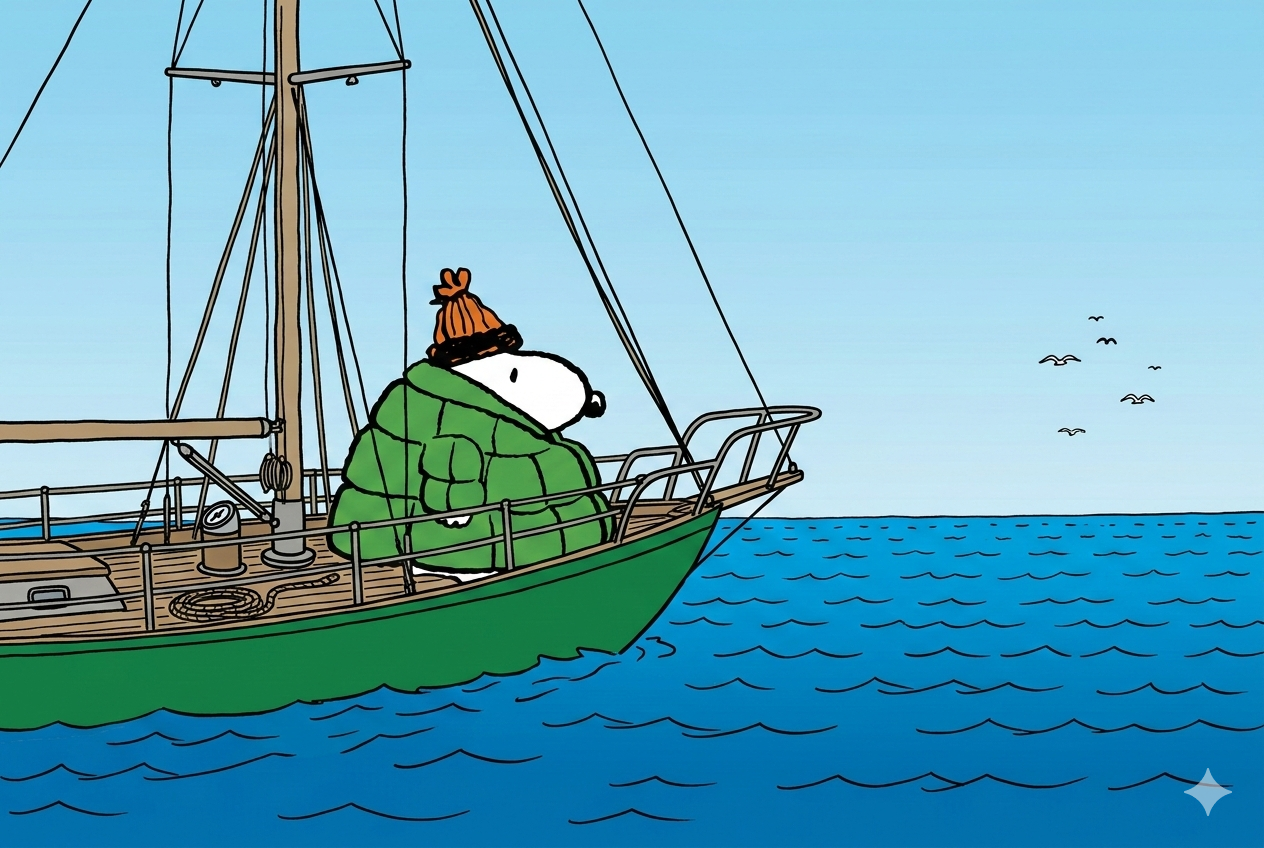
The featured image above is the result of having Geese’s Au Pays du Cocaine in my head all day. The line about a sailor in a big green boat and a big green coat made me think of Puffer Jacket Snoopy, and of course I had to realize the joke.
We got the sad news that Deliveroo is shutting down operations in Singapore. This comes on the back of an acquisition by DoorDash who must have run the numbers and decided that a 7% share of the local food delivery market after a decade wasn’t worth investing further in. We use it all the time and prefer it over Grab and Foodpanda — it is by far the better app and their subscription service is better value for money, but we’ve seen this movie before. It’s like how Uber lost out to Grab; the market doesn’t always choose efficiently.
I will probably switch to Foodpanda because Grab as a brand has the same icky halo as, say, Facebook or Spotify.
Google released Nano Banana 2, the new version of their hit image generation model. This one is cheaper to run and kind of almost as good as Nano Banana Pro, so they’re making it the default for everyone. Paid users can still access the Pro model, but it’s hidden behind some menus. It’s a regression in quality, a slight improvement in speed, and most importantly, a boost to Google’s bottom line. Since I only do silly things with these tools, it doesn’t bother me tremendously, but imagine the same happening at an enterprise level for more important work.
Screen recording of an AI panorama
One of the new things Nano Banana 2 can do is generate very wide panoramic images, so I asked it to render some “panoramas taken with an iPhone” in various locations. I then upscaled those and opened them in my Apple Vision Pro. They don’t have the photorealistic quality of images from Nano Banana Pro, and the resolution leaves a lot to be desired, but they’re still immersive and impressive when viewed in this way. You can see where this might go.
There’s been a lot of talk lately about how AI vibe coding could upend the SaaS market, if not replacing dependable enterprise tools with individually created ones, then at least giving IT departments a billion more unapproved apps to worry about. A viral essay from last week posited that AI coding could kill DoorDash, though I’d say they did a good job of that themselves out here. The other oft-discussed idea is that AI could replace the App Store, and everyone will just make their own apps instead of buying them from developers. Michael has been blogging about vibe-coding his own to-do list app based on Clear. I’ve been wanting to try this myself, making more little tools of my own to solve niche problems, but the opportunities have been slow to materialize.
This week the right idea presented itself and I made a web app using Gemini: an album cover collage maker that searches for the artwork or lets you upload your own. I’ve looked online for something like this before but only found a few that were quite lacking. Making one to my own specifications took maybe five minutes of prompting and testing. Then I thought it would be nice if you could drag the images to different locations. Gemini added that feature like it was nothing. I’m pretty hyped that even someone like me with zero current coding knowledge could will this into existence. If you’d like to try it, I’ve deployed it at collagen.sangsara.net.
Otherwise it was a sort of decompression week where I just read a lot, listened to the records I bought/ordered last week, and was regrettably glued to my phone watching day trading losses (Chekhov’s gun has fired!) and social media feeds.
It took a couple weeks of dawdling but I finished John Le Carré’s Call for the Dead, his first novel featuring the spy George Smiley. I may continue reading the series, seeing as his son Nick Harkaway (whose work I really enjoy) has decided to continue his father’s legacy and written one more already: Karla’s Choice. This one was a little dated and not particularly thrilling, but a fine introduction and scene setter.
It was immediately followed by Adrian Tchaikovsky’s The Expert System’s Champion, sequel to The Expert System’s Brother which I read at the end of last year. I recommend both as examples of sci-fi stories set so far in the future that humanity has looped back around to the beginning. It reminds me of the “middle chapter” in Cloud Atlas, if you remember that.
Then I read Hu Anyan’s I Deliver Parcels in Beijing, a modern memoir that reportedly did well in China when it came out in 2022. It details the author’s dual career as a writer and on-and-off gig economy worker, which is made more interesting by also being a portrait of what it’s like to live in the lower brackets of Chinese society today.
I also had time to tackle Rob’s recommendation of Marlen Haushofer’s The Wall, which was written in the 1960s but doesn’t feel that way, unlike Le Carré’s spy novels. He called it the best book he read last year, so I could hardly say no. It starts off like an intriguing sci-fi novel: a woman visiting friends in the Austrian alps wakes up one morning in the log cabin to discover she’s alone, and there’s an invisible wall separating her from the outside world. Things then focus on survival and what it means to live and be human in solitude, and in nature. Which, given that I’ll be home alone next week while Kim is away again for work, means I’m already in the appropriate headspace.
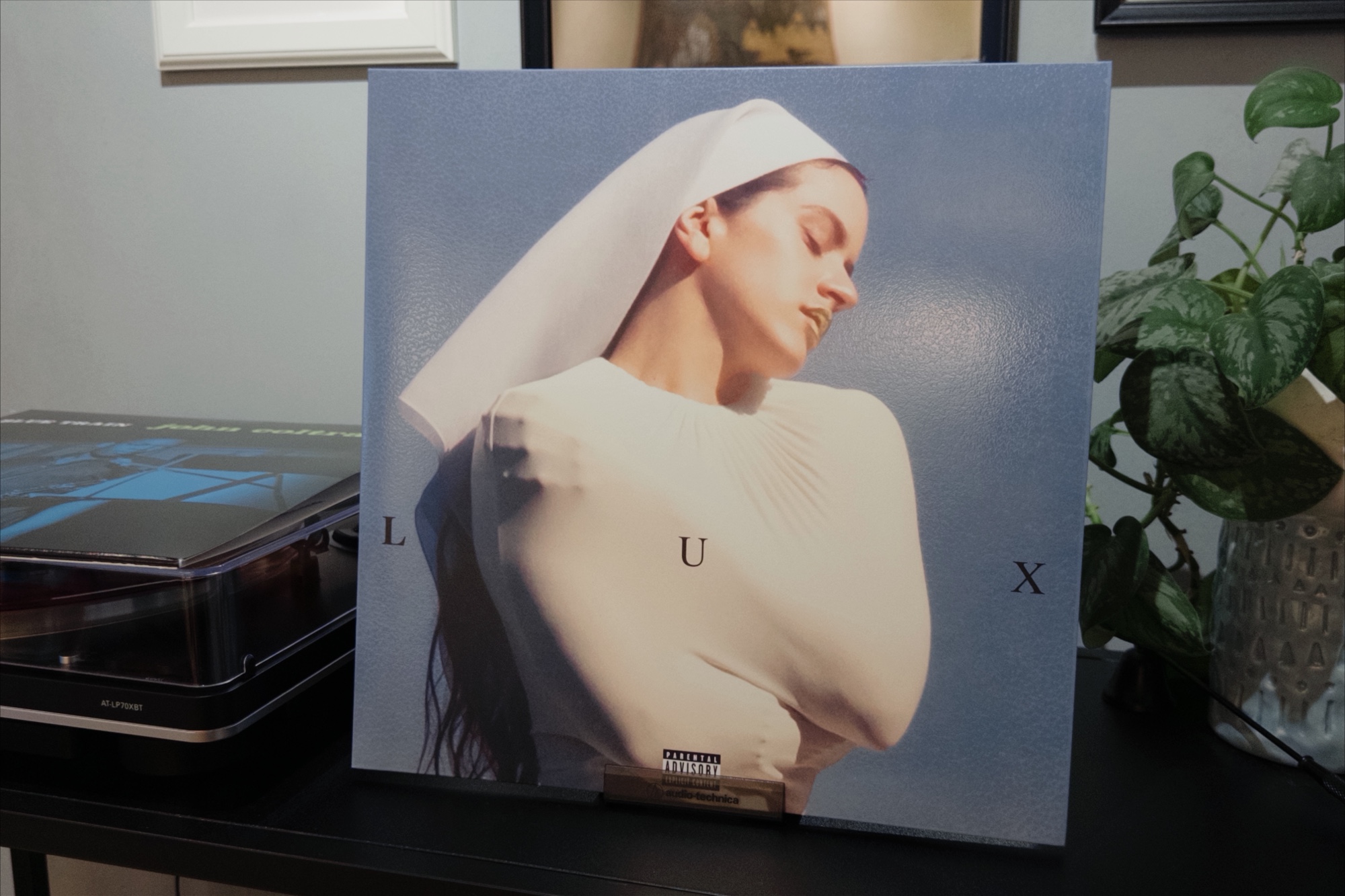
This week’s vinyl purchase was the album that restarted the whole idea of buying physical music again for me at the end of last year: Rosalía’s LUX. The digital/streaming version is intentionally incomplete, with 15 tracks instead of 18. Purportedly because she wanted to highlight the importance of ownership. The first thing I did after hearing that fact was to hunt down an MP3 rip of the CD and upload it to my Apple Music library. But it never felt right, and so I wanted to buy the CD, which led me to look at CD players, and then… you know the story. That’s it, no more. For real this time.
You know which company or live service does the best Wrapped/Replay/Year-in-review thing? It’s Nintendo, because they actually wait for the entire year to be over before sending theirs out. I think Apple Music gives out the Artist of the Year award in November. As a borderline OCD pedant, that shit doesn’t sit right with me.
So my Nintendo 2025 report says I played just 172 hours, spread across 43 games. I believe the first number but the second seems high. Maybe it erroneously counted some games I reinstalled after getting my Switch 2. In any case, that’s an average of half an hour per day, which is kind of a sweet spot: not high enough to be called a good-for-nothing bum, and not low enough that I’d question my life choices. My top game was The Legend of Zelda: Tears of the Kingdom, which I likely won’t return to and finish for another couple of years, if the previous game was anything to go by.
I started on a new game this week and discovered that an old-school adventure game was just what I’ve been needing. The kind where you don’t have to physically walk a character around, but instead choose options from menus to prod at scenes and investigate murders. This is its actual full name, btw: The Hokkaido Serial Murder Case: The Okhotsk Disappearance ~Memories in Ice, Tearful Figurine~.
If you remember the Famicom Detective Club games, this is similar in that it’s a remake of a classic NES-era Japanese adventure game, with updated graphics and music — albeit nowhere as lavish as the treatment that Nintendo and MAGES gave to their versions. Where the Hokkaido murder game justifies its asking price is in its scope. It’s actually two games in one; the original story set in the 80s, and a new sequel set in 2024 where your character returns to wrap up loose ends.
Ah that reminds me, when I was in Japan around this time last year, I saw a similar Switch game for sale that I didn’t recognize. I took a photo of the cover to follow up on later, and found out it’s my kind of murder mystery but hadn’t been translated for global release.
Then a few months ago, I remembered to look it up again. This is where that new feature in iOS that lets you tap and select text in a photo comes in super useful, especially when it’s a language you can’t read. I discovered that it’s been given a new title Path of Mystery (originally Mystery Walk in Japan) and a global release date: Feb 26, 2026.
This one has a unique feature that I’m excited for: while the story unfolds in both the past and present (similar to the Hokkaido game I’m playing), there are two separate UIs and gameplay styles. The past has retro pixel art graphics, menu-based commands, and outmoded gameplay conventions; while the present portion looks like a new game with modern controls.
Let’s round up all this game talk by making a list of the other titles I bought on sale over this holiday season. I fear there were quite a few, but I won’t know how many until I do this, and maybe this will keep me honest.
Videoverse — A game set in the early days of the internet where meeting new people online was wholesome and helped shape your identity for the better.
Okay, maybe I do have a problem! It’s going to take me all year to get through these alone — this is who you’re asking to get a regular job, by the way.
I read Network Effect, Book #5 in the Murderbot series for our book club, and I think this will be the last one I waste my time on. The writing is artless, soulless, and mainly serves to perfunctorily describe actions that the characters take. Surely reading this blog already gives you your recommended weekly allowance of that. Making matters worse is this installment being ‘normal novel length’ where the rest up to this point have been relatively short little stories. It’s definitely overstayed its thinly premised welcome.
One of the fun things my book club does is watch film adaptations whenever a book we’ve read has one, and they recently read Ready Player One. I already read the book once when it came out, so I skipped this one, but joined for the movie watch party. Most of us rented the 3D version for Vision Pro from iTunes/Apple TV, which was worth the six bucks.
The 3D presentation is spectacular, helped a lot by the fact that no one blocks action sequences like Steven Spielberg. Even when almost everything is CGI with billions of particle effects flying on screen, he’s an absolute master at keeping the eye focused on what matters. But time and growing up in general has not been kind to Ernest Cline’s writing.
The dialogue was so cringe, the heroes have zero aura, and honestly I’d forgotten the story and was convinced the genius game developer god Halliday was a bad guy because of how toxically narcissistic he was. I mean, he built a library of his own life story for “scholars” searching for clues to win the in-game prize he left behind. And in one scene, he actually says the words “I’m a dreamer” to the co-founder who wants him to take more responsibility for the online world he created. If I’ve learnt anything in this life, it’s not to trust any douchebag who calls themselves a ‘dreamer’ or ‘visionary’, especially if they’re involved with a metaverse project.
I just got back from a Sunday night dinner date in the East at a newish place called Carlitos. It was new enough that it didn’t have a Swarm entry, so I made one. That reminded me that the Foursquare app is about to be shut down, and I’m choosing to be optimistic about Swarm’s future. We’ve been promised some meaningful changes in the coming year and I hope the rethink will bring check-ins back in vogue.
Vision Pro updates
Kim got back from her work trip and the first thing we did was head out to the Apple Orchard store to pick up the new Belkin Head Strap that everyone’s talking about. And not a day too soon, because it’s now backordered into mid-December!
It is what it looks like: the top bit of Apple’s own Dual Loop Band, which you can attach to your existing Solo Knit Band — a rare best-of-both-worlds occurrence where the comfort, adjustability, and non-hair-mussing qualities of the Solo are met with the weight-relieving structure of a top strap. It works well, and I’m never taking mine off. I was using the Dual Loop before, but its thin strap that pulls upwards near the base of the skull cannot compare to the quality, fit, and comfort of the Solo band, which is such a wonderful design and product that it belongs in a museum.
I haven’t tried Spigen’s slightly cheaper version, but having read many reviews of how poor its adjustment range is, I can’t recommend you take the risk. You’ll want to get the tightness just right, so Velcro is the right solution, and Belkin has rightly made it.
Belkin was never an accessory maker I took too seriously in the last two decades, I mean, they made alright cases and cables, but I’d never choose them over first-party versions. That seems to be changing. This new Travel Bag for Vision Pro is further proof; it’s significantly smaller than Apple’s own Travel Case, and half the price.
1) Should have been in the box instead of the dual strap
2) $50 is overpriced but you’ve already paid $3500 so hard to complain.
3) When Apple knows an accessory is needed but doesn’t want to put its brand on it, it turns to Belkin (owned by a Foxconn subsidiary) https://t.co/oKM5HSIVi5
Career leak publisher Mark Gurman implied in the tweet above that Belkin is Apple’s secret partner; the one they go to when they want an accessory on the market but don’t want to make it themselves. The fact that they stock Belkin’s products in Apple Stores is supposedly proof. In this world, Apple knows the practical flaws of their own form-over-function accessories, and nudges Belkin (which is connected to Foxconn) into making uglier but more effective alternatives to keep customers satisfied. I don’t know if I believe it works exactly like this, but it’s not a bad arrangement? Let’s see if Belkin makes some kludge to access the power button on the underside of the new Mac mini, then.
A new Apple Immersive Video (AIV) feature was released this week, and a music video at that. It’s the song Open Hearts by The Weeknd, and Apple’s own press release says it’s a limited time exclusive for Vision Pro. Interestingly, they’re inviting people to visit their nearest Apple Stores to watch it, which means we’re entering a phase where the retail arm is positioned as providing free public access to the Vision Pro experience, not unlike the ‘Today At Apple’ sessions where people can learn to draw or take better photos with Apple products, even if they don’t own any yet. This is fine, but the barrier to getting people off their butts to see something cool (for free!) is somehow extremely high these days. Is this because the culture promotes ownership hand-in-hand with enjoyment, and people don’t want to try a device they already know they can’t/won’t pay for? I can’t afford a bottle of 55-year-old Yamazaki but I’d sure as hell have a free taste if offered one.
The new Apple Immersive Video from The Weeknd is worth experiencing. For one, it features a lot of movement but none of it is nauseating. I’m not sure if they’ve just figured out ‘one weird trick’ to make that possible.
Anyway, the music video is very impressive, as I said on Bluesky after seeing it. There are a couple of magical moments, some achieved with special effects and some that are just beautiful to experience in immersive video. For some reason, it never feels disorienting or nauseating even though the camera travels at speed for a fair bit. I wonder if they’ve cracked the motion sickness code and are inserting buffer frames or using some other imperceptible technique, but this bodes well for future productions. Perhaps it’s just very smooth dollying and sticking to just one axis at any time.
Apps
Perplexity: Google continues to struggle with integrating its Gemini generative AI models with search results in a way that doesn’t spit out lies, but Perplexity has been working great for me since I started using it earlier this year. It could be the types of questions I ask it, or the default stance of skepticism I adopt when it answers them (the sources are there for you to check, if something feels off), but it’s been a net positive for me and I keep the widget on my iPhone’s Home Screen and use it several times each day. In fact, I thought everyone was using it, and was very surprised to learn while talking to Viv that she had never even tried it.
This week, I got access to a year of Perplexity Pro for absolutely no money, thanks to a giveaway in Kevin Rose’s newsletter, and it feels great to have virtually no daily limit for Pro requests. Standard requests basically use a simpler model, think OpenAI’s GPT-3.5 series, which parses search results and writes an answer to your question. Pro requests use the latest models including Claude 3.5 and GPT-4o, and break your question down into its components before processing results, all to have a better chance of understanding what it is you’re trying to learn and answer accordingly.
I’m aware of the icky implications of Gen AI scraping and that this mode of bypassing publishers will probably destroy the web as it currently works. Perplexity claims to be paying publishers that it sources answers from, on a per-query basis that sounds similar to music streaming services, so it might be a best-alternative model worth watching. It’s an analogy that makes sense because of how Napster upended that entire industry through theft and wanton disregard for copyright laws… kind of like what AI companies are doing now.
===
Mattebox: Now here’s a name I never expected to hear again. I first mentioned Mattebox on this blog 13 years ago in December 2011, when I posted some photos I took on a holiday to Bintan. What I remember is that it was a camera app (as opposed to a photo editor), modeled on the ergonomics of the Konica Hexar camera (respect), and that its developer (Ben Syverson) cared enough to replicate a film-like response to clipped highlights. That torch is currently being carried by the upcoming Fig Camera app. It appears I even made/shared a filter for it called Velvius, which proves this has been a longer-standing hobby than I thought.
Anyway it disappeared off the App Store a decade ago for reasons I never knew, and then reappeared last week completely rebooted and redesigned. It’s now an editor, but still leans hard into the making and sharing of filters. It even lets you share a filter as an App Clip, which means people can apply your looks without even installing the app — probably a first in the photography app world.
I’ve played with it for a little while today and am quite impressed. It focuses on editing ProRAW files, even disabling tone mapping by default for a less HDR look (the trend these days), and a Pro subscription (S$40/yr) unlocks granular controls to dial in micro contrast, black levels, noise reduction, and so on. It even simulates physical diffusion filters, a feature that’s rare these days after the discontinuation of the Tiffen FX app around the same time Mattebox disappeared.
The UI is MUCH better than before, and although I already own the RAW Power app which includes all the same adjustments mentioned above, I would rather do them in Mattebox because of how neatly they are laid out. For a “first” release, Mattebox 3.0 gets so many essentials right, from having a double-tap gesture to reset values, to saving edits non-destructively over originals. You can even export your filters as LUT and Lightroom preset files. I’d like to try making filters for it but will 1) need to subscribe and 2) learn to use its HSL curve system, which is different from what I’m used to.
I’d love to see:
Undo/redo for adjustments
Indicators for RAW files in the photo picker
Using the system photo picker, actually, so you can view by media type, etc.
Grain tool
Media activity
I finished reading Variable Star after two weeks and gave it 4 stars on Goodreads.
I started on Han Kang’s The Vegetarian, just because it recently won the Nobel Prize in Literature. I’m 32% through it and I can’t say it’s anything terribly special yet. I saw that Sara reviewed it on Goodreads seven years ago and (I’m paraphrasing) said it was the kind of mediocre East Asian book that Western readers just lap up.
I watched Megalopolis (2024) in one straight sitting, in a giant virtual theater in Vision Pro, and it kinda rocked. What a Taj Mahal-grade vanity project, a pastiche of Shakespearean and Capital-C for Cinematic bombast. Watching this, you wouldn’t think that Coppola knows anything about urban design or architecture, they’re just metaphors for the story he wants to tell about great (and very pretentious) thinkers who change societies. They’re just MacGuffins for a crazy CGI movie that owes as much to Sky Captain and the World of Tomorrow (2004) as it does Fritz Lang’s Metropolis (1927). I typed that and then searched to see if anyone else made the same connection, and indeed they have. 4 stars.
We watched Look Back (2024). It’s an anime adaptation of Tatsuki Fujimoto’s one-shot manga work of the same name. It recently had a successful theatrical run in Japan, and I’ve been dying to see it since seeing the reactions online. It also played here, but I missed it, and it seemed weird going to the cinema for a film that clocks in at just 58 minutes. Amazon Prime Video secured the worldwide streaming rights, thankfully, and the whole time watching it I wondered why it wasn’t acquired by Apple TV+. That would have been a great fit. I don’t want to say too much about it, but it’s brilliant, beautiful, and a showcase of how animation can express feelings that live action could never. 4.5 stars.
Can I just take a minute to show you this Labubu I saw hanging on someone’s bag on the train? It’s carrying a Chanel bag like the very one it’s attached to! That is just so super cute to me, I think I have a brain worm like the future American Secretary of the Department of Health and Human Services.
Monday got off to a good start when I finally landed one of the coveted booth seats at the co-working space. Up to then, they were always occupied by the time I got in, and it was a feat not repeated at any other point in the week. Because I’d only signed up for the month of October, and with Thursday the 31st being a public holiday (Deepavali, not Halloween), this chapter of drinking too much coffee and watching movies while surrounded by busy people has come to an end — let’s be honest, though, most of their screen time looks like chatting on Slack/WhatsApp and browsing the web.
I’m feeling a sense of loss about it, actually. For starters, the renovation noise is set to continue next week and might drive me out of the house still, now without a place to go. But more than that, I was just getting used to the routine and would jokingly say to Kim, “I’m going to the office”. It’s akin to the loss of a ‘third place’, a social setting distinct from home and work. However, I don’t even have a second place these days!
One thing that sitting still in front of an iPad for hours on end has highlighted is how important yet increasingly difficult it is to single-task. While thinking about my/our deteriorating attention span — that constant feeling of being pulled towards other tasks while in the middle of doing things I chose to do — I identified a root cause in myself: I have less trust in my memory these days. So when something occurs to me, say looking up a fact or sending someone a message, it’s harder to file it away for later follow-up, because I think I might forget. Past experience has probably taught me that I’ll forget.
On one hand, I could make peace with that. So I’ll forget a thing or two; big deal! I don’t have to optimize every detail. Things can be allowed to slip and it’ll probably be fine. Or I could use the time-honored second brain productivity hack of… jotting thoughts down and then getting back to what I was doing? I may give that a go with the Quick Note button in my phone’s Control Center and see if it makes the distracted feeling go away.
The filmmaker Lav Diaz is known for making extremely long movies. At 10 hours, his Evolution of a Filipino Family (2004) is probably only consumable in several sittings and is the ultimate test of patience and focus. Like Richard Linklater’s Boyhood (2014), it was shot over more than a decade, and you see the actors age for real.
One could criticize its poor production values, shot in grainy and low-res black-and-white film and video, often with inadequate microphone coverage, or its loose editing and lack of action (its 10-hour runtime probably says something about Diaz’s attitude towards concision). But the message is in his medium, and I’ve found watching it to be a great meditative exercise; letting the mind alternately empty and gather and empty again as you watch the family slowly lead cattle from one end of the screen to the other or hold sparse conversations over meals, spread over minutes of near inaction. The first 2.5 hours passed effortlessly in a state of detached attention.
I also managed to watch Alain Resnais’s Hiroshima Mon Amour (1959) on MUBI without much distraction. It’s a hell of a film, visually inventive and beautiful, with an opening sequence that you have to see to believe, going from sensual shots of skin to burned and scarred consequences of the atomic bomb. Which is the backdrop for this film about war, love, and memory.
Having just visited Hiroshima for the first time last year, I was surprised to find so much of it familiar in this old work: the bombed-out dome, the peace museum, and its garden sculptures. It was also incredible to see its depiction of an interracial relationship between an Asian man and a white woman as equals. As far as I can tell, it was probably one of the first films to center such a couple.
The first few Apple Intelligence features launched this week in iOS 18.1, and while many in the tech press seem unimpressed by these ‘basic’ capabilities, especially when compared to products from OpenAI, Google, and Meta, I’ve found them so impactful to the way I use my computing devices that I can’t imagine going back.
Apple also announced impressive M4 updates to the iMac, Mac mini, and MacBook Pro this week, but I don’t need to upgrade!
For one, I can summarize long emails and webpages directly in Mail.app and Safari. My bank likes to send me long, jargon-filled market updates in its email newsletters, and now I can summon a quick paragraph that gets to the point.
When I get back to my phone after some time away, I can see what would normally be stacks of messages and notifications summarized into a few lines. I’ll still read them anyway, but it’s great to get a preview so I can triage for urgency. This is also useful when getting Siri Announcements over AirPods. Say someone sends me a long string of messages, instead of having them all read out over my music, I can hear a summary and know whether it’s important enough to pull my phone out for.
And coming back to the point about avoiding distractions, there’s a new focus mode called “Reduce Interruptions”, alongside others like “Work” and “Do Not Disturb”. This reads and assesses all your notifications with AI, and will only show you things that seem time-sensitive or important.
There are also Writing Tools that I’ll be using to proofread this post before sending it out, and a Clean Up tool that can remove objects in photos using a generative model. It’s quite good, certainly enough for casual use, and I’ve seen online examples of it pitted against Adobe’s equivalent AI tools and actually coming out ahead in some situations. Plus, everything happens on device, which is great for data privacy reasons.
A quick demo of the Clean Up feature in Photos.app
One grumble I have, though, is that Apple appears to be reserving its upcoming Visual Intelligence feature (where you can point your camera at something and have the phone offer contextual information) for iPhone 16 models with the new Camera Control “button”. I hope they’ll make it work with the Action Button on iPhone 15 Pro models, but am preparing that I won’t have it until I upgrade to next year’s 17.
In the meantime, I have found a new use for my Action Button: starting the Apple Music 1 radio station. This has proved super useful and convenient. If I’m anywhere with my AirPods in, getting some music going is now just a button press away, even without getting my iPhone out of my pocket.
Take a minute to appreciate this ad that Apple made to celebrate the debut of this radio station back in 2015, back when it was called Beats 1 — a far better brand in my opinion. It was a simpler, more optimistic time. Watching this, I believed that a global internet radio station dedicated to great music, across all genres, could map differences in culture and unite us all.
I must mention that Nintendo joined the music streaming app business this week. Nintendo Music is free for subscribers to the Nintendo Switch Online service (USD$19.99/yr), which I already am for purposes of playing games online and backing up saves from my Switch. However, the app is not available in Singapore as Nintendo’s online services are not officially available here — one has to create a US account instead. But complaining about Nintendo’s digital and worldwide strategy is a whole other post.
So far, this music service is pure win. Classic first-party soundtracks from the best in the business, with curated playlists for different moods and activities, and the ability to “extend” some tracks to an hour’s length (it appears there’s more to this than just looping the songs) for use as background music? With more music continuously being added? It was enough to make me jump through the hoops of switching App Store accounts to get the app on my phone. And so I’ve been listening to the sounds of Animal Crossing: New Horizons again, feeling nostalgic for the early days of the pandemic when great music in a cozy game did unite the world during a very stressful time.
They should add Shortcuts support to the Nintendo Music app so I can start playing music via the Action Button.
I may buy Nintendo’s upcoming Animal Crossing: Pocket Camp Complete smartphone app, which is their clever solution to keeping the live service mobile around after its servers shut down. You can buy a fully offline version for $10 (going up to $20 in January 2025), with all 7 years (!) of old in-app purchase content included. Current players with saves can resume their progress, but I will probably start over again. The new app launches on Dec 3, 2024.
Remaining media activity
I’m halfway through reading Variable Star, a book by Spider Robinson based on an idea and notes left behind by Robert Heinlein. So, it’s a posthumous collaboration, and a very entertaining one at that.
We waited till all episodes were out and then binged Season 4 of Only Murders in the Building. This is not my preferred way of watching the show; I believe spacing them out lets the story breathe and be remembered better. But Kim is going away again for a couple of weeks, and neither of us wanted to wait that long to pick it back up.
I finished Season 2 of The Old Man and remain impressed. It’s one of the best ‘classic’ espionage shows in recent years, and if you have a better one to recommend I’d love to see it. I’m talking old-school, Tinker Tailor-type spy intrigue, which reminds me I should pick up a John le Carré book next, because I don’t think I’ve ever read one. Btw did you know Nick Harkaway is his son??
After six months, we caved and reactivated the Netflix subscription. Kim wanted to watch Culinary Class Wars on her flight, and I’m keen to check out some of the new anime series they’ve put out, like Ranma 1/2, Dan Da Dan, and Season 2 of Oshi no Ko. I watched 9 episodes of the latter on Sunday; it’s that addictive. It was always a great looking show but the artistry and animated flexing is on another level now: some of the kinetic montages and dramatic sequences jump through a dozen art styles in as many seconds, and feel inspired by the Spiderverse films and maybe even Satoshi Kon’s Millennium Actress (2001), which might be my favorite animated film of all time.
It’s Monday, and for the time being, my schedule for writing these updates has shifted out by a day as Monday mornings now find me in a co-working space, and writing this gives me an opportunity to blend in better than, say, watching films or playing games whilst surrounded by people grasping their foreheads, stroking their chins, and sighing loudly. Yes, those things just took place around me.
It’s Monday, after a massive storm, and my feet are soaked from wading through puddles to catch the bus. You’d think this would be a common occurrence in Singapore, where the tropical rain gets heavy, but only a few occasions stick out in memory — those mornings where the office walkways are cluttered with umbrellas opened up to dry, like caltrops or anti-tank barricades; my damp, socked feet perched on top of sneakers I hope will dry before lunch; everyone else’s teeth a-chattering in vicious air-conditioning calibrated for sunny days.
Earlier this week, I shuffled my feet while sitting here and felt something come loose: the right heel of my (only) three-year-old New Balance 990v4 sneakers. So much for ‘Made in the USA’! I borrowed some black plastic tape to conduct unglamorous field surgery, and they lasted till I got home. I have two newer pairs (v5 and v6), and sure hope they hold up longer.
iPads are pretty great, actually
My daily companion over the past four days here has been my 11” M1 iPad Pro with Magic Keyboard, somewhat neglected of late. I’ve found that it does everything I need to pass an entire day, from library books and magazines with the Libby app, to gaming, video, web browsing, chat, and photo editing. My MacBook Air would be better for watching movies, but that’s mainly it. If anything, that only makes me surer that my next iPad will be a 13” model.
Unfortunately the new iPad Pros with M4 chips are priced on par with MacBooks, making the choice between the two much harder (and in favor of MacBooks if I’m being honest). Recall that the original iPad launched for just $499 USD, and its marketing tagline was “A magical and revolutionary product at an unbelievable price”. That’s still how the iPad lives in my mind: a powerful alternative device that does way more than its price suggests. So it occurs to me that the iPad Pro is no longer the right choice for me, and the iPad Air is a truer heir to that original proposition. (Put aside the product now simply called ‘iPad’, because at $349 USD it’s actually even cheaper than the first generation and more like a budget “SE” model.)
We’re seeing Apple push its ‘Pro’ lines further this year, packing them with innovative features that are useful for a small subset of professional users, but which most customers won’t need or appreciate. Things like streaming multiple 4K video feeds from iPhone cameras to a single iPad for production in real time. Or recording LOG-format video to massive ProRes files, including studio-quality audio from four microphones.
Adding these capabilities and pricing accordingly means some current Pro buyers might want to downgrade to the ‘mid’ models. In order to avoid losing them, Apple would need to elevate those products, and avoid artificially holding back features for the sake of differentiation. We’ve seen that happen with this year’s iPhone 16, which packs an OLED display, Dynamic Island, 48mp camera with a 48mm focal length option for the first time (!), Camera Control thingy, and even things like next-generation Photographic Styles and Audio Mix which they could have reserved for the Pro phones. The only thing it needs is a 120hz ProMotion display. I’m expecting next year’s iPad Air and iPhone updates will finally include that.
I love that the iPhone 16 is now a great enough product for almost anyone’s needs, but I’ll likely keep buying the Pro models as long as they offer better camera features. I can entertain switching to an iPad Air because I don’t even know what camera hardware it has and won’t ever use it.
A quick word on cameras and my presets
I mentioned before that I’ve been beta testing an app called Fig Camera. It has two standout features: great “natural” processing options that dial back Apple’s aggressive defaults, much like Halide’s Process Zero mode; and the ability to process photos on-the-fly with your own custom look. As someone who somehow finds it fun to make photo filters/presets, and has fortunately had some success with them, I love that I can now take photos with my favorite styles directly applied. It’s like how Fujifilm cameras’ “Film Simulations” obviate the need for post-processing. I can now snap photos in Fig that look great to me and don’t need any further editing.
Shot on iPhone with Fig Camera and my work-in-progress film LUT
I posted a few recent photos using a film-style sim on IG and Threads and asked something like, ‘should I become one of those preset guys and offer my own as LUT files you can buy?’, to which several kind people said ‘sure’! So I’m thinking about it. This particular look is inspired by the “Positive Film” effect on earlier Ricoh GR cameras (they changed it for the worse with the GRIII), but slightly more “dry” like Fujifilm Classic Chrome. I’ve been using and tweaking it for over a year now, so the trick will be knowing that it’s DONE.
Immersive Video and Submerged
I’m still sitting here and my shoes are still wet. I’ve thought about bringing my Vision Pro to this open-plan space—not for the attention, but because it would be nice to have a huge screen that no one else can see. There are many things in my MUBI backlog that would not be cool to watch in public. And what’s even better than a 13” iPad? How about a thousand inches?
We watched Submerged (2024) over the weekend, Apple’s new Immersive Video release exclusively for Vision Pro. It’s the first film they’ve done that isn’t a documentary or music performance — I guess the right word is fictional? I’m sure I said early on that this new immersive format (a full 180º view) lends itself best to video that puts you somewhere incredible, and wouldn’t be good for movie storytelling, with fast movement (nausea hazard) and quick cuts. I’m here to admit I was wrong.
Submerged, by Academy Award winner Edward Berger, is only 17-minutes long but about a 12GB file when downloaded offline. You can view it as the first experiment in what filmmaking with this new technology could look like.
I wrote on Instagram:
Apple Immersive Video is a new medium. People will be experimenting with how to tell stories with it for years to come.
Submerged is a great first step, the only movie I’ve ever seen that felt like “being inside” of it. More than seeing Avatar in IMAX 3D even.
That’s different from the “being there” of POV video — it’s 100% a film with directorial intent. You experience it like a spirit summoned into the world and held down by a seance, without knowledge of your body. Your consciousness is pure camera.
What I was trying to say was that making films for this format will require inventing a whole new set of techniques. Regular immersive video is easy: plonk a camera down in one static location and let people experience what it feels like to stand there and observe the action. This is the courtside seat at a basketball game, the front row of a performance. It’s amazing to us anyway because the viewpoint is rare, but a film made like this would only be a play.
In the near term, we’ll see directors converging on a few approaches that work. Like how early 3D movies always had things flying directly at your face. The key question for me is how do you make an audience look at the thing you want them to notice, when they can look almost anywhere around the world you’ve built?
Berger answers that in three ways. The first is action; big movements. When something explodes and water gushes out of a pipe a second later, you’re bound to notice it. The second is depth of field; like how I remember Cameron pushing and pulling focus at several points in Avatar (2009) to highlight subjects. This goes against natural vision and is more jarring in a wide-angle format like Apple Immersive Video, since you’re choosing for your viewer what they can and cannot look at, but it’s a filmic device everyone is familiar with.
The third is a combination of Dutch angles and heavy vignetting that produces a novel effect in Immersive Video. When you watch a film like this, you are a disembodied viewer (what I meant above by a summoned spirit), without the ability to see even your own hands. You are severed from the real world. Your viewpoint changes according to the director’s will; sometimes a subject is extremely close and larger than life, other times they are small and distant. Berger often cuts to shots where the edges of your 180º view are shrouded in darkness, and/or where the camera is tilted at an angle, such that you feel yourself almost falling towards the zone of interest. This serves to direct your gaze, as to look in the opposite direction of gravity unconsciously takes more effort.
I can’t wait to see what else emerges as more filmmakers play with this.
Other media activity
I’m watching Lady in the Lake on Apple TV+, a 7-part series starring Natalie Portman that no one seems to be talking about. It’s rather good, but a slow burn and not one to be binged.
Another show that we discovered on a recommendation from Jose, and that no one seems to be talking about, is Ludwig, a 6-part BBC series starring David Mitchell as a reclusive professional puzzle-setter who gets enlisted to help the police solve murders. It’s very good, and sidesteps many of the elements that make other episodic murder-of-the-week procedurals tiresome. Well, it’s short enough that you never reach that point. I’m hoping they renew this.
I read Stolen Focus: Why You Can’t Pay Attention — and How to Think Deeply Again, by Johann Hari. This was inspired by an article in The Atlantic about how American college students today can’t even read an entire book anymore because their attention spans have been destroyed by social media, and book-reading on the whole is in serious decline. Utterly depressing. In order to get better sleep myself, I’m now trying to limit caffeine in the afternoon, alcohol, and phone use before bed. I’ve always detested multitasking—so much so that I avoid using external monitors with my laptop—and I’m now trying to be more mindful of distractions while reading or writing. As I made my way through the book, I was horrified to notice that I was picking up my phone every five minutes to check messages or look up completely unrelated topics.