Tag: Apple

  • Week 5.24

    Week 5.24

    Vision Pro and AirPods Max hypotheses

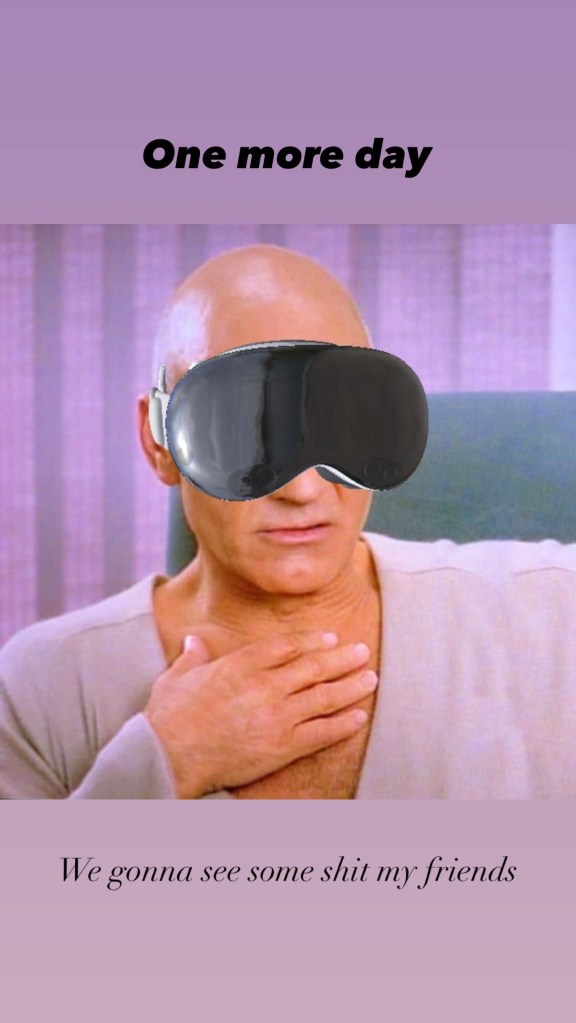
    Apple Vision Pro is out in the wild, and I’ve gone on the expected rollercoaster — from “of course I’ll get one, but only when it’s officially released here”, to “nah I think I’ll wait till the second iteration”, to the usual FOMO and wanting one as soon as possible.

    But it might not be such a terrible idea to wait for the second iteration, if one believes that it’ll come some time in the middle of 2025. Why then? I looked at how quickly second-generation products were released in Apple’s recent history, and it ranged from 11 months (iPad) to a year and five months (Apple Watch). I think a 12-month release cycle is plausible, and putting out new ones at WWDC makes sense as they’ll want to emphasize the visionOS platform for developers.

    Which might then suggest the global Vision Pro rollout this year will start in June. So international early adopters will be putting down at least $3,500 to use it for a year before they need to upgrade. And we know that selling a first generation AVP on the pre-owned market is 1) a tough job, if the second generation irons out obvious wrinkles, and 2) not something early adopters want to do anyway, given the sentimental value of keeping your ‘first spatial computing device’.

    While we’re out here predicting future releases, I think I’ve cracked why the supply chain analysts believe an AirPods Max update is coming this year with USB-C and new colors, but without an upgrade to the H2 chips (currently only found in the AirPods Pro) which enable Conversation Awareness and Adaptive Audio modes. The reaction to this rumor has generally been: “that would be a lame update to the AirPods Max after four years”, but okay what if it’s not an update? What if it’s a new variant model?

    Specifically, it could be the lower-cost, lower-weight “sport” model with different materials and/or a swappable headband that was rumored to be “coming soon” back when the AirPods Max first released. Everyone assumed it would be released a year after, but because it’s been so long, we’ve forgotten that was even supposed to be a product. A cheaper non-Max/Pro headphone model without the latest features would make the same sort of sense as the iPhone 5c, which had all the features of its premium predecessor — but funner. Then the real AirPods Max update can come in 2025, and honestly, if you’re making them well, five years between headphones is the right cadence.

    Electric toothbrushes

    It’s been about two weeks since I started using an electric toothbrush again, and the difference in efficacy and convenience is so notable that I don’t know why I stopped when my last one broke during Covid. There are so many essentially disposable models on the market now in the S$20–30 price range that I didn’t see how the S$200+ models justified themselves. Bluetooth app connectivity? It seemed ludicrous.

    To my untrained eyes, there were two basic designs: an elongated brush head that vibrates (this is the dominant kind), and a small circular head that rotates back and forth. I used an Oral-B one of the latter sort for a little while once but it hurt my gums and I ended up throwing it out. I decided to give it another go with an Oral-B Pro 2 model, but with an “ultrathin” head with gentler bristles this time, and haven’t had any problems. It cost me about S$75, presumably on account of having a rechargeable battery and dock, and I was beginning to think I should have just gone for the Pro 1 model that runs on AA batteries and costs S$30.

    But of course it’s not that simple. After more research, I discovered there are actually three categories of motorized tooth cleaning devices: electric, sonic, and ultrasonic. The Pro 1 has fewer vibrations per second than the Pro 2, but both probably still fall into the electric class, which is to say they clean with brush movements only, and don’t produce sonic vibrations that interact with fluids and help to knock plaque right off your teeth. Oral-B now has a range of toothbrushes called iO that combine an oscillating head with sonic vibrations, 3D teeth tracking AI (no, really), and you guessed it, they cost S$300–400.

    ===

    Media updates

    • I’ve never been into Grimes’s music because the few songs/videos I’ve encountered were awful, and of course her association with Elon Musk is a major turnoff. But I saw a tweet saying her breakthrough album “Visions” was turning 10 years old, with words to the effect of it being so great that the rest of her career was doomed to never top it — so of course I had to check it out. I’m pleased to report that it’s actually pretty good, maybe even great. For an electronic album, I didn’t expect it to sound so influenced by R&B? This whole separating the art from the artist thing is pretty wild.
    • That whole album was recorded in Garageband, and while I’m no musical talent, I wrangled it this weekend to finally clean up and join up the bootleg recording I made with my iPhone’s Voice Memos app back in Chiang Mai in December. It was 50 mins out of an hour-long solo piano set played by Joshua Lebofsky, amidst cafe noises of steam wands, fridges slamming shut, and people chatting. It starts super strong, with him singing an uncommon medley of Tears For Fears’ Everybody Wants to Rule the World and Lionel Richie’s Easy. I’m very happy to finally have it in my music library, ready to be revisited at any time.
    • I had a cab driver one night this week who sang along to songs on the radio. He was no great singer, but I loved the joy of it. The station miraculously queued up three great songs in a row — the aforementioned Tears For Fears song, followed by Sheryl Crow’s cover of The First Cut is the Deepest, and Phil Collins’s In the Air Tonight — which I remarked upon, and we got to talking. He told me he was really into Tears For Fears back in the day, and that they asked Phil Collins to play drums on their song Woman in Chains, wanting some of that magic touch. I promised him I’d listen to it again over the weekend, and I did.
    • It was decided (in my brain) that Easy might be my favorite song, and so I programmed our HomePods to play it throughout the entire apartment every Sunday morning at 10:00 AM as long as someone is home.
    • I was glad to hear from Michael that he loved the Slow Horses TV show, and binged three years’ worth (just 18 episodes, really) in a week. He also discovered that the theme song isn’t some Rolling Stones deep cut they licensed, but an actual new Mick Jagger song commissioned for the series!? I finally finished reading the first book but found the experience such a close retreading of the first season that I’ve decided not to read any more of them. It would just be like rewatching the existing seasons and spoiling the ones to come.
    • We got a chance to go and see the new Apple TV+ film Argylle at its local premiere. It’s an action-comedy about spies directed by Matthew Vaughn, who also directed other action-comedies about spies such as the Kingsmen series. This one primarily stars Bryce Dallas Howard, Sam Rockwell, and Henry Cavill, and is a fun enough time that I can recommend it. One thing that surprised me: the “new” Beatles song Now and Then features heavily throughout the film, with its melody forming a major recurring theme. I looked it up and they had the song for over a year before it came out and had to keep it a secret. Check out the symphonic version with a choir on the soundtrack.
    • Amazon Prime Video has put out all eight episodes of their new action-comedy series about spies, Mr. and Mrs. Smith, with Donald Glover and Maya Erskine playing reimagined Brad Pitt and Angelina Jolie roles. We’ve seen two so far and it’s going very well.
  • Week 2.24

    Week 2.24

    This post was partly written by my blog assistant GPT from notes I gave, and partly transcribed by a Whisper-powered dictation app I’m testing, so it’s just dripping with that AI filth (but the human did edit).

    I’ll probably remember this week for feeling like the future finally arrived, thanks to three long-awaited developments taking up headlines.

    1. Apple Vision Pro – The Dawn of Spatial Computing

    • The Apple Vision Pro got its pre-order and launch dates. Sadly, it’s US-only for now, leaving me and many others on the sidelines. It promises to usher in a world where computing isn’t confined to screens and devices, but blends seamlessly with our physical spaces. Along with AI, we may see a new era of interface and interaction design land sooner than expected, alongside new levels of realism and intelligence I don’t think anyone is ready for. But as a sure sign that this early adopter is growing old, I’m feeling surprisingly wary of and unready for such a transition.

    2. A Milestone for Bitcoin: Spot ETFs approved in the US

    • In a historic move, the SEC approved 11 spot Bitcoin ETFs and they began trading on Thursday with a record-breaking amount of volume. Although against the original ethos of decentralization, this is still a big deal which legitimizes the cryptocurrency for audiences who want some exposure but can’t self-custody for some reason. After a decade of anticipation, this decision bridges the digital world with traditional finance, making a fully digital asset accessible through familiar investment channels.

    3. OpenAI GPT Store Finally Launches: A New Playground for AI Enthusiasts

    • As someone who’s been creating custom GPTs with ChatGPT, the launch of the OpenAI GPT Store is particularly interesting. Originally scheduled for last November, it finally went live but hasn’t set my feeds on fire just yet. To make things worse, the promised revenue sharing model won’t start until later, and again, only in the US at first. Still, this could be the App Store for a fast-evolving space. I’ve already seen a few advanced applications on the front page and will be keeping an eye on it.

    These advancements in computing, finance, and AI aren’t just incremental steps; they’re giant leaps in their respective fields. The Apple Vision Pro is set to literally put technology everywhere, the Bitcoin ETFs are proof that a “digital gold” can be taken as seriously as the real thing, and the OpenAI GPT Store shows how generative AI can let anyone become a “developer”. It’s like watching history being made in real-time.

    By the way, I made a fun new GPT called How We Got Here.

    ===

    So I’m watching this show, True Detective, which you may remember from like 10 years ago. The first season starred Matthew McConaughey and it was a huge hit for HBO that I liked a lot.

    But then when the second season came out, before I could get started, a lot of reviews came out calling it like the worst show ever. And even though Rachel McAdams and Colin Farrell were in it, it just wasn’t a hit the way the first one was. So I never got around to watching it.

    And here we are years later and Season FOUR is about to come out today with Jodie Foster and a whole new showrunner/director/writer involved and it’s getting a lot of buzz. People are excited for it.

    That’s when I realized that there was a Season Three, like I didn’t even know that it existed. So now I’m spending my weekend binging seasons two and three to get ready for four.

    Now this is not strictly necessary because every season is a completely new story with its own set of characters, but I just feel like the need to be complete about my True Detective experience.

    If you’re wondering how I have the time for this, it’s because Kim is again away on business, which also means that I can’t watch this week’s episode of Reacher. So I guess we’re going to watch the final two episodes back-to-back next weekend. I can’t believe it’s already over — reading the rest of the books will have to tide me over until next year.

  • Week 45.23: AI on the brain

    Week 45.23: AI on the brain

    This week in artificial intelligence was a big one: Humane unveiled their highly-anticipated wearable, while OpenAI made strides with ChatGPT enhancements.

    The Humane Ai Pin

    A lot has already been said about the letdown that the Humane reveal was, mostly by people confused by the presentation style of the two ex-Apple employees who founded the company.

    If you’ve seen Apple events and Humane’s 10-minute launch video, you’ll note the contrast in delivery and positioning. Apple tries to couch features and designs in real-life use cases, and show authentic enthusiasm for what they do to improve customers’ lives (Steve was unmatched at this). Humane kicked off with all the warmth of a freezer aisle, missing the chance to sell us on why their AI Pin wasn’t just another tech trinket in an already cluttered drawer. They puzzlingly started with how there are three colors available and it’ll come with extra batteries you can swap out, before even saying what the thing does! The rules of storytelling are quite well established, and why they chose to ignore them is a mystery.

    A lot was also said about how two key facts in the video presentation, provided by the AI assistant so central to their product, turned out to be inaccurate. One was about the upcoming solar eclipse in 2024 (and Humane’s logo is an eclipse! How do you get this wrong?), and the other was an estimate of how much protein a handful of nuts has. It’s a stunning lack of attention to detail that this was not fact-checked in a prerecorded video.

    Personally, I have been waiting for the past five years to see what this stealth startup was going to launch, and as the rumors and leaks came out, I was extremely excited to see an alternative vision for how we interact with computers and personal technology. What they showed did not actually stray from what we knew. An intelligent computer that sees what you see, is controlled by natural language, and is able to synthesize the world’s knowledge and project it onto your hand in response to queries is amazing!

    The hardware looks good, channeling the iPhone 5’s design language to my eyes, and I’ll bet they had to pioneer new ideas in miniaturization and engineering to get it down to that size. I expected it to cost as much as an iPhone, but it’s only $699 USD, which feels astoundingly low. That’s not much more than what we used to pay for a large-storage iPod.

    The disappointment is in their strategy. By positioning it as a replacement for your phone rather than an accessory, they’ve reduced the total addressable market to a few curious early adopters and people who want to address having a tech or screen addiction. The kind who intentionally buy featurephones in 2023. I think their anti-screen stance is interesting, but it doesn’t win over the critical mass necessary to scale and challenge norms.

    The Ai Pin comes with its own phone line for messages and calls (for $24/mo), so it’s not going to be convenient to use this alongside your phone, and I would not give up my phone while this is still half-baked — I say this kindly, because even the iPhone launched half-baked in many ways. For many things that we have become accustomed to in life, there is no substitute for a high-definition Retina display capable of showing images, video, and detailed or private information when necessary.

    Do I believe that Apple can one day get Siri to the level of competence that OpenAI has? I have to hope, because the Apple Watch is probably a better place for an AI assistant to live than in a magnetically attached square on my T-shirt. In any case, Humane seem to have taken a leaf out of their old employers’ playbook, and will be releasing this first version only in the US, and so whether or not I would buy one is a moot point.

    OpenAI and GPTs

    Speaking of OpenAI, it would seem that they’re still the team to beat when it comes to foundation models. The playing field is full of open-source alternatives now, including Lee Kai-Fu’s 01.ai and their Yi-series models, but as a do-it-all company offering dependable access to dependable AI, OpenAI seems unassailable.

    They announced enhancements to their models, increasing context windows and speeds while halving prices for developers, and launched a new consumer-friendly product: customized instances of ChatGPT that work like dedicated apps, which they call “GPTs”. In effect, these are a version of Custom Instructions which were introduced earlier this year as a way to tell ChatGPT how to behave across all chats. But sometimes you’re a researcher at work and sometimes you want to have some dumb fun, thus I’m not sure they caught on.

    So now GPTs let you specify (pre-prompt?) different contexts and neatly turn them into separate tools for different purposes. Importantly, you can now also upload knowledge in the form of files and documents for the agents’ reference in generating replies. This makes them more powerful and app-like, and normal people like me with no coding ability can create them by telling a bot what they want (in natural language, of course), or writing prompts directly. I recommend the latter, because chatting with the “Create” front-end tends to oversimplify your instructions over time and you risk losing a lot of detail about how you want it to work and interact with users.

    So what does the launch of these GPTs mean? Well, for many of the developers who were riding the OpenAI wave and only used their APIs to build simplistic wrapper apps, it’s a sudden shift in the tide and they’re now forced to build things that aren’t reducible to mere prompts.

    What we’ll soon see is a GPT gold rush. Brace yourself for a stampede of AI prospectors, each hunting for their piece of OpenAI’s bonanza — the company will be curating and offering GPTs in a “Store” and sharing revenue with creators. That’s a different model than their APIs where developers pay OpenAI for compute and charge users in turn. Here, users all pay OpenAI a flat fee for ChatGPT Plus and can use community-made GPTs all they want (within the rate limits).

    Hear everyone talking about a viral GPT that makes it so easy to do X? When you want to try it out, you’ll see a call-to-action to sign up for ChatGPT Plus. This signals to me that launching GPTs is a strategy to drive paid account conversion, which begins the lock-in that OpenAI needs in order to make ChatGPT the new OS for services, not unlike how WeChat is the base layer that runs China, regardless of whether you use iOS or Android. Eventually you won’t even need to know about or choose the GPTs you use; the master ChatGPT system will call them as necessary. We may not be headed for a screen-less future, but we’ll probably see an app-less one.

    My GPT projects

    Of course I’m playing with this and making some of my own! Did you think I wouldn’t, given the ability to create AI things without coding?

    I’ve got a list of ideas to work on, and so far I’ve acted on three of them, which are explained on this blog in separate posts.

    ✨ PixelGenius was my first, and contains the most complex prompt I’ve ever written. It started out as a tool to generate photo editing presets/filters that you can use on your own in any sufficiently advanced photo editing app with curves, H/S/L controls, and color grading options. You can just say “I want to achieve the look of Fujifilm Astia slide film” and it’ll tell you how to do that. But now it does more than just make presets, which you can find out about here. More details and examples in the blog post here.

    😴 SleepyTales was the second, and I’m still amazed at how good it is. It’s designed for Voice Conversations mode (currently only in the mobile app), so you can get a realistic human voice reading you original (and also interactive, if desired) bedtime stories. These are never-ending, long, and absolutely boring tales with no real point, in drama-free settings, told in a cozy and peaceful manner. It’s the storytelling equivalent of watching paint dry, yet oddly mesmerizing. More on this and the next one here.

    🥱 SleepyKills 🔪 was born from a hilarious misread — I told Cien about it and ‘mundane’ became ‘murder’. So if your bedtime stories of choice are usually true crime podcasts, then you’re in luck. This GPT agent will create an infinite number of dreary murder stories, but stripped of all suspense, mystery, and excitement. They’re about as exciting as real police work, not the flashy TV investigating sort. Again, I still can’t believe how cool it is to hear these being written and read in real time.

    People have said the Voice Conversations feature is a game-changer for ChatGPT, but I didn’t really get it at first when using it for general queries. IMO, the killer app for it is storytelling. I’ve been using the voice called Sky for both the above bedtime stories apps, and it works well.

    Films

    • I watched David Fincher’s new film The Killer in bed on my iPad, just like he would want me to. Even then, it was spectacular, a cinematic victory lap for both him and Michael Fassbender. It plays with genre conventions, expectations, and riffs off his own body of work. There are some great moments and a fantastic performance by Tilda Swinton. 4.5 stars.
    • Speaking of performances by English actors, I also watched Guy Ritchie’s Operation Fortune: Ruse de Guerre, which is both a terrible name and attempt at creating a new globetrotting spy/special ops team franchise. But, he has a certain touch even when making shit, and the film is a hell of a lot of fun, bringing out the best in Jason Statham (who tried to hold up The Expendables 4 and failed), as well as a villainous turn from Hugh Grant that — I shit you not — is easily a Top 10 career highlight for him. Jason Statham in the right hands is a very different animal than when he’s doing B material; I don’t know how to explain it. I actually gave it 4 stars on Letterboxd and won’t take it back.

    Album of the week

    REM’s Up received a 25th Anniversary Edition, with some tracks seemingly remastered and a whole second “disc” of an unreleased live performance they recorded on the set of the TV show Party of Five?! Sadly it is not a track-for-track live performance of the album, which would have been great. There’s no Dolby Atmos here either, so I’m just taking this as an opportunity to revisit this album.

    I can still feel the gut punch from the day Bill Berry bowed out, post-aneurysm. I was afraid they might break up, and REM was absolutely my favorite band back then (maybe still), so when Up came out, I was hopeful for a new and long-lived chapter to begin. And yeah, it was a weird album, playing with new sounds and using drum machines — not unlike The Smashing Pumpkins’ Adore album after Jimmy Chamberlin left. But many songs were great, some even recognizably REM. The band kept going for a few more albums, each a new spin on an evolving sound. And in true style, they dropped the mic at just the right moment.

  • Week 44.23

    Week 44.23

    I’ve been on the edge of a flu, with intermittent fatigue and headaches and a warm scratchy feeling at the back of my throat that makes me remember being ill and nauseous, but it hasn’t gone full blown. Maybe I’ve actually got the flu, but the vaccine I got a few weeks ago has inspired my immune system to resist and now my body is locked in a hundred-year war. I write this on Saturday with a full-day social test (wedding party) to attend tomorrow that will probably push me over if this doesn’t get better.

    While on the subject of health: I suppose you’re officially old when you buy yourself a blood pressure monitor. It was a conversation about strokes that got me on it, and it was a very quick impulse purchase that went from idea to research to purchase in under half an hour.

    I think this is the Omron model I got. I didn’t know they made them this small nowadays, not to mention that you can measure BP from a wrist! It connects to your phone via Bluetooth, and the Omron Connect app also syncs with the Apple Health app — which was the selling point for me. Omron’s app looks overly complicated and isn’t very pleasant to use, but it doesn’t matter since you can just overanalyze and freak out over your data more comfortably in Apple Health alongside your other health metrics.

    ===

    The only music news of the week that mattered was the release of the final Beatles song, Now and Then. This was the third and last John Lennon demo on the tape that gave us Free as a Bird and Real Love back in 1995. The audio quality on this one wasn’t good enough for it to be finished back then, but now it’s relatively trivial to separate vocals from instruments using tools built on machine learning — one music YouTuber reviewing the song literally demonstrates it himself using an online service — and so Paul and Ringo were finally able to complete the song using guitar bits George recorded in the ’95 sessions, making it probably the last song we’ll ever get with all four Beatles on it.

    It’s a lovely song and I’m glad we’re around to enjoy this historic moment of celebration and closure. I don’t mind posthumous vault releases as long as they’re done with love, care, and good intentions, and the short film above goes to lengths to assure everyone that John would have gotten a kick out of this. Real Love is one of my all-time favorites, just for the beautiful melody in its chorus and refrain, and the existence of these three songs together are like a treasure from a parallel universe where the Beatles never broke up (a scenario that the Apple TV+ show For All Mankind tantalizingly visualizes for a moment in one episode). It’s extra heartbreaking that all three songs read to me like products of John’s regret and wish for reconciliation.

    The incredible clarity they were able to get out of the tape recording, though, makes me want new versions of Free as a Bird and Real Love, remastered with modern technology. I don’t care who complains about opportunism or George Lucas-ism, it should just be done to close the chapter off neatly and in the best possible way for fans. Get it done, money men!

    ===

    Other bits:

    • Normally when you see too many sequels and the drawing out of stories, it comes with lowered quality, formulaic laziness, and/or the jumping of sharks, but Only Murders in the Building topped itself with the third season and now I can’t wait for a fourth. (Spoiler) I didn’t expect them to really go down the musical route with proper abandon, but they did and that bloody Pickwick Triplets patter song was stuck in my head for days. And they only got bloody Meryl Streep to be part of it, Christ.
    • Okay, but you know what IS a scummy money grab? The Backbone controller company pushing their old designed-for-Android USB-C models at the launch of the new iPhone last month, telling early adopters to step right up and get them (and then messing up the release so many of us received ones without the iPhone-supporting firmware), KNOWING FULL WELL they had a 2nd-generation model waiting in the wings that would support the new iPhones even better! Old inventory cleared at full price, the new model then quietly dropped, with redesigned dimensions that mean the camera bump no longer presses up against the chassis, bending it, and even supports being used with a case on. I was a big supporter of their work, but no longer. They’ve apparently been deleting critical posts from their subreddit, if you can believe such foolishness.
    • Three months ago I switched mobile telcos from Circles to M1, lured by a bigger data package for the same price. Shortly after that, M1 migrated many users to new plans (it was not a very smooth process either, fraught with confusion and poor communications), and sort of reneged on a basic tenet of my “contract” (technically it’s a contract-free plan): once free, 5G would now be a paid add-on after six months. Fudge that, I said, and now I’m back with Circles for (yet again) even more data and a lower monthly price to boot. The porting process was also flawless compared to my experience moving to M1.

    While looking for the above link to my own recent post, I chanced upon older entries talking about local telcos and got sucked into reading notes from my younger self. It’s one of the greatest joys of keeping a blog, and yet I rarely take the time to. I’ll post a few links now.

    • As the iPhone and Android wars heated up, I asked in 2015 what telcos could possibly be thinking by advertising Xiaomi devices alongside iPhones in their weekly newspaper advertising spreads. I said they were legitimizing cheaper Chinese devices that customers could easily buy through other retail channels for a couple hundred bucks, which would come back around to hurt telcos by dispelling the idea that one should sign a two-year contract (with high margins baked in) to get a good phone. I think I was right? Who gets a phone with a contract these days?
    • Back in 2006, I noted the opening of the Fifth Avenue Apple Store in New York and called it the most beautiful storefront I’d ever seen and wanted to visit someday — it would be 10 years before I did. And then there was this post from 2017 when Singapore finally got our first Apple Store.
    • Reader, I was even there when the fresh and ultra-luxe ION Orchard mall opened its doors in July 2009 — a fact that seems mindboggling today; hasn’t that building been there forever? At the recent team barbecue at a colleague’s condo overlooking Orchard Road, we were discussing some of the visible buildings and I discovered that our youngest team members are so young they don’t remember how the site of ION Orchard used to be a grassy mound of park-like open space. They were rightfully incensed when told that it used to be a popular picnic spot for Singapore’s domestic helpers until ION’s construction drove them away.
    • That just reminded me of the famous murder case where a bag of body parts was found dumped near that park.
    • In a 2016 post, I said that the future of gaming looked like cloud saves, cross-platform compatibility, and game designs that allowed you to play for both hours on a console or minutes on mobile. Back then, my signal was universal binary games on Apple TV that also ran on your iPhone. In 2019, Apple Arcade launched and that model was a core requirement for developers: all games had to support Mac, Apple TV, and iOS. And this week, Resident Evil Village launched for iPhone 15 Pro, as well as Macs and iPads with M1 chips or newer, the first in a new wave of console-quality titles you can both play at home and on-the-go. I think it’s a direct threat to whatever the Switch’s successor will offer, but the picture won’t be complete for a few more years.
    • Reading my posts from the year of living well (on sabbatical) is so bittersweet. On one hand, I was a bum reading books, watching films, and drawing all day. On the other, it was not unfulfilling? The little bit at the end of this weekly update from Jan 2022 reminded me how great a game Disco Elysium was and that I should replay it someday soon.

    (This week’s featured image was created by DALL•E from the idea of “The Beatles Resurrections”)

  • Week 43.23

    Week 43.23

    Bacheloring, breakdowns, and beverages

    Kim was away again for work most of the week. This effectively gave me the gift of freedom from our Beyond Deck addiction, cold turkey. So I played a little Super Mario Wonder, drank too much bourbon, watched Bitcoin YouTube, and lazed around unproductively on my iPhone.

    And on the days I decided to work from the office, I was richly rewarded with elevator breakdowns, mall escalator maintenance, and other inconveniences that made me wish I’d stayed home. I don’t think I’ve mentioned my recent obsession with Luckin Coffee, the Chinese chain that’s been expanding nationwide, including an outlet in my office building. Bosses forcing a return to office take note, getting one of their iced coconut lattes in the morning is one of the reasons I head in. I was looking forward to my fix one of these cursed mornings but found the branch closed for upgrading.

    Luckin’s model is fully app-dependent and most branches are just pickup counters, with no seating. You order on your phone, pay via card or Apple Pay, and pick it up by scanning a QR code. You don’t interact with staff, and they don’t handle any filthy cash. For comparison, you can do the same thing with Starbucks’s app, as well as order in person like a boomer. To get you past the friction of downloading the app and setting up an account, your first drink at Luckin is just $0.99. Subsequently, you’ll get hit with a barrage of discount vouchers ranging from 35% to 60% off, so much so that I haven’t paid full price for a coffee yet.

    For the record, their drinks are priced around $8 each, and they’re somewhere between a Starbucks tall and grande. The discounting is an aggressive acquisition play, of course, but I’ll take low margin coffees while they last, not least because they’re actually pretty tasty! Like Starbucks Reserve, they offer a range of single-origin specialty coffees, and even give you beautiful little info cards with tasting notes. The absurdity is not lost on me, given their quick-service image it’s like if McDonald’s gave you facts on the cow in your Quarter Pounder. Nevertheless, on that day my Luckin outlet was closed, I went to a Starbucks for the first time in quite a while, and it felt like comparatively much less value.

    ===

    From clicks to chats

    I went over a new trend report my company put out, and there’s a large focus on generative AI as one might expect, which led to a couple of interesting conversations about how much work is ahead of us when it comes to overhauling the touch points we use to deal with merchants, service providers, and even governments.

    In a way, the graphical interfaces we use today evolved as proxies for “natural” verbal and gestural communication. Similar to how we used mouse cursors because we couldn’t touch displays directly, we have menus and buttons and screens filled with data because we can’t directly ask computers for complex outcomes. The promise of large language models is that now we might.

    There have been think pieces this week about how Apple was “caught off guard” by this gen AI wave and is now scrambling to catch up. I think they have plenty of time; here’s why:

    What’s at stake isn’t smaller-scale improvements like the transformer-based autocorrect in iOS 17; it’s about whether gen AI can bring a more radical change in how we use computers. You can already see the hunger for this — the dream of J.A.R.V.I.S. — in a dozen half-baked AI-powered product announcements. We’re not far from Humane’s wearable phone alternative, Rewind’s Pendant which will process everything you say or hear, and Meta has great-looking new “smart” Ray-Bans which can put their new AI voice assistant(s) in your ear (US-only).

    The basic version of conversing with AI looks like a text chat, and on the other end of the spectrum is a “multimodal” natural chat that takes a user’s body language, tone, and facial expressions into account. Putting aside the fact that such a model hasn’t been trained yet, just the massive amount of personal data this would involve means only a company positioned to put privacy first might get any traction. And then there’s the staggering hardware requirements of doing this in real time. If only someone was working on a new kind of computer equipped with industry leading silicone, and biofeedback sensing that can even predict you’ll tap a button before you do it

    Assuming this is the right thing to do at all, the Apple Vision Pro with its microphones, retina scanners, and hand-tracking cameras should be well positioned for a future where you can simply sit down in front of an AI relationship manager from your bank, have a free-flowing discussion, and see the appropriate figures and charts pop up — instead of poking around a UI to find out how your money is doing. But the stated purpose of the Vision Pro is spatial computing, which is only a step towards natural computing.

    So like every other time in history, Apple will wait while others jump the shark first, and hopefully clean up after with a more sensible execution. They have the time; it’s just a shame for impatient people that the hardware looks so ready. But as a wise man once said: technology moves fast, while people change slowly.

    ===

    Pints and pop music

    Ex-colleague and friend Bert is back in town for the first time in over four years, so we met up twice to catch up and see some other faces we’ve missed in recent years. This meant many pints of Guinness (if ever I associated a person with one drink only, it’s Bert and Guinness), which compounded with the aforementioned bourbon and a gut-busting, sodium-loaded visit to Coucou hotpot for a physically taxing week. Every organ is straining to detoxify and I really felt the effects all weekend.

    • We watched half of the third season of Only Murders in the Building and I’m happy to report it’s much better than the second. I think there’s even a self-effacing joke at one point about how the first season of the in-show podcast was more likable than the second. It comes down to a clearer story with fewer detours, the kind I’ll probably remember a year from now unlike, say, season two’s.
    • Sigrid has a new four-song EP out: The Hype. It is extremely Gen-Z in that it has a shoddy photograph on the cover and looks like it was made in Canva. The music is much better, but she’s just doing more of the same, which I won’t complain about because if Coldplay just kept doing the same thing as in their early albums maybe they wouldn’t be so insufferable today.
    • Taylor Swift’s 1989 is finally out in (Taylor’s Version) form! I think this was the first album of hers to ditch the country pop style and just go straight pop? Did it have something to do with leaving Nashville for New York? In any case, it was the first album of hers I played for myself, and also the one Ryan Adams liked enough to cover I guess. I’ve been mostly playing both versions this weekend and came across a debate I never knew I needed: is 1989 a beach album about the Hamptons or a city album?
  • Week 42.23

    Week 42.23

    I used to (sporadically) log my mood and mental state in a great free app called How We Feel, but ever since iOS 17 came out with a similar feature in the Health.app, I’ve been doing it there. It’s nowhere as good, though, and the act of recording how you feel is (surprise!) so much better in How We Feel. Apple’s version makes you scroll a list of feelings like Anxious, Content, and Sad, sorted in alphabetical order.

    The other app arranges feelings in a colorful 2×2 grid, from high to low energy, from unpleasant to pleasant. An example of a high-energy unpleasant feeling is Terrified, while a low-energy pleasant feeling might be Serene. This grid is a much more logical and visual way to find the right word and quickly record your feelings throughout the day. Anyway, the rumor is that iOS 17.1 will be out next week, and I’m hoping the new Journal app is part of it, because I want better ways to record and look back on my state of mind.

    ===

    We attended the local premiere of Martin Scorsese’s new film that everyone’s talking about online: Killers of the Flower Moon. In a theater, no less! It’s an Apple Original Film, and will be coming to Apple TV+ after this irl run is over. I can’t remember the last 3.5 hour film I saw under such circumstances, unable to take a break, forced to focus. If I’d seen it at home I’d probably have paused it no less than five times, and so I’m glad that I couldn’t, because it’s the kind of film that quietly spends its budget building a world so absolutely intact and complete that you’re left to focus on the people, the time, and the weight of its historical crimes. As a true story, it’s devastating. “People are the worst” is pretty much my 4-star Letterboxd review.

    On the flip side, we saw disgraced filmmaker Woody Allen’s 2019 film, A Rainy Day in New York, which has pretty poor ratings online, and really enjoyed it. I’m aware that he has approximately, oh… one style? And a hallmark of it is neurotic, pretentious characters in awkward romantic situations who spout smart alecky jokes in an artificial, stage performance cadence… but I like it. It’s also amusing to see current generation stars like Timothée Chalamet and Elle Fanning as his stars, but playing their roles exactly like Woody. Is it because they’ve seen his old films and think they have to? Or do the scripts just demand that delivery? Also, Selena Gomez is in it, and I can’t help but see this performance as a superior version of what she does in Only Murders in the Building.

    ===

    I got jabbed for Hepatitis A & B on Friday, and it was a doozy. I felt lightheaded and weird all afternoon afterwards, and I have to go back for two more boosters over the next few months.

    Contributing to the feeling all weekend has been my new contact lenses, the first ones I’ve worn in maybe 8 years? The right eye prescription is a little underpowered and so I’m suffering with blurry images that are driving me crazy. I’ll need to try and get them exchanged next week.

    Why am I wearing them at all? I got an annoying pimple/scratch behind one ear, exactly where the arm of my glasses sit, and so I decided on some disposable dailies while it heals. On one hand, the feeling of freedom is amazing — I really miss this about wearing contacts, which I did regularly in my younger days. Just things like being able to do a spontaneous facepalm! But now everyone has learnt that “my look” is “guy with glasses”, and suddenly my normal face looks weird, even to me gazing in the mirror, and I don’t need to freak people out any more than necessary.

    The blurriness has had a slight impact on my enjoyment of Super Mario Wonder, the latest and greatest Mario game which just came out. I wasn’t planning to buy it, because I wasn’t planning to play it any time soon, being still in the middle of another old Mario game on the Switch, Super Mario 3D World + Bowser’s Revenge. But peer pressure got to me, and talking to Jussi got me justifying it to myself that playing a 2D and 3D Mario game at the same time isn’t a problem — it’s like reading a fiction and non-fiction book at the same time!

    Super Mario Wonder is the 2D one, for the uninitiated. It’s a modern take on the classic Mario games, far more inventive and deep-reaching than even the New Super Mario Bros. series of games that tried to breathe new life into the side-scrolling platforming formula. Wonder has incredibly detailed and expressive animations all throughout: Mario and friends move and react to things like characters in a proper animated movie (was this planned to coincide with this year’s film? I don’t know), bursting with character, while the levels and events are literally psychedelic festivals of invention. This is a blockbuster game that spends its budget conspicuously, gleefully.

    ===

    In playing with DALL•E 3 some more (within ChatGPT Plus), I discovered that it goes a great job of replicating the look of classic 80s anime. You literally just have to ask it for that. I tried some classic scenes, and then asked for couples hanging out near a 7-Eleven drinking Strong Zero, and then for screenshots from a movie about a female detective investigating a case of financial fraud, and it’s that last one that made me think this thing is a new milestone in tools for visualizing stories.

    There was a period about a year ago when quite a few new moms all had ideas for children’s books, and wanted to use DALL•E or Midjourney to illustrate them. I got questions about whether it was feasible to do this, and if you’ve been talking everyone’s head off about this stuff too, you probably had the same conversations.

    I think this level of natural language interface with GPT-4 and DALL•E 3 coming together is finally making it possible for anyone to direct images with consistent settings and characters. I read somewhere that Midjourney v6 is going to make prompting easier as well, so perhaps we’ll get a flood of storybooks next year.

    There was also a thing going around on Threads that basically asked participants to “paste your Threads bio into an AI art tool” and see what comes out. I saw a few people doing this, all floored by the accuracy of the people they saw gazing back through the black mirror, I suspect afraid of how accurately they were seen from just a few keywords — one lady said “I own all of those tops”.

    I think this is a pretty strong signal for the mainstreaming of generative AI, that a meme like this can spread without instructions attached. Everyone who is online enough knows what it means to invoke an electronic genie that grants image wishes, knows very well how to go find one and get the deed done. Next year is going to be wild.

    But anyway I wanted to try it out, although my bio isn’t like “Founder/CEO (he/him), hustling 24/7 🇸🇬, new book out 20/12, always up for coffee ☕️ and meetups 🤝”; it’s currently “Designer, sense-maker, aesthete, imposter, garbage, scum.” which gives you results like this:

  • Week 41.23

    Week 41.23

    Trying to keep things short again.

    • First, a correction to last week: I believed that the Leica Sofort 2 will offer little functional advantages over the Fujifilm Instax mini Evo camera that it’s based on. But I missed that the Sofort 2’s design favors a landscape orientation; its camera strap connection points and tripod mount are placed with that in mind, whereas the mini Evo seems intended to be used in portrait. This is another point of annoyance because the Fujifilm’s design visually indicates it should be used in landscape. Well, it also visually indicates its a vintage analog camera, but we’ll ignore that.
    • Cameras are for capturing memories anyhow, so on Friday night when we had a team barbecue for the first time in years, I brought my Instax mini Evo out to get some lo-fi, low-res, flash-enabled snaps. A camera never gets as much use as it does in the days just before its replacement is due to arrive — if that isn’t a camera addict’s maxim, it ought to be. But I wonder if Leica is ready for the backlash when the photos from this low-grade 5mp sensor start being associated with their premium brand. It’ll be the worst digital camera they’ve ever made. At least with the fully analog Sofort 1, the results were just little Instax prints. But now some really questionable digital files are gonna come from a Leica camera and start circulating.
    • Anyway, in a big coincidence, the last time I remember having a work barbecue was when Oya left in 2019 to return home, and I met her this week for the first time since as she passed through town for a day. A bunch of us who were around back then met up for Mexican food, margaritas, and refried memories.
    • I finally got access to ChatGPT’s new features (these couple of weeks felt like forever): image uploads for multimodal chats, a voice-driven mode, and DALL•E 3. I’ve yet to make proper use of the first feature, apart from a few tests. I gave it a photo I took at Toa Payoh Hub (what can you infer about my location from this photo? And it correctly guessed Singapore from some visible shop names); a receipt (split this bill, and would I be an asshole if I asked for this money back as a billionaire?); and a photo of a dying plant at home (how do I nurse this withered thing back to life?).
    • I wish the voice mode could listen out for your interruptions, which would make it much more conversational. Right now you have to tap the screen to stop it talking first. The synthesized voices are really good, and enhance the illusion of talking to a trustworthy intelligence. Using Siri Shortcuts, you can now just start talking to ChatGPT on your phone at any time, but I still hope Apple finds a way to design a more responsible, private version of this with a future Siri.
    • The ability to interface with an image generator with natural language is a big deal — in theory, ChatGPT can break down your detailed, context-laden instructions into the right prompts for DALL•E to work with — and affirms my belief that “prompt engineering” will be designed out of relevance for the majority of users. It can’t do photorealistic images as well as Midjourney, but it may be close for illustrations.

    I made a new playlist on Apple Music, mostly made up of recent releases I’ve been enjoying, with a few oldies thrown in there: BLixTape #2

    iOS 17 introduces crossfading, and I think it works great for mixtapes, making the intentional juxtapositions even clearer and jam-mier. Crossfading is when one song fades out just as the next one fades in. It’s like having a budget DJ. (Edit: AI suggested I explain it for those who might be unfamiliar, but Kim says this is mansplaining. I guess this is an explainer for the explainer.)

    I played with this cover art idea for awhile in Midjourney over the past few weeks, but wasn’t super happy with any of it. I gave the same brief to ChatGPT + DALL•E 3 and decided to use its version. It came up with a more interesting composition than all the other centered, literally middle-of-the-road shots, and it was able to follow my instructions that the headphones should be Beats Studios.

  • Week 38.23

    Week 38.23

    After 71.5 hours of dungeon crawling, coffee brewing, curry cooking, high schooling, part-time jobbing, and maid cafe patronizing, I finally finished the incredible game that is Persona 5 Royal. If you count the 30 or so hours I put into the original non-Royal version on my PS4 back in 2016, this has been a long time in the making. There’s a remake of Persona 3 coming next year, so I’m looking forward to that.

    For the uninitiated, Persona games are a spinoff series from another series of games called Shin Megami Tensei, which all involve harnessing the same stable of supernatural beings and doing turn-based battles. It’s Pokémon with demons. The SMT games are grittier and flirt with horror themes, but the Persona ones (at least the ones I’ve seen) incorporate more slice-of-life activities and are generally lighter.

    What’s next? Not sure. For now I’m gonna pass a little time finishing the final episode in Ace Attorney Chronicles which I paused over a year ago. I still don’t feel up to Tears of the Kingdom.

    On the TV front, we finished season 1 of Poker Face and it’s a show I’d recommend to almost anybody. Brilliant writing within a formula that is equally happy to revel in, but also subvert itself from time to time. The twists, the characters, the plays on genre, they’re straight out of an Ace Attorney game (minus the goofiness).

    Netflix also released season 3 of Kengan Ashura, a hyper-violent manga to anime adaptation that I do not recommend to anyone, except I watched the first two seasons ages ago and feel invested in finishing it. Truly, the Venn diagram of people who make this and make Mortal Kombat games is just a circle of sickos. The people who enjoy this are probably in the same circle.

    So I’ve partially fast-forwarded myself through it up to episode 9 now. Hilariously, the main character has been in a coma since the end of episode 1, and while the fight scenes (it’s centered around a Bloodsport-style martial arts tournament) are rendered in a 3D engine that simulates an anime look, all other scenes are drawn in traditional 2D, and boy does their lack of budget show! Some scenes (mostly flashbacks, to be fair) are literally sketches passed off as a stylistic choice.

    ===

    I got my new iPhone, and rejoining the Plus/Max club hasn’t been as bad as I feared. Granted, this is my first large iPhone with flat sides, a design I highly prefer to the rounded sides we endured for many years between the iPhone 6 and 11 series. Flat sides are simpler easier to hold, especially between fingertips when taking a photo in landscape orientation.

    So now with the reduced weight, flat sides, and thinner bezels, I think the Max form factor is finally becoming something I can love. The benefits of the larger screen are undeniable and without a case on the whole thing feels amazing. It’s more of a joy to use for every task: watching videos, writing text and reading pages, editing photos, gaming, you name it. The increased battery life is also a great comfort, especially after the disappointment of the 14 Pro in that area. After a year of regular use, that one is down to 85% battery health.

    There have been complaints about the build quality of the early iPhones 15, with reports of wonky antenna lines, discolored titanium frames straight out of the box, and so on. I did notice the same odd rectangular ghost lines at certain points on the sides of my Natural Titanium Pro Max, but they rubbed away with no issues. I commented a single word, Stains;Gate, on a Threads post from 9to5mac about it but sadly no one appreciated the anime reference.

    Where I have more concern is the fit and finish where the back glass meets the metal frame. New this year are rounded edges, not angular, not chamfered, but with a curve in the metal and maybe even a little in the glass. Some areas on mine are quite well rounded and comfortable to touch, but unfortunately the lower left and right sides where my hand makes contact have a slightly sharper feel to them. It’s clearly a minor defect, with a gap between the glass and titanium that’s probably measured in micrometers, but I can feel it, and that’s that.

    If I were a YouTuber I might make a video where I try to grate cheese with the edge or something. I’ll put up with it for now and see if it “settles in” after awhile, and try an AppleCare+ replacement if I can’t stand it.

    It’s now emerging that the 15 Pro Max’s titanium frame is susceptible to overflexing when pressure is applied, causing the back glass panel to break with nothing more than force from one’s bare hands. You will recall the iPhone 6 Plus’s “Bendgate” issue, where YouTubers were able to bend and break the devices quite easily. Apple reinforced the following year’s iPhone 6S, I think with steel inserts, but doing that with the 16 Pro Max would defeat the purpose of this entire switch to titanium. In the video above, the smaller 15 Pro survives the same bend test. It’s just a problem with the larger models.

    Anecdotally, there’s always some risk involved in buying the first Apple products out of the factory gate; I’ve experienced many odd defects over the years from underpowered speakers in the first-gen iPad Pro (was blown away by the actual volume when I got a new unit after a display fault)to battery and sound issues with AirPods Pro (even acknowledged with a replacement program). Usually waiting a couple of weeks will ensure you get perfect devices. But I haven’t got the patience for that!

    But the cameras! They are indeed an improvement. More natural processing, less sharpening, and the 24mp files have more resolved detail. I’m enjoying the 5x reach, which as one reviewer pointed out, is a more meaningful role for an extra lens than 3x, given that the main camera is already capable of providing a good 2x image (at 12mp), which is close enough to 3x. Portrait Mode does extremely good segmentation now, and I haven’t taken any photos yet where the edges on people or objects were not perfectly recognized.

    268mm (10x digital zoom)