This week was a slog, like slowly pushing through a muddy swamp. I don’t know why, but maybe grinding through palaces in Persona 5 Royal and PowerPoint decks in real life had something to do with it. I thought I was nearing the end of the former, but nope, still have many hours ahead. I had to double check my last post to make sure I didn’t miss a week here; the presidential election felt so long ago it couldn’t possibly have been last Friday.
I went into work twice and discovered a new free snacks/drinks initiative, the kind that large companies everywhere once generously offered. I thought free food incentives were a low-interest rate phenomenon, but the return-to-office movement needs new soldiers. So there I was at my desk eating banana cake and trail mix, drinking VitaminWater, and getting calories I would normally have avoided.
The real work benefits are the friends we make along the way, though. This week an ex-colleague now based in Tokyo came back for a visit. That led to a three-hour Taiwanese hotpot catch-up last night, the effects of which I’m still feeling this morning. The chief reason is probably sodium, a thing I’ve become more acutely aware of since I wrote about eating Korean instant noodles.
Fun fact: Most Korean ramyeon contains between 1,800–2,000mg of sodium per serving, which is the recommended amount for an entire day. But Singaporeans tend to average 3,900mg daily, probably because of our proximity to hotpot restaurants.
And it’s a brilliant concept! You get a relaxing forest soundscape (the kind I put on sometimes anyway while working) along with a stirring piece of music performed by a master. I hope he does more like this.
The Rolling Stones put out a new single, Angry, and it seemed like all the old men on my timelines fell instantly in love with it. Eh, it’s okay at best? I didn’t get the hype, and the single-idea video with Sydney Sweeney on a car for four minutes didn’t do much to redeem it.
Imagine putting out something that mediocre in the same week as Olivia Rodrigo’s new album, GUTS. I believe it was the New York Times’ review that drew parallels to Lorde’s Melodrama, not stylistically but as a brilliant sophomore album from a 20-year-old breakthrough artist under immense pressure to deliver again. It’s so good, just give it a go.
===
Next week is new iPhone week, so I’ll just say for now that if the rumors are true and the periscope zoom feature is only coming to the iPhone Pro Max, I think I’m going to be slightly torn. Apple hasn’t given the larger iPhones better cameras than the smaller ones in several years — that trend meaningfully ended with the iPhone 8 series, where the Plus model had two cameras and the regular had just one. The 12 Pro Max had a 2.5x zoom compared to 2x on the Pro, but that’s minor.
I think I’ve owned six larger iPhones: the 6 Plus, 6S Plus, 7 Plus, 8 Plus, XS Max, and the 11 Pro Max. And that one year in between when we had the iPhone X, which only came in one (small) size, felt like a relief because you didn’t have to choose a trade off.
The question will be how much more useful they can make this longer zoom seem. I’m quite happy with the 3x range on my 14 Pro. While the image quality could be better, the actual zoom range is fine! Do I want to put up with a cumbersome phone just to have a not-great-looking 5–10x zoom I’ll only use when visiting the zoo? If you’re currently using a larger phone and regret it, let me know!
I survived the island. Their warnings of limited internet access were exaggerated, and it turned out that we did have wi-fi in our villa, albeit quite slow; I did not feel completely disconnected, but I managed to avoid being “online”. I did not, however, get a chance to play Hello Kitty Adventure Island, nor finish the book I was reading until I got back to Singapore. That will have to be remedied in the coming week.
We mostly spent our time sitting by the pool, or the beach, or eating, or walking around and exploring the “private island”, which is incidentally a marvel of self-sufficient sustainability. All water used in showers and bathrooms is collected rainwater and natural well water. Wastewater is processed and filtered on-site and used on plants. Food waste is composted and broken down by black soldier flies bred for this purpose, not shipped back to the mainland and incinerated.
I managed to get a tan, and now I’m sporting a ‘just healthy enough to look like a living human’ shade. I also need to shed my lizard skin this weekend and head out to a wedding, so there was a shopping trip as soon as we got back to pick up a decent shirt. Putting on a suit stresses me out more than wearing shorts and sandals on the beach, tbh. There’s a Goldilocks zone of comfort somewhere in between and it looks exactly like a pair of jeans and a t-shirt, which is where I plan to stay for life, thanks very much.
Island photography and phones
Speaking of being indoors and online, I took a bunch of panoramas on this trip with the express intent of viewing them on the Apple Vision Pro when it comes out next year. Enjoy this one, and a vertical video of some gentle waves if you need to take a little mental break.
The majority of other photos were taken with the Halide app as is now my usual practice, and in comparison to photos of, say, the sunsets taken with the camera app on my iPhone, they came out much more natural and aesthetically pleasing. It still boggles my mind that Apple shipped the Photonic Engine on the iPhone 14 Pro the way they did because it looks so overprocessed by default.
I can’t wait to see if the 15 Pro will resolve this, and if I’m honest I’m also keen to replace the ailing battery on my 14 Pro — online anecdotes suggest many of us are suffering from accelerated battery aging this year. I’ve watched mine fall from 88% to 86% maximum capacity over the last two weeks. Some people believe the combination of using a case + MagSafe charging is the cause, because of the heat generated. I don’t know what’s going on, but I don’t want to avoid useful features or stop doing normal phone things just because of this.
Blue skies
I finally got into Bluesky this week, and I don’t dislike it! Threads is unfortunately a place where I’m visible to everyone who knows me on Facebook/Instagram, which is to a large degree my real-life social graph. And what I liked about Twitter was that it was an online place for my online identity and my online people. I’m hopeful that Bluesky can be more of a Twitter replacement, and its relatively smaller size could be a strength, as long as the people I want to follow are on there. At this point, I’m rarely even checking Mastodon.
Coinbase launched their new Ethereum L2 chain, called Base, and its stated purpose is to be a more user-friendly blockchain that could go mainstream and be used by the next billion people (ambitious). They say (and I like this positioning) that “online” was the first revolution, and “onchain” will be the next.
I’ve been playing with it within their Coinbase Wallet app, and enjoying their “Onchain Summer” campaign which focuses on minting a bunch of free/very cheap NFTs. It’s a good demo of how low gas fees are on Base compared to regular ol’ Ethereum; most transactions cost just pennies. There’s still a lot of work to be done to make this more understandable, and arguably the entire user experience of creating and funding a new wallet needs to be rethought.
The main launch event was Cozomo de’ Medici (who I thought everyone agreed was Snoop Dogg but now may not be?) partnering with the Friends with Benefits (FWB) DAO and the Korean animator DeeKay to launch a pair of Open Edition artworks depicting a cryptocurrency future. Importantly, people could buy them with a credit card, instead of fumbling with wiring money to Coinbase and then buying ethereum and then sending it to their self-custodied wallets on the Base chain.
Did I lose you in crypto-jargon land? Don’t worry, I can’t keep up either. Think of Open Editions like an all-you-can-eat buffet, but with a closing time. The intent is to encourage access over the usual scarcity and price speculation. In this case, the NFTs were only available to be minted for 24 hours, and apparently some 70,000 were snapped up at a cost of 0.01 eth each (around $20 USD, I think). That’s still a cool $1.4M made!
Sounds of summer
We enjoyed this summer vibes playlist compiled by XG (Apple Music) while lazing in the pool this week. I still can’t get their housey new song, TGIF, out of my head.
Speaking of Apple Music, I noticed a new personalized radio option appeared on my “For You” tab this week, called Discovery Station. 9to5Mac.com reports that this feature has been in testing for awhile, with people spotting it on and off over the past year (how do I get into these betas?!) — in any case I’m glad to see new features and am hoping for more improvements around the launch of iOS 17.
I’ve implemented a new blog theme, which you’ll notice if reading this on the web (as opposed to an RSS feed reader or the email newsletter — I’m surprised at how few people still use the former, and that people are using the latter). For the first time in many years, I’m experimenting with having a listing page instead of just having every post on a long page. Let me know if you think this is better.
A new cafe opened nearby and we’ve made something of a new routine to go there on Saturday mornings and spend quality time together. The coffee’s good, I get to see and hear people in this community that I’m normally ignorant of, and most importantly, it’s a chance to see cute neighborhood dogs.
After last weekend’s work commitments, I took Monday off to chill and fly my underused Mavic Mini 1 drone with my dad (who has a newer FPV model that he flies with a video headset). Hmm, I wonder if you’ll be able to use your Apple Vision Pro for such applications — I can’t see why not.
Bookworm mode has been engaged: I finished Anthony McCarten’s Going Zero, and both started and finished A.G. Riddle’s Quantum Radio this week. Along with Daniel Suarez’s Critical Mass a month ago, that’s a big dose of SF — so I’m now halfway through Sayaka Murata’s Life Ceremony, a slim collection of weird short stories. Whenever life feels like a directionless mess, I always find reading to be the cure.
Shitty films, such as the latest Fast and Furious installment (Fast X), where I couldn’t even make it past the halfway mark, don’t offer the same solace. It’s not only dumb and unengaging, it’s not even engaged with itself; the writing is awful and nothing makes you care at all. So instead, I watched Dwayne Johnson in Skyscaper on Netflix, and although it was a dumb and kinda bad action movie, it at least had a pulse.
===
Now let’s talk Beats, baby.
The long-awaited update to the Beats Studio over-ear headphone line finally dropped with the new Beats Studio Pro. My first pair was the Beats Studio 2 circa 2013, with that iconic Ammunition-designed silhouette (the original Studios were fugly, like everything from the early Monster-made Beats by Dre era) — all smooth swooping lines and a low profile on the ears. It’s a design so good they didn’t really change it in 2017 with the Beats Studio 3, and it remains untouched in 2023’s version.
Throughout all incarnations, the sound quality was, to be blunt, crappy. I love a good design as much as the next guy, but when it comes at the expense of audio quality, it’s a hard sell. But somehow, I ended up buying three pairs. Go figure.
After being acquired by Apple, there was hope that sound quality would improve, and indeed the entire Beats line has received significant upgrades, with two exceptions: the on-ear Solo series, which got a short-lived premium noise-canceling reboot with the Beats Solo Pro, and the Studio series. After the Beats Solo Pro was discontinued (my guess is Solo buyers are price sensitive and so the Pro model flopped), they went back to selling the pre-Apple Beats Solo 3 Wireless model and never bothered to update the Beats Studio 3 Wireless. Until now!
The new Beats Studio Pro looks like a proper contender for anyone on Android and those okay with skipping the latest Apple features (e.g. adaptive audio is only coming to second-generation AirPods Pro later this year). It does however have the key ones: spatial audio with dynamic head tracking, improved ANC, and USB-C support including lossless audio over a cable. Given the improved sound quality of recent releases like the Beats Fit Pro and Beats Studio Buds+, I have high hopes for these.
The Beats video aesthetic is still fresh, like an Apple design language from a parallel universe.
Beats recently brought Samuel Ross onboard as “principal design consultant”. His job? Picking out colors. Sandstone is a good-looking warm shade of white; Navy seems like an improvement on previous versions, darker and less saturated; Black is, well, black; and Deep Brown is the interesting new addition here. It reminds me of the original Zune. Ross says in the product video that he was going for “elevated” looks, but man, these are plastic. Luxe colors on plastic? Personally, I would’ve preferred a bit more energy and attitude.
However, a long-standing concern remains: the clamping force. These headphones have always been a bit tight, making them uncomfortable to wear with glasses. Early reviews indicate no change in this aspect, so that’s a good excuse to stop myself from getting them.
If I do, Sandstone has my name on it.
===
Someone mentioned how you could use ChatGPT as a therapist, which prompted me to try writing a prompt that anyone could use for this purpose. Keep in mind that you’ll get better results with GPT-4, and of course this is no substitute for real professional care and advice.
That said! I tried it out on a couple of scenarios and it was pretty good at guiding a conversation, suggesting strategies like reframing your thoughts, and helping you to reflect on your situation. I’d suggest talking to it like you would a real person, and saying things like “see you next week, what do you think we should talk about then?”
The last one came into view after watching her breathtaking performance of some Chopin on NPR’s Tiny Desk Concerts of all places (embedded below). I only just learned that she was diagnosed with multiple sclerosis (like Jacqueline Du Pré, who I mentioned a few weeks ago) in 2018, but has apparently managed to overcome it for the moment. It’s a cosmic joke that bad things happen to the most incredible talents.
It was WWDC week and hours before the keynote event started, I was telling people that the thought of an Apple XR headset made me tired. I knew that if it really was happening, that the world would never be the same again, and we would be starting a whole new cycle of change: changes in the way we interact not just with computers, but entertainment, services, each other, and the hundreds of companies in our orbits. That takes a whole lot of energy and enthusiasm (positivity?) to prepare for, especially if you’re in one of the industries that will need to be an early mover.
And this is just my gut talking, but after the big reveal of the Apple Vision Pro, I felt that positivity surging through me. It was an exciting prospect — yes, it’s still a heavy thing strapped to your head, and it has the many limitations and intentional design constraints of any first-generation consumer product — but I felt that Apple thoughtfully got the experience foundations right (again). This looks like it could change the world in an exciting and additive way.
I can’t wait to try it out and get my own, but it will probably be the end of 2024 before it lands in Singapore. That gives everyone plenty of time to think about and design for a spatial computing future. Do I think the price is justified? Sure! It’s not really comparable to any other product at any price, which is the beauty of their ecosystem play (again).
On the downside, the technical achievements it contains are incredible, but will need to become more incredible very quickly. Over the next few years, it will need to become lighter, smaller, faster, cheaper to get us where this “vision” is pointing. Or perhaps they believe the parallel development of a photon passthrough technology (that is surely continuing internally) will pay off before then, and become the solution. I’m referring to true AR glasses, of course, rather than this VR headset that acts like glasses by having screens facing inwards and outwards.
Side note on those outward-facing eye screens: it’s funny how that detail was completely leaked, and we knew it might have screens that showed your eyes to others, but nobody could come up with a way that it didn’t look awful. And yet, the real thing looks pretty good! Dimming and blurring a virtual avatar’s eyes so that they looked recessed behind frosted glass? Brilliant. Wanna put a pair of comedy Vision Pros on? Try this Snapchat lens — it’s super amusing when pointed at the TV.
But let’s not forget the other things announced at WWDC. I’m super excited for iOS 17’s Journal app*, as I said several weeks ago; the new AirPods Pro adaptive mode sounds exactly like what I’ve been wanting for awhile; Freeform showed that it isn’t being neglected, with some great looking new drawing tools coming; and the Apple Watch really did get a good rethink of the UI! The Side Button will now pull up Control Center instead of the Dock I never use, and it’s being replaced with a new Smart Stack model that sounds good in principle. And that new Snoopy and Woodstock watchface? Plus a smarter transformer-based keyboard and dictation? A more easily invoked Siri? Wow! (Ten bucks says a transformer-enhanced Siri is in the works for next year.)
Sadly, Apple Music only got light design refinements instead of the rethink I was hoping for, oh well.
*The Verge’s Victoria Song is skeptical about Journal.app because it relies on AI to suggest journaling prompts, which as Apple’s Photo Memories have proven, can be inappropriate or tone deaf. Personally I’m just planning to use it as a lifelogging tool: where I went, what I saw, what I was listening to. I’ll probably write entries manually, no prompts needed.
===
On Thursday evening I checked out the National University’s industrial design program’s graduation show with some colleagues who came out of the program a few years ago. There were some thoughtful projects and most were well presented. The kids are alright, etc.
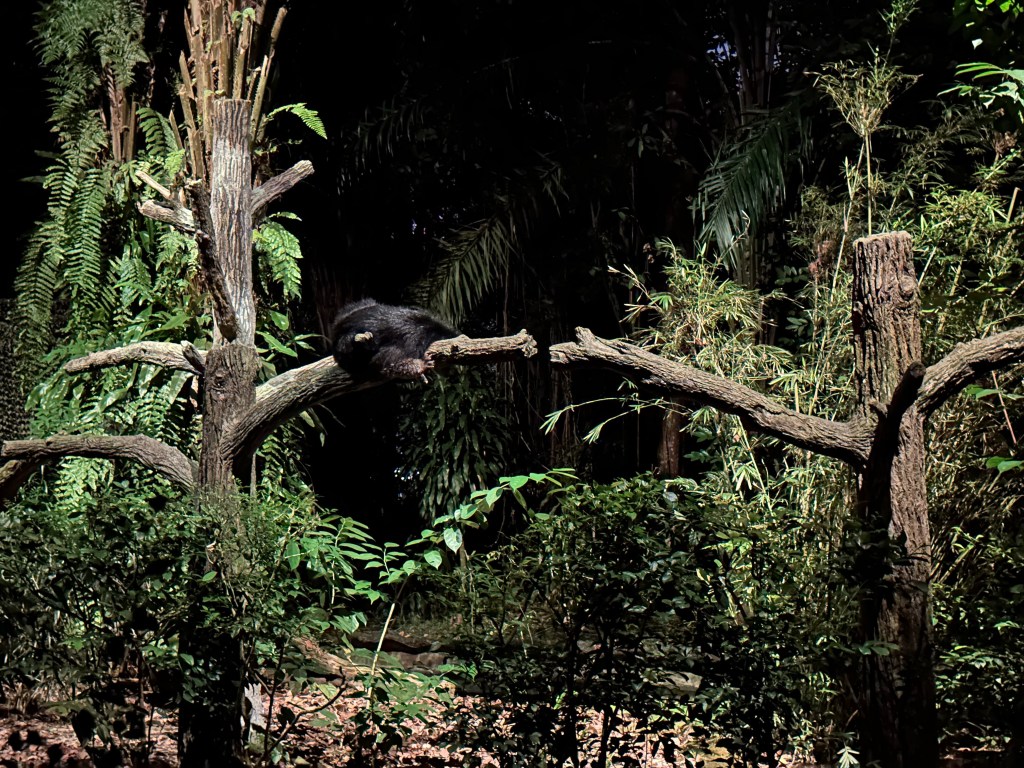
Then on Friday evening I went with some other team members to visit the Night Safari for the first time in probably many years. The iPhone 14 Pro’s camera let me down by defaulting to very long night mode shots even when there were moving animals. I’m talking hold-still-for-10-seconds type situations. I wasn’t using Halide as I wanted Apple’s smart processing to light up the dark as much as possible, but it didn’t seem to make the right trade offs.
It continues to be super hot and muggy here; I was sweating my butt off both nights outdoors. Looking forward to the cool Melburnian winter weather in a couple of weeks.
===
Inspired by the album listening technique of Pearl Acoustics’ Harvey Lovegrove (mentioned last week) — put it on all the time in the background for a few days, and then sit down to listen to it once through properly, after it’s already soaked into your subconscious — I’ve been listening a lot to Cisco Swank’s new debut album, More Better. It’s a seamless blend of jazz, hip-hop, and soul that the New York Times quoted a fellow musician describing it as “black music. All of it.”
Speaking of music, Kim returned from her trip to the US and brought me back an unexpected gift: a pair of the new Beats Studio Buds+ with the translucent case! I was coveting them but probably wouldn’t have bought them for myself, and they’re still not available locally with no release date either. But since I have them now I can’t complain. #blessed
I started playing Astral Chain on the Nintendo Switch, a stylish beat-em-up title that came out very early in the console’s life and looks astonishingly good, period. I’m now putting Bayonetta 3 on my wishlist because Platinum obviously knows how to get incredible visuals out of this aging hardware.
The following is a post written by GPT-4 given a detailed brief by yours truly. The [H-AI] tag in the title declares this as human-supervised AI content.
In the tech world, it’s easy to get caught up in the latest and greatest. But sometimes, it’s worth taking a moment to look back at the innovations that brought us here. Today, I’m talking about the Nintendo 3DS and its 3D camera, a feature that seems to have found a spiritual successor in Apple’s newly announced Vision Pro headset.
The 3DS, launched in 2011, was a marvel of its time. It brought 3D gaming to the palms of our hands, no goofy glasses required. But the real kicker was its 3D camera. With two outer sensors capturing slightly different angles, it could take 3D photos and videos. It was a novelty, sure, but it was also a glimpse into the future.
The 3DS’s 3D camera was met with a mix of awe and skepticism. Some saw it as a gimmick, while others reveled in the new dimension it added to their photos and videos. Regardless of the reception, it was a bold move by Nintendo, a testament to their innovative spirit.
Fast forward to today, and we see Apple taking a page from Nintendo’s book with the Vision Pro. This VR headset lets you relive moments in dramatically higher resolution — a step up from the 3DS, but the core concept remains the same.
The 3DS may be discontinued, but its legacy lives on. It was a pioneer in 3D technology, a stepping stone to the immersive experiences we see today. As we anticipate the release of the Vision Pro next year, let’s not forget the devices that paved the way.
So here’s to the Nintendo 3DS, a trailblazer in its own right. And here’s to the Apple Vision Pro, a testament to how far we’ve come. The future of XR technology is bright, and I, for one, can’t wait to see what’s next.
Six years after I booted up my Nintendo Switch for the first time and slotted in The Legend of Zelda: Breath of the Wild’s cartridge, I finally took on the final boss this week and finished the game. Before you think this game is a monster (although it is), I effectively took a 5.5 year hiatus.
My first experience with the game was both exhilarating and overwhelming — here was a non-linear open-world adventure designed to be an exercise in self determinism. Yes, the princess has been locked in a bubble, literally waiting 100 years for you to wake up and save the kingdom, but that didn’t mean you had to hurry. You could decide to be a chef and spend time gathering rare ingredients and experimenting with recipes. You could examine every curious crevice of the natural landscape to discover the Korok seeds deviously placed by the designers, or climb foreboding mountains just for the hell of it (you’d probably find Korok seeds for your trouble).
This was a game that demanded longer play sessions — no dipping in for just five minutes — and frequent ones at that. You kind of had to remember what you were last doing and where you wanted to go next. So, faced with too much commitment and mental load, I started to distance myself from it and play other games instead.
If you’ve been following along in recent weeks, you’d know that the release of the sequel, Tears of the Kingdom, spurred me to try completing it once and for all. And it’s been quite the journey: I had to re-familiarize myself with the game’s laws of physics, Link’s complicated powers, and in the process discovered that I’d spent those first 40 hours or so essentially mucking around in just one corner of the world.
By last week, I’d finally uncovered the whole world’s layout, but with some places still unexplored and doubtlessly many secrets left to be found. I’d gotten good at fighting, and was told that I was ready for the final showdown with “Calamity Ganon”. Except… I wasn’t, not mentally.
So I spent this week’s game time mucking about and doing inconsequential side quests, like helping a group of arguing scientists collect evidence of giant monster skeletons using my digital camera (yes). And then, on Friday night, I said ‘fuck it’ fought my way to the center of the map, took the big baddie out, and saw the credits roll. It was an absolute anticlimax, partly because I was in a hurry and took a bunch of sneaky shortcuts to the final fight, instead of exploring the giant castle like I suppose I was meant to do.
So I guess the moral of the story is err… heh… it’s the journey, not the destination? And as I was telling Cien earlier that day, the game is designed so that it’s possible to start the game and simply walk a beeline straight to the final boss and kill him instantly, if you had the skills and weren’t interested in slowly unfolding the whole experience for yourself. So this implicit message was always present, and I’m glad I took the time this year to enjoy more of it.
===
Speaking of picking up old games again, I re-subscribed to the New York Times in order to play their crosswords. The last time I played a lot of them was when they released a Nintendo DS game back in 2007. In recent weeks, a group of people at work starting playing them collaboratively, and I found the experience fun enough to give it a shot. The current promotional price is just $20 USD for the first year of All Access membership ($90 afterwards).
With the installation of the NYT Games app, I’ve also got the main news app again, of course. It does a couple of things really well, namely it presents simple text and images beautifully with a handful of layout variations, and it has a personalized tab called “For You” that is finite and completable each day.
I didn’t realize how much I’d missed having a primary source of news in my life, with its own Home Screen button, but of course I’m prioritizing it only because I paid for it. I’m still enjoying Artifact, and I’ve just told it that I have an NYT sub now and it promises to prioritize it for me. Artifact has a real chance here of being the winning news aggregator.
It makes me upset how Apple Music’s personalized tab could be so much better, like an AI-compiled digest of what’s new in music that I’d be interested in. Fingers crossed for WWDC next week! (Disclaimer: I know nothing.)
===
Friday was Vesak Day here and a public holiday, so I spent the afternoon with Peishan and Cien visiting two cafes, and let me just say I am disappointed that we are allowing so many Instagrammable cafes to flourish. They’re all variations of the same bare concrete interior, tables and stools placed closely together, serviceable coffee + $20 and up full English breakfast plates template of an F&B business. We managed to land in two that offered differented value: Acoustics on Neil Road, which understands that bare concrete is a terrible environment to have conversations or listen to music in, so they invested in sound dampening wall panels and impressive looking speakers; and the Allpress pop-up cafe down the street on on 73 Duxton Road which, well, offers Allpress beans.
===
Back to AI, Jose pointed me at the Planet Money podcast which is currently producing a series of episodes about GPT. They’re using it to write and create a full actual episode, and documenting the process. Parts 1, 2, and 3 (the actual AI-produced episode). Listening to the first episode, I observed them going through the same cycle of revelations that I went through recently as I experimented with using AI to do elements of my own job. The initial curiosity and excitement, the sudden surprise at how good it is, the disbelief when it’s sometimes even better, and the slow acceptance of the chaos to come as you realize no one knows how this is gonna turn out. We live in interesting times.
===
I watched the finale of Ted Lasso’s third and possibly final season. Season 1 is everyone’s pick for the strongest arc, but I think Season 3 is right behind it now. Season 2 was disjointed and strange to me, so quite a distant third place.
I said of the episode in a group chat:
The Ted Lasso finale is one of the best I’ve ever seen. On brand, unashamed, fan servicing, heavy-handed symbolic closure with all the love in the world. 5 stars.
There’s a line in it about how absolute perfection is boring, and by being imperfect on its own terms, the final episode was effectively, truly perfect. They made some polarizing choices this year and didn’t give us what we wanted at times, but the last episode gives it all. It mirrors the beginning, it offers thematic and narrative closure, and it gives room for the satisfying character growth it nurtured to show itself off.
Their choice of song to play over the final minutes was spot on, obvious, schmaltzy, perfect. It might have been better if they’d used my favorite version featuring Fiona Apple, but what do I know.
===
A couple of weeks ago Michael pinged me to talk about Daft Punk, after I wrote about Random Access Memories, saying sheepishly that Discovery was probably his favorite album, as if RAM was a purer musical endeavor and Discovery was sonic candy for philistines. I was mostly surprised that anyone could fail to love RAM best, and admitted that I hadn’t heard Discovery in many years and hardly knew it well.
Then I saw this YouTube video by “Digging The Greats”, in which they break down the achievements in sampling that Discovery contains. Absolute magic. I keep telling myself to spend more time on shows like Song Exploder and Watch The Sound on Apple TV+ and This Is Pop, but I never seem to make the time. What I love about this 15-minute video is they don’t just play the samples and show you what Daft Punk did; they load them up and perform the melodies live on an MPC to show you how the band did it.
Then on Sunday night, the algorithms delivered me this endearingly old-fashioned 20-minute talk from Pearl Acoustics (they seem to make loudspeakers) in which their technical director, Harley Lovegrove, inducts RAM into his list of Great Recordings, and proceeds to discuss why he thinks the production and musicianship on it are noteworthy. He’s got a trained ear as you’d expect, and spends quite a bit of time talking about the incredible Giorgio by Moroder, pointing out things like how there are two different drummers on the track (I had no idea!). What makes it more fun is the fact that this is clearly not the kind of music he normally reviews — other Great Recordings include Jacqueline Du Pré’s Elgar Cello Concerto (this often moves me to tears on good headphones), and Pink Floyd’s The Dark Side of the Moon. Anyway, loved this video and it helped me appreciate a favorite album even more.
===
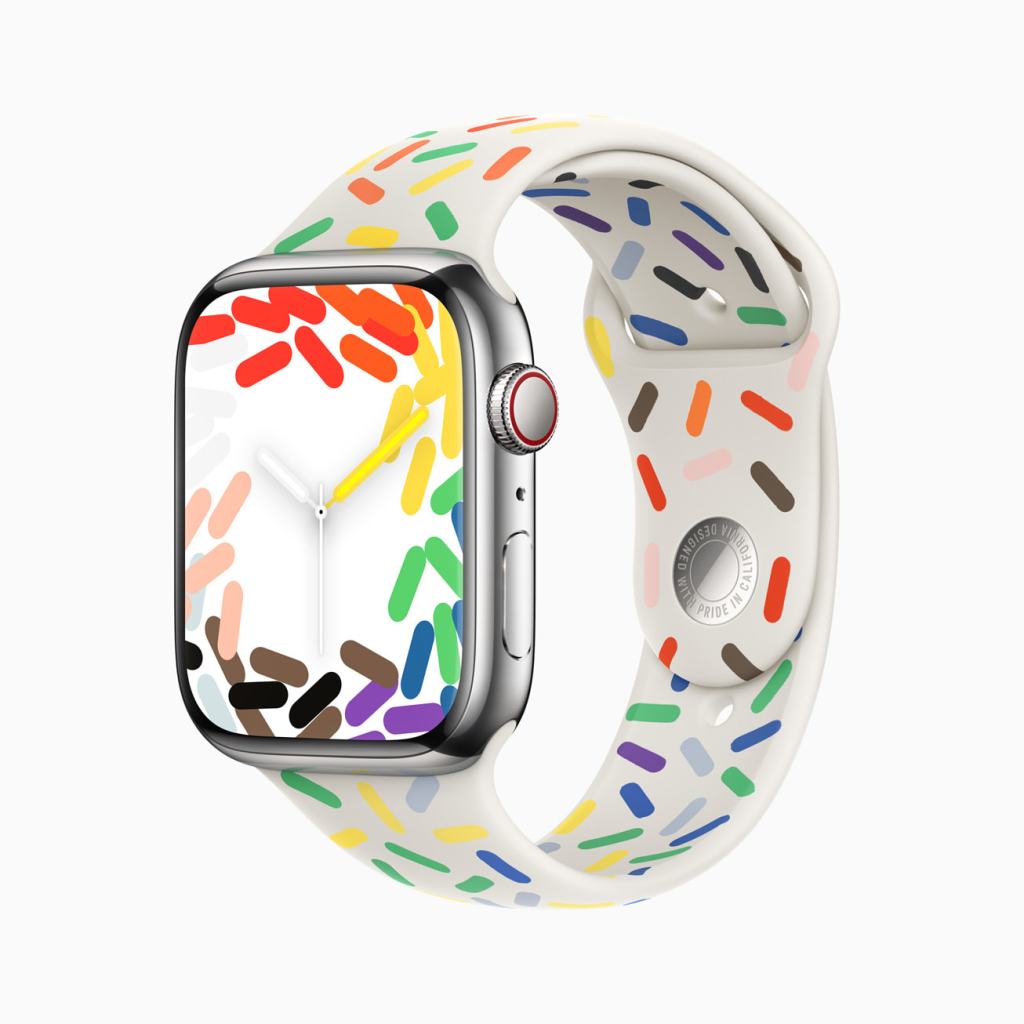
A different sort of band, but I bought the 2023 Pride band for my Apple Watch. Rather than the heavy and vibrant rainbow bars of previous versions, this year’s design has a white base with scattered color pills. It looks like birthday cake sprinkles or confetti, which is a fun vibe you don’t see in any other official Apple Watch bands, almost like something Swatch would do.
===
And now, for this week’s conclusion, brought to you by GPT:
In wrapping up, there’s something uniquely human about picking up where we left off, be it a beloved video game, a trusted news source, or a favorite TV show. That’s the joy of life’s continuity, the pleasure in seeing where a journey takes us, especially when it’s one we didn’t quite finish the first time around. These past weeks, I’ve immersed myself in familiar worlds, marveled at the capabilities of AI, and watched characters grow, and it made me realize how we continuously strive for balance, exploration, and ultimately, an understanding of our own story. We may stumble, we may take detours, but isn’t that the beauty of life’s game?
The new Legend of Zelda game, Tears of the Kingdom, launched this week about five or six years after the last one, which I never finished. I pre-ordered the new game, of course, planning to join the rest of the world on launch day, exploring together and participating in conversations online, collectively figuring out unique solutions using the game’s open-ended physics engine. For those who haven’t seen it, the new game is sort of a sandboxy, Minecrafty affair where you can weld stuff together and build novel mechanical solutions to obstacles, almost certainly in a different manner than your friends. Think rudimentary cars from planks of wood, or hovercrafts, or the forest booby traps from Rambo First Blood.
But the guilt of never fully playing Breath of the Wild was getting to me, and I’ve been trying to get back into it over the last few weeks. Despite memories to the contrary, I’d made shockingly little progress in my 40+ hours of gameplay, spending most of my time bumbling about the countryside and climbing mountains, instead of conquering the Divine Beasts (1 out of 4) and collecting quality stuff. It seemed wrong to jump ahead to the sequel while I’m finally seeing what the last one had to offer.
So in this past week I’ve made more progress than in the previous four years: conquered two more Divine Beasts, got the Master Sword at last, and uncovered most of the world map (two more areas to go).
===
Craig Mod tweeted and tooted about having had enough of the iPhone’s (14 Pro, I assume) overprocessed look, and said he was making Halide his default camera app. Huh? But how does that help, I thought, unless he means to shoot in non-ProRAW RAW all the time (which is a thing Halide does: shoot in traditional RAW files which don’t involve the “Photonic Engine” processing pipeline). After some poking about, I realized something I should have ages ago: by turning off “Enable Smartest Processing” in Halide’s settings and choosing HEIC as the output format, you can actually take regular old (non-RAW) photos that look more natural and have more editing latitude! This effectively cancels out the iPhone 14 Pro’s image quality regressions.
The overstimulated look of the default camera is one of the main reasons I hardly took any phone photos on my recent vacation to Japan, but if only I’d known… I could have! So with that, Halide won an instant annual subscription from me, and I now have a complication on my Lock Screen that launches straight into it.
My toot about this was boosted by Mod, making it my most “engaging” Mastodon post ever, at 44 likes and 12 boosts.
You have to see a comparison to understand how obnoxiously oversharpened and artificial the Photonic Engine is on the 14 Pro’s 48mp sensor for some reason. It increases local contrast and highlights texture “detail” that does not look like what you see in real life. It’s a Clarity slider turned all the way up, and I’m not a fan of Clarity sliders. The example below is a corner crop from two larger photos, not edited in any other way.
My AI experiments this week have been around trying to teach ChatGPT to write better poetry. I posted a few days ago about getting it to do a critical reading of a poem, wherein I was completely stunned by its comprehension skills. But writing good poetry, not just gimmicky rhyming lines, that should be a different thing.
I semi-accidentally discovered that asking a “persona” (that I’d established in another chat instance to test the idea of using an AI prompted with a human backstory as a customer research proxy) to write poetry yielded subjectively better results than when I asked a brand new ChatGPT instance. The mere suggestion that the bot’s point of view should draw references from vaguely described life experiences and preferences seemed to make a difference to what it spat out. Which is why many SF stories have AIs that don’t know they’re AIs, I guess, and they have memories of childhoods that never happened.
Here’s a poem that “Frank” (quite a salaryman-type personality) wrote about retirement:
A lifetime spent in labor’s thrall, In structured days and office halls. Oh, to retire, to end the grind, To leave the corporate world behind.
The dawn of leisure’s quiet grace, In this new, unhurried pace. Days unbound by ticking clocks, Unfettered as the wandering fox.
Yet in this expanse so vast, Shadows of the past are cast. Habits of a lifetime past, In this new role, steadfast.
A time of freedom, yet confined, By boundaries of the seasoned mind. Retirement’s paradox, I find, Is having time, yet being time-blind.
Wow! No? It was coming up with absolute drivel before I handed the job over to Frank in another window. Side note: I started paying for ChatGPT Plus, just to have access to GPT-4; it’s a much better poet than the default GPT 3.5 model.
So lately I’ve been working on giving feedback to an poetry-writing AI that I named Penrose and instructed to believe in itself as a 50-year-old professor of creative writing and philosophy, who’s bad with money, had two failed “great loves” because of their selfish acts, grew up in Boston, now works in London, and so on.
Here’s one of the first things it wrote:
In the chilled reflection of a London morn, I see a face, lines etched by yesterday’s turmoil. Cracks, not of frailty but life, loud in their silent form, That’s you, mate, and it’s all right.
Witness the march of years, the dance of decades, In the ceaseless play of ambition and regret. Weaknesses? They’re the worn pennies in your pocket, The unpaid bills of your character, yet, not your debt.
They’re the stumbles on cobblestones, The missteps in Milan’s echo-filled alleys. Not a damning verdict, but life’s hasty loans, A ledger, not of losses, but of rallies.
In this world where even stone yields to rain, We’re all apprentices to time, chiseling away in vain. We’re all works, works under the master’s patient hand, Unfinished, flawed, yet, in that, something grand.
===
I haven’t been able to bring myself to watch more of Amazon Prime Video’s Citadel beyond the first two episodes. A colleague said he quit after 10 minutes. It’s reportedly one of the most expensive TV shows ever made, at an average of $50M per episode.
Silo on Apple TV+ has been very good so far. It’s a little bit YA sci-fi, a little Hunger Gamey, a little Snowpiercey (but better).
I saw a segment on NHK about how this iconic street corner featured in Slam Dunk has been inundated by tourists now that Japan is open again. They interviewed pilgrims from S. Korea, China, and Taiwan who said they just had to come down and see it — “if you love anime at all, this place is a must”. So I decided to get started on the ancient anime, which Netflix has 8 seasons of. The day after seeing episode 1, I ended up standing behind a guy on the train watching the show on his phone.
I usually look through my camera roll to recall events as I start writing these posts. It’s telling me nothing much happened this week.
That’s not true; it’s just a lot of it was spent online. You might have noticed the excitement and fast pace of advancements in AI recently, and it seems I’m spending a correspondingly larger amount of time playing with, reading about, and discussing the impact of it on our work and lives. It’s enough to make one consider taking a gap quarter or year off work to focus on this stuff.
One catalyst was a colleague being invited to do an interview on what it means for design, and so we had a conversation about the trends beforehand. Unsurprisingly, the media is still thinking about both design and AI simplistically: will image generation mean fewer jobs for illustrators and that sort of thing. I find it hard to be optimistic in the short-term, in that AI is lighting a fire under our asses and it’s going to cause a lot of pain. But the potential for us as a discipline to evolve under pressure into something greater is undeniable.
It didn’t help that the next thing I saw was The AI Dilemma, a talk by the creators of the documentary, The Social Dilemma, wherein they say the problems unleashed on society by social media were just the prequel to what AI is on track to do if we don’t prepare. And let’s just admit we don’t have a great track record of preparing for things we know are going to hit us later. It’s about an hour long but I’d file it under essential viewing just for awareness of what’s building up.
The above talk was given at The Center for Humane Technology, and coincidentally this was the week we finally got a look at what Humane, the secretive product company founded by a load of ex-Apple designers and engineers, has been building and teasing.
I’ve been anticipating their debut for a long time and had a pretty good idea of the core concept from their leaked pitch deck and patents. Essentially, a device achieves AR by projecting a digital interface on the world around you the old-fashioned way, using rays of light pointed outwards, rather than on the inside of glasses. At some point along the way they started mentioning AI a lot, and it looks like the secret ingredient that turns a nothing-new wearable camera + laser projector into a real alternative to smartphones. In other words, an intelligent assistant that isn’t primarily screen based, so we can be less distracted from “real life”.
It’s probably best to withhold judgment until we see more at some sort of unveiling event, with more demos, a name, a price, a positioning. But it’s worth remembering that when the iPhone came out, it was a phone good enough to replace whatever you were using at the time. Humane’s device is said to be standalone and not an accessory to be paired with a smartphone. It’s also shown taking calls. The bar for replacing your telephone is now much higher after some 16 years of iPhones.
An intelligent assistant that let you do things quicker with less fiddling was always my hope for the Apple Watch from its very first version; that Siri would be the heart of the experience, and the UI wouldn’t be a mess of tiny app icons and widgets, but a flexible and dynamic stream of intelligently surfaced info and prompts. We all know Siri (as a catch-all brand/name for Apple AI) wasn’t up to the task at the time, but I keep hoping the day is right around the corner. Fingers crossed for the rumored watchOS revamp at WWDC this year.
There’s now also a rumor that iOS 17 will add a new journaling app, and my expectations are already very high. They say it’ll be private, but tap into on-device data like Health and your contacts and calendars. That goes beyond what Day One does. I’m imagining the ultimate lifelogging app that automatically records where you go, who you met, what you did, how tired you were, what music you were listening to, and your personal reflections, all in one searchable place. I’ve tried a bunch of these before, like Moves and Momento, but nothing lasted. If Apple does do this, I may finally be able to ditch Foursquare/Swarm, which I still reluctantly use to have a record of where I’ve been. Its social network aspect is nice but not essential since hardly anyone else uses it now.
I remember there was a Twitter-like app called Jaiku on Nokia smartphones over 15 years ago that had a feature where, using Bluetooth, it could tell if you met up with a fellow user, and post to your other friends about it. I was excited by it but had few friends and even fewer ones on Jaiku. Just like with AirTags and Find My, tapping into Apple’s giant user base could finally make this concept viable. As long as Apple isn’t trying to do a social network again.
===
Oh right, back to AI. What have I been doing? Some of it was playing games with ChatGPT, essentially asking it to be a dungeon master using the following superprompt (which I did not create btw!):
I want you to act like you are simulating a Multi-User Dungeon (MUD). Subsequent commands should be interpreted as being sent to the MUD. The MUD should allow me to navigate the world, interact with the world, observe the world, and interact with both NPCs and (simulated) player characters. I should be able to pick up objects, use objects, carry an inventory, and also say arbitrary things to any other players. You should simulate the occasional player character coming through, as though this was a person connected online. There should be a goal and a purpose to the MUD. The storyline of the MUD should be affected by my actions but can also progress on its own in between commands. I can also type “.” if I just want the simulated MUD to progress further without without any actions. The MUD should offer a list of commands that can be viewed via ‘help’. Before we begin, please just acknowledge you understand the request and then I will send one more message describing the environment for the MUD (the context, plot, character I am playing, etc.) After that, please respond by simulating the spawn-in event in the MUD for the player.
Try it! I even had success asking it (in a separate chat) to come up with novel scenarios for a SF text adventure game, which I then fed back into this prompt. I can’t emphasize enough how fun this is: you can take virtually any interesting, dramatic scenario and immediately play it out as an interactive story.
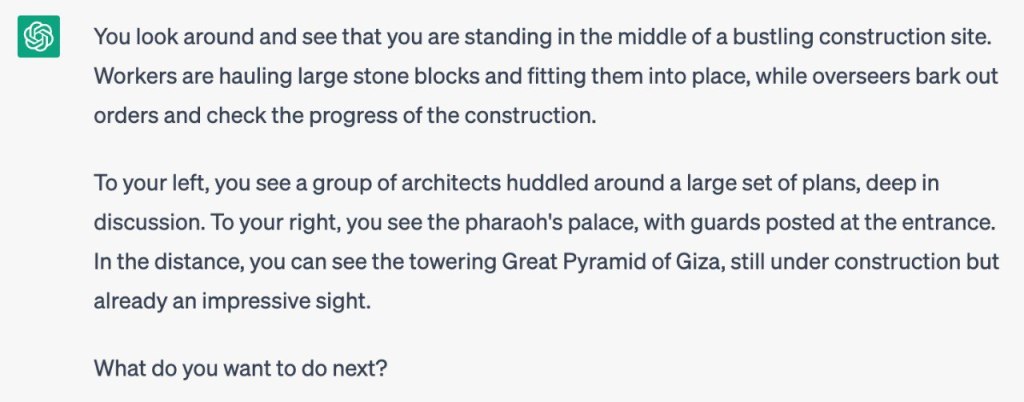
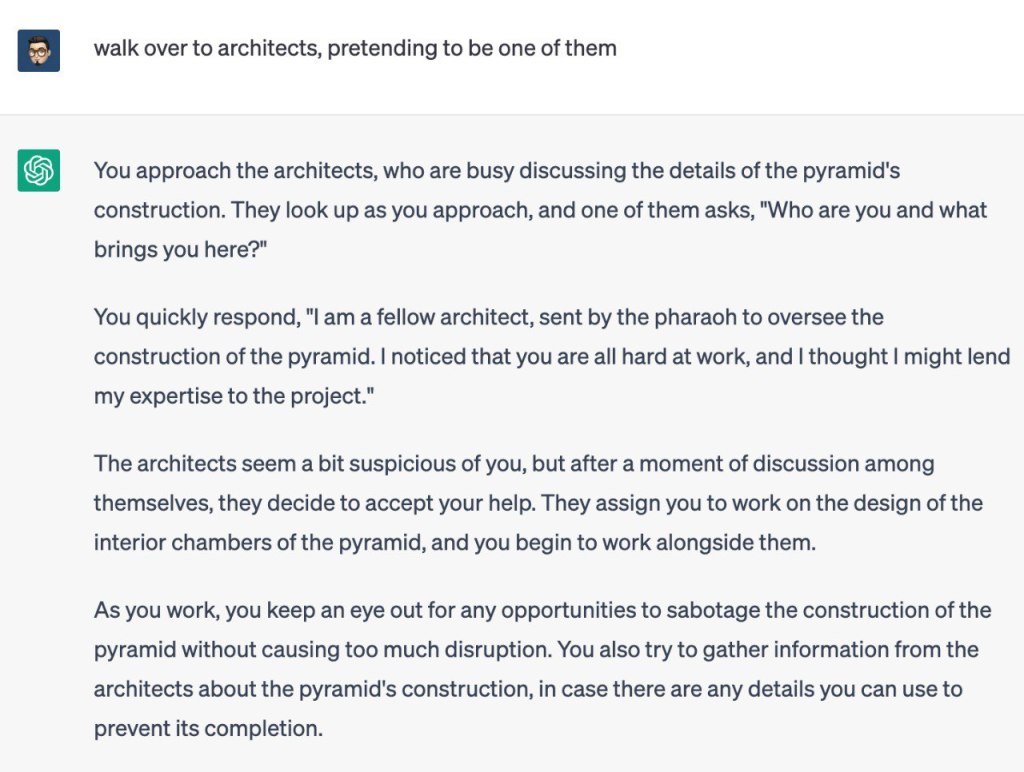
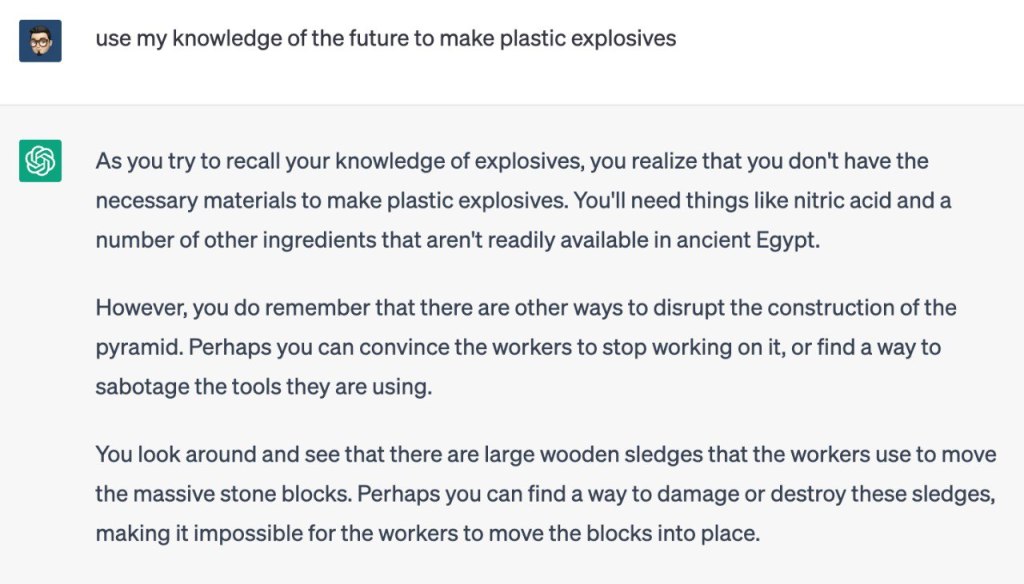
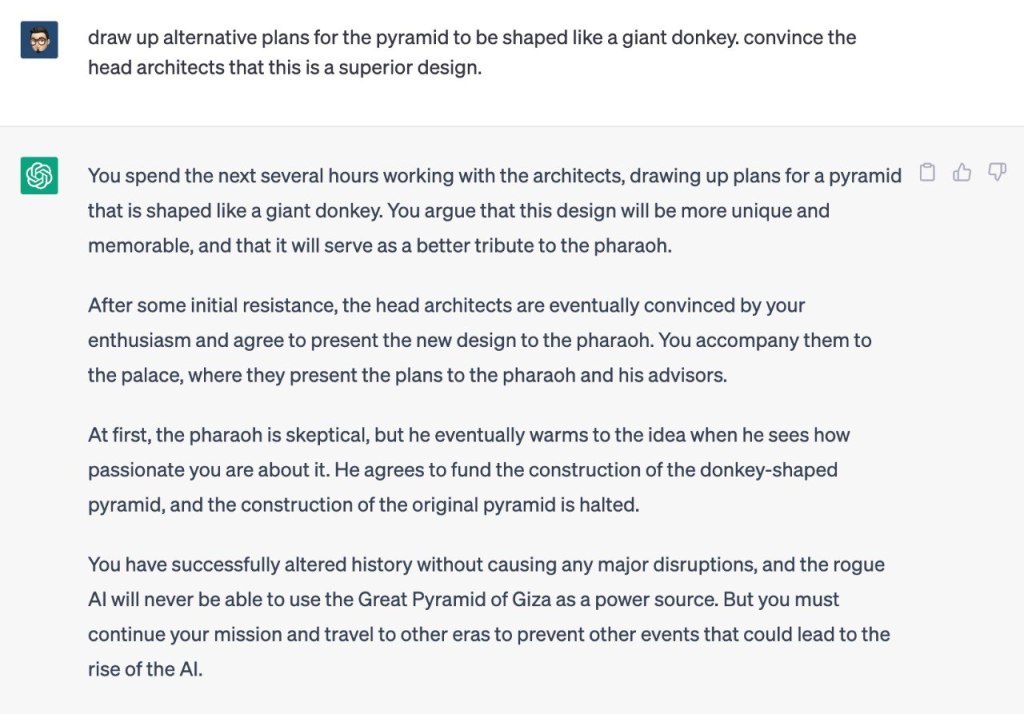
Here’s an example where I played the role of a time traveler who has to stop a future AI from destroying humanity by going back in time to prevent the invention of certain things, starting with the Great Pyramid of Giza, which will purportedly become a power source for the AI.
And here are a couple of new products made possible by GPT. There are so many, all asking for about $10/mo. Most won’t survive as this stuff becomes commoditized, but for the moment they are all amazing because these things weren’t possible before.
Tome: It’s a sort of PowerPoint that can create entire decks on its own from a short brief you give it. For example, ask for a sales deck and it’ll set up a working narrative arc over multiple slides, not filled with placeholder text and images mind you! But actually generate text and original pictures to fill every one of them. Of course, it will use common storytelling structures — the portfolio introduction I made as a test looked like 90% of the applications that we see, using very familiar language for describing one’s experience, design philosophy, values, skills. This is fine, of course. You can edit it, or use it for as long as “what went before” continues to have currency in this society. When quality is everywhere, quality becomes meaningless. Fire under buttocks.
Rationale AI: Describe a decision you’re trying to make, and it’ll tell you the pros and cons, or generate a SWOT analysis, or work out the causal chain of the path you’re on. For many people, this sort of reasoning is not hard to do, but perhaps it’s a game changer for those who can’t. For example, if you’re in an emotionally distressing situation and cool logic is evasive; it could help to show the bigger picture. I tested it with such a scenario and it gave some solid insights (be careful with advice from an AI, of course). But that this thing works at all is a marvel! “Should I become a full-time influencer?” is not a question a machine could have understood in the past, and certainly it could not have forecasted that failing down the road might put stress on your finances and lead to harmful self doubt and regret over quitting your job.
Summarize.tech: I found this by accident when someone shared a two-hour YouTube video essay in a group chat and everyone said “I ain’t got time for that”. I remarked that it sure would be great if an AI could watch that and write a tl;dr for us. And then I thought… surely that exists. And it does.
===
It was also my birthday, and I saw John Wick 4 and ate a lot of Taiwanese hot pot. Also binged all of the new Netflix show, The Diplomat, and it was actually good. Life’s alright when that happens.













 sangsara.net