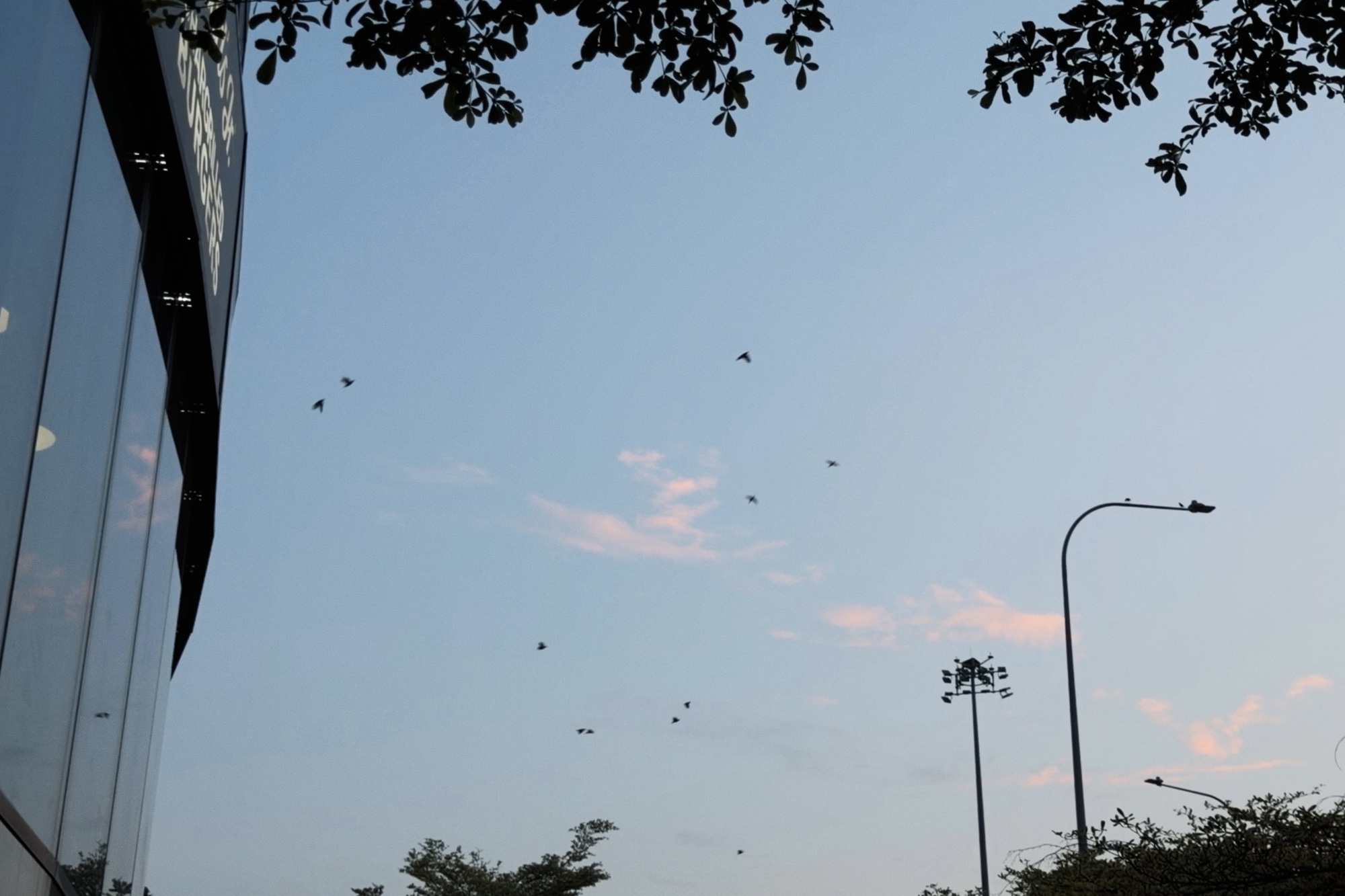
Summer is suddenly upon us. Like an overbaked Instagram filter stacked on top of an already eye-searing Photoshop edit, the heat in Singapore has been turned up to unglamorous levels. It is impossible not to be sweaty; we are at SWEATCON 1; omnisweat, eversweat, permasweat; we have always been in sweat in Eurasia. It was 31.5ºC and 79% humidity in my living room one afternoon, according to my HomePod. Somebody on Reddit worked out how much it costs to run the AC, in a bid to justify their own use. They say it might last till October.
It’s WWDC next week and I’m looking forward to seeing what Apple’s AI story has evolved into. I don’t envy their position — if I were in charge of a billion devices owned by all sorts of users, I wouldn’t want to put an AI assistant across all their data either. I doubt it’s possible to get 100% accuracy at scale understanding people’s appointments and emails in all their permutations, to say nothing of more complex use cases. The result is someone somewhere will lose something important and learn that their phone can’t be trusted. Is that worth it? Should everything AI have a permanent “(beta)” tag?
Even when it comes to writing code with AI, you have to be willing to accept bugs or only build simple, generic things. I think letting AI generate small pieces of functional code for people has some promise. Google and the ‘Nothing’ company are doing vibe-coded widgets on Android, so it would be nice if Apple copied that feature along with the long-rumored Shortcuts upgrade (the idea being that a more capable Siri would use Shortcuts and App Intents to control the system under the hood).
I was minding my own business this week when an idea for a website suddenly hit and I started to see if I could make it. Within four hours, I had a working version and decided to just publish it and walk away. Big mistake to think that, of course. I spent the next two days fixing bugs, expanding its data sources, and adding more features. What is it? It’s called Chinese Era and it creates random pairings of classical Chinese art and poetry. Some combinations are fittingly beautiful, others make you work to find a connection. I think that challenge makes the poetry even more powerful. I’m very happy with it, because it has the feel of a museum visit, albeit one curated purely by chance. I have no idea where the idea came from — did I see some Chinese artwork recently or read a Chinese poem? Not that I can remember.
How does it work? I read some translated Tang Dynasty poetry from Project Gutenberg many years ago, so I knew books were out there in the public domain for the taking. I didn’t know if I could access the necessary paintings, but it turns out institutions like The Smithsonian happily provide their collections via APIs. There’s also a free radio livestream of traditional Chinese music that I was able to incorporate for more atmosphere. Appropriately, the app was created with an open-source Chinese AI model: DeepSeek V4 Flash.
In terms of media activity, it’s been a week of tying up loose ends. I finished a bunch of shows that have been lying about half-watched for months: Lioness S1 on Amazon (S3 starts in August), Drops of God S2 on Apple TV, and the anime Tengoku Daimakyo (Heavenly Delusion) on Disney+. I even attempted to finish Carole & Tuesday, a Netflix show I remember watching back in 2019 (!) on my iPhone 11 Pro Max hooked up to my hotel room’s TV in Manila. But it’s just not very good.
Later edit: I spoke too soon. C&T has some really prescient stuff going on, with a police squad called MICE (Mars ICE) violently deporting illegal immigrants, and the central plot is about AI artists replacing human musicians? This was in 2019!
Keeping with the theme of unfinished business, I started Yakuza Kiwami 2 on the PS5, a game I bought during my first sabbatical in 2021 and never got around to playing before I went back to work. I hope this time I finish it before the next paycheck lands.
Speaking of unemployment, Peishan had an afternoon off and we went to the IKEA restaurant I wrote about last week so she could see the situation for herself. This time it was like a full-on retirement village. People sat there in their groups for hours, chatting over bottomless cups of tea and the remnants of their salmon and meatball lunches. Apart from worrying about whether this is actually sustainable, I found it shameful that a Swedish furniture company might be subsidizing a better community center for our seniors than the government’s organizations. More imagination is needed.
I read (re-read?) There is No Antimemetics Division, in its proper final form — the first version of the book I read last year was self-published, and it was completely rewritten for release by Penguin Random House. The old version can hardly be found now, which is very fitting for a story about disappearing memories and unknowable artifacts. The new version reads very well, and it’s much clearer what’s happening at all times. However, I rated the original 5 stars on Goodreads and this one felt like 4 stars. It’s undoubtedly a better version for mainstream release, but I enjoyed the original because its concepts were so vaguely sketched, its images so hazy, its atmosphere so oddly suspended between science, fantasy, and eldritch horror.
I finished reading The Refusal of Work and immediately afterwards saw that Pope Leo had published an encyclical (first time encountering this word) on AI that included some of the anti-work sentiments I’d just read about. I found the following in this tweet:
Among these ideologies, I consider particularly insidious the one that suggests that every person must earn or justify his or her own worth, to the point of attributing greater value to those who are more efficient or effective. From this perspective, persons end up being reduced to a means of achieving results, a resource to be used and exploited, and are no longer recognized as a proper end in themselves who should never be instrumentalized. The value of persons, however, does not depend on what they achieve or produce. There are rights that apply to everyone simply by virtue of being human, and no human power can legitimately deny or arbitrarily limit them.
I suppose it makes sense for the Catholic Church to attack a core tenet of protestant belief. But I find it impossible these days to disagree with the idea that working hard and making money isn’t the thing that defines us as human beings. By that logic, we can let AI have the jobs — work justifies their existence, but not ours. What we need is meaning outside of work (and maybe religion).
I’m now in the middle of David Pogue’s new encyclopedic record of Apple: The First 50 Years, still during the Steve Jobs era. I think it’s a good way to get ready for this year’s WWDC, which will be Tim Cook’s last as CEO before handing it over to John Ternus in the fall. The one thing I’ve taken away so far is that many of the conventions we now enjoy were slapped together by borderline burnt-out teams during hellish crunch periods. Apple’s best years were built on sleep deprivation, divorces, and denigration from their leader. He, of course, paid dearly too. Pogue’s book is the first I’ve seen to draw a faint line between the turnaround year of 1997, when Jobs himself was stressed to his limits and suffered kidney stones, and the eventual pancreatic cancer that would kill him.
But there’s a great part where Apple’s board tries to convince Jobs to stay on as permanent CEO during his iCEO (interim CEO) period, offering him a million Apple shares and six million more as options. Jobs maintained during this period that he had no wish to stay on, because he was just beginning to enjoy time with his family and running Pixar, saying, “This is not about money, I have more money than I’ve ever wanted in my life.” It’s a bit of a tragedy that he eventually changed his mind and gave so much of the rest of his life to Apple.
One of the people I used to listen to on my iPod was Sonny Rollins, who passed away this week at the age of 95 (NYT gift article). I think the first time I really took notice of his music was with the recording of his 9/11 concert, which I probably got from eMusic at the time. It amazed me then how he played with such strength at the age of nearly 80, so it’s no surprise he lived that long and only put the saxophone down a few years ago. I’ve been putting his music on all week.
Side note: I just discovered eMusic is still around?? I discovered a lot of great music in my college days through their subscription plan, where I think I got like 40 tracks to download as MP3s each month. It was like having a budget to buy only two CDs, so you had to choose wisely. Those iPod days were great, and we cherished the ability to carry our entire music collections around. Now we “carry” nearly all recorded music around and don’t appreciate it as much.
I’m still holding out on paying for “real” AI model access and making do with free DeepSeek for coding. It really works! I added a new Custom mode to Window Box that lets you pop in any YouTube video URL to use as a background scene. So you’re no longer limited to the three mostly static backdrops I made; thousands of live camera streams are fair game. The alignment and perspective may not match exactly, but hey, you get to see moving people and scenery. Here’s one in Venice, and one of Tokyo Station (above), if you need examples to try out.
Generating code isn’t the only thing you can do for free. I popped by an IKEA for lunch on a weekday and stumbled onto what must be a hack that every retiree knows: you can hang out at the air-conditioned cafeteria for ages and the drinks cost nothing. The place was packed with seniors. When I tried to pay the 50-cent asking price of my coffee (not pictured), I was told that it’s free for members. What’s crazier is that the cups are refillable. So I ended up sitting there reading for an hour instead of going to a Starbucks like I’d planned. Between two mediocre ultra dark-roasted coffees that taste like ashtrays, I’d pick the one that doesn’t cost $5.
Speaking of food prices, I’ve noticed something alarming recently. The country is running out of sardines in extra virgin olive oil. Leading regional brand, Ayam, only has sardines in tomato sauce — their premium varieties are out of stock everywhere. I’ve checked this across online and physical supermarkets and it’s the same story. There are a few cans of King Oscar still out there, but not many. Shelves are actually empty! NTUC FairPrice has John West brand brisling in EVOO but I can’t recommend them on account of their mushiness. I suppose it’s down to the rising cost of ingredients or shipping difficulties due to war. Hopefully temporary, but I’ve started a stockpile just in case.
Someone suggested that maybe I’ve got ADHD because of how I tend to (over)do things in big phases and then move on to something else. Case in point, this week I focused on reading, and somehow got through about six and a half books. It was Speaker for the Dead that unclogged the system, it was so engrossing that I didn’t feel the usual distractions: the urge to scroll a feed, or switch to a TV show, or check the chat apps. The ability to focus on long-form writing is like a muscle that loses its strength really fast if you’re not constantly training it.
Here are this week’s books.
Transcription (Ben Lerner) — This was a recommendation from Lorde on one of her IG Stories. I really wanted to like it, but felt too little to pass it on. 3 stars.
On the Calculation of Volume I – (Solvej Balle) — This 7-part time loop series has been on my radar and I thought I’d start. I’ll put it this way: as fun as Groundhog Day this is not. 3 stars.
On the Calculation of Volume II (Solvej Balle) — I’m still undecided if I should continue. The author drops a cliffhanger right at the end to help persuade you, though. 3 stars again.
It Lasts Forever and Then It’s Over (Anne de Marcken) — This was a recommendation from Rob, a zombie novel you’ll like even if you’re not into zombies, and it contains some absolutely brilliant bits of writing. 4 stars.
This last book is a fairly academic sort of essay + research project on how modern life is unhealthily tilted towards work — has been colonized by it, even. How work dominates our worldviews, is seen as a source of virtue, and supposedly gives life meaning. It references some incredible antiwork bangers from Bertrand Russell and others, and made a good case way back in 2015 for how we as a (presumably Marxist-leaning) society could make life better for everyone if we just stopped centering work and thought about what else we could do. And that was before generative AI.
Viewed through the lens of today’s technologies, it’s hard not to see the chance that AI offers for us to rethink society: we could sustain current economic outputs while letting everyone spend less time earning, giving more people the freedom to pursue other things. It’s a Charlie Brown football that’s been offered and yanked away by capitalism many times before, but we can still hope. You may think you have a life today, he writes, but aren’t you really spending that time recovering from work? Are you really able to do the things you want, or have you already been limited to the options that fit neatly into evenings and weekends?
I plugged this into Claude and it pointed out that I’ve been on sabbatical for months and made a dozen apps, which might be the echoes of work ringing through my bones, a ritual I can’t unremember. I disagree. Work may have been the first to put the tools in my hands, but what I do with them now is self-expression, possible because work isn’t at the center of my thoughts and time.
It was with this in mind that I attended a talk on Thursday organized by my friend QQ, featuring my former boss, Olof, and a guy named Phil who heads up an innovation office in the government.
The event’s topic was “Human-Centered AI” — broad enough to go in many directions. Olof gave a preview of the book he’s working on, which argues that play is the future of work: something humans do naturally and joyfully, and therefore a genuine creative advantage over AI. But he remained firmly focused on work as an indispensable part of life, which made Phil’s contribution useful as a counterweight — he suggested to the audience that AI could help them in creative pursuits outside of work.
I ran into a lot of people that I knew at the event. Many were ex-colleagues from the last couple of companies I was at. It’s times like these that Singapore makes you feel how small (or perhaps how tightly knit) its communities are. Quite a few of them have gone on to work with each other elsewhere, and a significant number have now landed in roles at the Government Technology Agency of Singapore (GovTech). As if to underline the point, one of the people I met at the post-event drinks was someone that YJ told me — just three days prior! — that he wanted me to meet. He was right; I enjoyed our chat and there might be an opportunity to do some fun stuff in AI together.
If you thought that all that reading meant less vibe coding, you’d be partly right. The bigger constraint was self-imposed: I’m currently not paying for any AI subscriptions, and have made it my mission to see how much I can do with free models. It’s like completing Doom with just the basic pistol, or Jason Bourne beating a guy to death with a book (I tell myself). Any idiot can ship an app with Claude Opus — but can they do it with DeepSeek V4 Flash?!?
(I’ll probably last another week before caving and resubscribing.)
Using only free access to Qwen 3.6 Plus, I managed to update Window Box with a slew of upgrades: transition animations between locations, better caching of assets for performance, accurate daylight timings, realistic sunlight movements from dawn to dusk (correctly oriented to the camera angles in each city!), and better handling of wind effects and sounds.
I also updated a maze, a maze, a maze to address a request I’ve gotten several times: the ability to see your path and the calculated optimal route after solving the puzzle.
During this time, Google released their new Gemini Flash 3.5 model and made some outrageous claims, such as how it rivals their own 3.1 Pro model in coding ability. After putting it through its paces and wasting quite a bit of time, I can say it’s currently nowhere as smart or reliable (at least when working in chat).
I wanted to add a page to this site containing a curated “bookshelf” of the best books I’ve read recently. I first made the page using a basic WordPress template, just a gallery of book covers that linked to Goodreads, but found it depressingly old-fashioned. Then I tried to use Gemini Flash 3.5 and DeepSeek V4 Flash to build a modern web app, with a stack of 3D books you could pull out to inspect, and ended up losing an entire afternoon’s work due to hallucinations and corruption.
The next day, I restarted the project from scratch and got something I was happy with. Only to test it with Cien, who gave me the feedback I knew in my heart but didn’t want to admit — all this faffing around with a fake 3D bookshelf wasn’t any better than simply seeing a grid of book covers. It was actually more annoying. So I redesigned it again, and you can see the results through the Bookshelf link in the site’s navigation.
And because I didn’t want to wade into code or ask an AI agent each time I need to update the list of books, I built in a visual tool to generate the very code it needs! I’ve named this project Shelf Expression, and will open-source the code on GitHub once it’s sufficiently kink-free. Other people should then be able to just point their AI agents at it and repurpose this to add bookshelves to their own sites.
It’s becoming hard to remain satisfied with traditional, restrictive CMS systems like WordPress.com when you can vibe code custom pages like this, but I’ll stick with them for now on the basis of boring = stable. I’ve got too much history here to risk a migration at this point, but the day will come, so this really is an existential risk for many companies unless they update their services.