I went to Apple Orchard Road and tried the Beats 360 headphones. They’re not large enough for my head; case closed. Money saved.
My new Apple Watch likes to try cheering me up by telling me that my body is “Ready” to “Go For It” (I assume “It” is a marathon, a swim to the far side of Australia, or something equally implausible) and that I had excellent sleep the night before, but these science and sensor-backed statements simply don’t match my reality. I’m tired; I wish I could sleep more!
I just took a little break (after one paragraph, natch) and went on Instagram, where I saw a post that read “Anyone else turn 40 around the start of the pandemic and now blinked and you’re somehow 46 wondering what the hell just happened?” On one hand, that sentence perfectly captures the fatigue that you’d imagine comes with being abducted by aliens and losing six years of your life — at the very least, the weariness of having to catch up with a lot of missed information, which is what being alive in this time of AI feels like, always on the back foot with lots to learn — but on the other hand, it implies not knowing at all where the time went, which I can’t identify with. Oh I know where the time went. I remember it all perfectly well, but it plays in my mind like a timelapse — hundreds of days passing, the figure getting in and out of bed, the view outside the window gradually changing.
Armchair theory: maybe what’s caused this ‘blink and time passed’ effect for many is the combination of massive disruption followed by repetitive discomfort. This is different from repetitive boredom, where days are long and time moves slowly. With repetitive discomfort, you’re constantly insecure and stressed, so the mind protects itself by generating summaries and discarding the details. This sharp change, followed by pain you’d rather forget, dislodges you from whatever life you were living before, making it feel like a separate country.
I’m listening to Apple Music 1 and three Taylor Swift songs have played in a short period of time. Without checking, I’ve known it was her from the fact that all her recent music sounds the same. It’s hard to feel bad for a billionaire, but that’s an awful place for any creative person to be. It’s like she doesn’t listen to any other music, or won’t allow herself to appear influenced by anyone else. Lonely at the top, as they say, which is why you won’t find me there (among other obvious reasons)!
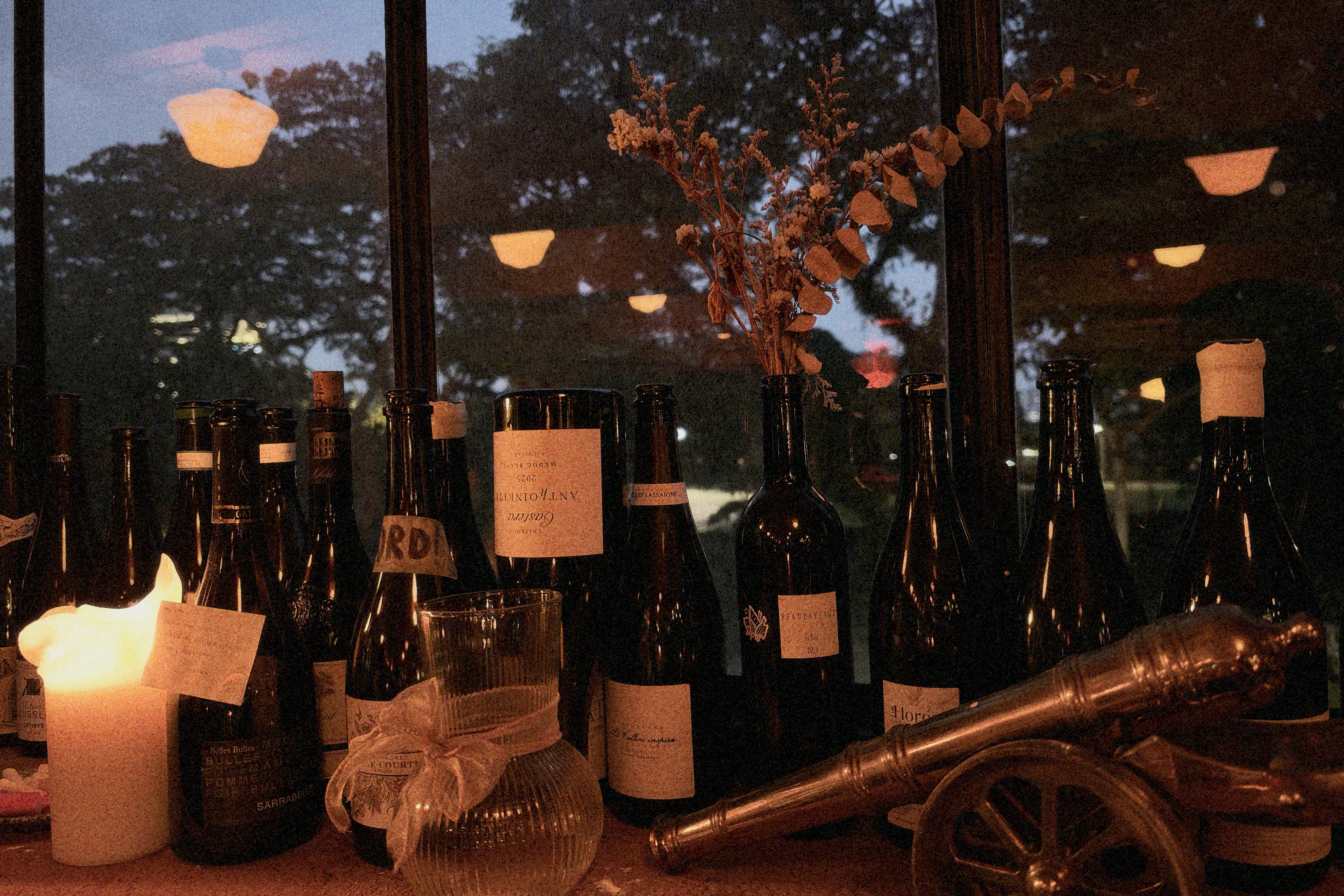
Kim and I met Mandy for dinner one night to mark her birthday, and we went to a wine-focused place called Fiasco which has taken over the spot where Kilo used to be, that weird little building out in the middle of nothing near Lavender. The food was all really good (I forgot to take pictures), and they’re doing some really interesting things with hanger steak and pork collar, the latter seasoned to resemble a very fancy charsiew.
In an example of culinary R&D jumping the shark, we ate at Surrey Hills over the weekend, where my mother-in-law’s corned beef hash came partially covered with a purple sweet potato foam. Needless to say, she did not appreciate the touch. The place purports to be Australian, and with her being Australian too, I tried to gaslight her into believing that it was an authentic Australian recipe that she’d somehow never heard about. Needless to say, I was not successful.
I finished PARANORMASIGHT: The Mermaid’s Curse, and found it a worthy sequel, arguably better than the first game in every way unless you want a spooky atmosphere. This one can’t be classified as horror at all. It’s a mystery adventure with supernatural elements so tame they’d elicit no more than a shrug from a timid baby. Like the first game, its story concerns Japanese history and legends that one might find a little boring, but you don’t have to read all the text in its menus.
Playing that game unwittingly prepared me for the film Inu-Oh (2021), which I’ve had in my library for years and suddenly decided to watch. From the opening scenes, it eerily echoed story points from PARANORMASIGHT, concerning the 12th-century Heike samurai clan, and their vengeful spirits said to linger across the land after they were wiped out. Inu-Oh is a wildly ambitious and stupendously well-animated musical that is let down by, well, its music. The concept is a fusion of traditional Japanese music with glam rock, and a main character starts playing his biwa one day like an electric guitar without any explanation. The visuals work, but the songs are poorly structured to modern ears, overly long, and basically repeat the same melodies while pages of historical narrative are sung over them. Imagine Billy Corgan’s worst material, stretched twice as long, and the lyrics are all about random days of Napoleon’s life, and you’ll begin to understand how it feels.
We finally saw Sentimental Value (2025) and wow it really deserves its Oscar and 95% Rotten Tomatoes score. The opening scene with the house, and the title card needle drop that follows it, was so good that my body felt compelled to stand up and applaud — I didn’t allow it, but that feeling went on for much of its running length. The train oner is a wonderful bit of technical showing off, and actually the whole film’s lush 35mm look just stunts on the pervasive digital signature of Netflix movies. Everyone is great in this, making art about how art both fucks you up and saves you — 4.5 stars.
Found time for a grab bag of other films too: Runner (2026) — not to be confused with Gal Gadot’s The Runner (2026), Good Boy (2025), Elle (2016), Grand Theft Hamlet (2024) — the one to watch out of all of these, a very human documentary about two out-of-work actors putting on a production of Hamlet inside the GTA Online videogame whilst stuck at home during the pandemic — Shelter (2026), and Tony (2026).
Singapore made headlines this week because of the launch of a new dating site by the government, currently in a pilot phase only open to civil servants. It’s called FirstDate, and matches people based on compatibility assumed from their responses to a questionnaire. The idea of a state-run service has amused observers, with some seeing it as a dystopian step towards arranged marriages by Big Brother, amongst other hot takes on this strategy to combat our falling Total Fertility Rate (TFR). History rhymes, of course, and older folks will remember the existence of the Social Development Unit (SDU) in the 1980s, a pre-digital precursor to this scheme, that was something of a government-run activities club to help rescue graduates from singlehood after being encouraged (by the same authorities) to optimize for good grades instead of dating during their teenage years.
But it’s hard for outsiders to decide if Singapore’s environment really does produce a special breed of hapless, rizzless forever-aloners, uniquely ill-equipped to find their own mates through empathy and communication, so Singapore’s own state-run media conglomerate is providing some data in the form of a new reality dating show called Wingman. The show’s format introduces an original element to the Love Island formula, namely that each contestant brings their own wingman/wingwoman to serve as hype men/women, espousing their good qualities so they don’t have to — a perfectly valid and brilliant tweak for Asian cultures where tooting your own horn unironically is a major ick. The contestants, in addition to a few Singaporeans, are a bunch of attractive 20-to-30-somethings from the Philippines and Thailand, all of whom resemble functioning young adults who can read social cues and body language, and interact normally with members of the opposite sex (there is no LGBTQ+ representation). There’s obviously a tilt towards extroversion, which you’d expect from people volunteering to be a dating show, but even correcting for that, there’s an intriguing, discernible difference between the Singaporeans and their SEAblings that’s best seen for yourself. Full episodes are available on YouTube. We binged all 10 so far in one night.
I have my new iPhone 18 Pro Max. It’s an all-round solid upgrade, and the only nits I can pick are the extra 20 or so grams of weight and the slightly worsened lens flare in dark conditions (the former I can feel, the latter I have only seen in online reviews). For a brief moment after preordering, I regretted not giving the new Glacier color a try this year, but that soon passed and I think this year’s Silver looks great. The white roundrect glass panel on the back of last year’s model was a seriously weird move.
There’s some doubt online about how big a deal the new wider maximum aperture (f/1.48) actually is, but I’m here to tell you that Bayer RAW photos have significantly less noise and an overall better appearance in low light scenes! On the past few iPhones, RAW (not to be confused with ProRAW) has been nigh unusable at night, with lots of weird purple color fringing around clumps of copious sensor noise. Color noise is still present, of course, but the overall aspect is smooth and high fidelity. This is on par with or even better than regular compact cameras, I think. (Edit: there’s a chance this may actually be down to the new RAW 9 engine in iOS 27.)
Style: Natural + Film
The new “Photographic Styles 3” image processing engine with texture controls, such as film-like halation and skin smoothing, appeared to be an exclusive feature for these new phones — after all, the last upgrade to Photographic Styles on the iPhone 16 was not retroactively made available to the iPhone 15 — but I spied a footnote in the press release that suggests it will be coming to older models at some point. Very unusual, and very unlike Apple. After all, the Pro manual controls in the default camera app are exclusive to the 18 Pro for no apparent reason. For anyone sitting out this year’s upgrade, it should be very welcome news these new options are coming to breathe new life into the camera experience.
Side note: The Apple Watch Series 12 is noticeably thinner and wider coming from a four-year-old model. The cover glass/sapphire crystal now reaches so far down the sides that you can barely see the metal. I reckon this year it makes the least difference whether you choose an aluminum or titanium body; you’ll hardly see it. The effect you get when looking at it straight on is that the watch is all glass and display. This is probably a precursor to the design concept of next year’s iPhone which should have the thinnest titanium frame ever: a glass sandwich with very little filling. Most of the Watch’s other benefits are invisible in everyday use, from better round-the-clock sensing to AI features that have yet to ship in software. I’m looking forward to Siri Recap in particular, and plan to hold conversations with myself doing different funny voices all day.
Silver goes with everything
I wish I could say that I’ve had a painless migration to the new phone, but it’s been terrible. And that’s all to do with telcos, not Apple. If you recall, I switched to M1 Maxx last week and marveled at how they could offer such incredible value for $12, naively forgetting to ask what the catch was.
The problem with eSIMs is that they can’t be popped out of one phone and chucked into another the way a physical card can. In order to be issued a QR code for installing the eSIM on my new phone, I had to go down to a physical store and wait in line to speak with a human. With Maxx being M1’s budget brand, they only opened up one service counter so the staff could stand around laughing at the broke people wasting their lunch break, while the rest of the store remained relatively empty. I waited a total of an hour. I was glad to have done this on Thursday because the line would surely have been many times longer after Friday’s launch.
Well it turned out that I couldn’t install it on Friday anyway, because their system didn’t register my old eSIM as deactivated after I’d done it. And these QR codes can literally only be scanned once — it seems that scanning and getting an error counts as once — so it became invalid after, necessitating another trip down to town to wait in line again. No fucking way, my friends. My solution: signing up for a new telco and porting my number away from M1 Maxx, just to get a working eSIM immediately. Total loss to this point: just $12 and several hours of my time.
But guess what? The new telco had problems too. SMSes either didn’t arrive or arrived hours after they were sent to me. This delay meant I initially couldn’t sign into any of my banks without my old phone, because logging into the apps on a new phone requires, yup, receiving an SMS. Later in the day, they started arriving 15 minutes late, and now on Day 2 they’re finally arriving on time. What irks me is how archaic this reliance on SMS is — why can’t companies use TOTP authenticator apps or email or (I can’t believe I’m saying this) WhatsApp? All local institutions should at least default to our national identity verification service, Singpass.
Shut up and take my freedom!
This sounds like a real first-world problem but that’s what it is — we’ve built an environment where it’s hard to live when you can’t access banking apps, PayNow, and Apple Pay. I’m not saying cash is the solution — because germs — but these accounts should just be biometrically tied to us or something. I used to think the Chinese system where you can pay with a palm scan was too invasive, too dystopian, but not anymore. I’m ready to sign over my rights in exchange for device-agnostic convenience. At time of writing, I still can’t activate FaceTime and iMessage using my phone number. God help me, I might be switching telcos for the third time next week.
You know what works well? Services that let you sell off your used devices, like Mister Mobile, CompAsia, and SellUp. In just a minute, you can arrange to have someone come to your doorstep and give you cash in exchange for your old phone. Let me walk you through the boy math I alluded to last week: A 512GB iPhone Pro Max loses about $500 in value if you keep it for two years instead of one. That means delaying an upgrade actually costs you money. So, take the price of that new phone, deduct the $500 of avoided depreciation, subtract the doorstep trade-in cash, and toss in the pro-rated refund from canceling your unused AppleCare+ plan, and upgrading annually might even provide better returns than investing in AAPL stock, and that’s saying a lot.
At least it wasn’t a total waste of time going out for the eSIM QR code on Thursday. I visited my favorite curry spot after, then dropped in on Jussi and Brian at their co-working office. I had my once-yearly pumpkin spice latte from Starbucks, and sadly have already forgotten what it was like.
After seeing tons of hype for the new Korean film, Hope, which is distributed by Neon and MUBI and was nominated for the Palme d’Or at Cannes, I’ve been anxiously waiting to see it in theaters here. That day came on Tuesday, and… I have no idea how anyone could recommend this stinking mess. Just another example of the West glazing Korean cinema, I guess. It has some positive qualities, like the first act where mysterious events steadily unfold with the action ramping up quickly; and the sudden appearance of leading lady Hoyeon (of Squid Game fame) about 40 minutes in, photographed so jarringly model-beautiful and flawless compared to everyone else in the podunk town setting, wielding an over-the-top weapon (whose origins are never explained) with utter seriousness, that the moment collapses into unintentional comedy. Unfortunately the rest of its 156-minute runtime is trash, the ending is one of the dumbest I’ve ever seen, and Michael Fassbender and Alicia Vikander may never live down their involvement in this. 2 stars, at best.
The National Library has a month-long ReadSG reading campaign underway and citizens are encouraged to log their daily reading sessions on a CrowdTask website, where meager rewards can be won but more importantly, a sense of community might emerge from trying to collectively hit 7.5 million reading minutes. For my part, I’m up to 51 books this year, the last two being Neuromancer and Lily King’s Heart the Lover. Then Kim showed me this Instagram Reel from Seoul, Korea, and I couldn’t help but wish our reading festival went all out like this. It’s aspirational, romantic, and makes reading look like something you’d gladly do with your friends instead of doomscrolling together in some cafe.
The week started in a healthy fashion: Kim took a day off and we went out to play a game of not-tennis, aka padel. It is not a cheap pastime, and that’s taking the discounted rate we got from going at noon into account. It was not in the least bit overcast and I don’t think I’ll be risking heatstroke like that again. Indoors, maybe; the less strenuous variety (pickleball), maybe. Honestly, the more I think about padel, the more upset I get. It’s clearly a lazy attempt at making tennis slightly easier, and the added walls feel like an afterthought to create differentiation for the sake of it. If you want a more accessible tennis where your strategic game isn’t held up by your poor physique, go straight to pickleball; embrace the unsexiness. If you want to hit a tennis ball hard and run around, just play actual tennis.
Suitably sweaty already, we then went to the Botanic Gardens for an afternoon walk and lunch at the outdoor restaurant, Park Side. I had a gussied-up luncheon meat sandwich and liked the look of the menu fine — it is after all an affiliated brand of P.S. Cafe, which I frequent a lot — but Xin disliked her own experience there enough to reach out and tell me it was underwhelming. Well, I for one was whelmed. Lmk what you think.
A couple of days later, I fell sick with a mild flu. Was it the sun exposure, or the mall crowds we braved that evening on the way to see The End of Oak Street? I put the odds at 50-50. The movie was a lot of fun to see in the theater, and stylistically called to mind Spielberg’s best work of the 1980s.
Laid up at home the next few days, I got a lot of couch business done. Nintendo Switch visual novel Iwakura Aria? All endings completed. It boasts some unique artwork, and the writing isn’t too bad apart from some elements clearly contrived to add shock value. I’d rate it a cautious recommendation: if you’re into Mages’s work and are happy with a quasi-horror story, go ahead. I went in knowing nothing!
It was a big week in game teasers: I mean GTA VI, obvs, which I’ll probably have to buy when it comes out. It’s like being alive when the Beatles released Abbey Road and deciding you weren’t going to listen to it. This game is going to be the entire culture for at least a fortnight in November. I was also excited to see The Witcher 3 Remastered get announced, especially since I’ll be getting it as a free upgrade for the Switch 2. This is a game I bought with the highest of delusions — a massive 300-hour fantasy RPG is not my jam at all — and ended up quitting because of how ass it looked on the original Switch. Now that it’s receiving a lush graphical upgrade, I’ll finally get to be disappointed by the realization that I don’t actually want to ride around fighting monsters on horseback.
I also spent more time on Tiny Bookshop after hearing from Cien that she’d finished the game. For one thing, I didn’t even know it had an ending. I took it for an infinite business simulation with a fairly repetitive gameplay loop, made palatable by the fact that you were recommending real book titles for customers to buy out of your mobile caravan store. I thought I’d seen enough of what it had to offer after 10 hours, but I was wrong. (Spoiler warning) I’m now nearing the end, which ironically involves clearing a bunch of tasks so that you can… take over a not-so-tiny bookshop? What’s left for the sequel, sell out to Barnes & Noble and stock board games and blind boxes?
Playing that game always puts me in the mood to read more, and so I decided to start on a lengthy Neal Stephenson one, the kind that I don’t dare attempt until after I’ve completed my Goodreads annual challenge. I think Goodreads needs to make it about the number of pages you read, not books. Reamde, for instance, is about 1,600 pages on my Kobo, versus 300–400 for most other novels. So if someone committed to 12 books a year, then choosing Reamde effectively ups it to 15.
Anyway, I’m about 38% through it now and having some of the most fun I’ve had reading a book since… the last Neal Stephenson, maybe. I’m literally laughing out loud and shaking my head at his ability to imbue standard paragraphs with comic timing. Its globetrotting adventure core involves MMORPGs, ransomware, Chinese gold farming, and Russian mobs. Although the 2010-ish setting is quaintly anachronistic — with mentions of characters using WAP, Flickr, Facebook, and encountering problems that could be solved with cryptocurrencies and generative AI — it holds up perfectly and I never want it to end. In that regard, its length is a feature rather than a bug.
I’ve been listening to the new CZARFACE album featuring Tom Hardy aka Frankie Pulitzer and while he’s not a bad rapper at all (many people say he’s great but I don’t know how much is because it’s Tom Hardy doing something unexpected), I think he’s outclassed here next to the likes of Inspectah Deck; his flow is never as crisp and satisfying, and by flattening his accent to a neutral delivery, it lacks the character of, say, a Staten Island native. The beats are fire, though.
I pushed through and finished the 460-something pages of The First Fifteen Lives of Harry August, which at some points felt like it was going to earn a 3-star rating, but I had to give it 4 at the end on account of its ambition and scope. It felt like I’d emerged from a long and arduous time war myself, so I’d say it succeeds. I’ve probably burnt myself out on too many stories of the same sort now, so the next book will have to be quite different.
I met Stacy for lunch and we caught up in person for the first time in how long? There’s a 21-year gap between her last mention on this blog, from around the time I got back from university, till earlier this January when she pointed me in the direction of a record sale downtown. So yeah, pretty long and the conversation definitely made us feel old. Besides filling in the blanks on what’s happened in all these years, we talked about the benefits of long sabbaticals and the weird things older people are using AI tools for. I honestly had not foreseen some of these use cases (ask me if you want to know). Meta is enabling some very sad and cyberpunk behaviors by putting generative video models in Facebook and WhatsApp.
Over the weekend Kim and I visited an “exhibition” on the impact of AI on design, with James and Peishan — more accurately, it purported to explore ‘the life and death of the human soul in design’. I’ll just say it was very poor as an exhibition: imagine a long academic essay printed in small type, set in center-aligned paragraphs, pasted up on the wall in a tight U-shaped corner of a bookstore. Packed with people trying earnestly to read it, the line didn’t move an inch in five minutes. The text was on sale as an S$18 booklet — clearly the intended format — meaning the wall space was completely wasted. It should have been used to provide a visually compelling (and more readable) snapshot of key points. A truly awful experience for something under the heading of design.
Reflecting on this, I’ve come to recognize that the role of design under capitalism is chiefly to provide products and services with competitive differentiation and positioning. The widespread support of human-centered approaches lately has less to do with altruism and more with a fortunate (and temporary) alignment with commercial goals. It’s become obvious that in the pursuit of optimization and convenience, in the name of improving user experience, digital product designers have been directed to unleash some absolutely demonic socio-technological forces. Design itself is not inherently a human-centered pursuit or practice — it can be used to center any number of priorities or doctrines. The human soul (i.e. the desires and values that we as customers/citizens/individuals put out into the world and conversely seek out in others) must continuously find a healthy host that capital will agree to feed and clothe, and now under AI, Design looks like a used-up orphan days away from being on the streets. I think it’s more interesting to ask where else the human soul can find refuge — what unlikely organisms might become new hosts for the creative impulse — rather than mourning the death of design.
I had tamales, I think for the first time. We met for dinner to celebrate three August birthdays last night, at Mami’s Tamales in the Keong Saik area. Going in, I expected them to be made with a stretchy, sticky consistency not unlike the Teochew soong kueh (which I hate), but it’s really just a polenta skin that’s kinda like firm mashed potatoes. They put avocados on everything there, and their guacamole was excellent: aromatic and creamy. I would go back.
I saw Spider-Man: Brand New Day (2026) in a theater and it was much better than the ratings had led me to believe. Yes, it’s more Marvel slop and I’m so over it, but I’ll always have the softest of spots for Spidey. Tom Holland gets my vote for the best person to ever play the role. Of all the films, this one felt the most connected to Insomniac’s videogames, partly because it lifts many signature fight moves and cinematic web-swinging camera moves from those games. It’s made me plan to finally play Spider-Man 2 on the PS5 in the coming weeks.
I saw Amores Perros (2000) on MUBI and got the shock of my life when I realized the young love interest Susana was played by the same woman who plays Maximo’s mom in the Apple TV series Acapulco (Vanessa Bauche). Goddamn, 2000 really was a long time ago.
Music discovery of the week: Puma Blue’s album Croak Dream. I haven’t heard his back-catalog yet, but this London-based musician (real name Jacob Allen) was supposedly a bedroom R&B artist who’s now veered into trip-hop territory with this new album. It’s glorious stuff. The title track evokes OK Computer-era Radiohead, but that’s really a compliment and not an accusation.
Picking up from last week: Tickets for DOMi & JD BECK’s Singapore concert date went on sale and I snagged ours in the first minute. The instrumental version of their album WHO ASKED? was also released digitally, entitled YOU ASKED! — and yes, online friends, we certainly did. This new mix without the vocal harmonies makes the underlying music much easier to focus on and appreciate. The vocals were designed to be part of the music and that’s always going to be the “real album”, but most people accustomed to pop music just don’t have the ears to make sense of these intricate notes and rhythms, so the existence of this version is very welcome.
You ever have one of those phases where all the stuff you read and watch converges on the same concepts? That’s happening to me right now, and it’s time loops and reincarnation.
After Man’s Search for Meaning, I reached for a lighter read and started on Ken Grimwood’s Replay, about a man who keels over in middle age and finds himself back when he was in college. It’s the same life, over and over. He tries different strategies, from the initial get-rich-quick-with-sports-betting that we all know we’d want, to just giving up and going wild. It’s written in a way that lets you really feel the frustration of having to start over and get through years of events you already know. 4 stars.
After that, I thought I’d keep going with David Atkinson’s Future Proof, which at least sounded like a different take. I won’t spoil the mechanism at work here, but this one is still fun although the stakes never feel as high as they do in Replay. Whereas each do-over there is a new, separate reality, in this book you get the ol’ “how do I unfuck the timeline after that last change” challenge, which reminded me a little of Blake Crouch’s Dark Matter. 3.5 stars.
I started and quit two books: Olivia Laing’s The Lonely City: Adventures in the Art of Being Alone and Mieko Kawakami’s All the Lovers in the Night. Life is just too short, and these two made me feel both boredom and irritation, like being trapped inside the head of someone who hates themselves and overthinks every action.
After that, I thought I should pick something totally different, and landed on Liane Moriarty’s Here One Moment, which I didn’t know anything about, nor could I recall how it ended up on my reading list. The cover art is a butterfly landing on water and causing ripples, and it unfortunately looks like a schmaltzy morality tale. Albeit one with a 3.98-star average on Goodreads. It starts well enough, with an old woman on a plane telling everyone when and how they’re going to die (and of course they start coming true). But then you notice pages being spent on unimportant descriptions and uninteresting asides; the sure sign of a prescribed word count trying to be hit. It turned out to not be as profound or as beautiful as I was hoping, even if its central point is to mindfully live the one life you get because time-loops aren’t real (not exactly reincarnation, but maybe preincarnation?). 2.5 stars.
And now I’m in the middle of Claire North’s The First Fifteen Lives of Harry August, whose title gives away what kind of story it is. Like Replay, this one involves a person continually reliving the same life, with different outcomes — unlike Replay, Harry restarts from birth each time, and yet the pains of having to redo mundane and difficult parts of life are quickly glossed over. So far at least, this book seems focused on developing the action rather than the philosophical hell of rebirth.
Over on Netflix, I was looking for a new anime series to start on, and decided on Gnosia, in which the main character is caught in a time loop on a spaceship where one crew member is secretly a murderous alien and needs to be identified. It’s like if Among Us was a 21-episode show and every player had garish costumes.
One night, I put Lost in Translation on the projector and left it playing in the background while I was reading. I’ve lost count of how many times I’ve seen this; several counts occurred on planes, also as familiar background wallpaper. It’s the perfect chill movie for such purposes because its level of energy is a constant low-level line, with the exception of that weird moment in a party where some fake guns are fired. Otherwise, it’s as dreamy and slow as hanging out in a hotel bar and wandering strange cities without a plan. I’d forgotten until recently that they even kiss at the end — that detail complicates any reading of a platonic friendship, but also makes the loneliness and sadness more acute.
Then I was in the shower one day and remembered Blur’s Look Inside America, about going on a press tour in the US (from the same self-titled album that contains Song 2). There’s a bit that goes “I should sleep tonight but I think I’ll watch videos instead / Annie Hall leaves New York in the end / Press rewind and Woody gets her back again”. I always thought that was a slightly corny line, but then I realized it’s just a kind of time loop, isn’t it?
You can be sad Bill Murray and Scarlett Johansson part ways at the end of Lost in Translation, but the next time you watch it they’re back again — infinitely trapped together in the Park Hyatt Tokyo, singing karaoke, making racist jokes about ‘brack toe’. We are able to read linear texts like these as repeatable, but an observer sitting outside of time as we perceive it would see all the moments of our lives as infinite and simultaneous. So take the best moment of your life, and realize that it’s still out there, existing. This is obviously an old idea, whose origin I can’t quite place (Buddha? Einstein? Rick Rubin??) but have definitely heard many times before. It just felt more legible in this moment to me than before, so thanks go out to Blur and Sofia Coppola.
Okay, enough of that. I also watched Season 1 (10 episodes) of The Agency, a modern-day espionage series set in London, starring Michael Fassbender and Richard Gere, most notably. It’s extremely good if you like a John Le Carre sort of spy story, with multiple operations, agendas, and loyalties pushing up against each other. Think of it as a less stupid Lioness, maybe.
I also played my first session of Big Walk over the weekend with Jose and Cien, and it was super fun. This is the new game from House House, makers of Untitled Goose Game, which was one of the best couch multiplayer experiences I’ve had. This one is more ambitious, letting 2 to 12 players go on a long hike together over 10+ hours, solving puzzles and chatting along the way. We had to do things like stand on each other’s shoulders to reach buttons, and split up to do things in unison, but there were also lovely moments of sitting around and enjoying the scenery. This is what true AAA game design looks like, not $300M spent on Wolverine and the result is the same gameplay as an NES-era boss fight.
Home issues, like a roof leak that I need to resolve with the building people, have been attacking my mental health this past week. I’ve spent too many waking and dreaming hours on them already, so I won’t get into it further apart from this record for posterity. Hopefully things will improve.
While browsing YouTube, I came across a Rick Beato interview with DOMi & JD BECK, whose 2022 alt-jazz album Not Tight I quite enjoyed. Now, I’d assumed that they had just disappeared, swallowed up by an industry that doesn’t have time for esoteric styles, so seeing them pop up was a surprise — I didn’t dare to believe it meant new music was coming. I started watching and was sucked in for the whole hour, and indeed there was a new album set to launch the next day. I decided right then and there to buy a signed copy on vinyl from the Blue Note online store. Shipping cost $31 USD but I was so keen, nothing was going to stop me.
The album WHO ASKED? is now out on streaming, and reactions are mixed. Complaints fall into two categories: technical and musical. They recorded and produced most of it themselves, with little experience, and many think the sound was compromised — muddy, distorted drums, and a very busy mix. Musically, it’s also a very challenging suite with a lot going on: orchestral instruments alongside their frenetic playing, loads of counterpoint, and switching time signatures. Plus, they sing on nearly every track, versus providing only harmony on one song off the last album.
Personally I find the Dolby Atmos mix on Apple Music to sound better, with better separation, and think of the whole vibe as a deliberate choice. They mention in the Beato interview that the vinyl mix was shipped earlier (same with Rosalia’s LUX) and has a more hi-fi sound with less bass. Musically it might be too early to call, but I like it and think it sounds exactly like what you get when you let two prodigies make music that interests them. Their live performances online were always better to me than the cuts on the first album, and that may be the case again here. I’ll drop a few links below to get you started if you’ve never heard them.
After joyously listening to music all afternoon, I loaded up the short film The Non-Actor on MUBI, starring Victoria Pedretti and Maya Hawke, which turned out to be about a woman who’s going deaf. Well, it’s not just about that, it’s also a lesbian/yuri story, but it made me think a bit about losing my hearing and how this might be my last decade before it starts to deteriorate. Imagine never hearing your favorite songs the same way ever again; the instruments slowly fading out or disappearing. I’d be inconsolable.
I also finished reading my 37th book of the year: Yang Shuang-zi’s Taiwan Travelogue, winner of the 2026 International Booker Prize. It’s also yuri, and this author has actually written manga. Although I’d seen numerous mentions of the book online, I started reading without knowing anything beyond what the title suggests. Turns out it’s a metafictional work that pretends to be a new translation of a little-known post-war novel based on a true story — despite being a completely new work of fiction. Ultimately it’s about colonialism’s effects on Taiwanese culture, Japan’s actions during WWII (there are notably several translated Taiwanese novels about this period, which I may read someday), female relationships, translation, and food. 4 stars.
My current favorite camera app, Analogue, got a big v1.5 update this week. I’ve preferred this for the last few months because of their unique approach: instead of using Bayer RAW capture to get more natural (less HDR processed) results from the iPhone’s camera sensor, they use a video pipeline — taking screengrabs in Apple LOG, which allows them to get really beautiful, softer images that you can apply LUTs to (including Fujifilm’s official film simulation LUTs in F-Log). Well, what does the new update add? Don’t laugh, but it’s Bayer RAW capture. However, unlike every other camera app such as Halide, Lampa, and NoFusion, Analogue merges the use of Bayer RAW with their innovative processing approach, meaning those Fuji film sims continue to work on top of sharper, native 4:3 photos. If none of that made any sense to you, the plain English is that this is your best alternative to the default camera app.
Sushiro is helping to break this Japanese sausage brand into the local market, and the sushi dog was their chosen vehicle.
I published Subconscious Samples and wrote up the app page myself instead of starting from an AI draft like I often do. The thinking is that since the agent already knows the app intimately, I just need to give it a concept and it’ll do an okay job of filling in the essential info, which I can then edit. Ironically, I don’t think many people can tell the difference between the two, and I worry that maybe I’ve internalized more of AI writing’s stylistic hallmarks than I’d like.
Speaking of slop, McDonald’s Singapore has a couple of new menu items to celebrate our upcoming National Day in August. One of them is a collaboration with my favorite curry puff brand, Old Chang Kee. The burger has a fried egg, a deep-fried chicken cutlet, and a thick curry paste with diced potatoes that’s reminiscent of OCK’s signature Curry’O filling. It’s as messy to eat as it sounds, and the top bun gets soggy and falls apart as you’re eating it. What makes Old Chang Kee work for me is the texture and mouthfeel of their crusty pastry, so the soft bun is a weak substitute. To make matters worse, I had the double version with twice the oily fried chicken, and felt like absolute crap afterwards. Speaking with Jose and Henry, who also ate this on the same day, I got tripartite agreement that this creation results in more regret than reward, and none of us will be having it again.
Michael’s collaborative crossword game, Crossmate, is finally out on the App Store! It’s free, open source, and I highly recommend it. You can import puzzle files, or use NYT’s puzzles if you have a subscription, then invite up to two other friends to play with you. It’s just like working in a live Google Doc, but funner. I’m not especially good at crosswords, but I’ve completed quite a few with him and others during the beta testing period and had a great time with it.
I read what was probably my first Philip K. Dick novel, as far as I can recall, Time Out of Joint, and came away slightly disappointed. Something about its style reminded me of other books from the same era, where you can almost smell the fumes from whatever they were huffing. The core ideas are good, and have been replicated in other works (including a particularly big Jim Carrey hit), but somehow the sum is less than its parts. In contrast with Rendezvous with Rama, a sci-fi classic I recently reread that explores big ideas with prosaic, forgettable writing, Time Out of Joint somehow comes away looking worse because Dick’s writing is too opinionated and rooted in his time, neither of which serves to elevate the story or its ideas.
I finished watching the Three Colors trilogy on MUBI with White (1994) and Red (1994). I believe White is often called the ‘weird’ or ‘different’ one out of the three, as it’s tonally and structurally quite a farce. For that reason, I enjoyed it but probably have to rate it lower relative to the emotional power of its siblings. What’s also impressive is how the director began with the legendary Juliette Binoche, and then went on to cast leading women of escalating beauty in Julie Delpy and Irene Jacob. Next up is The Double Life of Véronique (1991) which also stars Jacob, who I’d never heard of before this.
Despite believing that I don’t watch or enjoy horror, I think Widow’s Bay empowered me to believe that maybe I can do horror lite, so I bought a ticket to go see Backrooms (2026) on a weekday afternoon. I could have waited for a home release, but I wanted to test myself with a big screen. I have vivid memories of seeing Drag Me to Hell (2009) in a theater that was way too loud, and being so terrified by the sensory overload (despite it being quite an outlandishly funny film) that I felt like I was going to have a heart attack.
Thankfully, Backrooms was more fun than fatal, and I had a good time. I’ve seen the short film that this expands on, but the final result still feels a little thin. Rather than doing more expansive world building around the infinite labyrinth (ha ha) and its place in our world, it keeps the scope small, presumably for future sequels. This screening was the “Everything Must Go Edition”, with an extra 15-min segment tacked on after the credits. This strategy seems new — a way to further milk a film near the end of its theatrical run, either gaining repeat viewings from fans or convincing stragglers like me.
It was perhaps due to this ‘training’ that I not only endured, but enjoyed, a particular sequence in Christopher Nolan’s The Odyssey (2026) when we saw it in IMAX over the weekend with Peishan and James. I said before that I wasn’t particularly in a hurry to see this, and that I was anticipating Disclosure Day (2026) much more. In retrospect, it’s almost a crime to draw any comparison between the two. The Spielberg film seems made with decades of Hollywood muscle memory, and probably under healthy conditions that allowed everyone to have a life at the same time. Nolan’s film comes across more like a monumental undertaking, a transfer of life force from human bodies onto 70mm celluloid through back-breaking effort.
Afterwards, in trying to rank my favorite Nolan films, I decided that Interstellar (2014) is still my favorite, but this might come in second, followed by Inception and Tenet. The Batman films are dead last. When someone brought up how they were flawed, but Heath Ledger’s turn as the Joker was great, I said that I never understood the big deal about that performance: “For me it’s like if Freddie Prinze Jr. died after turning in a passable Zorro remake”.
I’m not usually the clumsiest person in this household but I got my turn this week when I slipped on the stairs (wet feet) and fell/slid down to the bottom, on my bottom. Fortunately nothing seems broken, and the bruises aren’t visible, but it hurts! I narrowly avoided landing on my tailbone and took most of the impact on my left side, shoulders, and hands. My first thought was, “if I was in my 70s, this would be real bad.”
Ex-colleague Jianjia was in town for a short stopover and we met up for a coffee on Tuesday. She’s about to make a big move across the world, so it will probably be many years before we meet again. Although we last saw each other two years ago, meeting her this time reminded me of the people we were back in 2017, and how much has changed. I think we’re both calmer, a little more jaded, but less to prove.
Afterwards I decided to bite the bullet and go watch Supergirl (2026) at a nearby GV theater. I’ve seen talk online about how it’s bombing and people are unfairly blaming Milly Alcock for it, and it’s another example of misogyny among comic book nerds or Hollywood or whatever. I can tell you that the movie has problems and none of them are her; she’s fantastic to watch and brings most of the life to be found in this dreck. I mentioned last week that Craig Gillespie directed this, but I don’t see enough people blaming him. It’s a film that not only fails to carry the baton that Superman (2025) passes it, but fails to achieve anything of value cinematically. It’s a pastiche of boring plot points and cliches. Its needle drops and beat ‘em up fight scenes lack emotional impact. Jason Momoa doing an impression of Jack Black is probably the second best thing about this film. 2.5 stars.
After that I came home and fired up the MUBI app like a thirsty man crawling towards a desert oasis. I decided it was finally time to watch the first of Krzysztof Kieslowski’s Trois Couleurs series: Three Colors: Blue (1993). No point saving all the good films for someday that never comes, because you never know when you’ll fall down the stairs and break your neck. Maybe it was the contrast whiplash, but what a glorious experience it was. In its first five minutes, it does more than Supergirl manages with a hundred and eight. 5 stars!
Not having learnt my lesson, I agreed to watch The Devil Wears Prada 2 (2026) with Kim on Saturday. It was okay, but a far cry from the fun of the first film, too focused on making current moment social commentary but then (unintentionally?) winds up being a downer because it can’t find a silver lining to this shit cloud we’re in. The only way to stop a billionaire is… begging another billionaire. There is a moment near the end that echoes the first film’s resolution where Andy reminds herself Miranda’s life isn’t worth what it costs, but any anti-work sentiment is swept aside and nullified almost as soon as it lands. Miranda’s victorious closing line, “I love working. I really do. Don’t you?” is one hell of a message for the establishment to lob at the general public; a naked admonishment from those boomers who complain “nobody wants to work anymore” without bothering to ask why that is. 3 stars.
You know what else was gross? The actions of ex-Apple design team leads which were revealed in a suit filed against them and their current employers OpenAI/io. I’ll leave you to look them up on your own, but I didn’t think it was possible for me to have even less respect for that group than after Jony Ive appeared in his partnership announcement video with Sam Altman. Ive isn’t named in the suit, but whether he knew what his closest lieutenants were doing or just has terrible judgment about who to partner with, it doesn’t look great. What is the point of all that money which lets you do anything you want, if what you choose to do is unethical and stains the only name you have? Absolute loser behavior.
Selection from Subconscious Heirlooms (2022)
I suppose my latest coding project also has something to do with “copying”, if just barely. It’s called Subconscious Samples, and borrows conceptually from the Subconscious Heirlooms series of drawings I made a couple of years ago. The idea is that your mind is always noticing and storing lots of visual patterns and ideas without you knowing it, and when you draw ‘mindlessly’ in a state of flow/play, some of them will emerge. This new software attempts to replicate the process, with a more transparent brain. You add some images, extract contours and shapes, and then it’ll compose new abstract forms out of them, in 2D or 3D space. I’m almost done with it but am still undecided if anyone but me will enjoy having a go.
App UI: a vaporwave take on classic Mac OS stylingSome 2D outputs from Subconscious Samples
The Rolling Stones’ new album Foreign Tongues is out, and I’ve been listening to it over the week. There are some good songs here, and it’s astounding how good they still sound. One of the comments on the music video (below) starring Anya Taylor-Joy and Charles Melton notes that she was born when the Stones were already 34 years into their careers, and that was 30 years ago. I’m in the middle of the hour-long Zane Lowe interview they’ve done, and hope to be even half as lucid as Mick Jagger is if/when I get to 82.
I may have lost a sticker collection when I upgraded my laptop a couple of weeks ago, but I’ve already got some new ones going from my last visit to the B-Side Label store and Village Vanguard in Shimokitazawa. The “How To Enjoy?” #StayHome one is actually from a series of three, with the girl reading a book and playing videogames in the others. What can I say? They spoke to me.