Subconscious Samples is a generative art tool that turns patterns in your photos into new, abstract compositions.
The human brain notices and retains a lot of visual information — not just traumatic images from childhood or the great moments of your life (insert dead wife montage here), but all sorts of patterns you’re not even aware of. These interact with each other in the unknowable cauldron of your subconscious, and are synthesized into forms that affect your actual life: the doodles you draw as your teacher or managing director drones on and on, the paintings you buy because they just speak to you, the brilliant shower idea that saves your bacon the night before a deadline.
Creative people draw on these inputs with varying degrees of control — connect the dots too well and it earns a name, plagiarism — but what about machines? We’ve been trying to give them artistic instructions for a long time. Harold Cohen spent decades building AARON, a program that drew and painted according to rules he wrote but couldn’t fully predict the output of. Vera Molnár was plotting geometric abstractions on a computer in the 1960s, before “generative art” was even a term.
Well, generative AI is the greatest plagiarizer ever invented, and yes it was employed in the coding of this tool. But Subconscious Samples is not powered by any AI model; it uses only the images you supply, and gives a fair amount of visibility into how it produces new imagery from inspiration. In that sense, you get to direct and watch the process happen inside its transparent brain.
Step 1: Deconstruction
Feed it some pictures, and then supervise a process in which short sections of lines and contours are traced. Fill the waiting palette with as many ’tiles’ of these samples as you want, add up to three manually selected ‘cutout’ areas (think scissors and a magazine), and then it’s off to the races.
Step 2: Reconstruction
After you hit “Generate”, the system takes those lines and rearranges them into abstract compositions. Mostly random, but often with loose rules. For example, the Mona Lisa might be reduced to a handful of curvy lines, which then get drawn as a spaghetti monster in 3D space. Is the pastafarian blob the equal of Da Vinci’s masterpiece? Obviously not. But could you say it came from it? Hmm, maybe? In a manner of speaking?
If the human brain is a supercomputer, then this program isn’t even an abacus. It’s possibly a pile of stones in a circle, drawn in sand. You could produce some interesting pictures with it, you might even use them as desktop wallpapers for a short time. But it’s no artist. Like AARON and those greater predecessors, it only exists to make you think about where our art comes from.
Related: I made a series of 39 artworks called Subconscious Heirlooms in the summer of 2022, the hand-drawn precursor to this idea. You can read about them on this page about my NFT projects.
I’m not usually the clumsiest person in this household but I got my turn this week when I slipped on the stairs (wet feet) and fell/slid down to the bottom, on my bottom. Fortunately nothing seems broken, and the bruises aren’t visible, but it hurts! I narrowly avoided landing on my tailbone and took most of the impact on my left side, shoulders, and hands. My first thought was, “if I was in my 70s, this would be real bad.”
Ex-colleague Jianjia was in town for a short stopover and we met up for a coffee on Tuesday. She’s about to make a big move across the world, so it will probably be many years before we meet again. Although we last saw each other two years ago, meeting her this time reminded me of the people we were back in 2017, and how much has changed. I think we’re both calmer, a little more jaded, but less to prove.
Afterwards I decided to bite the bullet and go watch Supergirl (2026) at a nearby GV theater. I’ve seen talk online about how it’s bombing and people are unfairly blaming Milly Alcock for it, and it’s another example of misogyny among comic book nerds or Hollywood or whatever. I can tell you that the movie has problems and none of them are her; she’s fantastic to watch and brings most of the life to be found in this dreck. I mentioned last week that Craig Gillespie directed this, but I don’t see enough people blaming him. It’s a film that not only fails to carry the baton that Superman (2025) passes it, but fails to achieve anything of value cinematically. It’s a pastiche of boring plot points and cliches. Its needle drops and beat ‘em up fight scenes lack emotional impact. Jason Momoa doing an impression of Jack Black is probably the second best thing about this film. 2.5 stars.
After that I came home and fired up the MUBI app like a thirsty man crawling towards a desert oasis. I decided it was finally time to watch the first of Krzysztof Kieslowski’s Trois Couleurs series: Three Colors: Blue (1993). No point saving all the good films for someday that never comes, because you never know when you’ll fall down the stairs and break your neck. Maybe it was the contrast whiplash, but what a glorious experience it was. In its first five minutes, it does more than Supergirl manages with a hundred and eight. 5 stars!
Not having learnt my lesson, I agreed to watch The Devil Wears Prada 2 (2026) with Kim on Saturday. It was okay, but a far cry from the fun of the first film, too focused on making current moment social commentary but then (unintentionally?) winds up being a downer because it can’t find a silver lining to this shit cloud we’re in. The only way to stop a billionaire is… begging another billionaire. There is a moment near the end that echoes the first film’s resolution where Andy reminds herself Miranda’s life isn’t worth what it costs, but any anti-work sentiment is swept aside and nullified almost as soon as it lands. Miranda’s victorious closing line, “I love working. I really do. Don’t you?” is one hell of a message for the establishment to lob at the general public; a naked admonishment from those boomers who complain “nobody wants to work anymore” without bothering to ask why that is. 3 stars.
You know what else was gross? The actions of ex-Apple design team leads which were revealed in a suit filed against them and their current employers OpenAI/io. I’ll leave you to look them up on your own, but I didn’t think it was possible for me to have even less respect for that group than after Jony Ive appeared in his partnership announcement video with Sam Altman. Ive isn’t named in the suit, but whether he knew what his closest lieutenants were doing or just has terrible judgment about who to partner with, it doesn’t look great. What is the point of all that money which lets you do anything you want, if what you choose to do is unethical and stains the only name you have? Absolute loser behavior.
Selection from Subconscious Heirlooms (2022)
I suppose my latest coding project also has something to do with “copying”, if just barely. It’s called Subconscious Samples, and borrows conceptually from the Subconscious Heirlooms series of drawings I made a couple of years ago. The idea is that your mind is always noticing and storing lots of visual patterns and ideas without you knowing it, and when you draw ‘mindlessly’ in a state of flow/play, some of them will emerge. This new software attempts to replicate the process, with a more transparent brain. You add some images, extract contours and shapes, and then it’ll compose new abstract forms out of them, in 2D or 3D space. I’m almost done with it but am still undecided if anyone but me will enjoy having a go.
App UI: a vaporwave take on classic Mac OS stylingSome 2D outputs from Subconscious Samples
The Rolling Stones’ new album Foreign Tongues is out, and I’ve been listening to it over the week. There are some good songs here, and it’s astounding how good they still sound. One of the comments on the music video (below) starring Anya Taylor-Joy and Charles Melton notes that she was born when the Stones were already 34 years into their careers, and that was 30 years ago. I’m in the middle of the hour-long Zane Lowe interview they’ve done, and hope to be even half as lucid as Mick Jagger is if/when I get to 82.
I may have lost a sticker collection when I upgraded my laptop a couple of weeks ago, but I’ve already got some new ones going from my last visit to the B-Side Label store and Village Vanguard in Shimokitazawa. The “How To Enjoy?” #StayHome one is actually from a series of three, with the girl reading a book and playing videogames in the others. What can I say? They spoke to me.
Almost every orchid you’ve ever seen was intentionally bred — a slow accumulation of crossings, selections, and genetic accidents that produced something new. This is the same process, just digital. Every visit generates a unique specimen: structure, colors, and proportions assembled from code the way a real orchid is assembled from DNA. No two are ever alike.
As it turns in the light, you’ll hear music shaped by the flower’s appearance — the soundtrack itself is a one-time miracle, as unique as the visuals on your screen. It completes the meditation.
When you close the window, the orchid dies. There is no save state, no gallery, no record of what you saw. Each plant lives only as long as you stay. If you weren’t there, it wouldn’t exist at all.
There is always another one waiting to grow — but not that one. That one’s gone.
Disclaimer: I made Orchids, Once. with the help of Gemini and Claude LLMs, and take no responsibility for any allergies or other harms.
I’m looking through my camera roll to remember what happened this week and it’s mostly a bunch of “artworks” I’ve been making. Wait, let me step back: I’ve had an interest in procedurally generated graphics (GenArt) for awhile, and it peaked with the NFT boom of 2021–22, where I spent a relatively obscene amount of money minting and collecting artworks I really liked (not the monkeys). I’m mostly drawn to the idea of mathematically rigid routines producing organic beauty — the contrasts in that, and the unpredictability of what you get when you roll the RNG dice.
So after my recent experiments in making apps, I wondered if I could get AI to write me code that would generate images based on concepts I described. The answer is, of course, yes! It’s important to note this isn’t prompting for images (like when you use Midjourney or DALL-E), it’s prompting for the math behind making images. And once you’ve created the rules by which it draws different art styles, you can create a nearly infinite number of unique artworks by dialing different variables up and down.
One example is a “style” I made called Labyrinth, which produces actual, solvable mazes. Depending on the variables you adjust, you can make mazes ranging from tiny to massive, with just one solution, or many. If you asked an image generation AI to draw a maze, it would likely lack the coherence of a real maze, because of the way it operates — focusing on the superficial appearance and not the integrity of its paths. But an AI model can make the math to draw a maze.
I start most of these by thinking up an artistic production approach, say “take sheets of colored cardboard or acrylic, and punch holes of varying shapes into them, then layer them on top of each other so the holes line up (or not), and randomly spray contrast-colored paint on some of them”. Then I describe the possible variations and variables I want to control to the AI, such as the density of shapes, the thickness of the borders, the ratio between angular and organic lines, and we iterate after seeing some of the results. Just think of all the methods and ideas you might want to play with, and how this lets any old idiot model them on their computers!
The meta project is that I’ve made a modular app that handles all these different styles for me, whether they require a 2D canvas or WebGL. The app provides a common UI layer that all “styles” can plug into, which allows me to control them. Now that it’s done, I can just focus on experimenting and having fun making new artworks. I daresay a few of these are executed as well as any of those I spent money on.
I’ll probably release it as a wallpaper generator once I have enough styles built in, if anyone’s interested. But mostly I love having this as a background project that I can dip into, on and off. It allows me to take on other app ideas as momentary “side quests”.
While making Labyrinth, I showed a maze to Cong, who said “You should do a puzzle maker”. To which I said, “Nah.” And then a minute later… “Although, a daily maze game. Hmm.” It made sense that I could save time by taking CommonVerse’s daily random generation mechanic and combining it with Labyrinth’s logic to make a daily maze challenge. But would it even be fun to trace a 2D maze with your finger and try to solve it? No… so what if it was a 3D maze you had to escape?
The first prototype took a couple of hours, and I’ve been polishing it for the last few days. I think it’s coming along nicely. I’ll put it out soon, once I balance the difficulty and get more feedback from testing.
Labyrinth, and the game it’s inspired
The development of a maze, a maze, a maze… was hampered by a rare bar crawl with Howard and Jussi on Thursday night that gave me a massive hangover lasting into Friday afternoon. When I got home, I was too plastered to care that my vinyl copy of J Dilla’s Donuts had arrived from Amazon US protected by nothing more than a flimsy paper envelope. By the clear light of day I was amazed that they would even do such a thing. The discs are intact, but the sleeve has a bent corner. If I’d ordered from Amazon Japan, I would bet a major internal organ that it would come wrapped in four layers of stiff cardboard, bubble wrap, and a handwritten apology for their carelessness.
Did I mention we’re going to Japan again? It’ll be a short vacation, in a couple of weeks’ time. Not much on the agenda, just checking in on the state of curry rice and egg sandwiches. Maybe see some nice art. Take some photos.
Which brings me to the latest betas of Halide MkIII, which I’m very much looking forward to using on the trip. They’ve been progressing the app nicely, and it might be enabling the Holy Grail of iPhone photography workflows for me. Ironically it involves using Halide not as a camera app, but just as a photo editor. You can shoot compact (lossy, JPEG-XL compressed) ProRAW photos up to 48mp with the default camera app, then edit them in Halide to have the same look as their Process Zero photos! What this means: you get all the benefits of computational photography at time of capture, including noise reduction and night mode, but you’re also free to dial it back and get natural, “real camera” photos in post if the scene calls for it.
As much as I like these side quests, I think making my own photo editor would be biting off entirely too much to chew, so I’m still rooting for these guys to crack it.
While writing this post, I got the news that an elderly aunt passed away at the age of 93. She had been in reduced health since the Covid years, but by all accounts she went very peacefully and I guess you can’t ask for much more than that after a long life. The extended family’s Chinese New Year routines fell apart in recent years after she pulled back from organizing them, so it was fitting that some of us got to reconnect at her wake on Sunday evening.
Our fridge is dying. After some eight years of dutifully cooling and freezing our food reserves, it’s losing its mind. Like a soldier left to survive too long in the jungle, it can’t tell right from wrong anymore, and it’s probably a threat to someone’s life. It started midweek when I decided to get some ice-cream and found the unopened tub mushy and soft to the touch. Ditto blocks of frozen salmon — uh oh, not a good sign.
I’ve realized in recent years that I get disproportionately upset when things go wrong in the household. They’re like waves rattling loose the stones in my psychological seawall; things at home simply need to be predictable, dependable, safe. Maybe it’s the result of some trauma. Maybe the outside world is just too much sometimes.
A new fridge has been viewed and paid for now, it will be roused from its Korean factory-induced slumber this Monday and loaded up with every surviving vegetable and condiment. I get images of them as war refugees lining up to get on a boat. They’re the tough ones, made of more shelf stable stuff. Pour one out for their fallen brothers: the spoils of war.
Do you know what new fridges cost these days? I certainly did not. I’m pretty sure our last one was under S$1,000, but they cost more now. Blame inflation, the chip shortage, whatever, but the ones under a grand now are the brands that probably don’t come to mind when you think refrigerators: Whirlpool, Electrolux, Sharp, and local OEM brands you wouldn’t think of at all. So now we’ll have our very first Samsung product, if you don’t count the displays and components they make for others.
Coupled with the so-called seasonal downturn in the markets now underway (supposedly the August and September months before a US election year tend to see significant corrections), there have been quite a few conversations about everyone feeling poor and worried. More than usual, anyway. I know one has to take a long view of these things, but the lack of bright spots is a little daunting.
CNA put out a two-part documentary on Singapore’s fiscal reserves, promising unprecedented access and interviews, which I found quite enlightening. There was a visit to a secret warehouse literally filled with tons of gold, and stories about how this war chest came into being from the early days of our independence. It had not occurred to me before that our reserves were used to weather the 2008 finance crisis and Covid without issuing more debt, a luxury most countries did not have. Nor that one of the reasons we’re able to enjoy such a low tax rate is that annual income from invested assets helps to offset spending on public infrastructure.
Here are the episodes on YouTube:
===
I had fun this week with TikTok’s “Aged” filter, which is certainly not a new concept as far as apps are concerned, but it’s probably the most advanced execution yet. Through a blend of machine learning with harvested personal data from millions of non-consenting people and regular ol’ voodoo, it shows you what you’ll look like as a pensioner (should pension funds survive the financial end times). Some people have tested it on photos of celebrities when they were younger, and the aged photos reflect how they really look now, so… this is probably how you’ll turn out! Might as well get comfortable with it.
It turns out that old me will look kinda like one of my uncles, and I’ve been having fun recording aged videos in a wheezing voice and sending them to friends and colleagues.
Some of the other trending filters on TikTok are pretty sophisticated mini apps that involve a prompt box for generative AI. It takes a photo of you and will restyle it as a bronze statue, an anime girl, or whatever you ask it to do. They are also incredibly fast, compared to other generative AI image tools, which suggests Bytedance is burning some serious cash to power these models and gain AI mindshare.
I also came across a new product called BeFake that will try to take this one feature and turn it into an entire social media network based on posting creative generative AI selfies. It makes some sense — you don’t have to be camera ready (already a low bar with some of the beauty filters now available), and you can showcase wild ideas. Will this sweep the world only for people to get tired of unreality and swing back to finding “boring” posts interesting? Stranger things have happened.
===
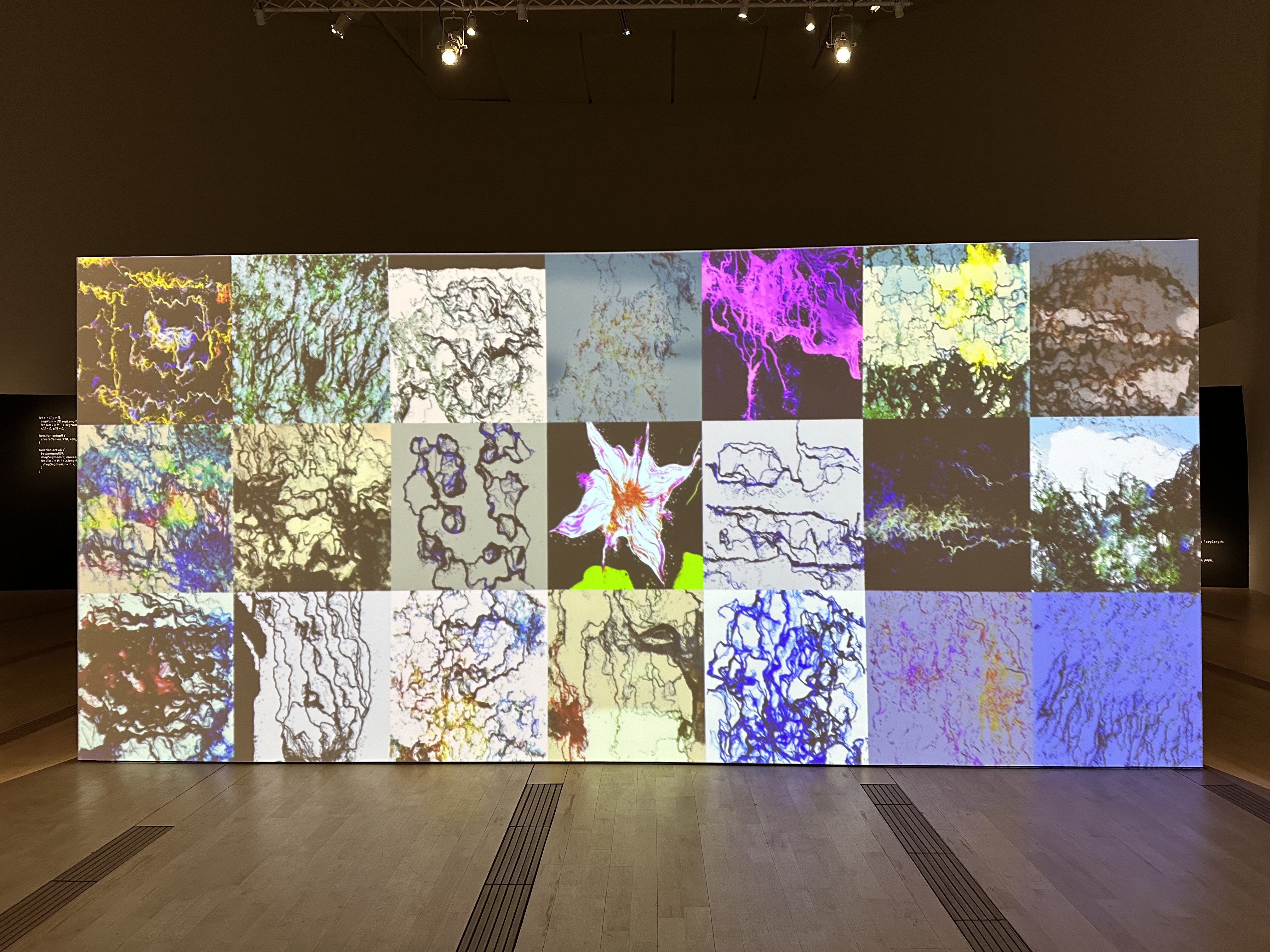
On Sunday we went to the ArtScience Museum (at the Marina Bay Sands) for a rare high-profile exhibition of digital art. Notes from the Ether says it’s focused on NFTs and AI, but it’s also got a lot of generative art that just happens to be encoded on blockchains. I was especially excited to see the inclusion of work by DEAFBEEF and Emily Xie (Memories of Qilin), and Tyler Hobbs and Dandelion Wist’s QQL project was also presented for anyone to play with.
Obviously this movement is in a weird sort of place at the moment. Valuations for most projects are as volatile as shitcoins, and a few “blue chip” projects like the ones displayed are more stable, but only about as much as bitcoin. Because NFT art is defined in large part by the medium, which is currently inseparable from talk of price and value, it’s hard to have a viewing experience divorced from these considerations. You don’t really visit a Monet exhibition and think about how much everything costs. Which is why the Open Editions I mentioned last week are interesting, and likewise with this event, which offers you a free NFT at the end. You get to co-create an artwork with an AI engine by uploading a photo of your own to be transformed, and it’s minted as a Tezos NFT if you’d like. I thought it was a very cool collectible to remember our visit by.
I don’t think I’ve ever seen more affordable tickets at this museum, just S$6 with a further 30% off if you sign up for a free “Sands Lifestyle” account, so there’s little excuse not to go if you’re remotely interested in this stuff.
Since we were already there, we also hopped into Sensory Odyssey: Into the Heart of Our Living World which pairs 8K video projections of natural scenes with immersive sounds and scents. In one space you’re smelling fresh air and damp earth in a rainforest, and in the next you’re underground with mole rats. It’s very cool, but ruined by small children being allowed to run loose in front of screens (can’t really be helped), and elderly museum staff loudly declaring that “this is a night savannah, very dark, no need to be scared!” (can be helped with training) in such a way that any illusion of being in a savannah is totally pierced — unless you’ve gone on a safari tour with a gaggle of Singaporean aunties, of course.
We kind of started planning our trip to Japan later this year, but there’s still a lot to figure out in terms of what to do, and where to spend our time. It seems a lot of the popular hotels and destinations are selling out fast, if not already sold out, because of the resumption of travel out of China. I’m going to use this as a test of two new collaboration features in iOS and macOS: shared Safari Tab Groups, and the new Freeform whiteboarding app. In theory this should allow us to gather links to interesting ideas and plot them out together across our devices over several days.
On Friday afternoon, I was excited to see an article saying that one of the best bowls of ramen I’ve ever had was finally coming to Singapore. In fact, it was their opening day, and we decided to just go down right after work to try and get a seat. After about 20 minutes of queuing (which was nothing compared to the maybe three hours we spent in line for the main restaurant in Tokyo), we got into Nakiryu at Plaza Singapura, and were sorely disappointed. For starters, their signature Szechuan-style Tan Tan/Dan Dan noodles were sold out. We ordered shio and shoyu ramen instead, and they were roundly mediocre. The service was also spotty and uncoordinated.
It’s a pattern that the local franchisee Japan Food Holdings (who’ve done the same thing with Afuri and others) seems to be repeating: bring in a brand people are excited for, then do nothing to capture the original taste and quality. I suspect if you did a side-by-side comparison of the ramen from several of their brands, you’d find they’re just selling the same product under different names. Sadly, they’ve probably got the connections to get these deals and as long as the money flows in, the original companies don’t care how badly it’s done outside of Japan.
Singapore Art Week is back and we attended two events: SEA Focus and the creatively named Art SG. The former’s at Keppel Distripark where the Singapore Art Museum’s temporary spot is, and features a little NFT art corner sponsored by Tezos. In contrast to the other exhibits, I found the work in there refreshingly playful, modern, vibey.
Art SG
At Art SG (a large and mostly serious gallery fair over two floors at Marina Bay Sands), I also found myself reacting more to the digital or digitally inspired work. There was a large print of a CloneX pfp, attributed to Murakami, mounted on a wall that I saw from across the hall and made a beeline towards. The Pace gallery (which I only happen to know because of their collaborations with Art Blocks) space featured teamLab’s NFT project, and a James Turrell projection. The teamLab one is cool: anyone can download and run the artwork (an app) on their PC or Mac. These are regarded as authentic and valid copies of the work. However, one can also own an NFT of the work (there are only 7), and these collectors can change the text seen in the art for everyone else. Oh, and they’re $200,000 each.
Elsewhere, I saw a work that was a white flag printed with a surrender message that I’d read before but didn’t know where. I googled the text but nothing came up. Later, I found a tweet from early 2022 referencing it: an on-chain exchange between two MEV… “searchers”? The tweets only have between a couple hundred and a couple thousand likes, so it’s probably not a widely known thing. But I definitely saw and remembered it from last year, which means I’ve spent too much time spectating in a very small fringe community. And my time spent appreciating generative art has definitely ruined traditional abstract art for me.
The Field #290
Speaking of which, I was excited to add an edition of The Field by Beer van Geer to my collection this week. It’s an interesting (animated) work in that all 369 pieces are different views of the same “territory”, starting at random points, zoom levels, and rendered with different palettes, but viewers of any section can move away from those starting points and explore. As I understand it, the field itself was created from noise data created by aggregating hundreds of images from the artist’s body of work, trying to derive a sort of pattern map or artistic fingerprint from their ouevre. Isn’t that so much more exciting than static paint on canvas??
===
Ricoh announced a new special edition of the GR III compact camera, called the “Diary Edition”. Yeah it sounds like one of those translated-from-Japanese names that sounds slightly awkward in English, but I like it. As a name, you can’t get much clearer about the concept of a camera that you’re meant to carry around to intentionally document everyday life, and it even comes with a new “negative film” look that will also come to older GR III models via a firmware update. Whether or not this behavior is one that users will actually embrace when they already have smartphones, I don’t know. I suspect not, outside for a few glorious weirdos. But the atmosphere and quality of these photos could hardly be more different than your smartphone snaps, unless you go the film route.
As a new colorway, I also love the look of the Diary Edition.
Here are a couple of photos I took with my GR III on the way to the art fair:
===
We watched a couple of spy TV shows, of which Jack Ryan’s season 2 was the undisputed best. We’ll start on season 3 soon.
Miyachi’s second album, Crows, is out. I heard it through once and it’s a bop. I don’t know what he’s rapping about but I’m sure it’s slightly problematic.
I finished Arcade Spirits but can’t recommend it if you’ve got many great games in your Switch backlog. To recap, it’s a Western visual novel about running a video game arcade. Some of the background art is basic and not very polished. I was struck several times by the thought that a game creator today could create far better generic bar/beach/arcade interior background art in seconds using AI. And they probably will/are already. So as an artifact of our pre-AI phase, Arcade Spirits stands out as a bit lacking in the production quality department.
Here’s a tweet showing a game prototype someone purportedly threw together using AI tools to create the graphics, icons, and voice acting!
Experimental 2.5D Adventure game prototype with graphics from #midjourney#aiart#gamedev It took me 2 hours to do the top down alley location from scratch complete with 3D mesh, navigation and current interactions & effects. Icons with @LeonardoAi_, audio from @ReplicaStudiospic.twitter.com/g6H1fGq3SG
— Jussi Kemppainen | Drivers of the Apocalypse (@JussiKemppainen) January 12, 2023
Quite coincidentally, I started experimenting with Midjourney prompts on Monday trying to get the EGA/VGA PC game look of the Sierra games I played in the 80s and 90s. I found a good solution and started using it to visualize screenshots of #fictionalgames from the golden era of PC games, ones that never existed, or that might be made today with modern concepts.
Police Quest 5: Capitol InvasionQuest For Glory 6: So You Want To Be A Private Military ContractorWhere in the Bahamas is Carmen Sandiego?Leisure Suit Harvey: In the Land of the Casting AgentsCommand & Conquer 2022