Local haze levels continued to climb and reached a ‘Very Unhealthy’ state in the middle of the week. My haze app, SecondHand, continued to see active use and added about 10,000 visits. I’ve heard that some people at the National Environment Agency (NEA) are aware of it and like it, which warms the smoky, congested cockles of my heart. For the record, Sunday brought some relief, with PM2.5 falling to near normal in some parts of the country.
It’s frankly been like an echo of those COVID days — staying home with the windows shut; that feeling of hunkering down under attack. And just like with COVID, restaurants are experiencing difficulties, so says the Straits Times. I’ve taken to walking on the treadmill as often as I can, usually for an hour while watching some insubstantial drama program I normally wouldn’t sit still for. This week, that’s been NHK’s Eat, Sleep, then Wait for Happiness on Amazon Prime.
But the real time suck has been provided by a return to vibe coding after a three-month hiatus. This has been thanks to Hark, which fulfills the promise of OpenClaw but without requiring the nerdery and foolhardiness of letting an AI take over your own computer. Hark’s computer runs in the cloud, and it’s intelligent enough to manage its own files and applications and capabilities — dare I say it? — so much so that it’s like handling a remote employee over chat. It sends me updates and artifacts, I give it problem-solving suggestions and creative input, and it comes back with the work. I spent so much time earlier this year with the self-imposed challenge of trying to squeeze water out of the rocks that are low-cost Flash-style models, that I completely missed experiencing what the very best frontier models can do. In retrospect, that was a little dumb, but the upside is I’m filled with so much wonder right now.
I’ve mainly been working on the procedural art generator tool that I mentioned back in April. Then, I described it as a never-ending background project for me to dip in and out of, due to each ‘style’ being modular, which has made it easy to jump back in this week. Using modern technology, I overhauled the rendering engines and revisited every individual style, as well as the app’s own UI and foundations (images above). It’s hard to explain how much better it is now, how much closer it is to what I wanted. It even has freaking Apple-style Liquid Glass effects on the toolbar! In a web app! I don’t know if I’ll ever release it or just keep messing around forever making wallpapers for my own amusement.
But I do have something to release today, something that came out of building one of those styles. Similar to how making a maze artwork generator led to making a maze game (a maze, a maze, a maze)in the April post above, I was making a pixel art landscape engine for the wallpaper tool and realized it would make a very nice desktop toy — in the vein of my earlier Window Box project.
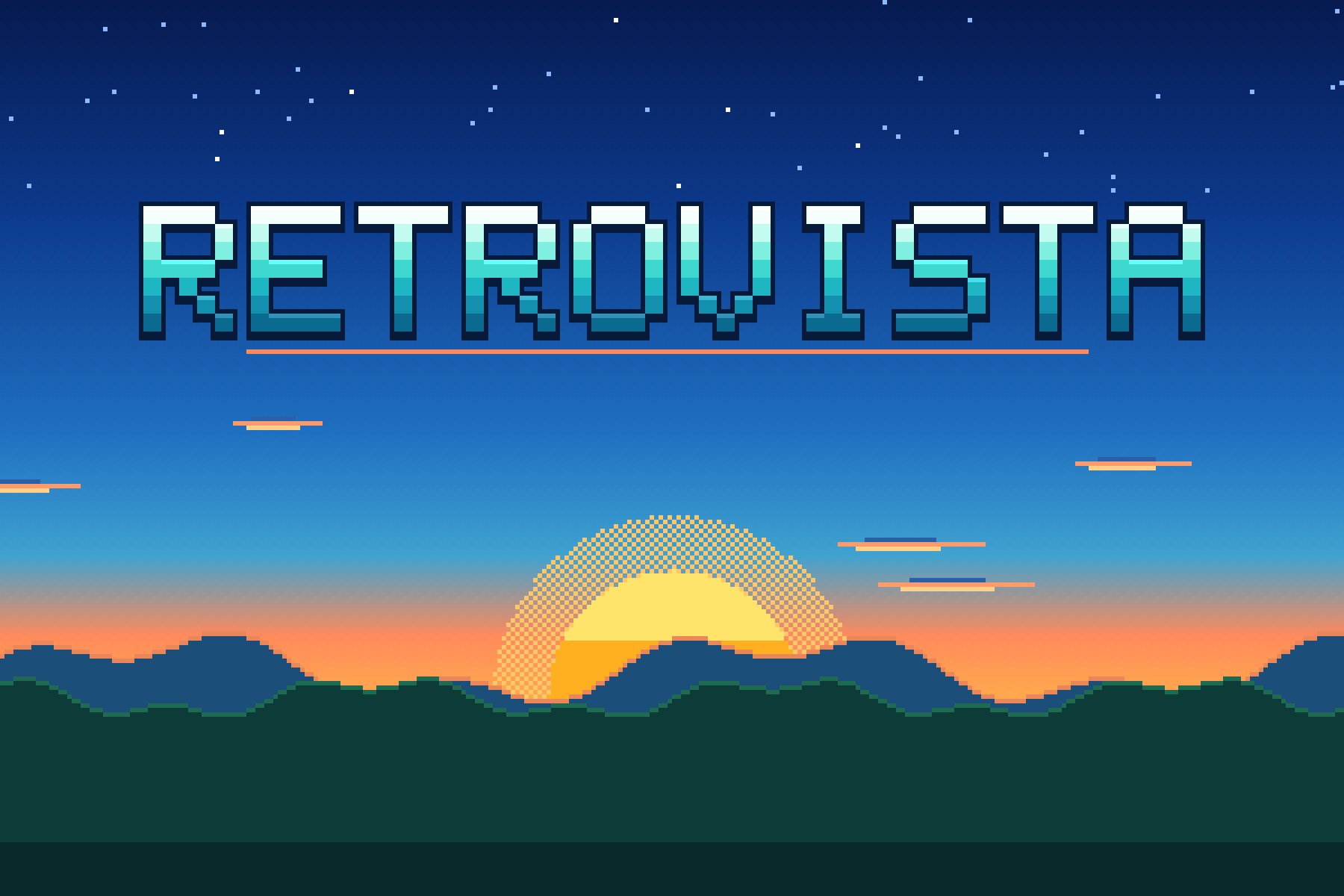
It’s called RetroVista! Leave it open in a spare window or second screen while you work, and its lush natural scenes and chiptune sounds might relax you, if you’re a millennial who grew up playing games that have somehow, seemingly overnight, become retro and vintage. You can read more about it in this separate post.
Speaking of old videogames, Street Fighter (2026) is out and we went to see it with Peishan and James. Watching every movie adaptation of games from my childhood, even if I know they’re going to be terrible, is a weak spot I probably share with many my age. One time, I went to see Street Fighter: The Legend of Chun-Li (2009) with Peishan, and followed that up with Snake Eyes: G.I. Joe Origins (2021), and now she thinks we have a bad movie watching tradition. But it’s not. It’s a specific ‘bad movies cashing in on nostalgia’ watching tradition.
To get in the mood for it, I fired up the Street Fighter 30th Anniversary Collection on Nintendo Switch the day before. I got my ass handed to me by the CPU in like, the second-round match of SF2 Turbo Edition. When did the game get so hard? When did a Dragon Uppercut become impossible to pull off when you need it?
The good news is that the new Street Fighter film understood the assignment. It’s aimed squarely at people who are now dealing with mortgages, perimenopause, reading glasses, and other mid-life crises. They’ve set it in the 90s, packed it with 90s chart-toppers like 4 Non Blondes’ What’s Up?, and exposition is handled with MTV-style video clips passed through faux-VHS filters. For two hours, it puts you in superposition between being a kid on Saturday morning and an adult watching their dream come true. The live action is broken up by anime sequences that are good enough they should be their own feature film. It’s flawed and stupid as hell, but I loved it. A very strong 3.5 stars.
My previous app Window Box was designed to be a second screen companion, showing views of the real world while you work. RetroVista brings you to more perfect places: the kind of pixel-art landscapes you might have grown up with, fully animated and sounding like a lost cartridge from 1989.
Hit “Start”, watch the console boot up, and find yourself down by the coast, or in the mountains, or a desert, a forest, the arctic, a city, or an alien planet. Each scene is procedurally generated, so no two are alike. Waves crash, clouds drift, birds flock, and trees sway. You can even enable Live Time and Weather and it’ll match the conditions where you are.
Alongside the vintage graphics, the sound is authentic too. Each console’s audio chip is synthesized in software, so pick the NES and you get its bright pulse waves, the Game Boy and its thin, warm beeps, or the Super Nintendo and its lush instruments. The Master System, Commodore 64, PICO-8, and a 1-bit mode are in there too.
Scenes produce rain, wind, surf, and thunder sound effects along with gentle, procedurally generated music that’s never the same twice. The tunes weave in and out of silence, slowly evolving, so you can leave them playing for hours.
Completing the experience are a realistic CRT filter, a handy clock, and a shuffle mode that brings you a new world every so often. Add it to your phone’s Home Screen as a progressive web app and it’ll even work offline.
Made for your second screen, and your inner child.
Changelog:
1.5.0 – City jazz!
Every City scene now plays chiptune jazz: swung rhythm, 7th chords over ii-V-I changes, a walking bass and soft brushes on the noise channel
1.4.10 – Foggy worlds no longer play a low buzzing drone
1.4.9 – Power savings
The screen draws at 20 frames a second instead of 30, which saves power and keeps rain and snow in step with the rest of the animation
Sound runs at a lower sample rate (22.05 kHz) with no audible difference, for about half the audio processing cost
The screen skips redrawing when nothing has changed
1.4.8 – Audio behavior
The speaker button in the top-left corner now stops and starts sound instead of muting it.
Music and sound keep playing when you leave the app or lock the phone
1.4.7 – Raindrop sfx and visitor animation fixes
1.4.6 – Master System improvements
Master System now plays by the real console’s screen limits: 32 of its 64 colors on screen, in two palettes of 16, with each 8×8 tile using one palette
1.4.5 – Further C64 optimizations
1.4.4 – C64 multicolor mode and colors
C64 now plays by the real machine’s multicolor bitmap limits: pixels twice as wide as tall, one background color for the whole screen, and only three more colors in each 4×8 cell
1.4.3 – NES hardware rules, sound behavior
NES emulation improved across all scenes to obey the real console’s color limits
iPhone and iPad: sound now plays with the silent switch on (it pauses other audio, like a music app)
1.4.2 – Version numbering
The splash footer shows the version number
1.4.1 – Cricket adjustment
Crickets go quiet in the rain, sing at one pitch per world (a second cricket joins now and then), softer, and in spells with long quiet stretches between
1.4 – Visitor and city sounds
City: trains clack along the rail and sound their horn as they cross, ferries give one long low blast and tugs two short toots, and planes swell overhead, only while they’re on screen
City: a car horn down the street now and then (rarer at night) and, very rarely, a far-off siren
Visitors everywhere get voices, timed to what they do on screen: the elk bugles when it stops, ducks quack, the hawk cries, the barn owl screeches, owls hoot from the trees, the heron croaks as it takes off, boars grunt while they root, gulls cry, dolphins splash back in, the coyote howls, tumbleweeds swish, the saucer warbles and zips off, the whale blows with each spout and sings, the arctic fox yips before it pounces
1.3.2 – NES colors
NES: shades the palette lacks, like a night sky’s navy, are dithered from two colors instead of snapping to the nearest one, so Arctic and Mountains nights no longer go flat teal
1.3.1 – City storms
The city keeps running in storms: ferries, tugs and trains carry on, and planes come in low under the cloud with their lights on
1.3 – Visitors
Visitors: incidental animations in every scene, by day, by night and in the rain (storms stay empty)
City: ferries, tugs, planes and trains on a waterfront rail
Mountains: elk, ducks, hawks and barn owls
Arctic: Arctic foxes, polar bears and whales
Coast: sailboats, dolphins, gulls, crabs and turtle hatchlings
Forest: deer with fawns, rabbits, boars with piglets, herons and owls
Desert: tumbleweeds, camel caravans, vultures, roadrunners, a howling coyote and fennec foxes
Alien: saucers, sky jellyfish, slimes, six-legged grazers and crystal spores
Visitors respect depth: nearer land hides them, and they’re scaled for their distance
Butterflies and fireflies in the forest
Night sky: shooting stars, satellites, the odd comet and meteor shower, peeking through on cloudy nights
City skies are dimmed by light pollution
Crescent moons are lit from below, with their horns up
Animations step at a low frame rate, like the rest of the art
Fixes: forest walkers no longer wade the stream, streams dim at night, desert mesas no longer hover, sailboats no longer clip the distant island
1.2 – Music and resolution
Three resolution modes: Authentic (default), Chunky and Hi-Res
Occasional drums, with kits that suit each world
Musical phrases now come home to the root chord
Rain and storms are rare in the desert
1.1 – Coast waves
The waterline moves: waves run up the beach, drain back and leave a wet sheen