
I managed to go a whole week without visiting the Apple Store.
We did visit a new branch of Go! KBBQ at Bukit Timah Plaza; the original on Amoy Street is perpetually busy and comes recommended by the Korean community (so I’m told), and even has its own aging room in the back with a viewing window. The new one lacks the aging room but IS in an aging suburban mall, which increases your chances of getting a table. We overestimated as usual, and ordered a 690g set of pork belly, neck, and jowl. They do the cooking for you — there are illustrated STOP! signs telling you not to even attempt it yourself — and everything was perfect.

===
I was saddened by the passing of another senior relative, aged 86, apparently from heart failure. The shock was compounded by the fact that I had just seen him a few weeks ago for the first time in years, at another uncle’s memorial, and he looked in great health. I remember him for hosting some of the more enjoyable Chinese New Year get-togethers of my childhood, where I learnt to play blackjack at the dinner table together with adults, spinning the lazy Susan around to draw cards off the pile, sweeping the pot (ashtray) of coins into my arms after winning a big hand, then experiencing the pain of losing everything — great preparation for the Terra Luna collapse decades later.
Due to a contagious illness at my parents’ place, I attended the wake alone and discovered a massive 9-storey building in Woodlands with multi-faith halls and columbarium facilities. The majority of these that I’ve attended have been at Singapore Casket in the Lavender district, a much humbler affair. Woodlands Memorial feels modern, which is to say efficient, cookie-cutter, and almost soulless. That joke is nowhere as distasteful as the marketing position I found on one of their posters: “Singapore’s premier one-stop afterlife venue”.
===
I spent almost all of Monday installing Windows XP on my iPad and MacBook using the newly approved UTM SE app from the App Store. The goal was to play an old Windows game that I have fond memories of: High Seas Solitaire. It’s really not much to look at, and the entire package weighs in at under 800kb. Published by ZapSpot, the game was part of a series of ad-supported titles that make Flappy Bird look like a big-budget production.
But in the early 2000s, I was stuck in a dreary clerical job that involved juggling Microsoft Excel and Access, stacks of official papers, and a cabinet full of file binders. High Seas Solitaire was on my Win95-powered computer, and it might as well have contained an entire 3D metaverse. When I found the above gameplay video on YouTube, I was shocked at how much detail my nostalgic brain had invented: I remembered a calming nautical world with ocean sounds, a creaking wooden ship, and seagulls flying overhead. In reality, the game has like four SFX clips that it plays at various times and that’s it.
I’ve forgotten the exact rules, but it wasn’t your standard solitaire game. You had to match cards that added up to 14, but pairs could also be matched, I think? It was just very satisfying to complete, and easy enough to do that a few times during each lunch break. I haven’t found any game based on the same mechanics since, but I dream about it.
Alas, while I managed to get Windows up and running, the game itself would not run. This led me to install VMware and try other online emulators, repeatedly install Windows, and even create CD-ROM images containing the game file for the virtual machines to mount. But each time, the game wouldn’t get past the loading screen. Finally, I asked Ci’en if she would try running it on her PC, and when even that didn’t work, I threw the whole project out of the window. Small comfort: perhaps even if I had succeeded, the CrowdStrike BSoD debacle this week might have wiped out my VM.
When I’m rich, I’ll bankroll the creation of a new, truly immersive version for visionOS.
===
I watched two video essays from the Digging The Greats YouTube channel which usually focuses on music history and song breakdowns, but these were about an “experiment” where the host tries to only listen to music off an iPod for a month. He deletes streaming apps on his phone, commits to use aux cables for in-car listening, and eventually goes down a rabbit hole where he also quits social media and starts using a dedicated digital camera and prints photos in lieu of Instagram (why? It’s not as if he was using Instagram to take the photos).
This sort of modern tech consequence confluence happens over and over throughout the videos. He says this experiment changed his life and his whole outlook on music, especially regarding the influence of algorithms. Because he has an iPod with finite storage and no internet connection, he has to make choices about what music to buy and load onto it; he can’t just rely on an omnifarious cloud library. Thus he makes it into a whole personality: he introduces the idea into his everyday conversations and asks musicians and DJs he meets for music recommendations. He thinks ahead about what music he’s going to listen to. And music takes up even more space in his mind (if that were even possible).
None of these benefits actually required an iPod! He could have conducted the same experiment on his iPhone with some self-discipline, e.g. only listening to music downloaded offline, which can only be done at home near a laptop. But the iPod is a physical object that makes limitations tangible and the experiment is a construct that reminds you of a goal — these sorts of things are great for creativity and focus. It’s the intentionality and “mode setting” of what he’s doing that’s producing the results. And this is something we can and should all practice from time to time.

A few years back, I committed to taking only black-and-white photos for an entire month. I can now identify that period very easily when scrolling through my photo library. It was an exciting, liberating, and frustrating exercise all at once that forced more conscious decisions and felt like I was working with new gear (sans the expense). When you keep a mission like that at the front of your mind, you look out for interesting photos everywhere, which is why so many people take their favorite photos on holiday.
The same applies to writing (“I will blog every week”), music (“I will write an entire album in one key”), or anything that gives you joy (“Let’s do an Arnie movie marathon this weekend”).
===
Media activity
- 💿 Apropos of the above: I listened to that new Travis album during a long cab ride and it was okay but didn’t make a huge impression. I considered deleting it, but then thought, “if I’d bought this on CD years ago, I’d listen to it at least a few more times, and the songs would probably stick in my head and years later I might even be thrilled to hear one of them come on somewhere in public”. That’s how my relationships with many of my favorite albums began anyway. This endless queue of options and dopamine-driven consumption pattern is not good for culture.
- 🎮 Ghostopia Season 1 continues to be an intriguing journey on the Nintendo Switch. It reminds me a little of Doki Doki Literature Club, not in content but in manner: layers of subversion and unexpected metaphorical depth under cuteness and comedy. I will be sad when it’s over (soon).
- 🎬 The following were all watched on MUBI.
- Saw a Tsai Ming Jiang short, The Night (2021), which is nothing more than a series of still camera takes of nocturnal Hong Kong street scenes. The bright, digital-looking aesthetic resists the traditional romantic notion of Hong Kong as a neon-soaked, tattered metropolis. It’s dirty, yet cold and empty. Perhaps that was the point, but it did nothing for me. 1 star.
- Saw One More Time with Feeling (2016), the first of the two Nick Cave films by Andrew Dominik. The inconsistent use of black-and-white footage upsets me. I probably should have watched this before This Much I Know to be True, but coming off that one I’m feeling that Dominik has a limited approach to getting things out of Cave, and when you hear him in the background asking questions, he can barely articulate them, sometimes letting his fumbling interrupt Cave’s train of thought, and that to me is an awful shame. He and the film crew also seem to greatly irritate Cave, which sadly continues in the sequel. They’re also transparently making a film, not a documentary, directing naturalistic actions to be repeated so they can be shot on the 3D camera. 3.5 stars.
- Saw 24 City (2008), another pseudo-documentary, this time about the closure of a long-running factory in China. As you may have heard, the scale of these operations makes them cities in themselves, with the children of workers attending school within their walls and identifying more as ‘of the factory’ than the communities around them. There are interviews with real people recounting their lifelong experiences at the factory, including some devastatingly emotional stories, interspersed with actors being interviewed as characters for reasons unexplained. This dilutes the effect and makes it hard to stay invested as you never know when you’re being ‘lied to’. One scene has the legendary Joan Chen playing a factory worker who grew up with the nickname “Little Flower” because of her resemblance to a character in a film played by Joan Chen. I mean, that’s some genius casting but also too much. 3 stars.
- 🛣️ I also rewatched David Lynch’s Lost Highway (1997) and ended up writing a longer review, below:
This film made a huge impression on me as a teenager, the early scene with the Mystery Man’s wide-eyed mask of a face staring spookily at Bill Pullman like Ryuk the ‘shinigami’ in Death Note — so grotesque and caked in unearthly tones that I remember it as employing special effects, but no, it was just Robert Blake’s face — talking to him from both sides of a phone call, surreal and inexplicable just like much of this entire film, it scarred me deep.
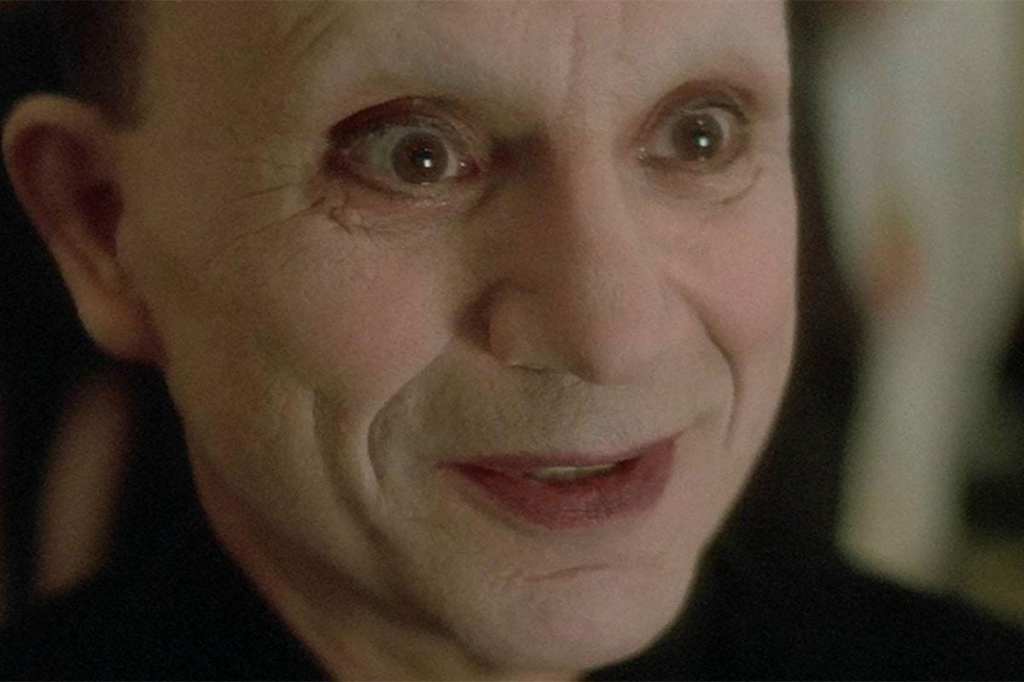
It seemed like a shockwave of audacity to have a main character morph into another person completely without any satisfying followup, just rolling into a new story completely. I remembered that, but mostly forgot the ending where the two halves converge. Making sense wasn’t the point anyway, it was a vibe. It’s jazz cinema.
I don’t think I had much early exposure to challenging art and I was making up for it through a phase into which Lost Highway fit perfectly, like William Burrough’s cut-up texts and visual poems like the Qatsi series: peering into randomness for meaningful patterns, meditating on nonsense to glimpse truth. Maybe even more than the film itself, I was really into the soundtrack, which featured David Bowie right in the middle of his Outside/Earthling era (which is where I started with him), the Nine Inch Nails, Rammstein, The Smashing Pumpkins. Teenager catnip. Was it also the first time I heard Antonio Carlos Jobim? Maybe!
Rewatching it now over two decades later, I expected to understand things at a deeper level, but maybe I’m just a boring old guy now or got stupider because all I can focus on is how ugly or sloppy things are from a craft perspective: Pullman’s tacky LA apartment with odd furniture, the awkward fight scene between Pete and Andy that ends with a forehead embedded in a glass table, the VHS look. Sure, I have theories about what it’s all about but come on, who casts Gary Busey as a caring dad? It’s all corny af. The cinematic vocabulary hasn’t aged well and the once-cool cyclical timeline where the end is the beginning is the end isn’t mind-blowing anymore, just lame. Marilyn Manson’s inclusion in a snuff porn excerpt isn’t edgy, it’s enabling a sex offender. The Mystery Man has lost all menace and looks pathetic in his white makeup; I bet I could take him. Yeah I’m boring now. 3 stars.




 sangsara.net