- I went to Apple Orchard Road and tried the Beats 360 headphones. They’re not large enough for my head; case closed. Money saved.
- My new Apple Watch likes to try cheering me up by telling me that my body is “Ready” to “Go For It” (I assume “It” is a marathon, a swim to the far side of Australia, or something equally implausible) and that I had excellent sleep the night before, but these science and sensor-backed statements simply don’t match my reality. I’m tired; I wish I could sleep more!
- I just took a little break (after one paragraph, natch) and went on Instagram, where I saw a post that read “Anyone else turn 40 around the start of the pandemic and now blinked and you’re somehow 46 wondering what the hell just happened?” On one hand, that sentence perfectly captures the fatigue that you’d imagine comes with being abducted by aliens and losing six years of your life — at the very least, the weariness of having to catch up with a lot of missed information, which is what being alive in this time of AI feels like, always on the back foot with lots to learn — but on the other hand, it implies not knowing at all where the time went, which I can’t identify with. Oh I know where the time went. I remember it all perfectly well, but it plays in my mind like a timelapse — hundreds of days passing, the figure getting in and out of bed, the view outside the window gradually changing.
- Armchair theory: maybe what’s caused this ‘blink and time passed’ effect for many is the combination of massive disruption followed by repetitive discomfort. This is different from repetitive boredom, where days are long and time moves slowly. With repetitive discomfort, you’re constantly insecure and stressed, so the mind protects itself by generating summaries and discarding the details. This sharp change, followed by pain you’d rather forget, dislodges you from whatever life you were living before, making it feel like a separate country.
- I’m listening to Apple Music 1 and three Taylor Swift songs have played in a short period of time. Without checking, I’ve known it was her from the fact that all her recent music sounds the same. It’s hard to feel bad for a billionaire, but that’s an awful place for any creative person to be. It’s like she doesn’t listen to any other music, or won’t allow herself to appear influenced by anyone else. Lonely at the top, as they say, which is why you won’t find me there (among other obvious reasons)!
- Kim and I met Mandy for dinner one night to mark her birthday, and we went to a wine-focused place called Fiasco which has taken over the spot where Kilo used to be, that weird little building out in the middle of nothing near Lavender. The food was all really good (I forgot to take pictures), and they’re doing some really interesting things with hanger steak and pork collar, the latter seasoned to resemble a very fancy charsiew.
- In an example of culinary R&D jumping the shark, we ate at Surrey Hills over the weekend, where my mother-in-law’s corned beef hash came partially covered with a purple sweet potato foam. Needless to say, she did not appreciate the touch. The place purports to be Australian, and with her being Australian too, I tried to gaslight her into believing that it was an authentic Australian recipe that she’d somehow never heard about. Needless to say, I was not successful.
- I finished PARANORMASIGHT: The Mermaid’s Curse, and found it a worthy sequel, arguably better than the first game in every way unless you want a spooky atmosphere. This one can’t be classified as horror at all. It’s a mystery adventure with supernatural elements so tame they’d elicit no more than a shrug from a timid baby. Like the first game, its story concerns Japanese history and legends that one might find a little boring, but you don’t have to read all the text in its menus.
- Playing that game unwittingly prepared me for the film Inu-Oh (2021), which I’ve had in my library for years and suddenly decided to watch. From the opening scenes, it eerily echoed story points from PARANORMASIGHT, concerning the 12th-century Heike samurai clan, and their vengeful spirits said to linger across the land after they were wiped out. Inu-Oh is a wildly ambitious and stupendously well-animated musical that is let down by, well, its music. The concept is a fusion of traditional Japanese music with glam rock, and a main character starts playing his biwa one day like an electric guitar without any explanation. The visuals work, but the songs are poorly structured to modern ears, overly long, and basically repeat the same melodies while pages of historical narrative are sung over them. Imagine Billy Corgan’s worst material, stretched twice as long, and the lyrics are all about random days of Napoleon’s life, and you’ll begin to understand how it feels.
- We finally saw Sentimental Value (2025) and wow it really deserves its Oscar and 95% Rotten Tomatoes score. The opening scene with the house, and the title card needle drop that follows it, was so good that my body felt compelled to stand up and applaud — I didn’t allow it, but that feeling went on for much of its running length. The train oner is a wonderful bit of technical showing off, and actually the whole film’s lush 35mm look just stunts on the pervasive digital signature of Netflix movies. Everyone is great in this, making art about how art both fucks you up and saves you — 4.5 stars.
- Found time for a grab bag of other films too: Runner (2026) — not to be confused with Gal Gadot’s The Runner (2026), Good Boy (2025), Elle (2016), Grand Theft Hamlet (2024) — the one to watch out of all of these, a very human documentary about two out-of-work actors putting on a production of Hamlet inside the GTA Online videogame whilst stuck at home during the pandemic — Shelter (2026), and Tony (2026).
- Singapore made headlines this week because of the launch of a new dating site by the government, currently in a pilot phase only open to civil servants. It’s called FirstDate, and matches people based on compatibility assumed from their responses to a questionnaire. The idea of a state-run service has amused observers, with some seeing it as a dystopian step towards arranged marriages by Big Brother, amongst other hot takes on this strategy to combat our falling Total Fertility Rate (TFR). History rhymes, of course, and older folks will remember the existence of the Social Development Unit (SDU) in the 1980s, a pre-digital precursor to this scheme, that was something of a government-run activities club to help rescue graduates from singlehood after being encouraged (by the same authorities) to optimize for good grades instead of dating during their teenage years.
- But it’s hard for outsiders to decide if Singapore’s environment really does produce a special breed of hapless, rizzless forever-aloners, uniquely ill-equipped to find their own mates through empathy and communication, so Singapore’s own state-run media conglomerate is providing some data in the form of a new reality dating show called Wingman. The show’s format introduces an original element to the Love Island formula, namely that each contestant brings their own wingman/wingwoman to serve as hype men/women, espousing their good qualities so they don’t have to — a perfectly valid and brilliant tweak for Asian cultures where tooting your own horn unironically is a major ick. The contestants, in addition to a few Singaporeans, are a bunch of attractive 20-to-30-somethings from the Philippines and Thailand, all of whom resemble functioning young adults who can read social cues and body language, and interact normally with members of the opposite sex (there is no LGBTQ+ representation). There’s obviously a tilt towards extroversion, which you’d expect from people volunteering to be a dating show, but even correcting for that, there’s an intriguing, discernible difference between the Singaporeans and their SEAblings that’s best seen for yourself. Full episodes are available on YouTube. We binged all 10 so far in one night.
Tag: MUBI
-
Week 40.26
-
Week 34.26
- I pushed through and finished the 460-something pages of The First Fifteen Lives of Harry August, which at some points felt like it was going to earn a 3-star rating, but I had to give it 4 at the end on account of its ambition and scope. It felt like I’d emerged from a long and arduous time war myself, so I’d say it succeeds. I’ve probably burnt myself out on too many stories of the same sort now, so the next book will have to be quite different.
- I met Stacy for lunch and we caught up in person for the first time in how long? There’s a 21-year gap between her last mention on this blog, from around the time I got back from university, till earlier this January when she pointed me in the direction of a record sale downtown. So yeah, pretty long and the conversation definitely made us feel old. Besides filling in the blanks on what’s happened in all these years, we talked about the benefits of long sabbaticals and the weird things older people are using AI tools for. I honestly had not foreseen some of these use cases (ask me if you want to know). Meta is enabling some very sad and cyberpunk behaviors by putting generative video models in Facebook and WhatsApp.
- Over the weekend Kim and I visited an “exhibition” on the impact of AI on design, with James and Peishan — more accurately, it purported to explore ‘the life and death of the human soul in design’. I’ll just say it was very poor as an exhibition: imagine a long academic essay printed in small type, set in center-aligned paragraphs, pasted up on the wall in a tight U-shaped corner of a bookstore. Packed with people trying earnestly to read it, the line didn’t move an inch in five minutes. The text was on sale as an S$18 booklet — clearly the intended format — meaning the wall space was completely wasted. It should have been used to provide a visually compelling (and more readable) snapshot of key points. A truly awful experience for something under the heading of design.


- Reflecting on this, I’ve come to recognize that the role of design under capitalism is chiefly to provide products and services with competitive differentiation and positioning. The widespread support of human-centered approaches lately has less to do with altruism and more with a fortunate (and temporary) alignment with commercial goals. It’s become obvious that in the pursuit of optimization and convenience, in the name of improving user experience, digital product designers have been directed to unleash some absolutely demonic socio-technological forces. Design itself is not inherently a human-centered pursuit or practice — it can be used to center any number of priorities or doctrines. The human soul (i.e. the desires and values that we as customers/citizens/individuals put out into the world and conversely seek out in others) must continuously find a healthy host that capital will agree to feed and clothe, and now under AI, Design looks like a used-up orphan days away from being on the streets. I think it’s more interesting to ask where else the human soul can find refuge — what unlikely organisms might become new hosts for the creative impulse — rather than mourning the death of design.
- I had tamales, I think for the first time. We met for dinner to celebrate three August birthdays last night, at Mami’s Tamales in the Keong Saik area. Going in, I expected them to be made with a stretchy, sticky consistency not unlike the Teochew soong kueh (which I hate), but it’s really just a polenta skin that’s kinda like firm mashed potatoes. They put avocados on everything there, and their guacamole was excellent: aromatic and creamy. I would go back.
- I saw Spider-Man: Brand New Day (2026) in a theater and it was much better than the ratings had led me to believe. Yes, it’s more Marvel slop and I’m so over it, but I’ll always have the softest of spots for Spidey. Tom Holland gets my vote for the best person to ever play the role. Of all the films, this one felt the most connected to Insomniac’s videogames, partly because it lifts many signature fight moves and cinematic web-swinging camera moves from those games. It’s made me plan to finally play Spider-Man 2 on the PS5 in the coming weeks.
- I saw Amores Perros (2000) on MUBI and got the shock of my life when I realized the young love interest Susana was played by the same woman who plays Maximo’s mom in the Apple TV series Acapulco (Vanessa Bauche). Goddamn, 2000 really was a long time ago.
- Music discovery of the week: Puma Blue’s album Croak Dream. I haven’t heard his back-catalog yet, but this London-based musician (real name Jacob Allen) was supposedly a bedroom R&B artist who’s now veered into trip-hop territory with this new album. It’s glorious stuff. The title track evokes OK Computer-era Radiohead, but that’s really a compliment and not an accusation.


-

Week 31.26
- Home issues, like a roof leak that I need to resolve with the building people, have been attacking my mental health this past week. I’ve spent too many waking and dreaming hours on them already, so I won’t get into it further apart from this record for posterity. Hopefully things will improve.
- While browsing YouTube, I came across a Rick Beato interview with DOMi & JD BECK, whose 2022 alt-jazz album Not Tight I quite enjoyed. Now, I’d assumed that they had just disappeared, swallowed up by an industry that doesn’t have time for esoteric styles, so seeing them pop up was a surprise — I didn’t dare to believe it meant new music was coming. I started watching and was sucked in for the whole hour, and indeed there was a new album set to launch the next day. I decided right then and there to buy a signed copy on vinyl from the Blue Note online store. Shipping cost $31 USD but I was so keen, nothing was going to stop me.
- The album WHO ASKED? is now out on streaming, and reactions are mixed. Complaints fall into two categories: technical and musical. They recorded and produced most of it themselves, with little experience, and many think the sound was compromised — muddy, distorted drums, and a very busy mix. Musically, it’s also a very challenging suite with a lot going on: orchestral instruments alongside their frenetic playing, loads of counterpoint, and switching time signatures. Plus, they sing on nearly every track, versus providing only harmony on one song off the last album.
- Personally I find the Dolby Atmos mix on Apple Music to sound better, with better separation, and think of the whole vibe as a deliberate choice. They mention in the Beato interview that the vinyl mix was shipped earlier (same with Rosalia’s LUX) and has a more hi-fi sound with less bass. Musically it might be too early to call, but I like it and think it sounds exactly like what you get when you let two prodigies make music that interests them. Their live performances online were always better to me than the cuts on the first album, and that may be the case again here. I’ll drop a few links below to get you started if you’ve never heard them.
- After joyously listening to music all afternoon, I loaded up the short film The Non-Actor on MUBI, starring Victoria Pedretti and Maya Hawke, which turned out to be about a woman who’s going deaf. Well, it’s not just about that, it’s also a lesbian/yuri story, but it made me think a bit about losing my hearing and how this might be my last decade before it starts to deteriorate. Imagine never hearing your favorite songs the same way ever again; the instruments slowly fading out or disappearing. I’d be inconsolable.
- I also finished reading my 37th book of the year: Yang Shuang-zi’s Taiwan Travelogue, winner of the 2026 International Booker Prize. It’s also yuri, and this author has actually written manga. Although I’d seen numerous mentions of the book online, I started reading without knowing anything beyond what the title suggests. Turns out it’s a metafictional work that pretends to be a new translation of a little-known post-war novel based on a true story — despite being a completely new work of fiction. Ultimately it’s about colonialism’s effects on Taiwanese culture, Japan’s actions during WWII (there are notably several translated Taiwanese novels about this period, which I may read someday), female relationships, translation, and food. 4 stars.
- My current favorite camera app, Analogue, got a big v1.5 update this week. I’ve preferred this for the last few months because of their unique approach: instead of using Bayer RAW capture to get more natural (less HDR processed) results from the iPhone’s camera sensor, they use a video pipeline — taking screengrabs in Apple LOG, which allows them to get really beautiful, softer images that you can apply LUTs to (including Fujifilm’s official film simulation LUTs in F-Log). Well, what does the new update add? Don’t laugh, but it’s Bayer RAW capture. However, unlike every other camera app such as Halide, Lampa, and NoFusion, Analogue merges the use of Bayer RAW with their innovative processing approach, meaning those Fuji film sims continue to work on top of sharper, native 4:3 photos. If none of that made any sense to you, the plain English is that this is your best alternative to the default camera app.

Sushiro is helping to break this Japanese sausage brand into the local market, and the sushi dog was their chosen vehicle. -
Week 29.26
- I published Subconscious Samples and wrote up the app page myself instead of starting from an AI draft like I often do. The thinking is that since the agent already knows the app intimately, I just need to give it a concept and it’ll do an okay job of filling in the essential info, which I can then edit. Ironically, I don’t think many people can tell the difference between the two, and I worry that maybe I’ve internalized more of AI writing’s stylistic hallmarks than I’d like.

- Speaking of slop, McDonald’s Singapore has a couple of new menu items to celebrate our upcoming National Day in August. One of them is a collaboration with my favorite curry puff brand, Old Chang Kee. The burger has a fried egg, a deep-fried chicken cutlet, and a thick curry paste with diced potatoes that’s reminiscent of OCK’s signature Curry’O filling. It’s as messy to eat as it sounds, and the top bun gets soggy and falls apart as you’re eating it. What makes Old Chang Kee work for me is the texture and mouthfeel of their crusty pastry, so the soft bun is a weak substitute. To make matters worse, I had the double version with twice the oily fried chicken, and felt like absolute crap afterwards. Speaking with Jose and Henry, who also ate this on the same day, I got tripartite agreement that this creation results in more regret than reward, and none of us will be having it again.
- Michael’s collaborative crossword game, Crossmate, is finally out on the App Store! It’s free, open source, and I highly recommend it. You can import puzzle files, or use NYT’s puzzles if you have a subscription, then invite up to two other friends to play with you. It’s just like working in a live Google Doc, but funner. I’m not especially good at crosswords, but I’ve completed quite a few with him and others during the beta testing period and had a great time with it.
- I read what was probably my first Philip K. Dick novel, as far as I can recall, Time Out of Joint, and came away slightly disappointed. Something about its style reminded me of other books from the same era, where you can almost smell the fumes from whatever they were huffing. The core ideas are good, and have been replicated in other works (including a particularly big Jim Carrey hit), but somehow the sum is less than its parts. In contrast with Rendezvous with Rama, a sci-fi classic I recently reread that explores big ideas with prosaic, forgettable writing, Time Out of Joint somehow comes away looking worse because Dick’s writing is too opinionated and rooted in his time, neither of which serves to elevate the story or its ideas.
- I finished watching the Three Colors trilogy on MUBI with White (1994) and Red (1994). I believe White is often called the ‘weird’ or ‘different’ one out of the three, as it’s tonally and structurally quite a farce. For that reason, I enjoyed it but probably have to rate it lower relative to the emotional power of its siblings. What’s also impressive is how the director began with the legendary Juliette Binoche, and then went on to cast leading women of escalating beauty in Julie Delpy and Irene Jacob. Next up is The Double Life of Véronique (1991) which also stars Jacob, who I’d never heard of before this.
- Despite believing that I don’t watch or enjoy horror, I think Widow’s Bay empowered me to believe that maybe I can do horror lite, so I bought a ticket to go see Backrooms (2026) on a weekday afternoon. I could have waited for a home release, but I wanted to test myself with a big screen. I have vivid memories of seeing Drag Me to Hell (2009) in a theater that was way too loud, and being so terrified by the sensory overload (despite it being quite an outlandishly funny film) that I felt like I was going to have a heart attack.
- Thankfully, Backrooms was more fun than fatal, and I had a good time. I’ve seen the short film that this expands on, but the final result still feels a little thin. Rather than doing more expansive world building around the infinite labyrinth (ha ha) and its place in our world, it keeps the scope small, presumably for future sequels. This screening was the “Everything Must Go Edition”, with an extra 15-min segment tacked on after the credits. This strategy seems new — a way to further milk a film near the end of its theatrical run, either gaining repeat viewings from fans or convincing stragglers like me.
- It was perhaps due to this ‘training’ that I not only endured, but enjoyed, a particular sequence in Christopher Nolan’s The Odyssey (2026) when we saw it in IMAX over the weekend with Peishan and James. I said before that I wasn’t particularly in a hurry to see this, and that I was anticipating Disclosure Day (2026) much more. In retrospect, it’s almost a crime to draw any comparison between the two. The Spielberg film seems made with decades of Hollywood muscle memory, and probably under healthy conditions that allowed everyone to have a life at the same time. Nolan’s film comes across more like a monumental undertaking, a transfer of life force from human bodies onto 70mm celluloid through back-breaking effort.
- Afterwards, in trying to rank my favorite Nolan films, I decided that Interstellar (2014) is still my favorite, but this might come in second, followed by Inception and Tenet. The Batman films are dead last. When someone brought up how they were flawed, but Heath Ledger’s turn as the Joker was great, I said that I never understood the big deal about that performance: “For me it’s like if Freddie Prinze Jr. died after turning in a passable Zorro remake”.
-
Week 48.25
My personal MUBI Shaolin film fest went on as planned, and I managed to watch a few more before they left the service. Gordon Liu had a role in just about all of them, which shows what a popular and influential figure he was in the industry. Who even comes close in Hollywood? Pedro Pascal??
If I had to recommend one Shaw Brothers film, it would still be Dirty Ho (1979) which I’ve mentioned here before. It’s essentially the same winning template that Jackie Chan’s career was built on — lots of brilliant, intentional fighting moves masked as accidents and incompetence.
The most uneven one I saw was Legendary Weapons of China (1982), which has about five different plot lines running through it, all to provide flimsy justification for the spectacular finale in which 18 (!) different Chinese weapons are brandished, and as many fighting styles showcased. It’s like Don Draper pitched that idea on a whiteboard and then they had to come up with another 70 minutes. There is an extended action sequence in a straw toilet hut floating over a river, where people literally end up in the muck. This absurd scene involves both kungfu and possession with voodoo dolls.
In another realm of absurdism lives Dogtooth (2009), the debut film of Yorgos Lanthimos which made a splash at Cannes that year. I saw it on MUBI this week because I liked Bugonia (2025) and wanted to start at the source. Jesus, this film is an exercise in creating the wrongest setup and then having its characters do things that follow on logically but are still nevertheless very wrong. You get the sense of perversity for the sake of it, or to give life to the director’s own kinks, sort of like Tarantino putting his foot fetish in everything — but still actually much worse.
However, do something terrible with craft and conviction, and it will gain lasting historical value. That’s how this world works; I don’t make the rules! But what if you don’t actually make the thing and just have the idea. In the form of a prompt, let’s say?
Images that never happened
Google released their Nano Banana Pro image generation model recently, and I’m sure we’ve all seen examples online by now. Things have progressed to the point where I’m constantly questioning the veracity of things I see online, and I think at some point the mental filtering will become so tedious that we’ll simply stop wondering and accept things that are true and untrue equally. If the short-form video that ruins your brain’s ability to focus and feel joy on normal terms makes you laugh, who cares if those things really happened? And then it will extend into other parts of life, and then… who knows?
I decided to see if Nano Banana could place me in ROSALÍA’s LUX album cover and, of course, the answer was yes. Too easily, in fact. I only supplied it with a single forward-facing photo of me at a dinner table, and it was able to extrapolate what I’d look like from a different angle. We are, ladies and gentlemen, so cooked.


It was also Black Friday sales week, and I decided to give VSCO Pro’s annual subscription a try at 50% off (hard to justify at full price). In addition to their Pro set of filters, which are actually really good, it also comes with access to AI tools, of course. Their object removal is state-of-the-art, to the point that it can invent very believable portions of an image that you wouldn’t notice unless really scrutinizing the scene. After a few experiments, sculpting messy scenes in old photos into what I wished they actually looked like, I had to step back and ask myself what the hell I was doing. Apple’s refusal to let the iPhone create “images that never happened” is absolutely the right stance.


VSCO AI Remove tool, before and after What becomes of designers?
AI’s obviously going to change the way we work, and I’ve been worrying for a while now about the future of the design profession. About the people who do this work, whether they will continue to be attracted to it, who will pay for their services, and what those services will actually look like. It’s been hard to imagine timelines that are positive by the standards I care about.
As with many sectors that have experimented with AI tooling, I often hear that senior practitioners using generative AI models can get more done “on their own” — the highlighted phrase implying 1) without the assistance of those pesky junior people, and 2) more cheaply for the business. But just because the tasks once performed by junior people can now be done by AI doesn’t mean juniors can’t find something else to do, or don’t need to be trained anymore. Nevertheless, some business leaders are acting as if that were true.
A friend told me how it’s now possible to run a small agency powered by seniors + AI only, without any junior hires. They were surprised that I pushed back — but the idea sounded irresponsible to me. It’s one thing if you can’t find employment and have to embrace AI to put food on the table. It’s another to be in a position of strength late in your career and choose this. If you can’t afford to leave the ladder down behind you, I said, it would be better not to do it at all.
But because bean counters can always be counted on for short-term thinking and a reluctance to spend on design, some companies will go further and not hire AI-augmented senior people at all. They’ll either use inexperienced juniors or ask someone like a product manager to handle “design stuff” on the side using AI. Depending on how much the tools improve, the visible outcomes of this may seem acceptable for quite a while! Design won’t go away as a function, it’ll merely be handled by a different group of people.
My main concern has been that doing a good-enough job in this way will scale so well, and become the dominant approach so quickly, that we’ll lose the diversity and depth of craft that comes from having human practitioners out in the real world, doing things like interviewing users to understand outlier behaviors, reading contextual cues and hearing what they don’t say as much as what they do. Then using these unique stories to make the larger design solution more resilient. It’s a job that humans are well equipped to do. A business that relies on AI to create an average of best practices may happily miss all of it.
Why do I think this matters? Because while a bunch of LLMs trained on world knowledge (including artifacts from past design exercises) will generate pretty good insights and workable interfaces from a wide field of generic possibilities, it’s still a path to a monoculture of experience. And if we break the chain of passing down the skills to do the work, then some future post-AI generation will have to learn them all over again.
I wondered if there might be a market for artisanal human-led design work. After all, centering the role of human craft has kept the luxury goods market alive in the face of mass manufacturing. But that would mean it becomes something performative, and necessarily restricted to higher paying customers. I actually believe that AI augmentation can produce better work; I just don’t trust our economic systems to nurture it over cheaper work.
Teach an LLM to fish…
Then this week, I saw something on TV that seemed like an apt analogy and put me into a more zen state of acceptance. It was an episode of Japanology Plus on NHK, with long-suffering host Peter Barakan forced to go out on a small fishing boat in challenging waters. I was honestly surprised the producers/insurers allowed a man of his age to do it.
Anyhow, as they were heading back from being thrown around by the waves, he asked the captain how fishermen in the old days would have survived that ordeal without GPS, walkie-talkies, and engines. The captain’s reply was that it was more dangerous back then, and they had to use their experience and intuition, navigating by looking at the mountains and stars, reading the winds and currents. You can imagine many lives were lost on the job.
Would any of those old fishermen trade places with their descendants today, giving up those seafaring skills for the ability to catch many times more fish and live twice as long, comfortably? Very likely! Modern fishermen are still out there on the ocean but their technology distances them from intuiting the waters in the same way. We also know now that the scale at which they fish those waters is unsustainable.
Likewise, there will be more designers in the future, less skilled by today’s standards but able to oversee projects too complex for us to fathom. Maybe with worse overall outcomes for the world than if we’d never opened the mystery box of AI. But I realize now that this pattern of losing one thing to gain “something more, but worse” is simply an inevitable law of the universe. Two steps forward, one step back.
-
Week 38.25
I type this while listening to Sam Fender’s last album, People Watching. I’ve been meaning to hear this through for awhile, but it got buried in my ever-growing library of new music. Thankfully, with the latest update to Apple Music in the OS26 series, you can now pin up to six albums or playlists to the top of your screen. I’ve wanted this sort of ‘Now Playing’ or ‘Heavy Rotation’ virtual shelf for the longest time — it’s the first feature I’d add if designing a music player app. So this album and five other neglected ones are now sitting up there, and I can give them the attention I want.
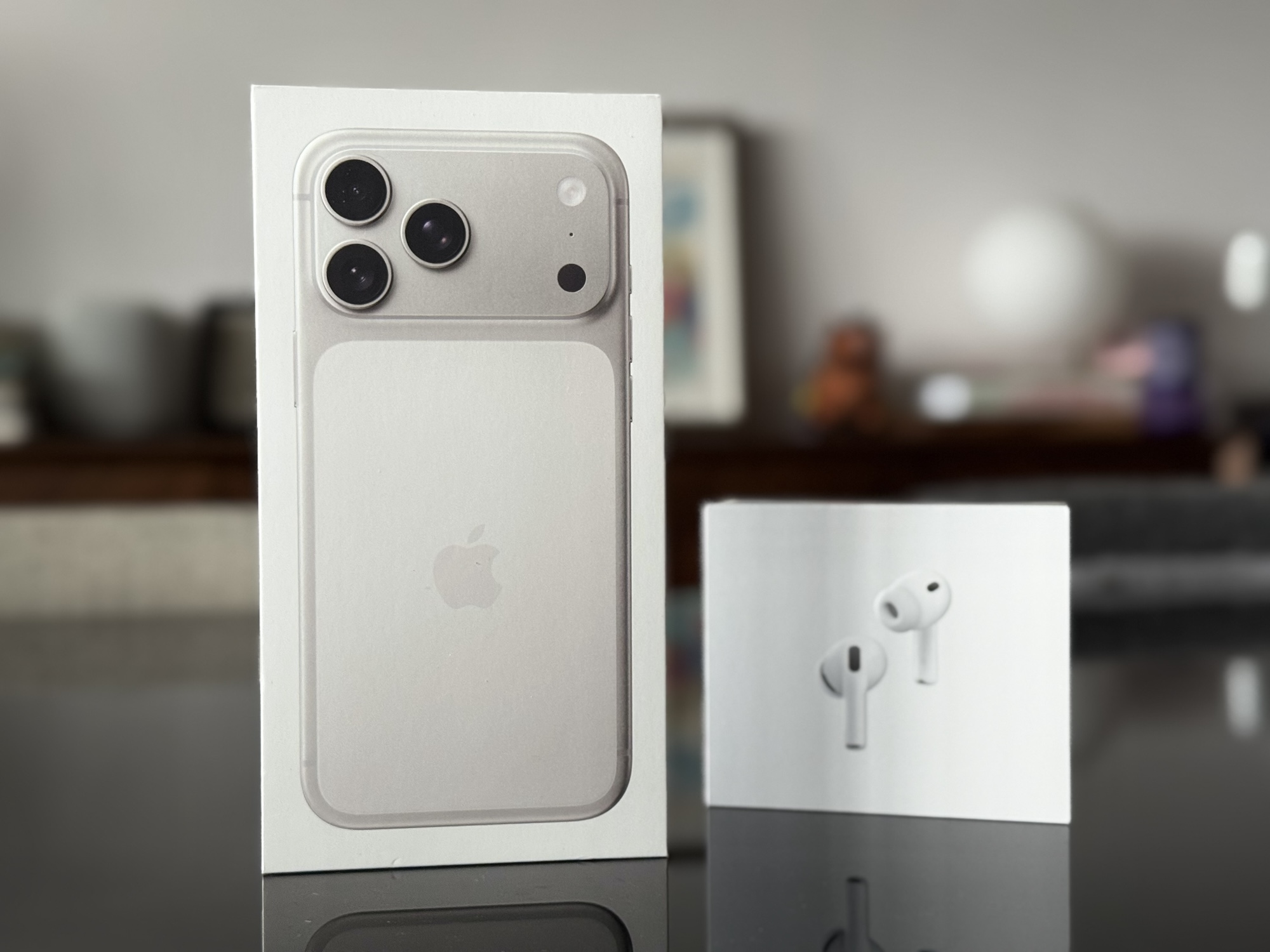
I’ve been listening on both my new AirPods Pro 3 and an original pair of AirPods Pro, and dare I say the difference is quite obvious. Louanne asked me what I do with old pairs of headphones when I get new ones, and the answer was “put them in different rooms!”, of course. I’m fast running out of rooms. The new model sounds much more Beats-like than ever (modern Beats, not OG Monster Beats). That is to say, a bass-forward sound with a very clear, almost sparkling high end. It’s a fun sound, and I think they’ll be very popular for all kinds of music, if not audiophile-grade neutral. They appear to fit better than before too, and the difference in body shape will strike longtime AirPods users as soon as they pick them up.
Then my new iPhone arrived, and before you judge, the old one is being returned to Apple’s Trade In partner in a few days, where it will hopefully be responsibly refurbished or at worst recycled. They’ve suggested that I’m likely to get nearly half the original cost back, which is an astounding deal for a two-year-old model! I’ll believe it when the deposit lands in my bank account.
I’m very happy I decided to stick with the Pro Max size instead of switching to a Pro. The slight increases in height and width are visible if you put them together, but isn’t really noticeable in the hand. The increase in thickness IS, but combined with the new gentler corners on the seamless aluminum body, I think thicker is actually better? This might be the best feeling iPhone ever.


I’ve yet to put the new camera system through its paces, but I’m excited and very pleased after a couple of days with it. Images look cleaner, and the redesigned front-facing camera is a revelation. I took a test selfie and could scarcely believe how presentable I looked. Coming from the iPhone 15 series, I’m also new to the new Photographic Styles that were introduced last year, and am getting a lot out of them. I compared photos shot in RAW with Halide and in HEIC with the default camera using a tweaked “Natural” style, and they’re extremely close in both SDR and HDR. This is a big deal! Along with the revised Photonic Engine this year, the dark days of overprocessed iPhone photos may be behind us.
When reviews get creative
One thing I’ve noticed this year is how bland and predictable the video reviews from the usual tech YouTubers and influencers have been. They go through the spec sheets while speaking to the camera, do a few test shots, and end without any thoughts you couldn’t have pulled out of ChatGPT. But then I saw a couple of videos from the Chinese-speaking side of the internet, and that’s when I realized Western civilization is well and truly finished.
Take a look at these and tell me you’re not duly impressed by the storytelling creativity, production skill, points of view, and passion on display — even if you can’t understand a word (but most of them have English subtitles you can enable). They could just shoot the phones on a stand while swinging a light overhead, but they instead they go hard with CGI, costumes, sets, comedic sketches, and cinematic editing. And they do these in the WEEK they’ve given between the phones being revealed and launching.


We visited a local art sales event for works based on the Ghost in the Shell: Stand Alone Complex franchise, just to have a look. The metal-printed pieces were going for upwards of S$4,000, so there was never any chance we’d buy one — but I got a little acrylic plate standee for my desk (S$25). Above are some snaps straight from the iPhone 17 Pro Max, using only Photographic Styles.


Afterwards, we visited the SG60 Heart&Soul Experience which is being housed at the site of the old library@orchard. Supposedly it will be renovated and return as a downtown library next year, which is great news. From what I can gather, it’s meant to inspire people about what Singapore’s future might look like, and what place they’d have in it (employing lots of tech to personalize the journey). Criticisms I’ve heard are that it doesn’t go far enough, and the future shown looks kinda like the present: delivery drones, working in VR headsets, greenery everywhere. Visit and see for yourself. Bookings are required, but the tickets are free. It’s quite an involved production with each visitor being given a guide device (an encased Xiaomi smartphone) to wear around their necks, and human facilitators bringing them through the stations.

Oh, speaking of cases, we went by Apple Orchard Road after the show to have a look at the iPhone Air, and I haven’t seen that store so packed in years. I picked up a rather loud Beats case in “Pebble Pink”, mostly because I really wanted a Beats case last year but they only made them for the iPhone 16 series. It’s hard plastic with a matte finish that’s slippery when your hands are dry but tacky enough if there’s a bit of moisture.
Check out my reel with the Pink Panther theme:
And while we’re on the subject of great directors, I finally sat down with Bernardo Bertolucci’s The Dreamers (2003) on MUBI. More explicit than I expected, it’s easy to see why people call it pretentious with its heavy callbacks to classic cinema, but it’s never boring and it sure knows how to use mirrors. I gave it 3.5 stars on Letterboxd, mostly because there’s “altogether too much time spent lying on floors for my liking”. There’s also one truly revolting moment where, out of money, they raid the apartment building’s trash for scraps of food and assemble the world’s grossest bento.
Spike Lee’s Highest 2 Lowest (2025), now on Apple TV+, is a remake of Kurosawa’s High and Low (1963), which I’ll embarrassingly only get around to watching after this homage. But this is a fine film that stands on its own: a sharp, sometimes experimental exploration of class and morality, constantly playing on the gulf between generations — Motown vs. modern rap, film vs. digital, Kurosawa vs. Lee.
-

Week 12.25
- I found solutions to a couple of longstanding bugs and problems relating to date metadata saving on iPhone photos and battery drain on my Kobo, but published them as two separate posts so as not to clutter this update with nerdy troubleshooting.
- Had a good couple of days in Bangkok. As others prepared me to expect, the shopping centers are a cut above anything in Singapore in terms of scale, brand availability, and features. And there are so many of them, from giant complexes full of small kiosks that feel like the old days of Sim Lim Square, where you have to stay alert or be taken for a ride (MBK Center), to luxe architectural marvels I can’t figure out the sustainable economics for.
- Like in Tokyo, it was again nice to see so many bookstores thriving, sometimes two in a single mall, which is so not the case in Singapore.

- I had some time to kill on my first afternoon so I went to the cineplex at Siam Paragon and saw Mickey 17 in a widescreen format called ScreenX that I’d never heard of before. It was also showing in 4DX (with chair motion and blasts of wind, etc.), and the other theaters supported IMAX and different 3D options. They sold popcorn in 8 flavors.
- The fact that Singaporean cinemas are struggling to survive and haven’t invested in these new technologies/gimmicks was making me slightly jealous, until I read this MUBI Notebook article about how 4DX just distracts you from the film and is an uncomfortable seat to boot.
- In this new issue of Notebook, they also look at the immersive content available on Apple Vision Pro and comment on these early explorations as being typical of a new form of cinema trying to find its place in the world. As novel as it was to watch Mickey 17 with ScreenX’s additional peripheral content, it obviously doesn’t compare at all to Vision Pro’s immersion, and probably isn’t necessary compared to watching the regular version of a 2D film. So I can’t blame our cinemas for not investing in these new formats to win people back.


- Also at Siam Paragon, there was a large Nintendo store run by an authorized retailer that kinda gives real Nintendo stores a run for their money. Because they’re not bound by arbitrary brand rules, they can sell third-party products alongside the games and official merchandise, which has the effect of giving a fuller picture of the ecosystem and better celebrating Nintendo’s cultural impact.


- Japanese culture has a large presence in Bangkok. I saw many brands and retailers that we don’t have here, like Loft, Matsumoto Kiyoshi, Hinoya Curry, and their Books Kinokuniya stores are massive and stocked with tons of manga and anime-related products. There were dedicated Gundam plastic model (Gunpla) stores, a Bandai Namco gachapon store, and even a major Jujutsu Kaisen exhibition in one mall with tickets costing about S$22 (I decided against it).
- I ended up eating curry rice from Coco Ichibanya and Maji Curry instead of Thai food on a couple of occasions. Cocoichi is better there than it is here (not saying much), but isn’t quite the same as in Japan. Maji Curry, however, should be commended for their consistency. It’s just as good everywhere I’ve had it. That said, they offered me a choice between chicken and beef-based curry sauces, and that was definitely new.


- The ICONSIAM mall was recommended by many people, but perhaps I was just all malled out by that point because I wasn’t feeling it. The Apple Store there is pretty cool, with very high ceilings and lots of natural light, but it had the effect of making the minimal product displays feel lacking. The Apple Store at CentralwOrld is much more interesting, with its circular design, spiral staircase, and two-story layout.


- It might also be that minimalism is a rare creature in the Bangkok mall landscape. It can be seriously overstimulating, with hundreds of colorful decorative elements dangling from every surface, or crowded aisles like in the basement of ICONSIAM, which is a bewildering recreation of a chaotic street market, complete with roast crocodile meat on sale, and then you walk 50 meters and pop out next to a sleek Rimowa flagship store.
- The traffic in Bangkok is a major drawback, pushing visitors to choose calling for a Grab motorbike instead of a car. That’s not a dice roll I’m ready for, so I spent several hours editing photos in the backseats of cars. For example, a 14km trip to the Museum of Contemporary Art took over an hour in the middle of the afternoon, instead of the 15–20 minutes you’d expect from looking at the map.


MOCA Bangkok - MOCA, by the way, has the most breast-obsessed permanent collection I’ve ever seen anywhere in the world. Well over 50% of the work on display features topless women, and I regret not taking more photographic evidence to prove it to you. But here are some paintings I saw plus the current special exhibition, Mammals, which was said to feature 1:4 scale models of animals, except the artist couldn’t resist adding human mammaries to each one for comparison.


- The National Museum was thankfully a lot tamer, featuring Buddhist statues and unearthed ceramics that tell the story of Thailand’s history over the past few thousand years. These insane carved ivory tusks, though, I thought were worth sharing. They’re fairly recent, made in the 20th century by artisans from Myanmar.
- Man, that Severance finale, eh? Woof.
- Wait, I mentioned the shopping scene in Bangkok, but what did I actually come back with? A pair of jeans (that I could have bought back home, really), a Snoopy “Scenery Box” blind box that I first saw in Japan and have regretted not buying, and a MagSafe PopSocket from the current Peanuts Cherry Blossom series that is being featured in select countries’ Apple Stores right now.


-

Week 47.24
People sometimes say that I’d make a good teacher if I ever tried it. I think good teachers are probably more patient than I am and love speaking in front of people a lot more than I do. But on reflection, those are both things I’ve gotten a little better at over the last decade, so maybe.
I got a little taste of it this week when I was given the chance to hear a class of college students make their final presentations for a design thinking course, and provide assistance in the assessment of their assignments. They were asked to identify a group with needs, understand them, and then design games that could be of help. They had to prototype and test their ideas before finalizing a working version. They all did pretty well, creating solutions that were surprisingly polished.
The general idea about deploying Generative AI tools in the workplace is that they don’t do much to enhance the work of already talented employees. But for the vast majority of average or below-average workers, LLMs elevate their productivity and quality of work to a consistently higher level, which is still a net positive for teams.
Apple’s current ad campaign for Apple Intelligence seems to take that tack too, resulting in a message that’s so far from the Macintosh’s promise of a “bicycle for the mind” that these ads are rightfully catching some flak. But in the classroom, I saw AI tools give students (with limited time and a lack of traditional design skills) the ability to execute their ideas at high fidelity. Making card games that look and feel almost like professional products, fully illustrated without the help of artists, is not something we could have pulled off when I was their age. I’m partly envious, but also afraid that on a wider scale, execution will be confused with education.
Earlier in the year, when I sat in on another class being taught by a friend, I was struck by how hard it is to control the chaos of a large room of modern students, and the same thing was true here. When you get over 40 laptop and iPad-equipped young adults in a room, having their attention is not a given. Side conversations are happening all the time, and listening to whoever’s speaking seems like a choice.
Maybe it was just my experience as an English student, but our class sizes were smaller, and discussions almost always followed a single track, led by a professor pacing around the room rather than anchored to a screen at the front. There were hardly any screens, come to think of it, just books and notepads. Now everyone’s on Figma, Canva, Miro, and a host of other infinite sheets of AI-enabled SaaS paper. I’m not saying we had it better, but I worry that the option to take things slowly and still excel is disappearing. When kids today say they’re stressed, it’s hard not to believe them, having seen the performative polish that’s now standard. We’re getting awfully close to expecting students to pop out fully formed and ready for the mines.
===

Over the weekend, we decided to get our eyes tested at a Zeiss-approved optician’s, to order the official prescription inserts for Apple Vision Pro. This will let me use the device on days when I’m not wearing contact lenses. The need to have them on first has admittedly been only a very minor inconvenience, but now nothing will get in the way of hopping into the uh… spatialverse.
Of the three eye tests I’ve had this year, this was probably the most thorough one. The key seems to be patience (there’s that word again) on the part of the tester, in the sense that the testee should never feel hurried. They should be allowed to flip between options 1 and 2 as many times as they need to identify the sharpest and most comfortable images. As a result, I have a new prescription that shows my eyesight has slightly, but surely, deteriorated for the first time in over a decade.
My last test was in 2019, when I got my last pair of glasses from Zoff. Those were so comfortable that I stopped wearing contacts regularly and became a spectacles guy again. Now I wonder if wearing contacts actually helped arrest the decline of my eyes.
Anyway, armed with a new prescription and an appetite for vision correction, I went to the nearest Zoff outlet and ended up with a new pair of glasses. I learnt afterwards that the frames I chose were “trendy” and “perfectly suited for Gen Z styling”. Along with recent purchases of wide-leg pants and oversized tees, my fashion Bryan Johnsoning is complete.
Side note on Japanese express optical brands: I stopped considering Owndays because all their frames are small and narrow — they literally don’t have large options. Zoff at least stocks a few, and in general they overindex on “Boston” and “Wellington” shapes, so on both occasions I’ve been able to find something I like with almost no effort.
===
Media activity
- After taking a break for several months, I returned to Like a Dragon Gaiden: The Man Who Erased His Name on the PS5 and finished it. And this was a short game by Yakuza standards. I expected to feel pretty over the series by this point, but the emotional ending to Kaz’s story has got me quite excited to get started on the next game, Like a Dragon: Infinity Wealth, sooner rather than later.
- I also returned to Luigi’s Mansion 3 on the Switch, which I started (and stopped) playing when I first got the console back in 2017. This game has just sat there for 6 years waiting for me to get back in, and all credit to Nintendo’s designers, it was stunningly easy to pick up where I left off.
- There’s a ton of movies on MUBI due to leave in the next two weeks, so I started with Toni Erdmann (2016), which was nominated that year for the Palme d’Or. On the surface, it’s about a jokey dad whose daughter has become a miserable management consultant, and he decides she/they are not doing so well and could use a little cheering up. And yet as a film it was like nothing I’ve ever seen before: I laughed, I cried, I was bewildered. It’s simply art. 4.5 stars.
- Another film that is leaving is a 2011 documentary by the late Austrian filmmaker Michael Glawogger, Whore’s Glory, which examined the lives of sex workers in Thailand, Bangladesh, and Mexico. The film’s biggest problem is its inappropriately “cool” millennial-era Western music soundtrack featuring Cocorosie, Tricky, and PJ Harvey. My 3.5-star Letterboxd review: “If anyone asks why I look sad, from now on my answer is ‘I saw Whore’s Glory back in 2024’.”
- I haven’t held space to experience the new suddenly released Kendrick Lamar album, GNX, the way it deserves. Hopefully by next weekend.
- Kim Deal of the Pixies has a new album out at the age of 63 and I quite like it. It’s called Nobody Loves You More.
- I discovered a Japanese singer by the name of Kaneko Ayano while looking for artists with a similar sound to Happy End. She has an awesome ‘gimmick’ where every album is recorded and released in two different ways: acoustic and with a full band.
- But for the song/video of the week, it’s Hanumankind’s Big Dawgs. I was listening to Apple Music 1 when it came on, and had to look it up immediately. He’s an Indian rapper from Kerala by way of Texas, and he’s just broken out now with this song after years of making music. His lyrical game is considerable, and as evidence I offer the existence of a YouTube comment calling him “Lendrick Kumar”.
- I’m also embedding an older video I like, a freestyle performance, and a recent interview on Apple Music where it’s clear he’s an articulate and very driven young musician who’s going to be huge.