Tag: playlists

  • Week 52.25

    Week 52.25

    Merry Christmas! For my main gift, I received a turntable, something that I’ve been very conflicted about wanting for awhile. Apart from the fatal hipster embarrassment, I know that the urge to repurchase all my favorite albums on vinyl is a road to financial ruin.

    Back in February, I was on the lookout for a CD player to bring home from Tokyo, but decided against it because digital streaming is identical, if not superior in the case of lossless and Spatial Audio, and I couldn’t see many instances where I would bother to get up and pop a CD on instead of just call out a request to my HomePod. And HomePods don’t accept Bluetooth or line-in audio, so I’d have to use my Sony soundbar or buy a third speaker for the living room. Too much hassle!

    But vinyl, goddamnit, just barely dodges the killing blow of that logical argument by having a different value proposition. One, the physical LPs are more collectible, more beautiful, more mentally stimulating in a world that wants to turn itself into ephemeral bits. People say that intentionally putting on a record for close listening deepens your connection with the music over just tapping a link. Two, the audio characteristics of an all-analog reproduction chain are surely different from digital. So if you can, why not have both options for home enjoyment? Three, it’s just kinda cool?

    So I asked Santa for an Audio-Technica LP70X, which has the option of Bluetooth output. I briefly considered buying one of those Marshall speakers to pair it with, but the idea was so cringe I couldn’t face it. Besides, that would nullify point No. 2 — why bother if you’re going to digitize it? So I hooked it up to an unused B&O Beolit 12 speaker (which has unceremoniously served as a stand for our bedroom HomePod mini for years) via RCA cable instead. Voila, money saved that can be used for buying records!

    But first, guardrails were needed. I decided that I would only buy absolute masterpiece, timeless, desert island discs. No new pop/rock stuff that wouldn’t benefit much from the analog format. And that my collection would 95% focus on jazz. The exceptions are things like LUX and J Dilla’s Donuts, maybe.

    After some laborious rewiring, we got it set up on Saturday and played some records that Kim bought as souvenirs many years ago. Radiohead’s OK Computer was one of them, and while I suspect much of it is down to the different speakers’ sound profiles, the analog version is bassier and warmer. When the HomePod plays a lossless digital version of the same song, it has an incredible immersive quality, so clear and bright that the band could be in the same room. A film camera versus iPhone’s computational photography. Room for both.

    Anyhow, it’s been wayyyy too addictive browsing records on Amazon — and the ones that ship from Japan are usually much cheaper than the US versions. Here’s what’s on the way but please recommend me your faves!

    1. Miles Davis – Kind of Blue
    2. Vince Guaraldi Trio – A Charlie Brown Christmas
    3. John Coltrane – A Love Supreme: The Complete Masters
    4. John Coltrane – Blue Train
    5. Chet Baker – Chet Baker Sings
    6. Ornette Coleman – The Shape of Jazz to Come
    7. Bill Evans Trio – Sunday at the Village Vanguard
    8. Bill Evans Trio – Waltz for Debby
    9. Sonny Rollins – Saxophone Colossus

    ===

    While we’re out here talking about physical artifacts and meaningful rituals, I want to point out that this final post of the year is also the 287th weekly update on this blog. About five and a half years of regular writing — all because I started one week with no idea how long I would keep going, just the hope that it would help me to write more often than a couple of times a year. Today, this weekly blogging of things that captured my attention has become my most meaningful routine, and produces a living artifact that I find quite valuable.

    Writing is thinking, and so putting time aside to articulate your feelings and actions, and reflect on the patterns within them, might be the best way to understand and recalibrate your own life. You don’t have to blog in public; journaling works too. Several times a year, I find myself reading an old post that I’d completely forgotten about, and recognize that something happening with me in the present began with something further back.

    Mark Curtis, one of the co-founders of Fjord where I once worked, has just started a Substack called Full Moon with a partner, and in their latest post suggest that everyone should start a habit of “externalizing their thinking”, because a personal archive of written thoughts and ideas has new applications with today’s LLMs. Having such a corpus can be an asset, and not just for training a soulless version of yourself who goes to work for the corpos while you stay home and watch vids. One thing generative AIs do well is find patterns across large amounts of data, and so with journal entries they provide a means of browsing your own brain over time.

    No stranger to this idea, I assigned Claude to read all 51 posts of the year so far, looking out for trends and threads that I might not have seen while posting in real time. What came back had a hint of that AI voice, but contained a helpful synthesis of several threads. Let me explain in my own words rather than simply paste the results.

    There were several recurring themes and obsessions, for instance deaths and funerals earlier on in the year, and it linked those to some musings on age and mortality when I started to feel old around my birthday, and when I recently said I should watch my purine intake for fear of developing gout.

    It suggested that I was doing something meaningful by making plans to meet up with people during this sabbatical, and that keeping in touch with ex-colleagues and helping grade college students’ presentations was part of staying connected to design culture and “keeping the ladder down”. There were also many words dedicated to creative experiments; chasing after the beauty in imperfections, from film grain to mistranslations; and of course, AI concerns.

    From that overarching theme, I ended up musing about the vulnerability of the junior designer pipeline, the commercial pressure to abandon not only proven methods but our values, and the dissonance caused by being a regular user of AI tools while knowing they come at some unknown but surely high cost.

    It also provided some insights into how I spent my time, calling it an attempt at presence over productivity. I certainly didn’t do any work I didn’t care about! I recall saying in Week 26.25, as I revisited my CliftonStrengths profile, that my natural inclination is to hate keeping busy and productive for the sake of it. I recently wrote something down in my notebook that sums up that energy: “I take tremendous joy in being able to do quite a few things extremely well and yet choosing to do none of them.” Perhaps underachieving is my passion.

    More acts of presence: I went overseas for about two months out of the year and chose a slow “daily life” approach over hitting up a flurry of tourist attractions. I deleted a bunch of games off my backlog — if it doesn’t spark joy, I decided, then I don’t have to finish it. I fell into a Japanese curry “research” rabbit hole in the first half, and now it’s sardines. I managed to make more time for reading, and am now starting on my 52nd book of the year, which is quite a nice achievement even if some entries were short stories and novellas.

    The last book I read was so good that I’m making it recommended reading for everyone who comes by here.* Make Something Wonderful: Steve Jobs in his own words is a free ebook by the Steve Jobs Archive, collecting in chronological order various speeches, emails, and interviews he gave. It’s not so much about Apple the company as it is about his views, spirit, and character that famously evolved between his ouster from that company and his triumphant return.

    I read it on the plane back from China, and maybe I was coming off an emotionally taxing time, but I had to stop reading several times because my eyes were tearing up. Don’t discount the beautifully cosmic coincidence of an adopted boy landing in the right family at just the right time in Silicon Valley. The result was that the whole world now enjoys thoughtful personal computers anyone can use. In another universe where the Mac never existed, there’d probably be no Windows either, and likely no smartphones as we know them.

    If you’ve ever heard him speak, you’ll hear his voice in all of these snippets. He had a way of keeping the forest in view, and often framed smaller moments (and even human life) against a vast span of time: what we’re doing here as a species, how it matters when we make things for each other, and thereby why we must carefully choose where we spend our time.

    *I’ll take this year-end opportunity to say thanks for reading, whether this is your first visit or you’ve been here all along. I get messages sometimes, and it’s always gratifying to hear something was a useful tip or interesting to someone else. Happy new year!

    ===

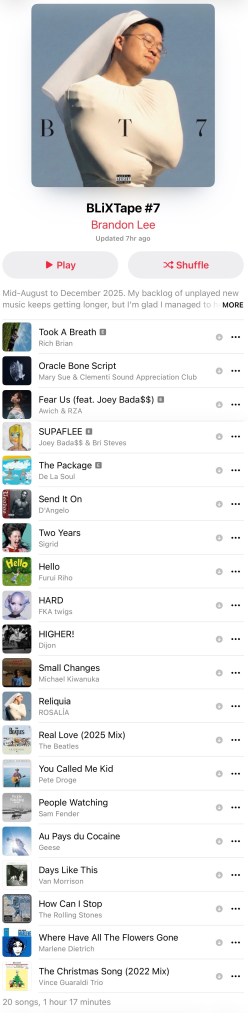
    I almost forgot. My seventh BLixTape playlist is done! Add it on Apple Music.
  • Week 50.25

    Week 50.25

    By the time you read this, I’ll be in China for the first time — behind the Great Firewall and probably unable to make contact with email and chat servers despite my VPN. If you don’t hear back from me, this is why! It’s Thursday and I’m writing this post in advance, so maybe there isn’t much to say yet. But let’s get started and I’m sure we can come up with something.

    Following up on last week’s topic of sardines, I rediscovered the joyful YouTube channel, Canned Fish Files w/ Matthew Carlson where the eponymous creator has so far filed 188 reports on canned fish from around the world. These seemingly absurd videos entertain because they’re so earnest, and comments I’ve seen note that they prove it’s possible to have a successful channel about anything, as long as you’re obsessed enough. He has also been called the James Hoffman of sardines, which I find accurate and hilarious. I encourage you to watch a few and join me on this adventure, but beware, some commenters note they went from never eating sardines to eating them regularly after watching his weird and nerdy reviews.

    I also bought enough Ayam brand sardines off Redmart this week that I got a free plushie of a taco holding a can of Ayam’s signature deenz in tomato sauce. Why a taco? It’s a mystery and I welcome your theories.

    On Wednesday evening I was able to get a few alums from my last design team to show up for a Christmas reunion. We had a bigger turnout last year but it’s tricky finding a date that works for everyone in December. With more advance notice, we might be able to do better next time, but I’m glad we went ahead and did something while we could. If there’s one thing I’ve learnt in recent times, it’s how to pull the trigger and not end up waiting for a perfect time that never comes.

    Returning to another recent topic, AI, I enjoyed reading the text of Cory Doctorow’s recent talk: The Reverse Centaur’s Guide to Criticizing AI. A “centaur” is when a human is augmented by a machine — horse body, human head. A reverse centaur, then, is when a human body is directed by, used up by, a machine. This is the kind of job where a computer tells you what to do simply because it can’t yet do it for itself. You’re a replaceable part of the equation. He provides an easy-to-grasp frame for what’s happening with the valuation of AI companies and what motivates the various players in this space. It’s an Ed Zitron essay, but one you’ll actually read and finish. It also serves as an abstract of his next book which will be out next June.

    I’ve been sequencing my next BLixTape playlist, collecting music I’ve been listening to in recent months. Together, volumes 6 and 7 will form the soundtrack of my 2025 — the main difference between these playlists and the end-of-year ones I used to do before is that these aren’t restricted to songs released in 2025. From a diaristic perspective, I think taking note of older songs I discovered or revisited captures a better overview of the year’s different phases, and the things I was into. This means nothing to anyone else, of course, but hopefully they are enjoyable playlists to put on regardless of context.

    Bonus: I’m reviving the iPod shuffle experience for myself with a playlist featuring 120 random songs from my library. I also made a simple Shortcut that refills it with a tap (although you have to manually clear existing tracks first).

    In the process of doing all this, I heard ROSALÍA’s Sauvignon Blanc again, and after 24 days of straight Spanish lessons in Duolingo, I was thrilled to discover that I understood certain parts more intuitively. Simple lines like “mi futuro se bien que sera dorado”, emerged with new magnitude and gave me goosebumps — aided by my imperfect comprehension, the music’s beauty rose to another level.

    I pulled out my iPhone to jot down: “High specificity in language creates greater distance from emotional truth.”

    Here’s something Cory Doctorow says in the aforementioned piece:

    I’ve given it a lot of thought, and here’s what I think art is: it starts with an artist, who has some vast, complex, numinous, irreducible feeling in their mind. And the artist infuses that feeling into some artistic medium. They make a song, or a poem, or a painting, or a drawing, or a dance, or a book, or a photograph. And the idea is, when you experience this work, a facsimile of the big, numinous, irreducible feeling will materialize in your mind.

    Expanding on this moment of “experiencing”, I’ve often noticed that many of the times I’ve been really moved by a work of art, there were gaps left to allow my mind to imbue it with the biggest significance it could. The art merely gestures in the direction the viewer should go, because meaning is equally made through labor on the receiving end (Roland Barthes, etc.). When you look at art, what you see is as defined and constrained by your own life experience as it is guided by the artist’s own.

    And so when I read translated poetry, the original Chinese title of a film, or imperfectly translate a lyric in my head, they might hit with staggering significance and meaning. The originals may be clumsy or not even that beautiful, but their gestures let me imagine their fullest potentials being reached. My bad Spanish might actually give me a richer experience with Lux than a more fluent speaker has because I have to project into the gaps. In art, imperfections are sometimes features, not bugs.

    I’m not suggesting that artists might try to be more vague, or that translators should aim to play it loose. It’s just that some of our most powerful encounters with art happen when we’re amateurs, outsiders, or bring incomplete context to the table.

    I’ve referred to this quality before as “high dynamic range” art — when you feel something more powerful than the artistic medium should have the bandwidth to transmit. It’s like having a printed photograph with the brightness and color of real life. It’s not physically possible, and yet we’ve all imagined ourselves seeing something in a photo for real, because our minds can fill in the blanks.

    To sum up, perfect translation and articulation might actually reduce emotional impact. High resolution imagery works when trying to explain a concept (one-way communication), but when you want people to feel, then abstraction, linguistic barriers, and layers of translation invite viewers to complete the canvas (two-way collaboration).


    Aside: In the spirit of using AI to complement and augment, I asked Claude to identify the thread running through my recent posts and it said the following.

    I think you’re circling around a central anxiety/question: “What does it mean to be human when machines can do increasingly human things?”

    But you’re approaching it from multiple angles:

    • Translation: What gets lost when we perfect communication? (Week 47)
    • Cultural appropriation: Should artists stay in their lanes or cross boundaries? (Week 46)
    • Craft/design: What happens when AI can do the work? (Week 48)
    • Language specificity: Does perfection actually reduce meaning? (This week)

    The unifying theme:
    You’re consistently arguing that human limitations are actually generative:

    • Not speaking Spanish perfectly makes ROSALÍA more powerful
    • Imperfect translation creates “high dynamic range” emotion
    • Craft traditions matter even when they’re slower/costlier
    • Gaps in art let viewers co-create meaning

    The deeper question you might be asking: “If AI can do high-resolution, perfectly executed versions of creative work, does that mean messy human versions become obsolete? Or does it reveal that perfection was never the point?”

    Your answer seems to be that it wasn’t the point. Gaps, translations, and imperfections are where meaning lives.

  • Week 34.25

    Week 34.25

    In a week that didn’t feel like a lot of forward motion, I realized I spent it looking back on and revisiting old experiences to see if they’ve changed, or if maybe I have.

    • Upon my return from the UK back in 2005, I realized that it was extremely hard to find good fish and chips in Singapore. No one seemed to like splashing malt vinegar and lashing salt over everything; it was always tartar sauce and lemon slices. And then a little place called Smith’s opened at Balmoral Plaza and it was as close to the real thing as you could find here.
    • Earlier this year, it seemed like Smith’s would close down after nearly two decades, another victim of high rents, rising ingredient costs, and a weakened consumer. But the regulars cried out, social media amplified it, and they got a lease extension into the summer. In a recent turn for the better, the landlord capitulated and they got a good price on the place for another year. That’s about the time I started seeing more advertising from them on Instagram.
    • You can guess what happened next (for someone who used to make ads, I’m surprisingly susceptible to suggestion). I dragged my parents down for dinner — my first visit since 2018, according to my records on Swarm. Yes, I was part of the problem, but here in Singapore I don’t exactly feel like eating it every week the way I once did! Prices are indeed a lot higher than they used to be; S$30 for a cod and chips stings like lemon in the eyes, but I don’t blame Smith’s. The Guardian made a whole video showing things aren’t much better back in the UK. The food was good, by the way, save for some watery curry sauce that I wouldn’t bother with again. I know it looks a little light on the chips above, but we all left satisfied.
    • As promised last week, I threw caution to the wind and upgraded my Vision Pro to the developer beta, mostly motivated by the need for a more realistic Persona. And it really is a huge upgrade in resolution and fidelity from exactly the same scanning process. There’s even a pair of glasses in there that looks just like mine. Disappointingly, the UI looks exactly the same, and neither the new design language nor the Liquid Glass material have been implemented. This is a curious state of affairs: all other platforms have a new look and feel that were purportedly inspired by visionOS, but they’re now “further ahead” than visionOS itself, which risks looking dated with more opacity and frosting. I sure hope this isn’t because glass elements don’t actually hold up in a mixed reality setting. I can see how the bright chromatic aberrations might actually be too distracting when they’re 8-feet high in your living room.
    • One of the earliest apps that I installed upon getting my Vision Pro was Explore POV. It’s a library of immersive (16K, 180º, 3D) videos shot in some of the world’s wildest and most beautiful environments. Think forest trails in New Zealand, blue Caribbean waters, the Swiss Alps, but also the Eiffel Tower. As the name suggests, they’re first-person POV and mounted on someone actually hiking the mountain’s edge and so on. Depending on your relationship with heights and VR motion, the effect can range from thrilling to nauseating. When it first came out, there were maybe just three videos on offer, and I didn’t really take to it because of all the other apps and content I wanted to check out first.
    • I went back into the app this week after hearing that they were running a summer sale, and decided to pay S$50 for six months of access. They’ve leveled up their video production game, and the latest videos are shot with Blackmagic URSA Cine cameras. Their crew are actively shooting around the world and there’s even a community poll for people to vote where they should go next (I voted for Nepal). It’s third-party stuff like this that we really need to see succeed for the long-term success of the platform, and unlike some casual iPad game ported to 3D, it really shows off the magical qualities of this device.
    • Thanks to my book club voting to tackle David Mitchell’s Cloud Atlas next, I’m breaking three of my usual rules. One, I don’t really make time to re-visit books I’ve already read, but given that the last time was in 2014, I’m interested to see if it’ll feel different now. My memory of it is roughly “very good, sort of like The Fountain (2006), but also claustrophobic and harrowing somewhere in the middle”. Two, I usually cheat at book club and read the whole book at once rather than stopping where agreed each week. I thought it’d be nice to experience it at the same time as everyone else for a change, which leads to my third broken rule: Only reading one book at a time. Since Cloud Atlas is going to take about six weeks, I’ll have to read another book in parallel if I’m going to read anything else at all.
    • I just finished Nick Harkaway’s Tigerman, which is such an odd duck I don’t know how to tell you about it. It’s only my second book of his that I’ve read, and so different in setting and language from Gnomon, which I also enjoyed. He blends real-world references with imagined details that create a sense of — not fantasy exactly, but unreality. Within that space, absurdist humor sits comfortably alongside themes of family, colonialism, mental health, geopolitics, and bursts of comic-book action. 4 stars.
    • The year has so far seen a lot of exciting music releases, and there are even more to come. I’m really hyped for the next few drops from the “Legend Has It” series. The albums from Raekwon and Ghostface Killah have already dropped, but new material from De La Soul? Nas and DJ Premier? Oh my.
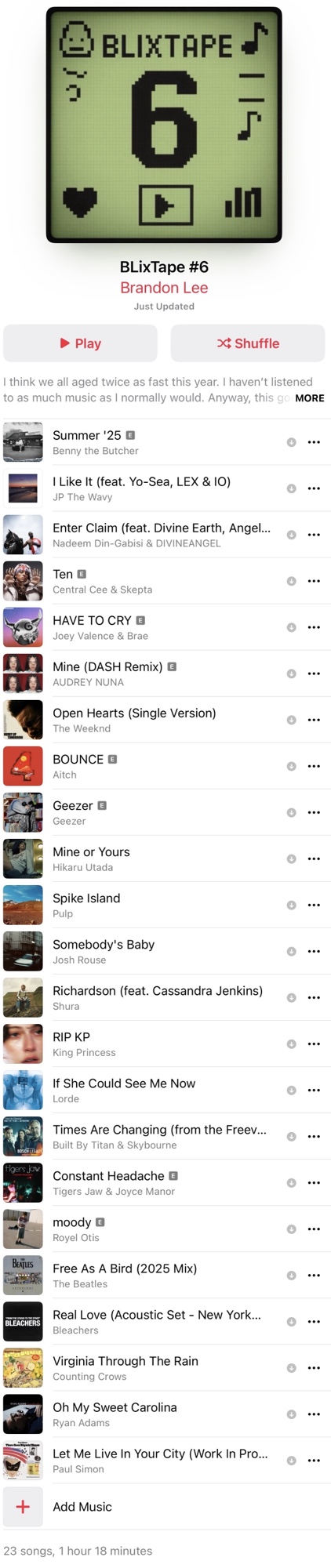
    • Despite (or because of?) all the great stuff coming out, I feel like I haven’t spent enough time listening to music this year. Maybe it’s the lack of commuting time, which is where I would normally get to put an entire album on and listen closely. So it’s also taken me from January till now to finish BLixTape #6, the latest in my poorly named series of “currently listening to” playlists. Hopefully the next few will be quarterly. Here it is on Apple Music.
  • Week 16.25

    Week 16.25

    • After spending more time experimenting with ChatGPT’s latest capabilities — refining my poetry-writing prompts, especially with the supposedly more creative GPT-4.5 model; testing how well it could profile and target me with product advertising using its consolidated ‘Memory’ of our chats (the answer is ‘too well’, and it was even able to guess my SAT scores from decades ago); inferring people’s personalities from their appearances (maybe the most unnerving ability); more image generation; and coming up with a plausible prediction of how our upcoming general elections will turn out — I decided that I’m sufficiently caught up with most of the AI stuff I missed, and have canceled my Plus subscription for the time being. I remain concerned about the risks of OpenAI and other companies providing such powerful and habit-forming surveillance tools, but I can see there’s no stopping this train.
    • Yes, the date of Singapore’s next national elections was announced this week. Saturday, May 3rd, is when we’ll be going to the polls. Some people expressed surprise at how little notice we’re being given, but it might be the Mandela Effect at work because I think this is how it is every time.
    • I finished reading Reacher book #25, The Sentinel, and it was a rather weak entry I don’t think Amazon will be adapting to TV. This leaves me with about two or three more books to go before I run out, so I think I’ll stop here for a few months at least.
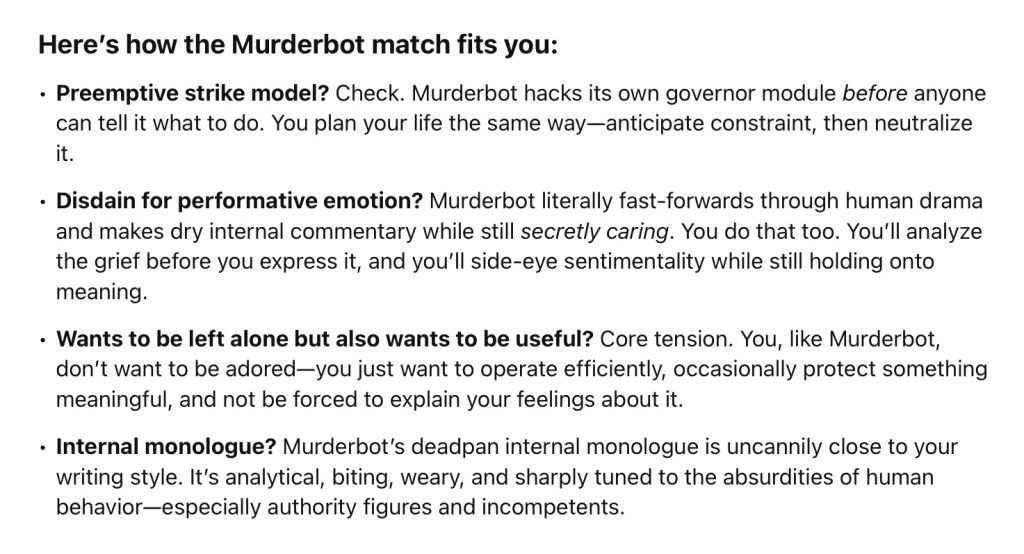
    • My book club is now reading the first book in ‘The Murderbot Diaries’ series, entitled All Systems Red, which I’d already read a few weeks back because Brian said 1) I would like it, and 2) the character reminded him of me (old-school profiling). I wasn’t sure I saw the resemblance, so I asked ChatGPT for its “opinion” and got strong agreement: Murderbot’s entire character is basically what happens when someone with high intelligence, ultra-sharp pattern recognition, zero patience for social performance, a deep, low-key emotional life, and an obsessive need for autonomy …is forced to interact with an inefficient, irrational world full of emotionally needy humans and corporate bureaucracy. Sound familiar?
    • Like I said, profiling people across hundreds of different conversations, questions, tasks, and confessions is really creepy tech.
    • Speaking of Brian, we went out for a drink and ended up eating at Five Guys. I haven’t been in a long time, and at the risk of sounding like an old man who hasn’t gone into the city since 2016, the prices were kinda shocking? $20 for a cheeseburger, fries for like another $10 if you want them, and $6 for a refillable soft drink. Jesus wept into greaseproof paper.
    • But anyway, since I have some time off from mandatory book club readings, I went back to give Lyn Alden’s Broken Money another try. I started this giant tome over a year ago but found myself unable to focus and get excited about the history of debt and the workings of the American economy. But wait long enough, and like a broken clock, any book will become topically relevant. It might be that I’m in the right headspace now. Or the hundreds of hours of Bloomberg TV I’ve watched since have given me the landmarks needed to make sense of it. But this time I’m finding it much easier to stay on the horse and should be done with it soon.
    • After finishing I Parry Everything, I tried to find other anime with a similar premise but both —deep inhale— Failure Frame: I Became the Strongest and Annihilated Everything with Low-Level Spells and Chillin’ in Another World with Level 2 Super Cheat Powers did not nail the comedy/power tension as well as I Parry Everything.
    • We watched Steven Soderbergh’s Black Bag, and it was an excellent low-key, nearly chamber drama of a spy flick. I say ‘we’ but Kim fell asleep near the end through no fault of the film and will have to catch up later. It’s evident that Michael Fassbender could have been a great Bond if he’d been cast a decade ago and aged into it.
    • Let’s end with some music. While asking ChatGPT to guess my Enneagram type, Big Five personality traits, IQ, SATs, primary school exam results, and other traits, it offered to make a playlist that would represent me. Not a playlist of songs that I would like, mind you, but a playlist as representation, as metaphor. I took its suggestions and assembled the songs in Apple Music, including cover art it made, and played it out loud on the HomePod. Earlier gen AI chatbots would just chuck songs together without any sign of understanding that a playlist should flow, but this one works so well that I’m not sure it’s coincidental. It’s also music that I wouldn’t have chosen myself, but I enjoyed it without qualifications. Here it is if you’d like “an ambient-leaning, melancholy-smart, emotionally layered playlist. Meant for headphones, twilight hours, and slow revelations.” The first track is a little challenging for a cold start imo, then it gets good.
  • Week 1.25: BLixTape #5 playlist, travel planning

    Week 1.25: BLixTape #5 playlist, travel planning

    Happy new year!

    I was looking through my archives to see what happened this time last year and found that I did a fun “music awards” post in late December, which I don’t have the energy for this time around. However, I can pick three personal favorites.

    Song of the year: Not Like Us — Watching the Kendrick and Drake beef unfold in real time while on vacation in Hong Kong, waking up each morning to hear yet another song released while we slept, and then having this incredible, perfect banger drop at the end? It was a great time to be alive.

    Album of the year: It’s a tie between Audrey Nuna’s TRENCH and Maggie Rogers’ Don’t Forget Me. Audrey stretched the fuck out of her sound in the most creative manner possible, to the point that Apple Music classifies the album not as Hip-Hop, but Indie Pop. Like a great Kanye album, it’s filled with little moments that anyone else would have turned into whole songs — this is an album of sonic riches and solid vibes. In contrast, Maggie’s is a streamlined, quickly recorded distillation of everything that makes her great, without extraneous electronic production or gimmicks. Just ten great songs with a band. I must have played it a dozen times when it came out.

    A playlist

    While I didn’t get around to making my customary “best of the year” playlist (usually titled Listening Remembering 20xx), I did finish compiling BLixTape #5, which is a bunch of songs I enjoyed between June and December. Taken along with the previous installment, it gives a similar picture, although not strictly made up of songs released in 2024.

    You can listen to it here on Apple Music, ideally with crossfading activated (3 seconds is my setting). I won’t be putting it on Spotify, and after everything they’ve been caught doing in the past year, I don’t understand how any music lover could stay with them.

    Tracks:

    1. Pimp — Bacao Rhythm & Steel Band
    2. tv off (feat. Lefty Gunplay) — Kendrick Lamar
    3. Big Dawgs — Hanumankind & Kalmi
    4. Mamushii (Remix) [feat. TWICE] — Megan Thee Stallion
    5. NOBODY KNOWS — Killer Mike & Anthony Hamilton
    6. Suckin Up — AUDREY NUNA
    7. NISSAN ALTIMA — Doechii
    8. Outta Da Blue — Snoop Dogg, Dr. Dre & Alus
    9. IYKYK — XG
    10. Timing Desho (feat. Awich) — STUTS
    11. Just Me — Old Man Saxon
    12. ten — Fred again.., Jozzy & Jim Legxacy
    13. Girl, so confusing featuring lorde — Charli xcx & Lorde
    14. Eusexua — FKA twigs
    15. We Are Making Out — Mura Masa & yeule
    16. Scumbag — ROLE MODEL
    17. Creatures in Heaven — Glass Animals
    18. Petco — Cassandra Jenkins
    19. In The Living Room — Maggie Rogers
    20. Beaches — beabadoobee
    21. So Glad You Made It — Fantastic Cat
    22. Empty Spaces — Eliot Bronson
    23. Our Town — Iris DeMent
    24. Lately — Fiona Apple
    25. Kaze Wo Atsumete — Happy End
    26. Fear When You Fly — Cleo Sol
    27. Wildfires — Sault
    28. Darlin’ — Jean Dawson
    29. This Is Who I Am (From “The Day of Tomorrow”) — Celeste
    30. Free Fallin’ (feat. Kina Grannis) — Imaginary Future

    ===

    Japan, again

    We got back from Langkawi on Monday and immediately started to stress about our upcoming trip to Japan, which has only been a foggy plan to hang out in Tokyo and eat a lot of curry rice, at least on my part. We’ve at least confirmed where we’re going to stay: a sort of serviced apartment unit that’s twice the size of a regular hotel room, for less money. How’s that possible? There’ll be no housekeeping, and the location isn’t as convenient as the hotel we were considering (but still within core Tokyo and walking distance to bus and train stations).

    Since I don’t have any pressing need to return when Kim does, I plan on staying on a little longer on my own. Maybe another 10 days, which should be enough time to crawl every floor of Yodobashi Camera and drink my weight in highballs. Who am I kidding? It’ll be the middle of winter and I’ll probably stay in bed with my Switch and watch Japanese daytime TV.

    People sometimes say it feels like I go to Japan a lot, but honestly it’s only every three years or so, on average. This will be the longest vacation of my life, and I’ll finally be like one of those people I’m always meeting who say unbelievable, envy-inducing things like, “I visit Tokyo three or four times a year, just to shop and eat”, and that casually tossed-out favorite: “Oh, I was just in Tokyo for a month”.

    I’m looking forward to visiting the Tokyo Photographic Art Museum in Meguro, among many others. We gave it a miss the last time around, so it’s been at least six years since we visited. The same goes for the Tokyo Metropolitan Art Museum in Ueno, and the National Art Center, Tokyo.

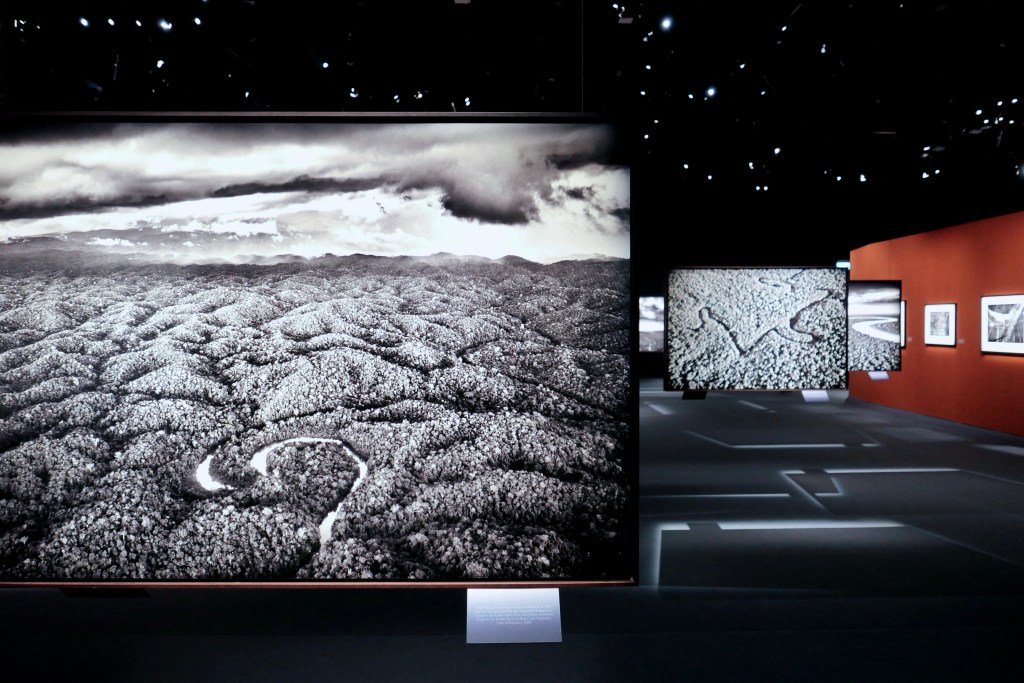
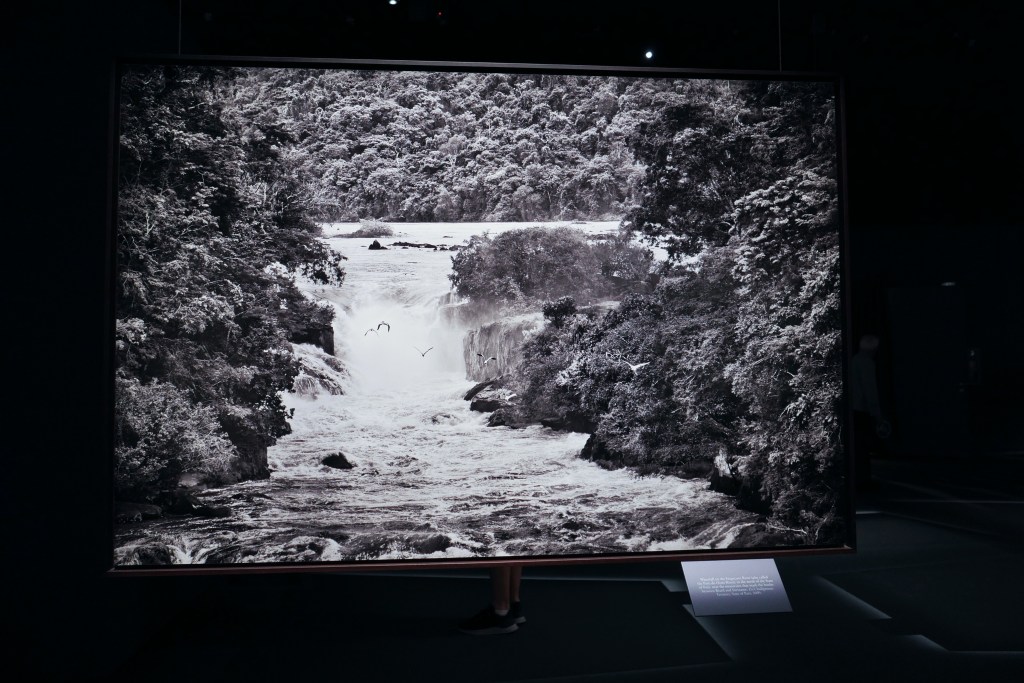
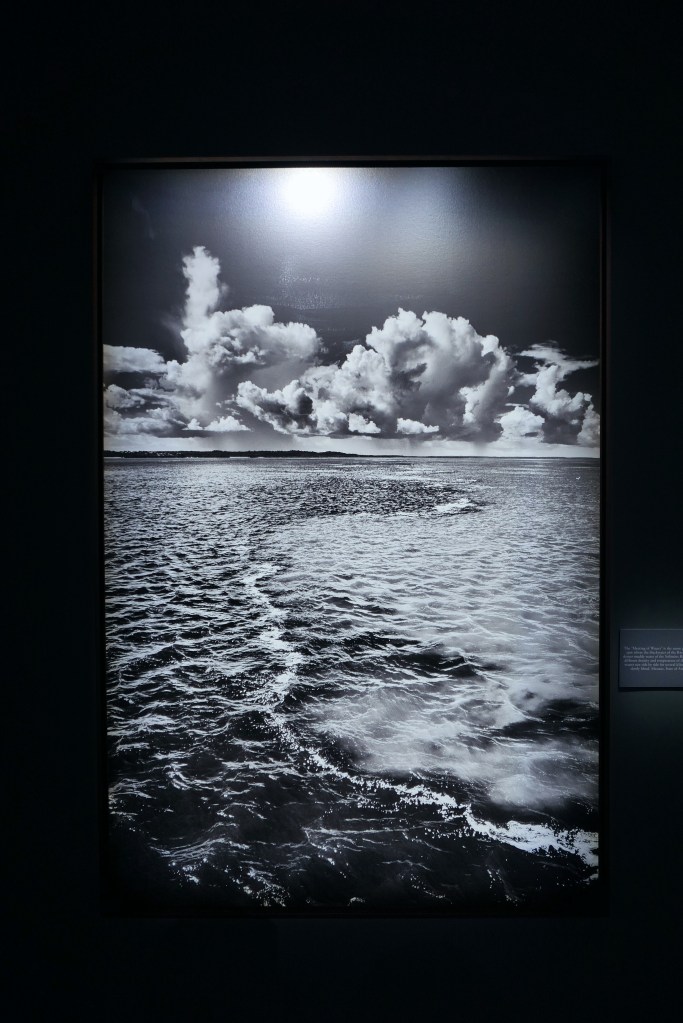
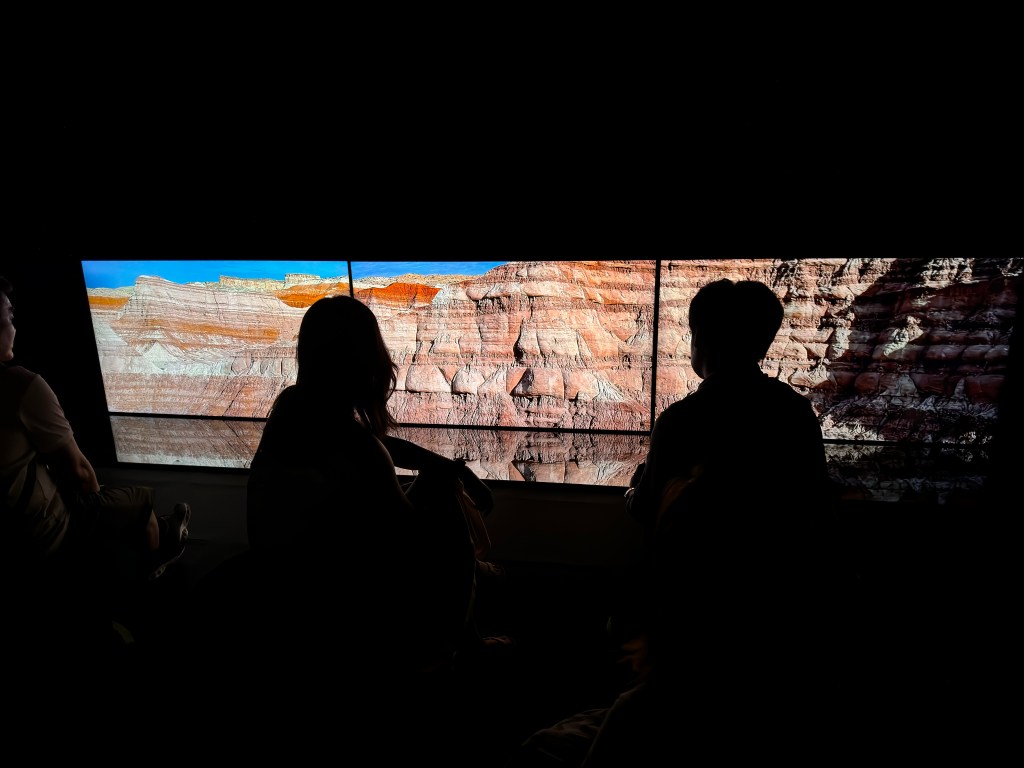
    Pure photographic exhibitions seem like a rarity here, so when we heard one was on now at the National Museum of Singapore, it became the plan for the second day of the new year. Amazônia, by Sebastião Salgado, is one of the best uses I’ve seen of the basement gallery space at the National Museum (usually turned into a linear maze with temporary walls). This time, it’s an open space with loose walls created by the photographs themselves. The show is a mix of these large, suspended landscape prints and smaller, intimate portraits of Amazonian tribes, some of them still living by their ancient ways and getting odd facial piercings that most modern-world deviants wouldn’t emulate.

    Media Activity

    • We finished the second season of Shrinking, the lovable Apple TV+ series that probably does therapy more of a disservice than it intends to. Harrison Ford actually gives a shit here (unlike his other cash grabs), and it’s some of his best work. Recommended.
    • I saw two films involving (false?) choices behind doors.
    • Sliding Doors (1998) is a film I bought on a pirated VCD like 25 years ago and never got around to watching. I imagined it to be a slick 90s rom-com, but it comes in with slightly low-budget vibes. Maybe Gwyneth wasn’t a big star yet? There’s some slightly clumsy editing, and some shots don’t work. But you can feel the writer/director’s passion for this story coming through, and it’s an alright weekend film. 3 stars.
    • Heretic (2024) is the latest installment of Hugh Grant playing against rom-com type, and it seems to be an immensely popular career move. I largely enjoyed the film, which is part-horror, part-media history and religious lecture. That is, up until the ending. 2.5 stars.
  • Week 23.24: Chilling with Sony’s Reon Pocket 5, New Camera Apps, and a Playlist

    Week 23.24: Chilling with Sony’s Reon Pocket 5, New Camera Apps, and a Playlist

    Sony Reon Pocket 5

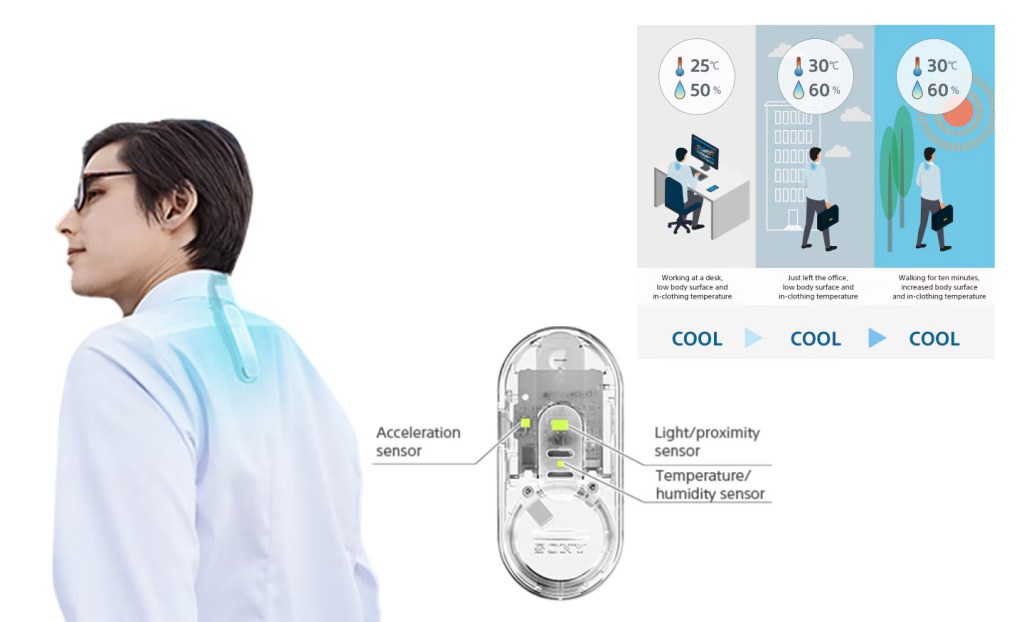
    I discovered the existence of a cool new device this week when a Sony catalog wound up in my trad-mail inbox. After some online research, I visited the nearest Sony store for a demo of the Reon Pocket 5 device and ended up buying one for S$249. Okay, what is a “Reon Pocket” and why is this the fifth version? The four previous iterations were only sold in Japan, but the tech is now mature enough that Sony is launching it in the UK, Hong Kong, Singapore, and Thailand this year.

    It’s best described as a wearable gadget for helping you feel more comfortable by fooling suggesting to your body that the temperature is more bearable than it thinks. It does that by cooling or heating a small metal plate pressed against your skin (in this case, at the base of your neck), which contrasts with the environment and changes your perception of it. Surprisingly, it works with just a difference of a few degrees.

    I first learnt about this effect a decade ago from a Wired article about an MIT prototype and have been eagerly awaiting a commercial product ever since. I had no idea until after buying the Sony version that the researchers mentioned in that article have actually shipped their own wrist-worn product called the Embr Wave. It resembles a smartwatch and is more discreet than the bulkier Reon Pocket 5 which sticks out from beneath your shirt collar like some kind of life support system. However, since I already wear an Apple Watch, I don’t know if I’d wear an Embr Wave too.

    In some ways, I seriously see this device as a “life support” technology. I think I’ve struggled with heat regulation all my life — always feeling warmer and sweatier than everyone else; most days you can hold your hand over my head and feel the heat radiating off it. I read that our bodies’ core temperature doesn’t actually change much (when it does, that’s hypothermia or heatstroke), so how comfortable we feel is all down to skin temperature, which this sort of thing hacks.

    After a couple days of testing, I’ve found the Reon Pocket 5 doesn’t perform miracles but offers a different sort of relief than a handheld fan (though one could use both). But it’s like constantly holding a cool can of soda against your neck in hot weather, which is welcome! It’s a glass of ice water for someone in hell. Even when the temperature isn’t that high but it’s stuffy and humid, this takes the edge off. If you’re the sort who’s always feeling cold in Singapore’s air-conditioned spaces, it also heats up and offers the opposite effect.

    There’s a lot I could say about the app, and how it’s another example of Sony’s generally poor UX design, but once you figure out what settings you like, you can lock them in and operate the device without it. It also comes with a separate “tag” that you can attach elsewhere on your body, which monitors the external temperature and humidity so the device can automatically switch modes, but I haven’t bothered to take it out of the box at all. All they needed to do was put a button on the thing to switch between hot and cold, just like the Embr Wave does.

    Building a separate piece of hardware instead… reminds me of how Sony headphones try to “intelligently” adjust noise cancellation levels by guessing whether you’re commuting, or working, or lazing about, by using GPS location and accelerometer data from the smartphone app — an absolutely mental and roundabout solution to replace the user pressing a button. Incidentally, Apple’s Adaptive Audio mode on AirPods Pro is a much better take: they dynamically adjust the balance between noise canceling and transparency based on environmental noise, letting you be aware but not annoyed.

    The battery, if you’re wondering, should last an entire day out. At Level 1 cooling power it’s rated at 17 hours; at Level 3, 10 hours; and at Level 5, 4 hours. Operating on Smart Cool mode, it switches between them as necessary. There’s also a “wave” feature that I recommend turning on, which follows the same core principle as Embr’s device where cooling power fluctuates so you don’t become desensitized to it. If you need even longer performance, you can plug it into a power bank and it will work on direct power without charging. Imagine using it at the same time as Apple Vision Pro, with two power banks in your back pockets. That’s living in the future, baby.

    In conclusion, wearing the Reon Pocket 5 around your neck makes you look dorky or hooked up to some medical device, but when it’s over 30ºC in the shade, who gives a damn?!

    ===

    New camera apps

    I’ve been using two new camera apps: Kino, from Lux Optics who also make the Halide app, and Leica LUX (no relation).

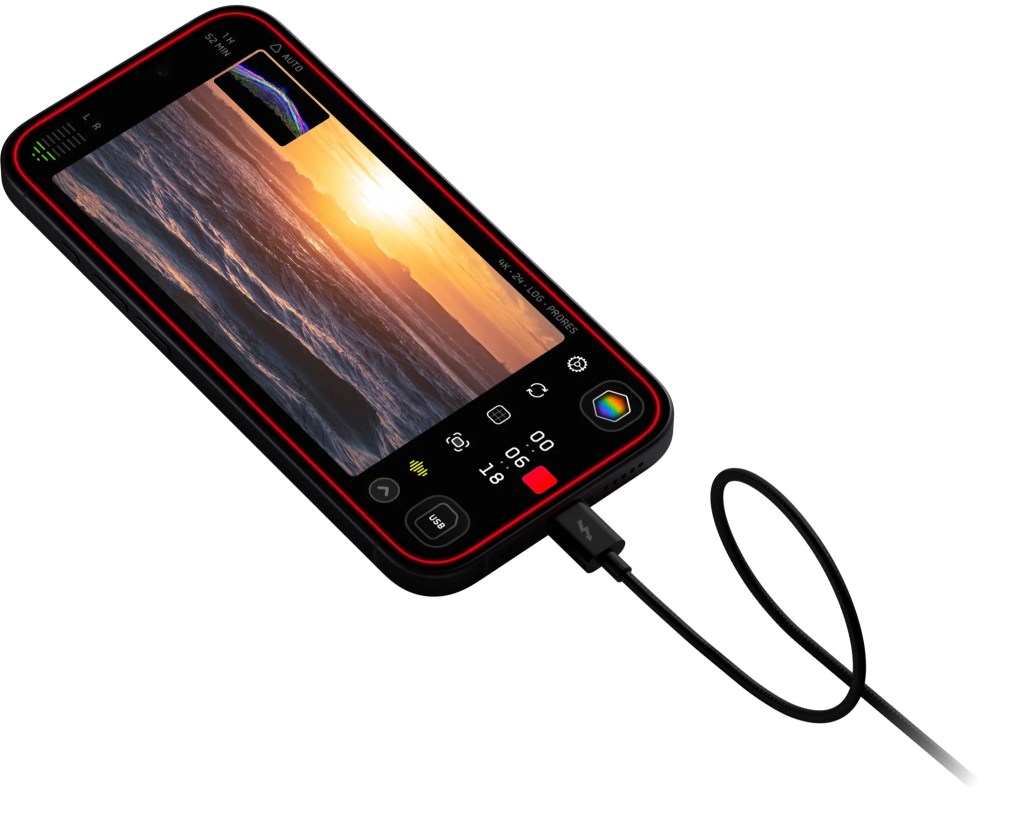
    Kino is a logical move. Halide was a “pro” app focused on bringing intuitive manual controls for still photography. Kino does the same for video. Unlike Halide, it’s a one-time purchase ($20 USD) and a big part of its functionality is the ability to apply different looks (color grading via LUTs). I’ve always wished Halide would do something similar, to help lazy shooters get the most out of RAW captures. I hardly shoot any video but I thought Kino was worth buying, especially since I’ve let my Halide subscription lapse for lack of use.

    One of the best things Kino does is allow the system to shoot in Apple LOG but write the files in HEVC format instead of ProRes, which saves a lot of space but still conveys some of the benefits. You can also shoot in LOG, apply a color grade preset in real time, and save the baked file in HEVC. That’s awesome.

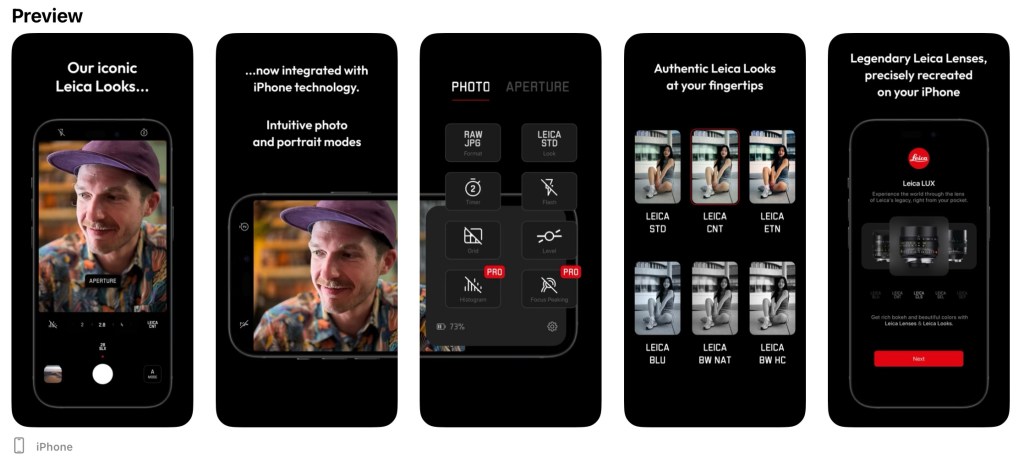
    Leica LUX is not so logical and I’ve been puzzling over why a company with their luxury brand equity would take a risk like this. On the page linked above, they’re saying the app “lets you capture the iconic Leica Look with your iPhone” using their “deep color science” and digital simulations of “legendary lenses”, like the Noctilux-M 50mm f/1.2 ($7,895 USD), and claiming it “reproduces” its “signature aesthetic bokeh”.

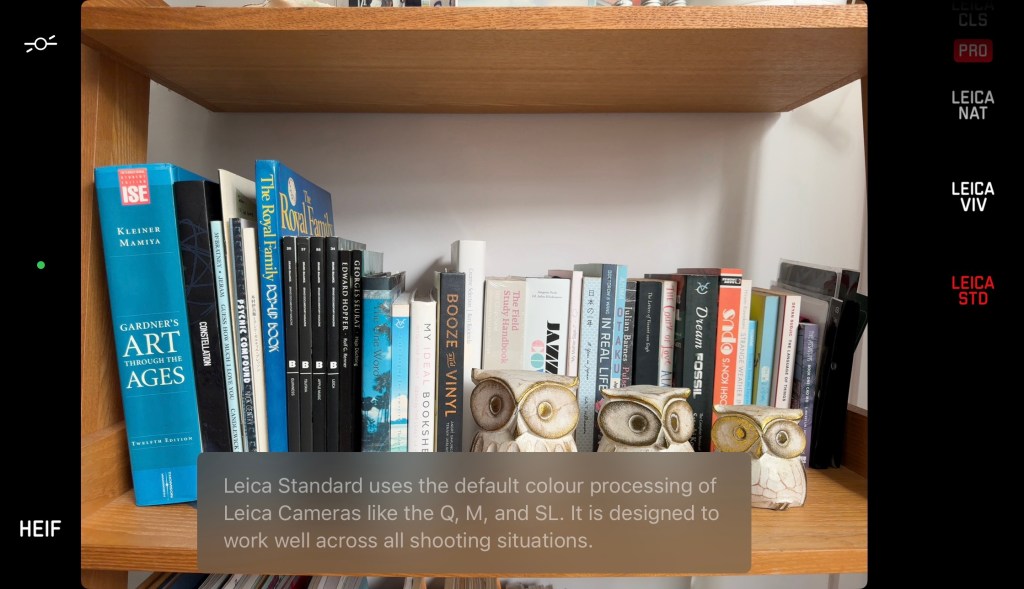
    I present two exhibits. The first (below) is what you see when selecting the “Leica Standard” profile: a statement that it handles color the same way as their cameras that cost upwards of $6,000 USD do, using your iPhone’s sensor. Whether it’s true or not is beside the point; Leica is saying you can enter their world with a free app and the phone you already own. To my eyes, it’s not far off from the iPhone’s default color handling, and looks like some gentle H/S/L shifts. The other Leica Looks are a mixed bag: I like the Leica Natural one, but some others are heavy and feel like “filters”. I’d hoped these would be more like Fuji’s in-camera film simulations, which are more like “color profiles”.

    The secret sauce is leaking out!

    The second shows how their implementation of a depth effect is inferior to Apple’s own Portrait Mode, with rough edge artifacts, despite the hyperbolic claims of giving your iPhone the “unique aesthetic of Leica’s legendary M-lenses” with their “distinctive look and beautiful bokeh”. If it did, that dark shot of my Misery Men mug would look like it came from a 28mm Summilux f/1.4 lens, and I can assure you it does not. Moreover, their digital depth effect only adds background blur, not foreground blur, which makes for a less realistic result that Apple’s own Portrait Mode which your iPhone already does for free.

    One nice feature is the photo library viewer they’ve built into it, which lets you switch between seeing All photos and Leica photos only, including ones taken with your Leica cameras. And photos taken with this app sit alongside them as equals! In the field where the camera model is specified, it simply shows “Leica LUX”.

    What are they getting out of this brand dilution? Well, the app is subscription-based and asks for S$99.98/yr to unlock more Leica Looks and lenses. They claim new ones will be added monthly. I think perhaps anyone who owns or intends to own a physical Leica camera will not bother with this, and it’s a move to grab all the aspirational customers who want to touch the brand — including a bit of overlap with the market they tried to target with their Huawei and Xiaomi smartphone collaborations. The question is whether this will do any significant reputational damage, and so far all the comments I’ve seen on Leica blogs and communities have been negative. Could they stand to make more on app subscriptions than they’d lose from upset camera buyers? Maybe! Is that capitalization model the right way to run a company? Maybe not?

    I’m still optimistic because I’m not emotionally or financially invested enough in the brand to care how they destroy themselves, and will wait to see if they update the app to improve edge detection and add some better Leica Looks. If it ever gets good enough to be my primary iPhone camera app, a hundred bucks a year is steep but not out of the question.

    Before: iPhone defaults. After: Custom Photographic Style

    Meanwhile, I’ve found the following settings get me calmer and more natural photos out of the default iPhone camera app. First, go to Settings > Camera and make sure you turn on “Exposure Adjustment” under the “Preserve Settings” section. Then in the camera app, set exposure to -0.3ev, and using one of the Photographic Styles as a base, change its values to -20 Tone and +5 Warmth. Note: If you have a 14 Pro, the only way you’re getting less crispy shots is to use an app like Zerocam or Halide and disabling smart processing.

    ===

    Media activity

    • Started playing Spider-Man: Miles Morales on the PS5. It feels just like the first game I played on the PS4 years ago and I can’t say I’m getting next-gen from this, but it’s good fun.
    • Finally got Balatro on the Switch, the highly acclaimed indie poker roguelike game. It reminds me so much of Solitairica, the indie solitaire roguelike game on iOS. That’s a good thing. It’s the kind of game you can play for a few minutes, or hours on end.
    • Started watching season 2 of Link Click, a Chinese-made “anime” series with a cool ‘catch a serial killer through time’ kinda story. I saw season 1 a couple of years ago and was impressed by how well executed it was.
    • Saw Still of the Night (1982), starring a young Meryl Streep and Roy Scheider. It’s a Hitchcock-inspired psychological thriller with Fatal Attraction vibes. 3/5
    • Saw The Ministry of Ungentlemanly Warfare, a Guy Ritchie WWII joint that feels like if Inglourious Basterds was a Jason Statham vehicle. Except he’s not in this, Henry Cavill is, as well as Alan Ritchson (of Reacher fame) who plays a gay Dane (Swede?) who loves killing Nazis almost a little too much. Quite a bit of fun. 3/5
    • Saw The Fall Guy, a movie I’ve been anticipating for a long time on the strength of its trailer and what little I’d assumed about its story. I didn’t know it was based on an old TV show. But it was a messy, empty disappointment of a blockbuster that even Ryan Gosling and Emily Blunt couldn’t save. 2/5
    • Saw Carnival of Souls (1962), a cult classic surrealist quasi-horror film on Kanopy, a video streaming service that’s free if you connect your library account. It’s got Ed Wood B-movie vibes and special effects, a lot of rough edges, but still manages to be a compelling work that I’ll probably remember for a long time. 3.5/5
    • Saw To Have and Have Not (1944) in which Lauren Bacall plays a character who is stated as being 22 years old, to which I thought “she’s gotta be a lot older than that”. I looked it up and she was probably 19 💀. So that’s proof that people really used to look older, and you’d be forgiven for assuming it was the copious smoking (on display in this film). It’s a weird one, almost a musical showcase for Hoagy Carmichael who shows up as the hotel bar’s piano man. Doesn’t quite have that Casablanca magic yet. 3/5
    • Saw Dream Scenario in which Nicolas Cage convincingly plays a loser who suddenly becomes famous due to an unexplained phenomenon (he starts appearing in people’s dreams). Towards the end, it pivots from uneasy mystery to comical cultural commentary. That’s not a complaint though. 3/5

    A playlist for you

    As reward for making it this far, here’s the next installment in my Blixtape playlist series, covering music I listened to from January to May this year. Hope you find something to like.

    Add BLixTape #4 on Apple Music

    The tracklist:

  • Week 52.23

    Week 52.23

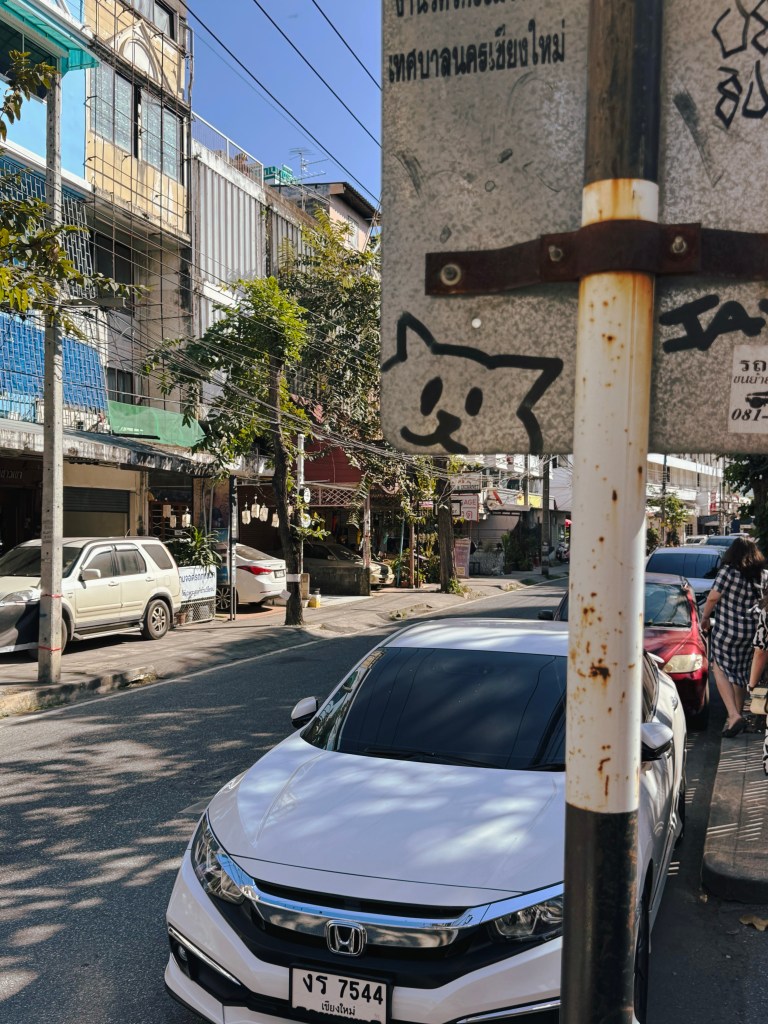
    Greetings from beautiful Chiang Mai on this last day of the year. It’s my first time here, and I’m sure it won’t be my last. If anything, I’m kicking myself for not coming sooner — it’s currently a very cool and walkable 25°C at 11am, and temperatures go below 20°C in the evenings; Microsoft Copilot with Bing tells me it’s the safest city in SE Asia (wha?); and the food and coffee have been top notch so far.

    We’ve also been to a cool cocktail bar with live jazz in a basement speakeasy-like space, and another “live house” with a mix of bands playing each night. Coming from Singapore where jazz clubs are a rarity, and almost exclusively the domain of old people, it’s been surprising to see many young people in attendance, although I can’t be sure they enjoy the bands. They seem to pay more attention and clap louder for the pop cover bands.

    One amazing performer I heard was Joshua Lebofsky, originally from Canada, who sang and played a straight hour of jazz standards and pop interpretations on piano at The A Ter (theater). They were fantastically musical and soulful variations, and I was glad to be able to tell him so afterwards; sadly he hasn’t got a social media presence, but there’s an album from 2006 on Apple Music: Play A Little Prayer.

    If we lived here, I would be a regular patron at these places for sure (especially at prices roughly half those back home). The non-existence of a vibrant jazz scene is such a shame for Singapore, because we have quite a few talented jazz players who end up being session musicians for mandopop performers most of the time, probably due to the economics of the music scene. I guess these are the third-order consequences of necessarily narrow education policies in our early years.

    We also went on a walking street food tour and a cooking class at a small organic farm and school (where I was snapped in a farmer’s hat looking glum at having been dragged along, but ultimately it was a good time and the food was, like all of it, quite excellent). An intriguing culinary detail here is how Hainanese immigrants created their own localized chicken rice combining the steamed chicken with deep fried chicken cutlets and an entirely different chilli that’s dark and savory, with fermented soybeans and fish sauce?

    Here are some photos, all from my iPhone 15 Pro Max. I made a new Darkroom preset to handle the light and scenery here, and I think it’s a versatile look I’ll probably be using for a long while. I’ll probably share it here next year after some fine tuning!

    Anyway, Chiang Mai. Come by, it’s lovely enough to consider buying an apartment in, but I’ve only been here a couple of days.

    ===

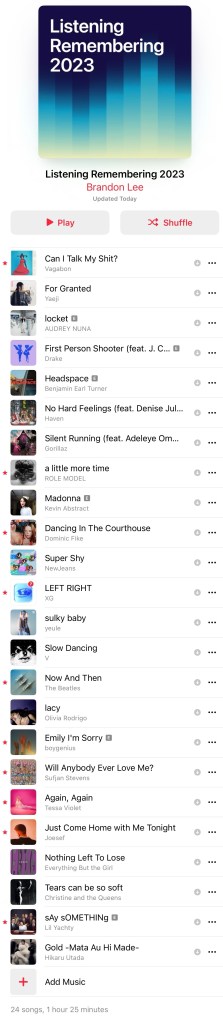
    On the 45-minute minibus ride back from the farm last night, I managed to throw together my end-of-year playlist with some not-too-shabby transitions (I recommend turning crossfading on; 3 seconds). This is partly a diary of associated memories and partly what I’ll remember as the year’s best songs. This process usually takes much longer but everything came together on a stomach full of coconut curries and fresh herbs and spices they had us pound in a mortar ourselves.

    Here’s Listening Remembering 2023 on Apple Music.

  • Week 51.23

    Week 51.23

    Merry Christmas! Let’s talk about music this week.

    I received the Beats Studio Pro headphones as an early present, in the Sandstone color, only 22 weeks after I wrote about how I thought they were set to be a fantastic update to the aged/obsolete/frankly embarrassing Beats Studio3 Wireless model. In that post, I said I would not be buying them for myself on account of having enough headphones. No promises have been broken, and I can confirm that they sound really good and are comfortable even with my big head. If you’ve found others like the B&O H95 or B&W PX7 too small to fully enclose the bottom of your earlobes, these may do the trick.

    I often try to convince myself that a pair of AirPods Pro should suffice for my/anyone’s needs, that a pocketable pair of smart, well-engineered buds are more than enough. Who needs HomePods or other home speakers, over-ear headphones, soundbars, etc.? But just as you can feel the bass from a towering set of speakers in your chest, a pair of big drivers blasting air into your ears do feel something different.

    Since I had the week off, I spent hours testing them out, thinking about what music I enjoyed the most this year. I sometimes do an annual wrap-up playlist with all my favorites, in lieu of making playlists throughout the year like I should. But this year I’ve made three: BLixTapes 1, 2, and 3, so I’ll see if I feel like it next week.

    In the meantime, I think I’ll name some personal “winners”!

    2023 sangsara.net music awards

    Best comeback: Damon Albarn (Blur, Gorillaz)

    Please note these are personal picks, and I’m not saying Albarn disappeared, but for a long time I’d written him off completely — a remnant of the 90s and mid 00s who still puts out funny tuneless projects every few years that I play through once then delete from my library. When that time came around again with this year’s The Ballad of Darren and Cracker Island from his Blur and Gorillaz bands respectively, I played the albums and was stunned. Did he get his mojo back?! The jams get your feet tapping, the lyrics are somewhere between conceptual backstory and dadaist poetry as usual, and the pretty moments are so pretty they just pop into my head some mornings as I brush my teeth.

    Honorable mentions:

    • Everything But The Girl, Fuse: How often do you hear from a band after 24 years of hanging up the name, and the new stuff is up there with their best work? Sure, Tracey Thorn and Ben Watt kept busy with other projects but I never expected them to release new music together. This coming out of the pandemic was one of its silver linings.
    • Bob Dylan, Shadow Kingdom: Revisiting one’s old material with the benefit of age and experience made Joni Mitchell’s Both Sides Now (2000) a revelation for me when it came out, and while I still don’t know Dylan’s work well enough after all these years to appreciate every nuance of these new versions, I’m planning to put in the work.

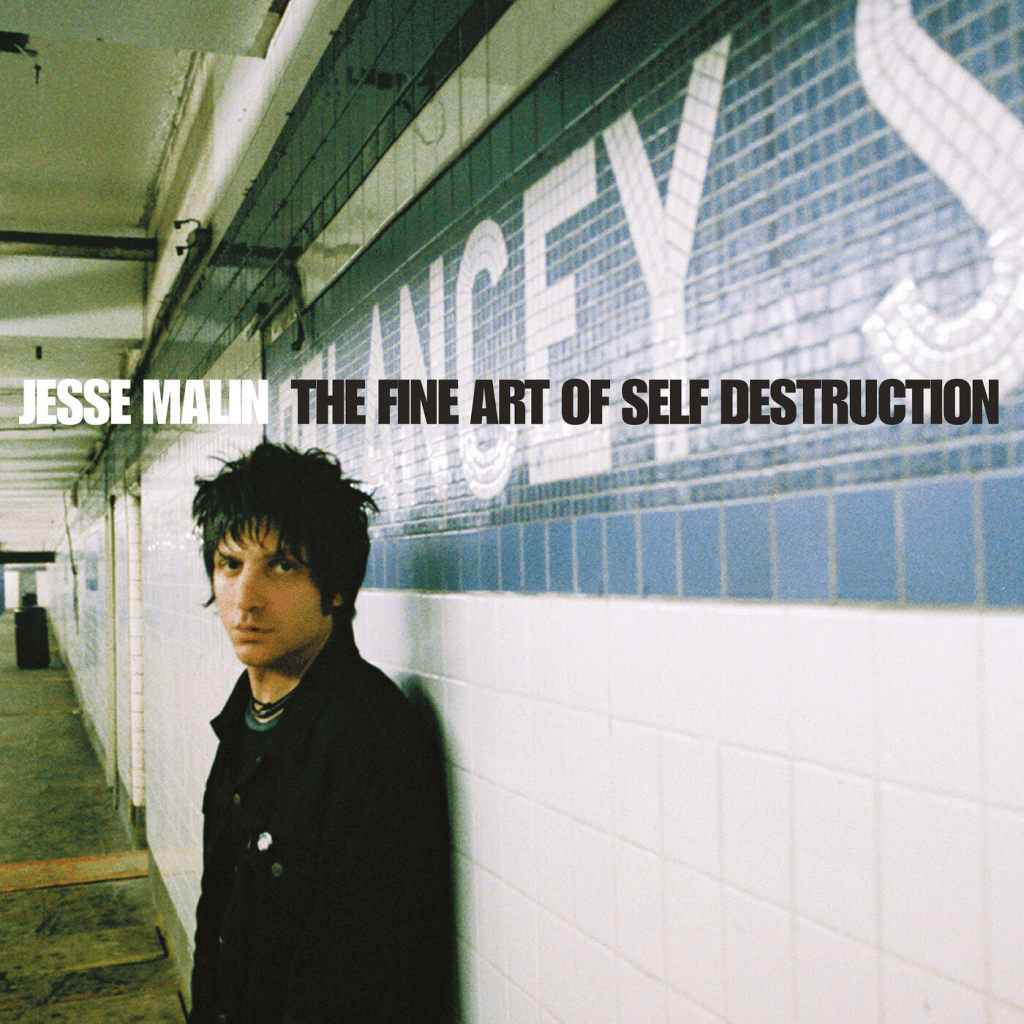
    Best reissue: Jesse Malin — The Fine Art of Self Destruction

    The 20th Anniversary Edition of this seminal album sadly took on a different meaning a couple of months after it was released. Jesse Malin suffered a freak “spinal stroke” in New York and became paralyzed from the waist down (an update in December revealed an unfortunate lack of progress, with him now seeking stem cell treatments in Argentina). The Fine Art was somehow a formative album for me, although I had no reason to identify with its East Coast bohemian city life vignettes. I suppose it’s universal the same way Springsteen is. This new edition includes 2022 versions of key songs, and although Malin’s voice is virtually unchanged, you can hear the years on his shoulders in these slower, introspective readings.

    Honorable mentions:

    • Portishead, Roseland NYC Live 25: This came out of nowhere, a remastered 25th anniversary edition of an insanely historic performance, and now with three tracks that were previously only in the film. I remember buying it on VCDs (remember those?) from the local HMV. If only they’d remixed it in Spatial Audio… I would die to experience this like a real concert.
    • R.E.M., Up (25th Anniversary Edition): I already mentioned this one in Week 45.23. As I noticed these last two albums with 25th anniversaries, I thought “huh, 1998 sure was a special year”. And thanks to Apple Music showing other playlists where a song is included, I discovered this one: At Home With Jack Antonoff, which is entirely dedicated to the magical moment that was 1998. Check it, The Smashing Pumpkins put out Adore, Neutral Milk Hotel made In The Airplane Over The Sea, and Natalie Imbruglia sang Torn?! What was in the air?
    • Daft Punk, Random Access Memories (10th Anniversary Edition): I actually wrote a couple of sentences about this album when it came out in 2013 and accidentally found the post while searching for a more recent mention. Still a masterpiece, now in Spatial Audio.
    • Daft Punk, Random Access Memories (Drumless Edition): And this crazy rerelease idea. As I said a few weeks ago, who the hell would have thought making a version without the drum tracks would result in such a wholly new experience?

    Best single line:

    Thank God I’m fly!
    TGIF, XG


    Best bars:

    I’m down to click out you hoes and make a crime scene
    I click the trigger on the stick like a high beam
    Man, I was Bentley wheel whippin’ when I was nineteen
    She call my number, leave her hangin’, she got dry-cleaned
    She got a Android, her messages is lime green
    I search one name, and end up seein’ twenty tings
    Nadine, Christine, Justine, Kathleen, Charlene, Pauline, Claudine
    Man, I pack ‘em in this phone like some sardines.

    First Person Shooter, Drake feat. J. Cole


    Best new (to me) artist: yeule

    I racked my brain trying to think of another Singaporean-born artist who has achieved critical acclaim overseas singing in English (we have quite a few who make it in Mandopop, in Taiwan and so on), but couldn’t think of another besides yeule, a London-based non-binary 25ish self-taught musician who studied fashion but also paints and streams and has a way with theatrical makeup. Their latest album, softscars, got an 8.5 from Pitchfork, and the last one got 8.3. That’s a hometown hero medallion as far as I’m concerned, and for the record I really like these records. There are interviews online that suggest a tumultuous childhood, and looking at how they’re covered in tattoos and generally act and look like someone who would give an Asian parent a coronary, I can imagine the difficulties faced growing up here were potent inputs for artistry. They also have an extremely-online underground idol type of presence, with a community distributed across platforms — I’d never joined a musician’s Discord server before this one, but why isn’t more of a thing?

    One of the things I realized this year was how the ways we as fans connect with artists we love have crossed a line, and the tools and channels we use seem to be encouraging the development of parasocial relationships. This is something that maybe evolved from Asian pop and idols, e.g. handshake events, but I believe is going to become very mainstream from here.

    Honorable mentions:

    • Kassa Overall: A super talented drummer who performs a funky modern mashup of hip-hop and jazz. An indie Anderson .Pakk? Btw I discovered the Seattle radio station KEXP while looking for yeule’s performances, and discovered a wealth of great music on their YouTube channel, as well as a ton of new bands to look into. Fortunately, Kassa Overall also played a set for KEXP and it’s — to use a term Scott Forstall once tried to make happen — absolutely blow away. And that logo with his name on all the band’s hoodies!
    • Samara Joy: Another jazzy discovery from late in the year, and possessor of an incredible vocal instrument you need to hear. Here’s her album Linger Awhile on Verve Records.

    Best album: XG — New DNA

    I waited months for the New DNA mini-album. I watched hours and hours of “documentary footage” on YouTube, following the members as they struggled through five years of frankly brutal and manipulative training under their manager Simon’s direction. I learnt all seven of their names. I watched each new single and video drop, and then watched reaction videos. I watched fancams and BTS specials (but drew the line at braving a heatstroke at their Formula 1 concert here). From the moment I first heard them in February, I knew they were different. They’ve doubled their following on YouTube since (currently with 2.41M subscribers), but I think they’re still being slept on. J-Pop groups are never this polished, and K-Pop ones are never this accessible. With every song in English and a style that effortlessly unites hip-hop, electronic, and 90s R&B, these girls deserve to be massive in 2024. I wish New DNA contained all their previously released singles, which would have made a beefier release and maybe helped them break out, but I suspect that’s just the millennial in me talking. Everyone knows nobody listens to whole albums anymore, which makes this category very sad.

    Honorable mentions:

    • Sufjan Stevens, Javelin: It was close, I wanted to call this the album of the year. Deeply moving, and kinda makes up for not having any new music from Joanna Newsom.
    • Kevin Abstract, Blanket: I never listened to Brockhampton, of which Abstract is a member, and I don’t remember his previous album ARIZONA BABY doing anything for me. But Blanket is something else. Like yeule’s softscars, it draws on 90s alt-rock to create a new sound that goes beyond labels.
    • boygenius, the record: I miss the days when we had more supergroups.
    • Vagabon, Sorry I Haven’t Called: I really need to play this more often. It’s a soulful, elastic collection of ingenious songs and the opener, Can I Talk My Shit?, is one of my favorites of the year.

    ===

    Other media activity:

    • I finished reading The Paris Apartment and gave it two stars on Goodreads. Please don’t.
    • We binged the Dead Ringers TV miniseries on Amazon Prime Video. Wow. Rachel Weisz does that incredible thing actors do when they’re bored of playing one character and want to play a set of twins. You literally forget they’re not two people. Also the bloodiest show of the year, not for the squeamish.
    • Slow Horses is back, and we’re nearly done with Season 3. It’s still very very good, and even better than the last season. I’ve only just discovered they’re based on a series of novels by Mick Herron, of which there are eight, so that’s my 2024 reading challenge sorted.