I have my new iPhone 18 Pro Max. It’s an all-round solid upgrade, and the only nits I can pick are the extra 20 or so grams of weight and the slightly worsened lens flare in dark conditions (the former I can feel, the latter I have only seen in online reviews). For a brief moment after preordering, I regretted not giving the new Glacier color a try this year, but that soon passed and I think this year’s Silver looks great. The white roundrect glass panel on the back of last year’s model was a seriously weird move.
There’s some doubt online about how big a deal the new wider maximum aperture (f/1.48) actually is, but I’m here to tell you that Bayer RAW photos have significantly less noise and an overall better appearance in low light scenes! On the past few iPhones, RAW (not to be confused with ProRAW) has been nigh unusable at night, with lots of weird purple color fringing around clumps of copious sensor noise. Color noise is still present, of course, but the overall aspect is smooth and high fidelity. This is on par with or even better than regular compact cameras, I think. (Edit: there’s a chance this may actually be down to the new RAW 9 engine in iOS 27.)
Style: Natural + Film
The new “Photographic Styles 3” image processing engine with texture controls, such as film-like halation and skin smoothing, appeared to be an exclusive feature for these new phones — after all, the last upgrade to Photographic Styles on the iPhone 16 was not retroactively made available to the iPhone 15 — but I spied a footnote in the press release that suggests it will be coming to older models at some point. Very unusual, and very unlike Apple. After all, the Pro manual controls in the default camera app are exclusive to the 18 Pro for no apparent reason. For anyone sitting out this year’s upgrade, it should be very welcome news these new options are coming to breathe new life into the camera experience.
Side note: The Apple Watch Series 12 is noticeably thinner and wider coming from a four-year-old model. The cover glass/sapphire crystal now reaches so far down the sides that you can barely see the metal. I reckon this year it makes the least difference whether you choose an aluminum or titanium body; you’ll hardly see it. The effect you get when looking at it straight on is that the watch is all glass and display. This is probably a precursor to the design concept of next year’s iPhone which should have the thinnest titanium frame ever: a glass sandwich with very little filling. Most of the Watch’s other benefits are invisible in everyday use, from better round-the-clock sensing to AI features that have yet to ship in software. I’m looking forward to Siri Recap in particular, and plan to hold conversations with myself doing different funny voices all day.
Silver goes with everything
I wish I could say that I’ve had a painless migration to the new phone, but it’s been terrible. And that’s all to do with telcos, not Apple. If you recall, I switched to M1 Maxx last week and marveled at how they could offer such incredible value for $12, naively forgetting to ask what the catch was.
The problem with eSIMs is that they can’t be popped out of one phone and chucked into another the way a physical card can. In order to be issued a QR code for installing the eSIM on my new phone, I had to go down to a physical store and wait in line to speak with a human. With Maxx being M1’s budget brand, they only opened up one service counter so the staff could stand around laughing at the broke people wasting their lunch break, while the rest of the store remained relatively empty. I waited a total of an hour. I was glad to have done this on Thursday because the line would surely have been many times longer after Friday’s launch.
Well it turned out that I couldn’t install it on Friday anyway, because their system didn’t register my old eSIM as deactivated after I’d done it. And these QR codes can literally only be scanned once — it seems that scanning and getting an error counts as once — so it became invalid after, necessitating another trip down to town to wait in line again. No fucking way, my friends. My solution: signing up for a new telco and porting my number away from M1 Maxx, just to get a working eSIM immediately. Total loss to this point: just $12 and several hours of my time.
But guess what? The new telco had problems too. SMSes either didn’t arrive or arrived hours after they were sent to me. This delay meant I initially couldn’t sign into any of my banks without my old phone, because logging into the apps on a new phone requires, yup, receiving an SMS. Later in the day, they started arriving 15 minutes late, and now on Day 2 they’re finally arriving on time. What irks me is how archaic this reliance on SMS is — why can’t companies use TOTP authenticator apps or email or (I can’t believe I’m saying this) WhatsApp? All local institutions should at least default to our national identity verification service, Singpass.
Shut up and take my freedom!
This sounds like a real first-world problem but that’s what it is — we’ve built an environment where it’s hard to live when you can’t access banking apps, PayNow, and Apple Pay. I’m not saying cash is the solution — because germs — but these accounts should just be biometrically tied to us or something. I used to think the Chinese system where you can pay with a palm scan was too invasive, too dystopian, but not anymore. I’m ready to sign over my rights in exchange for device-agnostic convenience. At time of writing, I still can’t activate FaceTime and iMessage using my phone number. God help me, I might be switching telcos for the third time next week.
You know what works well? Services that let you sell off your used devices, like Mister Mobile, CompAsia, and SellUp. In just a minute, you can arrange to have someone come to your doorstep and give you cash in exchange for your old phone. Let me walk you through the boy math I alluded to last week: A 512GB iPhone Pro Max loses about $500 in value if you keep it for two years instead of one. That means delaying an upgrade actually costs you money. So, take the price of that new phone, deduct the $500 of avoided depreciation, subtract the doorstep trade-in cash, and toss in the pro-rated refund from canceling your unused AppleCare+ plan, and upgrading annually might even provide better returns than investing in AAPL stock, and that’s saying a lot.
At least it wasn’t a total waste of time going out for the eSIM QR code on Thursday. I visited my favorite curry spot after, then dropped in on Jussi and Brian at their co-working office. I had my once-yearly pumpkin spice latte from Starbucks, and sadly have already forgotten what it was like.
After seeing tons of hype for the new Korean film, Hope, which is distributed by Neon and MUBI and was nominated for the Palme d’Or at Cannes, I’ve been anxiously waiting to see it in theaters here. That day came on Tuesday, and… I have no idea how anyone could recommend this stinking mess. Just another example of the West glazing Korean cinema, I guess. It has some positive qualities, like the first act where mysterious events steadily unfold with the action ramping up quickly; and the sudden appearance of leading lady Hoyeon (of Squid Game fame) about 40 minutes in, photographed so jarringly model-beautiful and flawless compared to everyone else in the podunk town setting, wielding an over-the-top weapon (whose origins are never explained) with utter seriousness, that the moment collapses into unintentional comedy. Unfortunately the rest of its 156-minute runtime is trash, the ending is one of the dumbest I’ve ever seen, and Michael Fassbender and Alicia Vikander may never live down their involvement in this. 2 stars, at best.
The National Library has a month-long ReadSG reading campaign underway and citizens are encouraged to log their daily reading sessions on a CrowdTask website, where meager rewards can be won but more importantly, a sense of community might emerge from trying to collectively hit 7.5 million reading minutes. For my part, I’m up to 51 books this year, the last two being Neuromancer and Lily King’s Heart the Lover. Then Kim showed me this Instagram Reel from Seoul, Korea, and I couldn’t help but wish our reading festival went all out like this. It’s aspirational, romantic, and makes reading look like something you’d gladly do with your friends instead of doomscrolling together in some cafe.
“You’re really in your outdoor cat era”, said Nicolette, in response to my frequent excursions this week (I posted on IG Stories more this week than I have all year, because I realized they’re a convenient way to remind people that you’re alive). I also spent more time out of the apartment than I have in the past few months. I’ve had the freedom to go out early in the morning and do things all this while, but it took the threat of being deafened and annoyed by a neighbor’s renovations to actually make it happen. As it ticked closer to 9am each morning, I sensed the stirrings of men and machines on the other side of the wall, got my bag^ together and headed for the front door — see ya!
^ A quick word about said bag: I took the opportunity to get a new one for my upcoming sojourns in the out-there, and found this updated “2Way Utility Bag” from Uniqlo as part of their new lineup with creative director Clare Waight Keller (Givenchy, Chloé). It’s big enough for the stuff one needs to survive in a cafe, co-working space, or library all day: a laptop/iPad, umbrella, water bottle, power bank, camera, book, handheld fan, sunglasses^^, Nintendo Switch, or any of the things I’ve mentioned in recent weeks.
^^ A quick word about said sunglasses: I finally found a pair that fits my wide face and doesn’t slide down my low nose bridge. Admittedly I hadn’t tried Ray-Bans because the last pair I bought in Italy like, a decade ago, didn’t do so well on those two fronts and have gathered dust in a drawer. But Ray-Ban has since expanded their product catalog with inclusive new variants and I found some that fit. They resemble the classic Wayfarer model, but with some changes like flat lenses, and so are given a terrible product number (RB4391D) instead of a cool name. Oh and they’re made in China.
As mentioned before, this period of domestic exile coincided with Singapore Design Week, which gave me enough things to do and see. On Tuesday, I paid S$130 to attend Day 1 of what was called the Design Futures Forum, which was noted by other attendees to have very little to do with futures exploration (many things discussed were of the present moment), and disappointingly never unpacked the business/social/political challenges that an audience of designers would be thinking about. I overheard someone say, “I could have read this in a designboom article.”
For example, AI was a key topic as you’d expect in 2024, but presented with the breathlessness of a Forbes contributor piece from over a year ago; without offering contrarian viewpoints, sufficient interrogation of its costs and consequences, or thoughts on how its widespread use might be steered into balance with sustainable creative employment. The AI hype was pervasive, and if the audience played a drinking game triggered by every mention of it, the theater would have seen more vomit than the local ByteDance office. Some of the better speakers seemed to feel some responsibility to subvert the theme, and took genial pot shots at AI whenever they could. But I get it. We’re probably not the real audience for these events, and who knows what purposes they serve anyway? Me, I was only there to pass the time and meet old friends.
The next day, I visited the Enabling Village, which is described as “the first inclusive community space in Singapore dedicated to integrating persons with disabilities in society”. On top of just wanting to see the place, I attended a series of presentations on projects with inclusive design elements, including some interesting work from Sony. They’ve made prototype musical instruments such as a finger-free saxophone that can be played by humming into a mouthpiece. Your voice gets turned into synthesized sax tones. I wish I could buy one, then my neighbors would be paid back in spades (j/k).
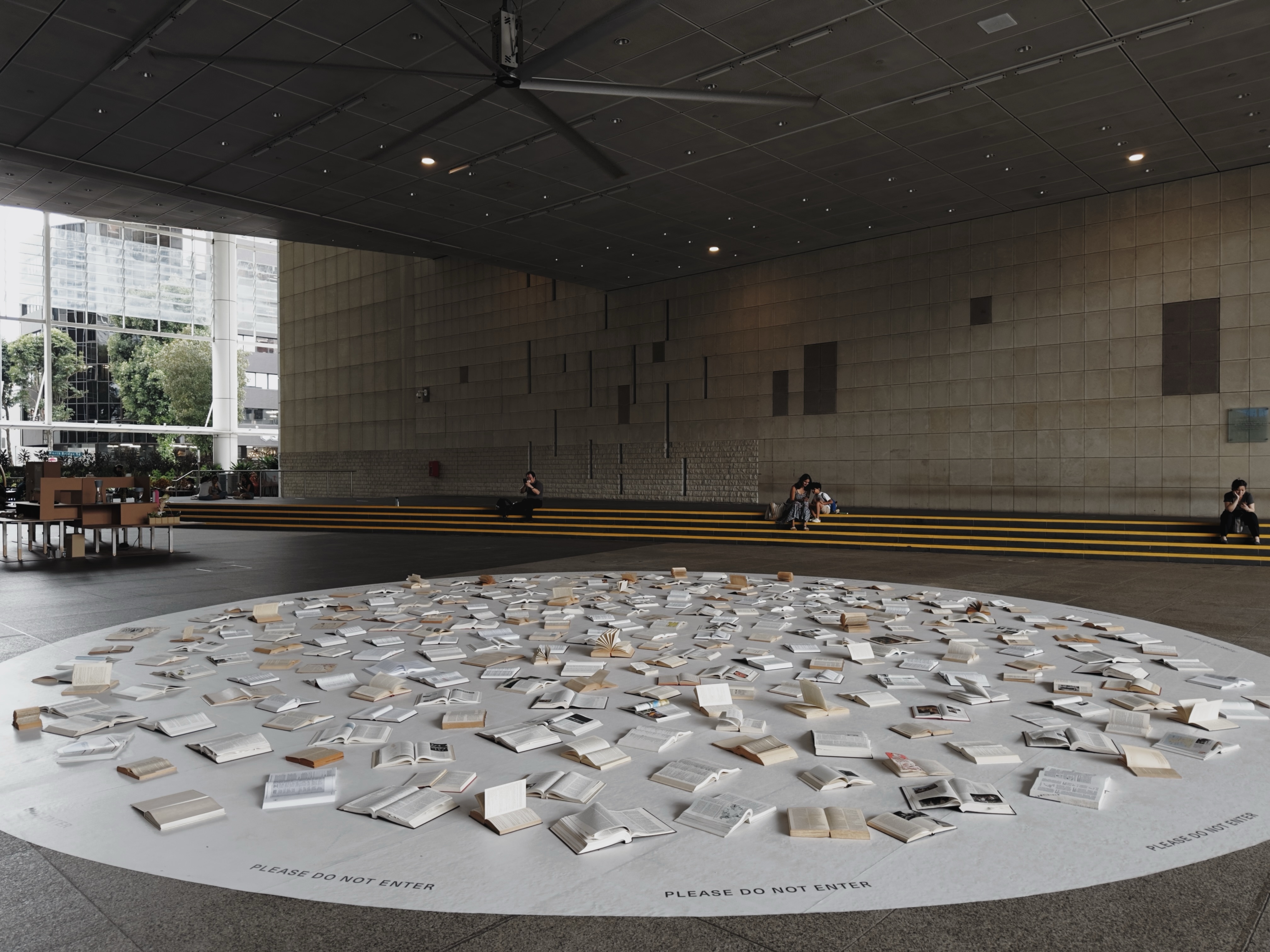
There were also many free events and exhibits across town, and I filled pockets of time by dropping in on the ones around Orchard Road and the Bugis district. My favorite location was probably the Central National Library building which hosted some thoughtful and playful meditations on books and reading: from the physical aspects of holding spines and flipping pages, to sensorial explorations like how smelling different types of paper can evoke long-buried memories.
It was my first time really checking out the Central Library, and it’s quite impressive. The reference section spans some five levels (from 7 to 11, I think), with the public lending library in the basement. Nearly every free seat was taken on a weekday afternoon, many by students of all ages who were… doing homework? I spotted someone doing math on the Humanities floor, so I guess it’s just an air-conditioned spot for some, nothing to do with the materials available.
I wanted to read some poetry, and found a copy of the collected works of Philip Larkin, in the exact same paperback edition I had as a student. I sat with that for half an hour, next to some senior citizens who looked very much at home.
Let’s loop back to Uniqlo: I half-joked on Instagram that one of the best design artifacts I saw whilst out exploring Singapore Design Week ‘24 was in fact Issue #11 of the free Uniqlo LifeWear magazine they give out in stores. It’s in both Japanese and English, with elements of Japanese editorial design and whimsical Monocle-esque illustrations. In addition to the expected fashion spreads of their products on models, there are also recipes, features about their global stores and the cities they’re in, and profiles of artists they collaborate with. I wish we had more brand publications like this, where there’s no distinction between making something nice for customers and trying to sell things. You can also read it online.
On Thursday morning with some time to kill, I decided I’d best drop by the library@orchard to have a quick look before it closes down at the end of October for a lengthy renovation. It won’t be back until 2026, and the cynic in me thinks it won’t come back at all, much like how the Singapore Art Museum is now seemingly trapped in shipping port limbo, unable to return to its original downtown location because the land is now too valuable to allocate to the arts or whatever. I mentioned this before.
Then I spent the afternoon with Peishan and Cien at an odd cafe that identifies as a co-working space — essentially you are welcome to sit there all day and leech off their power and WiFi, with no stated minimum purchase amount or anything. I don’t get the business model, but they’ve survived for years somehow. Perhaps it’s guilt based, because I ended spending twice as much in food and drink than the cost of a hot desk would be for an entire day.
Media Activity
I presume the other two got some work done, but I spent my cafe time clearing email newsletters and watching an episode of The Old Man, a 7-part TV series from 2021 that I didn’t know existed until recently. It stars Jeff Bridges as an aged CIA agent in hiding whose past catches up with him (I know, I know! But I’ll always make time for a set up like this), and the first two episodes were directed by Jon Watts (Wolfs, Spider-Man: Homecoming). The whole thing is so well executed that I wish it was longer. I’m told the second season, running now, has lost the plot. But trust me, if you like spy stories at all, you’ll want to see the first.
Wolfs (2024) is now out on Apple TV+ and I enjoyed it just fine. For me, seeing George Clooney play a spiritual reboot of Winston Wolf, the fixer from Pulp Fiction (1994), is such a treat that it overrides other parts of the film being predictable or “small scale”. There’s also undeniable chemistry between him and Brad Pitt, who does that thing where he goes from smug, unlikable asshole to an alright guy after all, right before your eyes. Too bad he can’t do that with his real family. 4 stars.
I finished The Book of Elsewhere, a sci-fi/fantasy (really, I think it’s both) novel by China Mieville and Keanu Reeves. It was extremely enjoyable while sounding in many places like a thesaurus was devoured in the writing of it. Once you get past some of the “awkward” use of big words when smaller ones would do, the rest of the writing is good, and occasionally becomes deliciously unhinged. Phrases literally collide with one another and tumble down pages like experimental poetry in some places. Elsewhere, Mieville (I assume) manages to replicate the dreamlike quality of visual storytelling — this story first appeared in a comicbook series entitled BRZRKR, by Reeves and Matt Kindt — and narrates the immortal protagonist’s violent fugue states and how he experiences passing from death to rebirth with some of the most Class-A, Colombian-grade stream-of-consciousness I’ve ever seen.