




Category: General

  • The Colonial Bar

    That much of the building’s history has been recorded and can be found online without too much trouble. I’m trying to assemble a better picture, mostly from anecdotal information offered by the neighborhood’s older residents, who’ve stopped by to check out the newly-revived icon, as told to the bar’s current staff. My assumption is that the Colonial’s current claim of being “established in 1924” is accurate, as it must have existed in some form to serve patrons such as the governor. Whether or not it continued to operate up until the Japanese Occupation of World War II is uncertain.
    During the occupation, I am told the Ellison Building was commandeered by the Japanese army for use as one of their headquarters, which would make sense, given the proximity of the place to the Jalan Besar Stadium where the infamous “Sook Ching” screenings and executions took place. My knowledge of this period in history is regrettably weak, not having been fortunate enough to watch any of Channel 8’s many Chinese drama serials set during the war (2). In any case, I recommend reading the aforelinked article. As many as 100,000 people are said to have been killed by the Japanese in a matter of weeks, with one source claiming 30 million victims throughout Asia.
    When asked to confirm whether the Ellison was indeed a Japanese army HQ, my grandmother replied: “We were too busy hiding and trying to survive then to pay a visit to the Japanese headquarters.” In my opinion, there was no need for the sarcasm; I did ask nicely.
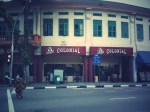
    At some point after the war, the Colonial was resurrected and was known to have been in business at least between the “60s and 80s”, according to the current manager. I can attest to not having seen the bar during any of the years where I shuttled up and down Bukit Timah on my way to Sim Lim Square, which is to say all of the last decade. If it was, it stayed hidden behind the signage for an Indian eatery and a second-storey roach motel for backpackers. This post-war period is where most of my questions about the Colonial are concerned. Does anyone remember it? Under what circumstances did it close? On October 24 2009, the newest version was unveiled with little fanfare, incongruously positioned between a decaying Indian newsagent and a tactical military equipment supply store. Diagonally across the street, another remodeled local icon, Tekka Centre, is now a floundering mall called The Verge.
    ~
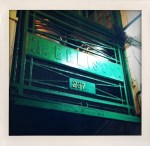
    The first thing one notices is the snazzy, illustrated logo of a helmeted British army man on the signboard and on posters throughout the premises. These materials have obviously been designed with some care and effort, although they are not at the level of say, Leo Burnett’s work for the Ya Kun Kaya company (3). Several large LCD television screens display a mix of live sports and insipid cable fare such as Ellen DeGeneres’ talk show, while the music is the kind of radio-derived playlist one might expect to find Jason Mraz and Norah Jones on. Volume levels are conversation friendly.
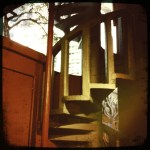
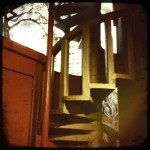
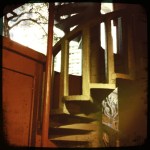
    Few colonial touches are present in the decor scheme, if you count the black and white floor tiles arranged in a loose checkered pattern, but for the most part it’s comtemporary with strange design contradictions. The black bar counter is sleek and frames a liquor shelf dramatically lit from above, but other furnishings are on the cheap side. There’s a pool table, foosball table, and touchscreen games machine in an adjacent wing, which is what you’d expect in an above-average pub, but the roof doesn’t fully extend to cover this section. You actually see trees and the sky above, while an intact original spiral staircase winds its way through like some ancient tree embraced by a hippie boutique hotel built around it. No doubt, the place has a charm of its own, but it’s raw while trying not to be. I sense the hand of a younger entrepreneur behind all this, which leads to interesting questions like, “Why bring this bar back?”, “What’s their connection to the Ellison?”, and “Ellen DeGeneres? Really?”
    But we could sit here all day talking about aesthetic details and whether or not the specter of colonial rule makes this an appropriate place for a foreign man to be seen with a local woman, or we could talk about how absolutely cheap the booze is. My friends, it is CHEAP. When I first wandered in a week ago, Happy Hour (till 8pm) prices were an incredible $15 for two jugs of Tiger beer. That’s draught beer, and yes, one jug (four glasses worth) for $7.50. They can’t keep this up, I screamed aloud, they’d be crazy to sell drinks at these prices! And so when I returned today I found that they’re not crazy, just a little unsound. The new Happy Hour deal is a single jug for $11, which is still cheaper than any hawker center or kopitiam I can think of. For context, that’s less than the cost of a pint in most bars where you’ll find white people drinking today. Colonialism is dead, long live the Colonial!
    —-
    (1) According to a 2007 article at JewishExponent.com, and the Singapore Tourism Board’s Little India website.
    (2) I hear The Little Nyonya is a good example, if one were so inclined.
    (3) Full disclosure, one of my former bosses worked on them.
    —-


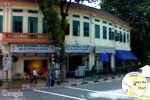
    Edit 8/2/2010: This is Google Street View’s photo of the corner before The Colonial:

    —-

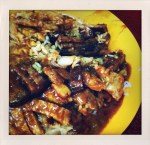
  • Eleven Finger (Eu Kee) Scissors Curry Rice

  • %%TITLE%%

    %%CONTENT%%

  • %%TITLE%%

    %%CONTENT%%

  • On taking holiday photos

    Back from Japan and already making plans to learn the language and move over. Only half-kidding. I don’t think I could take the grind of commuting to a crushing office job every day, even with the weekend salve of maid cafes and pachinko. It’d have to be a work from your tiny home sorta job.

    Since I left talking about cameras, I’ll come back to the subject. The Sony WX1 held up really well and I took more photos with it than with the Panasonic Lumix LX3. Having it just two seconds away in my pocket at any time made all the difference. I think it’s my new favorite camera for casual street use. It struggled under tricky lighting conditions though, and couldn’t really handle park/nature scenes with shadows and subtlety. Comparing it with such shots from the LX3 really shows up its weaknesses.

    I usually have a two camera limit, but the iPhone’s camera complicates things, and I bought a Digital Harinezumi 2 from the Superheadz Camera Cabaret store in Shibuya (truly fantastic little place – here are some directions: Go north from the Tokyu Hands store, and it’s just across the street from the Ward Office (and the Shibuya Tobu Hotel). You’ll find it up a little road on the right leading towards the two Beams boutiques. The store itself is on the right, before you reach Beams, after the popular ramen shop with the logo that looks like the number 9 in Chinese. [九]) In all, I took about 2,200 photos with four cameras.

    Editing these poses many problems, as you might imagine. My approach now is just to shoot the hell out of everything. Multiple shots with different exposure settings, use the widest angles and the longest zooms, a few safety shots if people get in the way, and sometimes if a place feels interesting, just take a few shots in case I find something later in them to crop to. Sometimes along the way I’ll delete a few hopeless ones from the camera, but there isn’t always time. But when I get home, paralysis sets in. I can’t remember why I took a particular photo. Or I’m afraid to cut out too much of it. I try to reverse-engineer my intentions from the composition. Why is this shot this way, why is that the subject? I don’t dare to delete anything once home because every photo is an artifact of a place I cannot soon revisit, and must be preserved. I forget that sometimes I didn’t know what I was doing.

    I think the answer is to treat holiday photography like a two-stage process. It’s not just shooting and cleanup. Postprocessing is like shooting the photos all over again, with possibly different intentions. You have to go into it ready to make the effort. When you’re walking all the time and can’t afford to stop and study the angles and plan the perfect shot that will represent the atmosphere of a place, you just have to shoot everything and do the best you can in 30 seconds. Once back, you have to start over with new eyes and not work backwards.

    One obstacle to this is always your own memory. It colors everything and makes unimportant, uninteresting things seem worth sharing. Ideally, I’d only post about a hundred photos from the two thousand shot, but right now I’d be happy to come in under 600. I suppose a second round of culling the best into another Flickr set can happen later. I’m quite certain other people have the same problem, especially teenagers, as evidenced by most Facebook photo albums. Most casual photographers post everything, similar shots and bad shots along with their best. Completionists and hoarders have it worst, and I know I’m a little bit of both.

    Anyway I’ll post a link to the full photoset here when I’m done. At the moment I’m uploading as I go along, but might make some more of the poorer choices private as I go.

    — Posted from my iPhone

  • Going to Japan

    Leaving for Japan tomorrow with a couple of friends. It’s a trip we’ve talked about for the last two years but never got around to actually booking until now. Long-time readers will remember that I set up a wiki on this domain back in 2007 for notes on things to see/eat in Tokyo. I think we cancelled for a number of reasons, one of them probably being that I’d just left my job and wasn’t sure what I was going to do. Coincidentally, one of us going on this trip has just quit his. Some people like to go on long, liberating holidays after quitting. I’m far too conservative with money for that. Oh did I mention that I’ve just bought a new camera for this trip?

    I really didn’t need it, because I’ve still got my Panasonic Lumix LX3, which is by far the best non-SLR digital camera I’ve ever owned, apart from being a bit of a fatty. The Sony WX1, on the other hand, is as small as my Canon IXUS 80, but with a 24mm wide-angle lens and low-light performance that beats the rather noisy LX3. The only way around color noise on the LX3 is to shoot no higher than 400 ISO, but you’ll need steady hands for that. Sadly, the WX1 only offers 4:3 shooting; the other aspect ratios are just crops. But once you see how clean its handheld night shots are, you’ll want one too.

    I just thought I’d put that out there in case anyone was thinking of buying the same. It’s a good pocket companion to a more prosumer camera like the Canon G11, S90 or Panasonic LX3. It’s lack of manual controls will keep you from using it exclusively, while small and fast enough to rely on when the other one’s at home/in the bag. I swore off Sony cameras a couple of years ago because they were a bit of a pain to use and had poor outdoor white balance with our local lighting conditions. But this one is an easy recommendation so far (as long as you turn the Dynamic Range Optimization function off).

    This is a photo of what I had at lunch today, virtually untouched from the camera.

    Roast pork belly

    I should have more when I get back in two weeks. Mata ne.

  • M1, StarHub, and Apple’s iPhone exclusivity

    Using network growth to fight Android’s ubiquity

    Earlier today, StarHub announced their plans to offer the iPhone before the end of the year. Set aside for a moment that feeling of deja vu, when it does happen, Singapore will be one of few countries (if not the only?) to have the iPhone on all its nationwide carriers.

    I’m not interested in the telco strategy here, which is obviously to prevent bleeding customers over to the other guy with the iPhones. Apple seems to be doing this all across its international markets. In the UK, O2 lost its exclusive rights after about two years, and you can now get the smartphone from Vodafone too. AT&T loses its three-year rights next June. I see that as the deadline for these expansion plans. Apple appears to be expanding its reach in anticipation of June, which will likely bring a new iPhone model that could possibly work with another major US carrier’s network. Or two.

    The iPhone’s current greatest weakness isn’t the lack of a physical keyboard, camera flash, multitasking, or all those other things Verizon’s first iDont (sic) ad pointed out – it’s the network exclusivity. Many people want one, but won’t switch to AT&T/Singtel/etc. for countless personal or practical reasons. Verizon sees its rival’s weaker 3G network as the button to hit, and hits it three times with these new ads, also launched today. The Android platform has catered largely to people wanting an alternative to the iPhone on other networks by making itself available on a (promised) raft of devices. In Singapore, M1 and StarHub have spent the last cold, quiet year pushing Symbian, Windows Mobile, and Android smartphones to customers in lieu of the iPhone. I don’t believe Apple sees the first two as threats. Android is beginning to look like competition, which is a good thing.

    But it’s clear that people hate AT&T’s service quality. Unreasonable tariffs have also inspired similar feelings of animosity around the globe, towards Singtel, Rogers, and so on. Continuing the way they were, iPhone sales might have stalled. This latest round of international market expansion, culminating in a new US carrier next year, is probably their most visible play at limiting Android adoption.

    What I mean is this: Given the choice between an iPhone and an Android phone in the same store, the data shows most people will choose the iPhone. What further kills Google’s mobile OS is the fact that I can’t see either M1 or StarHub, having blown a huge wad of cash to secure the iPhone in 2009, spending too much time or money promoting alternative phones in 2010. The long wait has made them hungrier and more eager to extract gains from this last-minute victory, and they’re going to be pushing the iPhone as hard as Singtel did when it was given exclusive rights last year, if not harder. Apple is notoriously good at playing suppliers against one another to get better deals, so it’s no surprise that they’d do it to their retail partners too.

  • ArcSoft Panorama Camera for iPhone

    Just a word of warning to everyone who reads this site: don’t buy Panorama Camera for the iPhone ($2.99). It’s pretty crap, and I’ve got a review up over at Positive Machine to that effect today. Autostitch is still your best bet.