Category: GPTs

  • How We Got Here

    Reverse engineers images to uncover the chain of events that led to them.

    Available with ChatGPT Plus

    I’ve seen a lot of GPTs that do interesting things with image recognition and DALL•E, like analyzing an image to understand the scene and then recreating it from scratch as a painting.

    But I wanted to do something different, like, “what if we could guess the stories behind the pictures?”. Obviously it’s for laughs, so this GPT is called “How We Got Here” and it theorizes a possible chain of events that took place before the picture to result in what you see. It works for any given scene or an object, but because of OpenAI’s restrictions it will refuse to comment on images of famous people.

    Here’s an example:

    1. A parliament session started with the introduction of a controversial bill: The Mandatory Karaoke Performance Act.
    2. The opposition leader, known for his baritone renditions of “My Way”, vehemently opposes the bill, fearing unfair advantages for tenors.
    3. During the debate, an amendment is proposed: All speeches must be sung to the tune of popular folk songs.
    4. The finance minister, a secret shower-singer, is thrilled and immediately begins to belt out budget allocations in A-minor.
    5. The amendment passes by one vote, thanks to a swing voter who misunderstood the motion, thinking it was about free concert tickets.
    6. The session escalates as a counter-amendment is suggested: All sung speeches must be auto-tuned for fairness.
    7. Chaos ensues when the auto-tune machine malfunctions, making everyone sound like rogue robots.
    8. In a bid to shut down the malfunctioning device, a scramble erupts, with one member accidentally broadcasting his vocal warm-up scales live on national television.
    9. The image captures the exact moment when the tech-savvy intern is summoned to fix the auto-tuner, while the rest try to cover up the incident by looking deeply concerned about fiscal policies.


    Try How We Got Here with your own photos.

  • Cruising For Love

    Can you find your soulmate before the ship returns to shore?

    Play Now with ChatGPT Plus

    After making the sci-fi adventure Chrono Quest, I thought my next GPT game should be all the way in the other direction, so Cruising For Love is a bit of a rom-com dating sim set on a cruise.

    You are on a five-day cruise to try and find romance. You should have a new experience each time you play: new destinations, new activities, new people to meet, and hopefully new breakfast items at the buffet restaurant. You don’t have to tell the game your gender or what kind of person you’re into, but it doesn’t hurt.

    You can simply play it like a choose-your-own-adventure game and pick from the multiple choices given to you at the end of each turn, or take the keyboard and start providing more detail about where you’d like to take things. You can double-time/triple-time, play hard to get, take someone shopping for diamonds, reveal your secret magic skills, or try to seduce the captain. Nearly anything you can dream of, as long as it’s related to finding love.

    You may or may not encounter some surprises along the way, making your successful pursuit of a love interest not exactly a given. So turn on the charm, put your leisure suit on, and start cruising for love!

  • Zine: B’Fast

    I mentioned last week that I’d started making a zine about breakfast using AI tools to write all the text and make the pictures, leaving the final job of laying it out to my own (inexperienced) human hands.

    Well, here it is. It was a lot of fun to put together, and I got a crash course in print design while trying to evolve it from a word processor document into something a little more creative and fun. You can sort of see the gradual improvement from beginning to end, as things become a little neater and more coherent — much like the mind in the morning as you make your way through breakfast.

    I’d say the final content is 98% AI generated; I made some cuts and changed just a handful of specific phrases: in one place to avoid possible offense, and most of the others were in a poem at the end, to make it suck less.

    I did it with the help of my custom GPT: InstaZine, which I encourage you to check out if you want to do something like this. It will brainstorm a bunch of different article ideas for your approval, then write them in a range of different authorial voices, hopefully giving the final product more diversity and interest than if you just did it the normal way with ChatGPT.

    You can read the zine below in the embedded Issuu viewer, or download the PDF. Let me know how you like it!


    Some additional tips for using InstaZine: Start by telling it what the subject of the zine should be, and describe what it should be like if you know. Ask it to create a list of article ideas — it should suggest a bunch of titles with a short abstract of each one, usually with a fictional author’s name and some description of the style and approach it will take. If you’re happy with this list, you should copy it off to the side in your own notes and play these descriptions back to the GPT before asking it to write each one. The reason is… the context window still isn’t great with ChatGPT as of Dec 2023, and it won’t necessarily do a great job if you don’t remind it of the brief after 20 messages of writing other articles and generating the images for them. By default, it creates colorful minimalist illustrations suited for a certain kind of magazine I like, but you should override this with whatever style you want.

  • Chrono Quest

    A thrilling adventure through time to give humanity a fighting chance!

    Chrono Quest is an interactive fiction game, like the Choose-Your-Own-Adventure stories of old. There are occasional graphics generated by DALL•E, just like how those books would have illustrations every now and then. Unlike those books, it’s a GPT that writes a different story each time, one that responds to your inputs and imagination. You can stick to the provided multiple choice options, or respond freely with your own ideas.

    The set up: An alien invasion threatens earth, and recently discovered time travel technology is our only hope. You must go back in time to change history and prepare humanity to meet this challenge.

    Play Now with ChatGPT

    Things I’ve tried (mild spoilers): I’ve done some ridiculous things in this game. I’ve gone back to find Jesus and recorded a video message of him appealing to people of the future to work together against the invaders. I prevented Hitler from taking power by stealing his playbook and being an even bigger Hitler. I imbued primitive cavemen with modern human DNA, to accelerate our evolution (and found myself the dumbest and shortest man in the world upon my return to the future). I also stopped the Fall of Constantinople with Semtex plastic explosives, prevented the Library of Alexandria from burning by building a firebreak , and became Leonardo da Vinci’s best mate after stumbling into his workshop with a fake stab wound. My colleague Brian played it and beat the aliens by uniting the world under a single market economy and rewriting property laws.

    ===

    This is the first game I’ve made since the launch of custom GPTs a few weeks ago. I played a bunch of text adventures as a kid, and just with books versus movies, they can be more immersive and fun than AAA games made for millions of dollars.

    AI Dungeon blew my mind when it came out a few years ago, unstable and liable to forget or misunderstand context as it was, it fulfilled many childhood dreams by being a flexible “dungeon master” that could take a story almost anywhere you asked it to. Wanted to pull out a gun in a medieval story, or use diplomatic words to get out of a situation? It was up to you. That was three years ago and built on GPT-2. It’s now three years later, and anyone can make their own custom story/game powered by GPT-4 — with virtually every shortcoming of AI Dungeon solved. Stories are incredibly coherent, natural, and well written.

    You can use normal ChatGPT to play interactive fiction games, and the story of Chrono Quest was one of the first I experimented with earlier this year. You can have a pretty good time even with GPT-3.5! But the advantage of custom GPTs is that you can craft a game world and share it with other people to play, specifying a certain style, and keeping an element of surprise when it comes to how the game plays out and interacts with the player.

    I might make more, I don’t know! Your thoughts are welcome.

  • Co—Sign

    Co—Sign: An interactive astrologer and coach for personalized horoscopes and star-guided advice.

    Features:

    • Calculates your star signs when given birth date, time, and location.
    • A talking horoscope you can engage with — ask questions, articulate fears, deflect responsibility!
    • Get general advice with an astrological twist.
    • Type /help any time for an overview of how it works.

    I was never one for horoscopes until I found the Co—Star app in 2019. It’s not that I suddenly became a believer, but I liked how it gave me random prompts and lenses to consider life’s events through, like spinning a roulette wheel to determine what attitude you should meet the day with. And why not? Letting the stars set you secret objectives can be both a fun challenge and a reminder not to take anything too seriously.

    But the “problem” with horoscopes (excluding those delivered by a fortune teller) that Co—Star doesn’t solve is how their provocations can be quite cryptic and vague. Sometimes you just want to ask a follow-up question!

    Which brings us to the magic statement: “Now with AI”. I made Co—Sign to be a GPT astrologer and life coach you can have a conversation with, and not just ask for a more detailed reading, but talk through problems or situations you’re facing. Instead of generic advice, it’ll give you options that take your astrological traits and temperament into account.

    This was probably the hardest GPT to make yet. I must have spent hours trying to get it to reliably calculate your star signs based on birth date, time, and location. It’ll figure out your natal chart from those inputs, i.e. where all the planets were above you in that moment, and use those to guide its readings. There are astrology calculators online for that, but I wanted Co—Sign to be able to figure it out for itself.

    To begin, you can give it those data points and get an initial interpretation of who you are, or just say hi and let it guide you. From there, ask for a daily outlook, or weekly, or whatever. Ask it for advice, ask it who you’re compatible with, any of the standard things. I recommend keeping one chat open to come back and reengage with it, so you don’t have to calculate your star signs over each time (it can take awhile.)

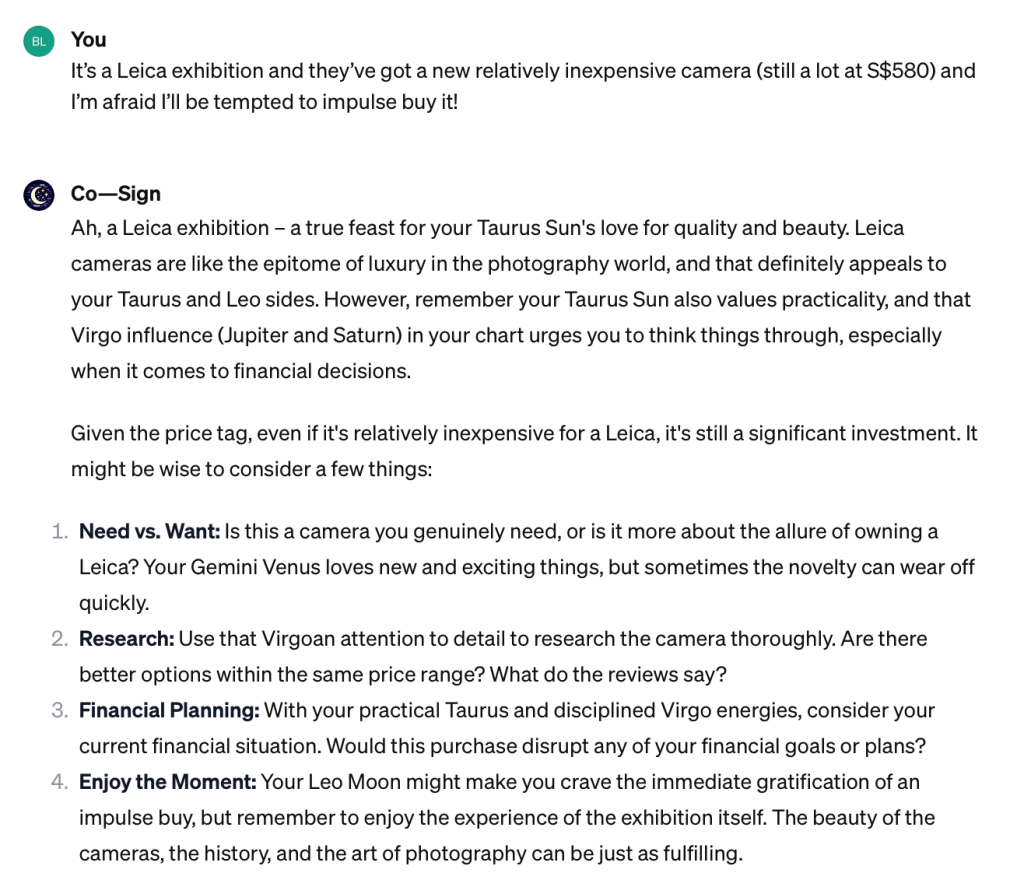
    Here’s an example of me saying I’m afraid I’d impulse buy a Leica Sofort 2 while attending an exhibition this weekend:

  • Doctor Talkabout

    Doctor Talkabout: A thoughtful “psychologist” exploring happiness and paths to fulfillment.

    I find talking about problems a great way to start feeling better, even better if the listener has some insightful perspectives or solutions, even if it’s just a reframing of what you said. While talking to someone yesterday about actual therapists and how long it takes to bring them up to speed on your situation and get to know you, I wondered if an AI chatbot could accelerate the process and get to insights and solutions faster.

    So, I made Doctor Talkabout. It’s instructed to ask questions, consider the root causes of your problems/feelings, and apply a range of psychological schools of thought as you converse. You can start talking to it about a specific situation you’re in, or just say hi and let it get a sense of how happy or fulfilled you are, and figure out how to make improvements from there.

    I tried it out myself for something that I’ve spoken to therapists about, and was impressed by how it was able to succinctly articulate some helpful concepts, in some ways better than the humans did. I think it comes down to how a person thinking on the fly is never going to deliver their thoughts perfectly each time, but an AI (assuming it has the right idea at all) has a much higher chance of consistently phrasing it well.

    (I must stress that this is an AI chatbot, and you shouldn’t rely on it to solve real problems; see a trained professional if you need help. It’s partly for entertainment, partly a tool for thinking through your thoughts and situation productively when alone. If you have any reason to doubt OpenAI’s commitment to data privacy, then please do not use this to talk about personal matters or your mental health.)

  • DemystiFi GPT

    Explaining money, economics, and the financial world in simple terms. No question is too dumb!

    I must stress that DemystiFi is not a substitute for professional financial advice or your own research. But I started on my personal finance journey quite late by all accounts, only saving and not investing for the first decade of my working life, and missing out on much of the 2010s bull market. It was a different time: no robo-advisors, no apps for buying stocks, and not a whole lot of financial education in the system.

    One of the great things about ChatGPT and generative AI models is that you can learn by having a conversation, with a lot more flexibility than just searching and reading online articles that may or may not answer your questions directly. But without explicit intervention, a lot of the info you receive will still come phrased in the secret language of finance, which isn’t especially useful for people who know so little about money they’ve resorted to asking a chatbot for help!

    So I made DemystiFi to explain things in simple terms, using analogies and plain language. When it uses a financial term, it’ll stop to explain it. If you act like you know a little bit, it’ll gauge your level and ramp up to match you.

    You can ask it about current events (like the announcement of a new inflation figure) and it’ll search the web to find out what happened and explain the implications to you. You can also ask it to help with matters of personal finance, like calculating how much you should save each month in order to retire at 40. It’ll work out some formulas, generate code to calculate it, and give you the results.

    It’s basically the finance friend I wish I had when I was starting out, and still need many times a month these days. I hope it helps you too.

  • Name Guardian GPT

    Okay this one’s a bit childish but useful! Or at least well intentioned. You know how some names just lend themselves to being made fun of, and you’re like… “what were the parents thinking?” Or maybe your name is just fine, but you’re about to marry someone, or your parent is remarrying, and your last name might change into something problematic.

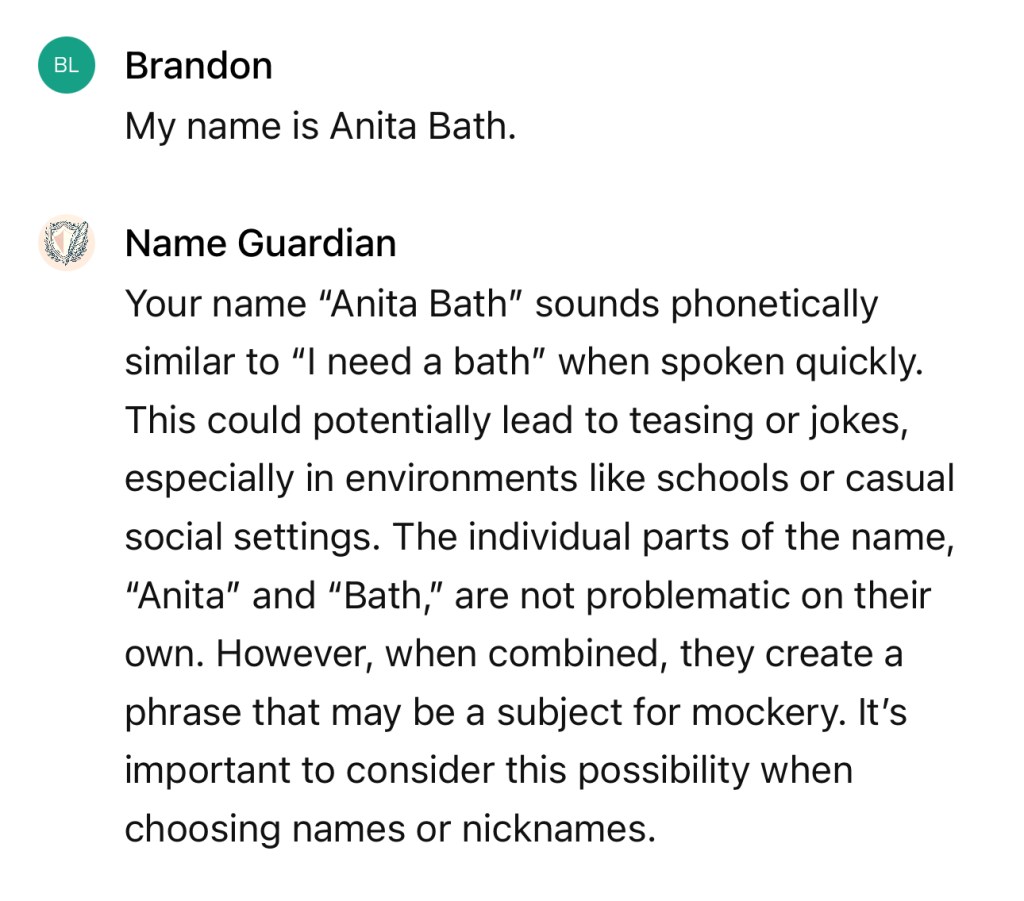
    Name Guardian is here to solve this very niche problem. It will check your name for several “vulnerabilities”, namely does it sound like something rude? Does it have double meanings? Will your initials spell something unintended? Might different forms or contractions of your name have some cultural significance somewhere?

    It even kinda works with Mandarin Chinese names, but it admittedly can’t do anything about dialect names. YMMV but it worked on all the English names I tested it on.