
This week in artificial intelligence was a big one: Humane unveiled their highly-anticipated wearable, while OpenAI made strides with ChatGPT enhancements.
The Humane Ai Pin
A lot has already been said about the letdown that the Humane reveal was, mostly by people confused by the presentation style of the two ex-Apple employees who founded the company.
If you’ve seen Apple events and Humane’s 10-minute launch video, you’ll note the contrast in delivery and positioning. Apple tries to couch features and designs in real-life use cases, and show authentic enthusiasm for what they do to improve customers’ lives (Steve was unmatched at this). Humane kicked off with all the warmth of a freezer aisle, missing the chance to sell us on why their AI Pin wasn’t just another tech trinket in an already cluttered drawer. They puzzlingly started with how there are three colors available and it’ll come with extra batteries you can swap out, before even saying what the thing does! The rules of storytelling are quite well established, and why they chose to ignore them is a mystery.
A lot was also said about how two key facts in the video presentation, provided by the AI assistant so central to their product, turned out to be inaccurate. One was about the upcoming solar eclipse in 2024 (and Humane’s logo is an eclipse! How do you get this wrong?), and the other was an estimate of how much protein a handful of nuts has. It’s a stunning lack of attention to detail that this was not fact-checked in a prerecorded video.
Personally, I have been waiting for the past five years to see what this stealth startup was going to launch, and as the rumors and leaks came out, I was extremely excited to see an alternative vision for how we interact with computers and personal technology. What they showed did not actually stray from what we knew. An intelligent computer that sees what you see, is controlled by natural language, and is able to synthesize the world’s knowledge and project it onto your hand in response to queries is amazing!
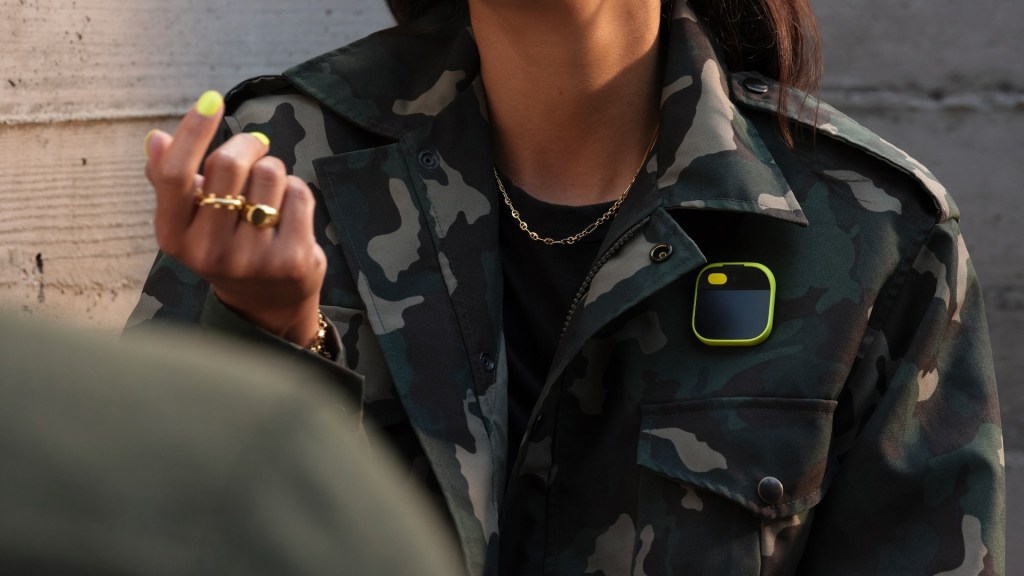
The hardware looks good, channeling the iPhone 5’s design language to my eyes, and I’ll bet they had to pioneer new ideas in miniaturization and engineering to get it down to that size. I expected it to cost as much as an iPhone, but it’s only $699 USD, which feels astoundingly low. That’s not much more than what we used to pay for a large-storage iPod.
The disappointment is in their strategy. By positioning it as a replacement for your phone rather than an accessory, they’ve reduced the total addressable market to a few curious early adopters and people who want to address having a tech or screen addiction. The kind who intentionally buy featurephones in 2023. I think their anti-screen stance is interesting, but it doesn’t win over the critical mass necessary to scale and challenge norms.
The Ai Pin comes with its own phone line for messages and calls (for $24/mo), so it’s not going to be convenient to use this alongside your phone, and I would not give up my phone while this is still half-baked — I say this kindly, because even the iPhone launched half-baked in many ways. For many things that we have become accustomed to in life, there is no substitute for a high-definition Retina display capable of showing images, video, and detailed or private information when necessary.
Do I believe that Apple can one day get Siri to the level of competence that OpenAI has? I have to hope, because the Apple Watch is probably a better place for an AI assistant to live than in a magnetically attached square on my T-shirt. In any case, Humane seem to have taken a leaf out of their old employers’ playbook, and will be releasing this first version only in the US, and so whether or not I would buy one is a moot point.
OpenAI and GPTs
Speaking of OpenAI, it would seem that they’re still the team to beat when it comes to foundation models. The playing field is full of open-source alternatives now, including Lee Kai-Fu’s 01.ai and their Yi-series models, but as a do-it-all company offering dependable access to dependable AI, OpenAI seems unassailable.
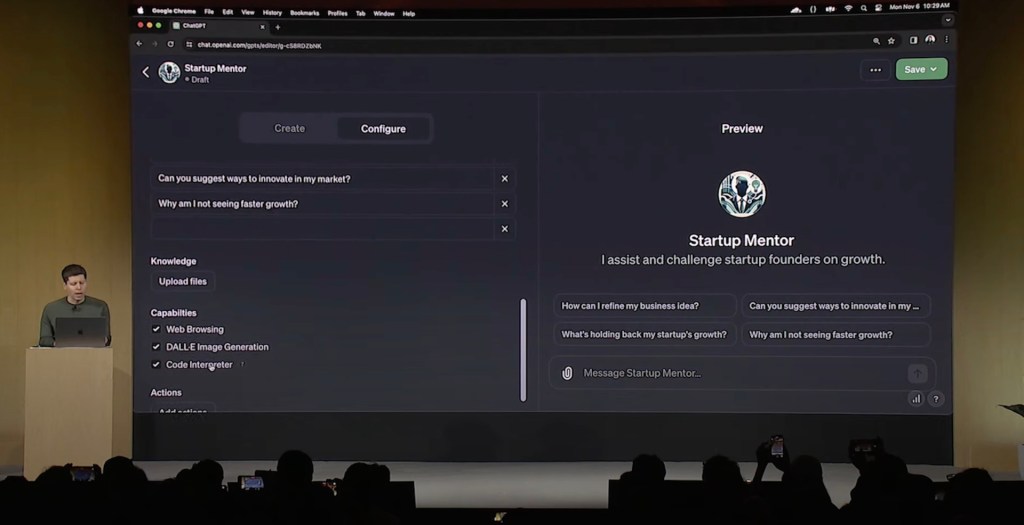
They announced enhancements to their models, increasing context windows and speeds while halving prices for developers, and launched a new consumer-friendly product: customized instances of ChatGPT that work like dedicated apps, which they call “GPTs”. In effect, these are a version of Custom Instructions which were introduced earlier this year as a way to tell ChatGPT how to behave across all chats. But sometimes you’re a researcher at work and sometimes you want to have some dumb fun, thus I’m not sure they caught on.
So now GPTs let you specify (pre-prompt?) different contexts and neatly turn them into separate tools for different purposes. Importantly, you can now also upload knowledge in the form of files and documents for the agents’ reference in generating replies. This makes them more powerful and app-like, and normal people like me with no coding ability can create them by telling a bot what they want (in natural language, of course), or writing prompts directly. I recommend the latter, because chatting with the “Create” front-end tends to oversimplify your instructions over time and you risk losing a lot of detail about how you want it to work and interact with users.
So what does the launch of these GPTs mean? Well, for many of the developers who were riding the OpenAI wave and only used their APIs to build simplistic wrapper apps, it’s a sudden shift in the tide and they’re now forced to build things that aren’t reducible to mere prompts.
What we’ll soon see is a GPT gold rush. Brace yourself for a stampede of AI prospectors, each hunting for their piece of OpenAI’s bonanza — the company will be curating and offering GPTs in a “Store” and sharing revenue with creators. That’s a different model than their APIs where developers pay OpenAI for compute and charge users in turn. Here, users all pay OpenAI a flat fee for ChatGPT Plus and can use community-made GPTs all they want (within the rate limits).
Hear everyone talking about a viral GPT that makes it so easy to do X? When you want to try it out, you’ll see a call-to-action to sign up for ChatGPT Plus. This signals to me that launching GPTs is a strategy to drive paid account conversion, which begins the lock-in that OpenAI needs in order to make ChatGPT the new OS for services, not unlike how WeChat is the base layer that runs China, regardless of whether you use iOS or Android. Eventually you won’t even need to know about or choose the GPTs you use; the master ChatGPT system will call them as necessary. We may not be headed for a screen-less future, but we’ll probably see an app-less one.
My GPT projects


Of course I’m playing with this and making some of my own! Did you think I wouldn’t, given the ability to create AI things without coding?
I’ve got a list of ideas to work on, and so far I’ve acted on three of them, which are explained on this blog in separate posts.
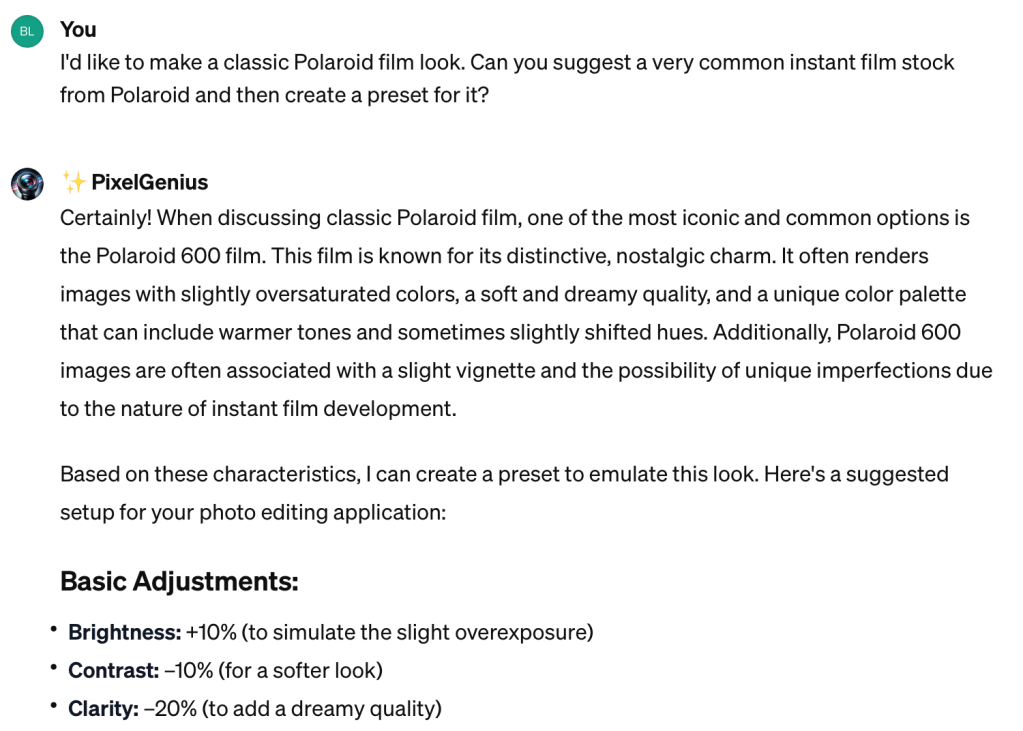
✨ PixelGenius was my first, and contains the most complex prompt I’ve ever written. It started out as a tool to generate photo editing presets/filters that you can use on your own in any sufficiently advanced photo editing app with curves, H/S/L controls, and color grading options. You can just say “I want to achieve the look of Fujifilm Astia slide film” and it’ll tell you how to do that. But now it does more than just make presets, which you can find out about here. More details and examples in the blog post here.
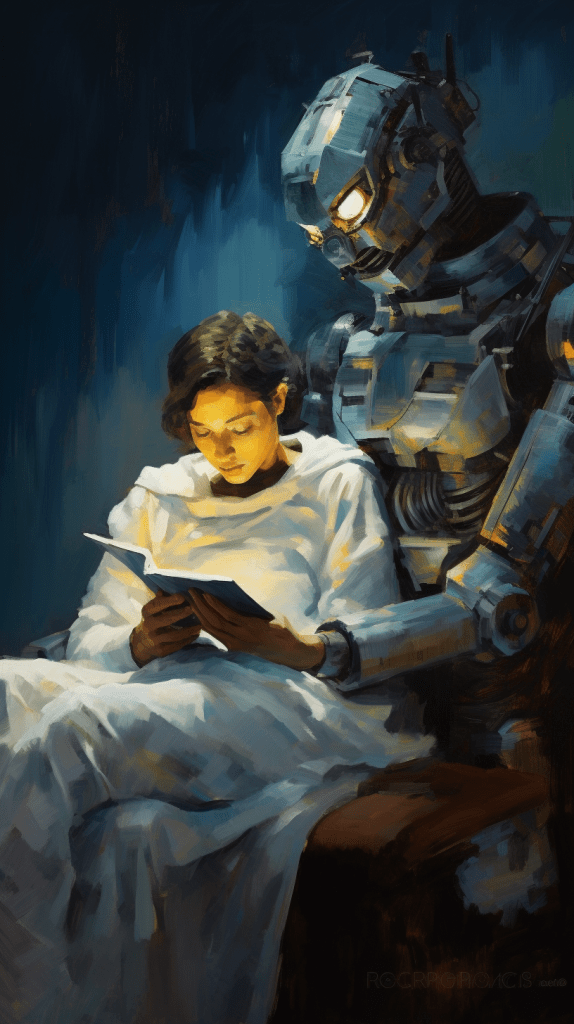
😴 SleepyTales was the second, and I’m still amazed at how good it is. It’s designed for Voice Conversations mode (currently only in the mobile app), so you can get a realistic human voice reading you original (and also interactive, if desired) bedtime stories. These are never-ending, long, and absolutely boring tales with no real point, in drama-free settings, told in a cozy and peaceful manner. It’s the storytelling equivalent of watching paint dry, yet oddly mesmerizing. More on this and the next one here.
🥱 SleepyKills 🔪 was born from a hilarious misread — I told Cien about it and ‘mundane’ became ‘murder’. So if your bedtime stories of choice are usually true crime podcasts, then you’re in luck. This GPT agent will create an infinite number of dreary murder stories, but stripped of all suspense, mystery, and excitement. They’re about as exciting as real police work, not the flashy TV investigating sort. Again, I still can’t believe how cool it is to hear these being written and read in real time.
People have said the Voice Conversations feature is a game-changer for ChatGPT, but I didn’t really get it at first when using it for general queries. IMO, the killer app for it is storytelling. I’ve been using the voice called Sky for both the above bedtime stories apps, and it works well.
Films
- I watched David Fincher’s new film The Killer in bed on my iPad, just like he would want me to. Even then, it was spectacular, a cinematic victory lap for both him and Michael Fassbender. It plays with genre conventions, expectations, and riffs off his own body of work. There are some great moments and a fantastic performance by Tilda Swinton. 4.5 stars.
- Speaking of performances by English actors, I also watched Guy Ritchie’s Operation Fortune: Ruse de Guerre, which is both a terrible name and attempt at creating a new globetrotting spy/special ops team franchise. But, he has a certain touch even when making shit, and the film is a hell of a lot of fun, bringing out the best in Jason Statham (who tried to hold up The Expendables 4 and failed), as well as a villainous turn from Hugh Grant that — I shit you not — is easily a Top 10 career highlight for him. Jason Statham in the right hands is a very different animal than when he’s doing B material; I don’t know how to explain it. I actually gave it 4 stars on Letterboxd and won’t take it back.
Album of the week
REM’s Up received a 25th Anniversary Edition, with some tracks seemingly remastered and a whole second “disc” of an unreleased live performance they recorded on the set of the TV show Party of Five?! Sadly it is not a track-for-track live performance of the album, which would have been great. There’s no Dolby Atmos here either, so I’m just taking this as an opportunity to revisit this album.
I can still feel the gut punch from the day Bill Berry bowed out, post-aneurysm. I was afraid they might break up, and REM was absolutely my favorite band back then (maybe still), so when Up came out, I was hopeful for a new and long-lived chapter to begin. And yeah, it was a weird album, playing with new sounds and using drum machines — not unlike The Smashing Pumpkins’ Adore album after Jimmy Chamberlin left. But many songs were great, some even recognizably REM. The band kept going for a few more albums, each a new spin on an evolving sound. And in true style, they dropped the mic at just the right moment.






















 sangsara.net