Tag: Apps

  • Week 32.26

    Week 32.26

    • The dentist frowned at the stains. “These have come back very quickly since your last cleaning”, she said. Well, I do drink a lot of black tea, like maybe three or four big mugs a day, I explained. “That will do it. If you see the inside of your mug getting stained, that’s happening to your teeth as well.” I don’t know why I never thought of that before. So now I have to either switch to green tea or alternate between mouthfuls of English Breakfast and plain water, because somehow even my Oral-B electric toothbrush isn’t scrubbing these out.
    • The contractor frowned at the stains. “We can try to do another round of waterproofing on the roof, but if the water seepage continues after that, you’ll either need to do PU injections in your ceiling or call in a structural engineer.” This temporary solution offered a glimmer of hope, but I’m not looking forward to having our ceilings hacked and drilled and molested if there truly is a structural issue.
    • Look, I’m in no way (in no way!) equating my troubles with those faced by the prisoners at Auschwitz, but as I read Viktor E. Frankl’s Man’s Search for Meaning this week, I found some comfort in his words — essentially perspectives from an explorer who traveled farther into human suffering than any of us will ever know in our lives, like a psychological astronaut… psychonaut? I cannot imagine going that deep into darkness and reemerging intact. But the human mind (or at least some) is incredibly resilient and/or adept at self-preservation. He writes of their return to society after the war:

    But for every one of the liberated prisoners, the day comes when, looking back on his camp experiences, he can no longer understand how he endured it all. As the day of his liberation eventually came, when everything seemed to him like a beautiful dream, so also the day comes when all his camp experiences seem to him nothing but a nightmare.

    • I finished reading Gabrielle Zevin’s Young Jane Young. The only other book I’ve read of hers was Tomorrow, and Tomorrow, and Tomorrow, which I loved whole-heartedly, and I’m glad to report that this one was also a minor masterpiece. The subject matter (a political sex scandal) didn’t appeal much to me at all, but her characters, and their dialogue and humanity, were wonderfully handled. Movie trailer voice: “It’s a story about family, friendship, and second chances.” 5 stars, and it goes on my shelf.
    The famous design process squiggle diagram
    • On Thursday I met some young entrepreneurs exploring product and service spaces that they might be able to play in, especially now that the availability of generative AI tools can amplify their talents. I came away impressed by how much drive they have, and was also reminded of how vital the quote-unquote design process can still be in an age where building happens in parallel with ideation. There’s so much value in “slowing down to speed up” in the early stages, as my friend Ted likes to say, and you can save not only time, but now tokens too, with more upfront research and problem selection before committing to code.
    • Kim and I had a choice between an ‘omakase’ yakitori dinner and a visit to Barrel: Story of Hibiki, which seems to be a Suntory-operated or at least Suntory-blessed restaurant that makes use of their Hibiki Harmony Japanese whisky in several recipes. I like yakitori fine, but associate it more with, I dunno, prices that aren’t S$280 a person before drinks?? So Barrel it was, and it was pretty great. Their simple vanilla ice-cream topped with a Hibiki-infused honey and Maldon salt might just be the best soft-serve I’ve ever had.
    • I passed a few hours playing Lumines Remastered, which has now been launched on mobile with controls that are quite usable. Friends will know that I consider Lumines to be one of my favorite game franchises, almost the equal of Tetris in its ingenuity, replayability, and ability to induce a blissful flow state. I’ve bought every one of these games multiple times, on every platform I can (Java featurephones, Symbian smartphones, iOS, Xbox 360, PSP, PS Vita, PS4/PS5, Switch). For S$9.98 (the first few levels are free), I can recommend the new iOS port if you’ve never played it before or don’t have access to a game console.
    • It was also Singapore’s 61st National Day over the weekend. This time, there were three songs instead of the usual one. I didn’t like any of them, and one in particular tried to strike an optimistic note but its titular refrain, “You’ll be okay”, works like a counterproductive doubt-caster. Like saying don’t think of an elephant. Were we not going to be okay? Why are you saying that?
    • It was a big week in proper music: my DOMi & JD BECK record arrived, and they announced two amazing things. 1) They’re coming to Singapore on Dec 1, and 2) there’s an instrumental version of the album coming soon. Those were both of my wishes to Jazz Santa. Thanks, JS, you’re the best.
    • ROLE MODEL also released his new album, Chuck Timely & The Hourglass, which is transparently about being a pretty fuckboi who’s now nearing 30 and still single while all his friends are getting married, and I love it. The sound is fantastic, a sort of alt-Americana piano rock from the good old days of Springsteen, Petty, and Fleetwood Mac.
    • Also, a new album from The Mountain Goats! Days is classic stuff, with better production values than ever, and a Weezer-like song about touring with the band Candlebox that has what it takes to be a hit single.
    • But the highest highlight for me has been Tricky’s new album, which I put off listening to for a few weeks. I said to myself I needed to hear it “in the right conditions” but really I think I was afraid it would suck. I ended up putting it on while on the train. It does not suck. It does not suck so hard! It’s as good as anything he put out after the first two albums of his career. Pitchfork points out that when Maxinquaye dropped in 1995, few would’ve bet on Tricky still making records three decades later — yet here he is, having outlasted Portishead (Third came out in 2008) and Massive Attack (16 years without an album), turning out what they call “a record of pointed modern blues that suggests an artist still driven to create.”

  • Week 29.26

    Week 29.26

    • I published Subconscious Samples and wrote up the app page myself instead of starting from an AI draft like I often do. The thinking is that since the agent already knows the app intimately, I just need to give it a concept and it’ll do an okay job of filling in the essential info, which I can then edit. Ironically, I don’t think many people can tell the difference between the two, and I worry that maybe I’ve internalized more of AI writing’s stylistic hallmarks than I’d like.
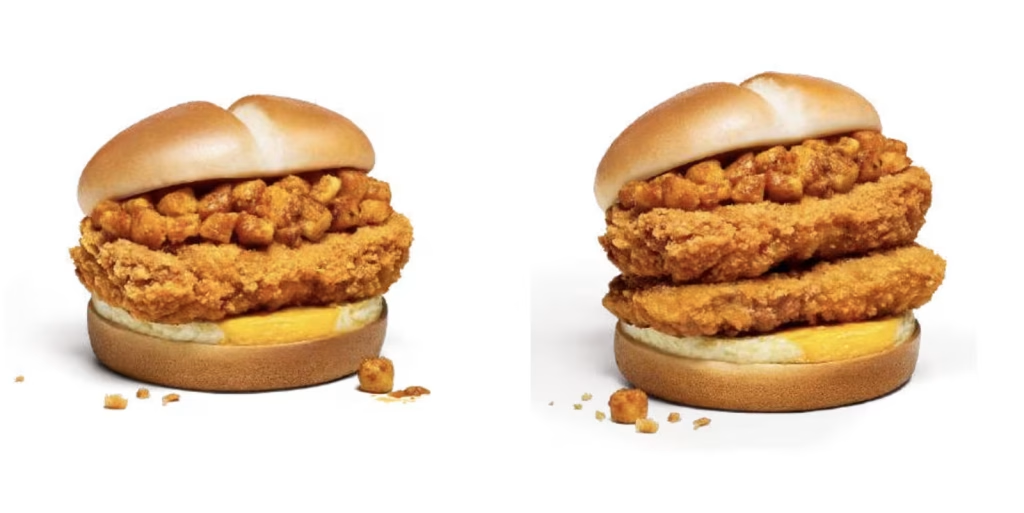
    • Speaking of slop, McDonald’s Singapore has a couple of new menu items to celebrate our upcoming National Day in August. One of them is a collaboration with my favorite curry puff brand, Old Chang Kee. The burger has a fried egg, a deep-fried chicken cutlet, and a thick curry paste with diced potatoes that’s reminiscent of OCK’s signature Curry’O filling. It’s as messy to eat as it sounds, and the top bun gets soggy and falls apart as you’re eating it. What makes Old Chang Kee work for me is the texture and mouthfeel of their crusty pastry, so the soft bun is a weak substitute. To make matters worse, I had the double version with twice the oily fried chicken, and felt like absolute crap afterwards. Speaking with Jose and Henry, who also ate this on the same day, I got tripartite agreement that this creation results in more regret than reward, and none of us will be having it again.
    • Michael’s collaborative crossword game, Crossmate, is finally out on the App Store! It’s free, open source, and I highly recommend it. You can import puzzle files, or use NYT’s puzzles if you have a subscription, then invite up to two other friends to play with you. It’s just like working in a live Google Doc, but funner. I’m not especially good at crosswords, but I’ve completed quite a few with him and others during the beta testing period and had a great time with it.
    • I read what was probably my first Philip K. Dick novel, as far as I can recall, Time Out of Joint, and came away slightly disappointed. Something about its style reminded me of other books from the same era, where you can almost smell the fumes from whatever they were huffing. The core ideas are good, and have been replicated in other works (including a particularly big Jim Carrey hit), but somehow the sum is less than its parts. In contrast with Rendezvous with Rama, a sci-fi classic I recently reread that explores big ideas with prosaic, forgettable writing, Time Out of Joint somehow comes away looking worse because Dick’s writing is too opinionated and rooted in his time, neither of which serves to elevate the story or its ideas.
    • I finished watching the Three Colors trilogy on MUBI with White (1994) and Red (1994). I believe White is often called the ‘weird’ or ‘different’ one out of the three, as it’s tonally and structurally quite a farce. For that reason, I enjoyed it but probably have to rate it lower relative to the emotional power of its siblings. What’s also impressive is how the director began with the legendary Juliette Binoche, and then went on to cast leading women of escalating beauty in Julie Delpy and Irene Jacob. Next up is The Double Life of Véronique (1991) which also stars Jacob, who I’d never heard of before this.
    • Despite believing that I don’t watch or enjoy horror, I think Widow’s Bay empowered me to believe that maybe I can do horror lite, so I bought a ticket to go see Backrooms (2026) on a weekday afternoon. I could have waited for a home release, but I wanted to test myself with a big screen. I have vivid memories of seeing Drag Me to Hell (2009) in a theater that was way too loud, and being so terrified by the sensory overload (despite it being quite an outlandishly funny film) that I felt like I was going to have a heart attack.
    • Thankfully, Backrooms was more fun than fatal, and I had a good time. I’ve seen the short film that this expands on, but the final result still feels a little thin. Rather than doing more expansive world building around the infinite labyrinth (ha ha) and its place in our world, it keeps the scope small, presumably for future sequels. This screening was the “Everything Must Go Edition”, with an extra 15-min segment tacked on after the credits. This strategy seems new — a way to further milk a film near the end of its theatrical run, either gaining repeat viewings from fans or convincing stragglers like me.
    • It was perhaps due to this ‘training’ that I not only endured, but enjoyed, a particular sequence in Christopher Nolan’s The Odyssey (2026) when we saw it in IMAX over the weekend with Peishan and James. I said before that I wasn’t particularly in a hurry to see this, and that I was anticipating Disclosure Day (2026) much more. In retrospect, it’s almost a crime to draw any comparison between the two. The Spielberg film seems made with decades of Hollywood muscle memory, and probably under healthy conditions that allowed everyone to have a life at the same time. Nolan’s film comes across more like a monumental undertaking, a transfer of life force from human bodies onto 70mm celluloid through back-breaking effort.
    • Afterwards, in trying to rank my favorite Nolan films, I decided that Interstellar (2014) is still my favorite, but this might come in second, followed by Inception and Tenet. The Batman films are dead last. When someone brought up how they were flawed, but Heath Ledger’s turn as the Joker was great, I said that I never understood the big deal about that performance: “For me it’s like if Freddie Prinze Jr. died after turning in a passable Zorro remake”.
  • MacHeist 4 ends today

    MacHeist 4 ends today. The annual bundle has gotten bigger and better — just US$29 for a ton of apps and services worth 20 times more — but they’ve struggled to reach the minimum target of 25,000. That was how many needed to be sold before the premium bonus apps became unlocked for everyone. After 8 days into the 10-day window, they gave up and opened them anyway. Now they’ve finally crossed the mark (26,053 at time of writing) with hours left to go.

    There’s probably a longer article in here about why this is the case. Bundles like these used to make a much bigger splash, and I remember a period where Groupon-like daily deal sites for Mac applications were like… daily deal sites for free iOS applications. I guess that’s where the attention has gone now, and much of the spending intent has followed the growth in mobile platforms. Prices there are generally lower too, and I wonder if this means independent Mac apps have to start charging less, or more, to keep profits up.

    Anyway, I highly recommend you look into MacHeist while it’s available. 25% of the money goes to charity, and you get a 15-month subscription to Evernote Premium as part of it. I usually pay US$45/year for Evernote and find it immensely useful as a place to store all the webpages I see and want to have searchable, shopping and reading lists, wholesale documents for safekeeping, and snippets of data in an offline notebook whenever I go on a trip. It’s essentially a digitized version of your memory for sanity. There are also great games like Braid, Bioshock 2, and the episodic adventures of Sam & Max, Jurassic Park, and Strong Bad, from developer Telltale Games. That’s like… a hundred hours of gameplay.

    One great utility was added this morning: Bartender. It’s not a cocktail recipes app, the world hardly needs more of those, but a tool that sits in your Mac’s menu bar and subsumes all the other menu bar items into it. I’ve greatly cleaned up the visual clutter on mine (made somewhat worse by recent versions of OS X preferring to show menu bar icons in monochrome only), moving things like Bluetooth status, Volume, Dropbox, and my Jawbone status monitor into Bartender’s “bar menu”. Good stuff, and normally sells for US$15.

  • Why Can’t Twitter Be Like Foursquare?

    Turf Geography Club

    I never thought little ol’ Foursquare could lead the way for Twitter, but their approach to the third-party access and monetization problem shows more class and understanding. For the past few weeks now, instead of investing in a user experience that users would choose, Twitter’s stated solution has been to make their apps the only ones in town.

    Thanks to a tweet from @tarngerine today, I discovered Turf Geography Club, a location-based iPhone game built atop Foursquare’s place database, with additional Monopoly-like mechanics for upgrading and defending your property. It stands out from all the other “check-in and own this location” type apps by taking a flat-out fun (as opposed to a utility) approach: retro 16-bit style graphics, a Wes Anderson-inspired aesthetic (evident in the name, video trailer, and writing), bears, compasses, illustrated logbooks, and nonsensical references to an eternal struggle between man and nature.

    What I liked was how I could suddenly start using Turf as my Foursquare client of choice, checking in as I usually do, but also playing this separate, app-specific metagame at the same time. Likewise, I can choose to use Path to document my movements with friends, and share a subset of those actions to Foursquare, for my other contacts to see them. Or I could document something private in Day One, the journaling app, and still check in to Foursquare from there where the location made sense (publicly, without sharing the contents of my journal entry).

    Whatever you think of Foursquare and the people who use it, you can’t deny that this is what everyone would love Twitter to continue being, and what the company seems bent on defying: a confident social platform open to innovative ways of being used.

    Foursquare recently updated their mobile apps in a big way, taking focus away from previous key features such as Mayorships, and emphasizing discovery and recommendations instead. The Foursquare app is now really good at showing you things of interest nearby, in categories such as food, shopping, and sightseeing, based on recommendations from other users. I can’t get those in Path or Turf, but my one-way actions in those apps feed back into the enrichment of Foursquare. That’s reason enough for me to keep the Foursquare app on my phone in addition to all the other ones that offer check-in functionality.

    Twitter’s mobile apps also do a couple of things that third-party apps aren’t allowed to. It shows interactions that your friends have had on the service: tweets they’ve liked, people they’ve recently started following, and it shows supposedly personalized things of interest: local trending topics, and popular links being shared. The latter is where their advertising monetization is meant to happen, and it’s something that no one loves because it’s often dead wrong about what we want to see.

    Imagine if Foursquare’s app showed you places you would never go, or check-ins from people you didn’t know or like. What would be the value in that? Instead, contextual intelligence and expert data mining help Foursquare stay valuable and interesting to users when they want to explore, while their availability to third party apps keeps users active and in the equation. The people at Twitter can’t go wrong throwing everything behind the creation of that value, in the interests of long-term viability, instead of shutting down the future of their service that may come from apps like Turf.