We arrived in Tokyo after dark and headed to a nearby supermarket for apartment essentials: toilet roll, hand soap, face towels, etc. Supermarkets here open till 11 p.m. or midnight, which I did not expect. We’ve been seeing more 24-hour supermarkets back home as well, so maybe that’s just how people shop now (or how late people work now).
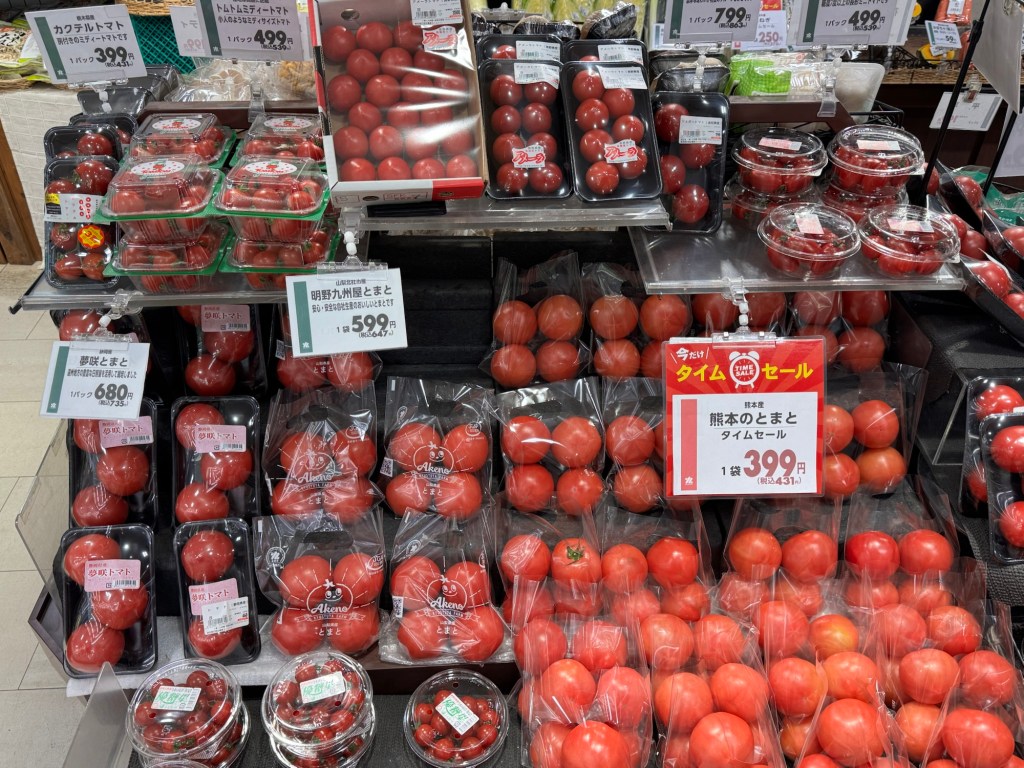
The domestic produce here is, unsurprisingly, beautiful and better than anything you can easily find in Singapore. Prices range from a little more to a GTFOutta here more. I mean, look at those tomatoes. We’ve also been eating some lovely strawberries from a random fruit stand near Gakugei-daigaku station.
My foray into videography was short-lived. After just a day, I’ve gone back to just taking photos. It’s too much work to break in the habit of filming scenes with camera moves and multiple angles whenever something interesting appears.
We ducked into a used records store that carried both CDs and vinyls, and for a short while, I entertained the thought of getting a new CD player to put my teenage collection back into service. If I can find a nice-looking one that supports AirPlay (ha) to our HomePods, then I might. Why hasn’t anyone made an all-in-one, retro revival-ready CD/cassette/LP player with decent quality? They’d make a killing.
Sleep eluded me for two nights. It was the combination of a smaller bed, snoring, and variable room temperature while we figured out the settings. Things got better once I busted out my Loop Quiet II earplugs. They’re well worth the $20-odd bucks.
AccuWeather shows the city has a constant dry air advisory in effect. That’s certainly true in our apartment when the heating is on, and now we’re going to buy a cheap humidifier from 3 Coins (aka ¥300), a Daiso-esque home goods chain that has some really nice products like a 3-in-1 iPhone/Apple Watch/AirPods charging stand and even transparent Switch Pro-style controllers for about S$26. It’s funny that in Singapore I’m constantly dehumidifying, and here it’s just the opposite.
It’s not really that cold. Between 0° and 11° is fine by me, but 15° and sunny would obviously be ideal.
There’s a longstanding idea/stereotype that the Japanese diet is low on vegetables, and I suppose historically that might have been true, with most of it in pickled form? Sean and Cien were just here too, and they’d read that people keep their toilet businesses running smoothly with the help of probiotic milk drinks. Specifically, this Meiji R1 product (or Yakult). We bought some; the verdict’s still out. Meanwhile, trying to get a healthy dose of mealtime fiber with vegetable ramen, side salads, and shredded cabbage, and honestly, the prevalence of vegetables is no different from what I’m used to.
We had dinner at a yakitori restaurant featured in a video on the Japan By Food YouTube channel, and all the local diners were ordering raw chicken tataki, which funnily was not on the English menu given to tourists. But one hot dish we ordered, chicken neck shu mai, came with pink bits of effectively raw meat inside. When in Rome…
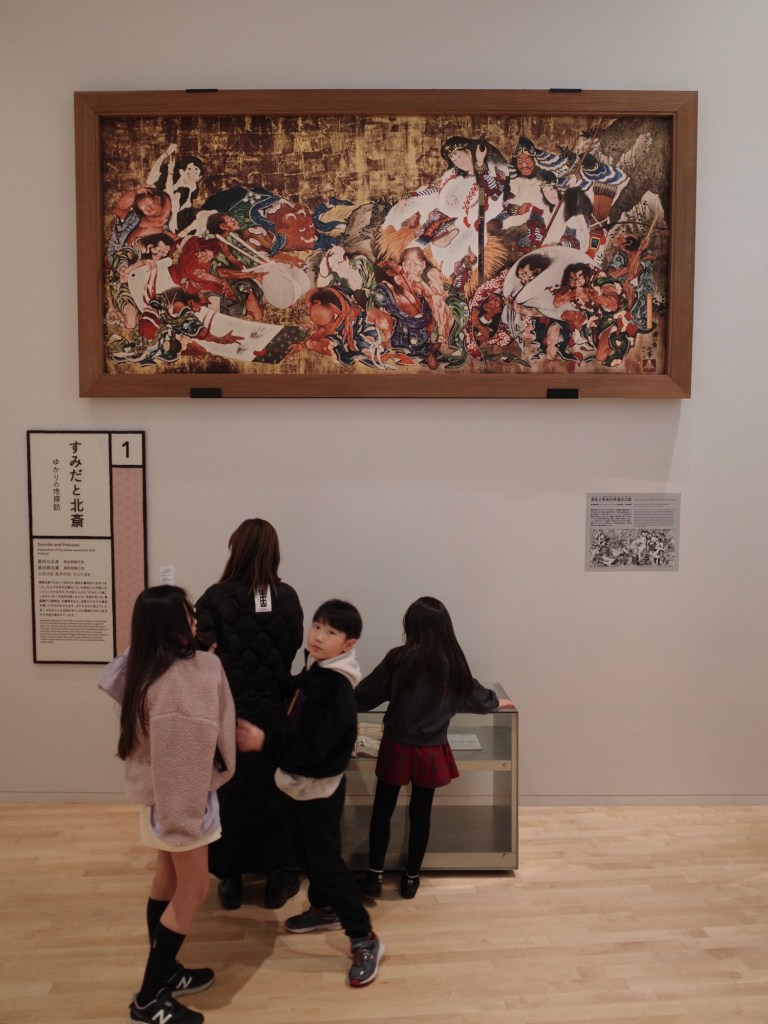
It was meant to snow on Sunday, but that didn’t end up happening. We made it out on foot to a nice coffee shop (apparently a branch of a Sydney business), and then spent the morning in the Hokusai museum looking at a small slice of his insane output over 90 years. He apparently produced over 30,000 works, including woodblock prints, sketches, and paintings. I remember having a poster of The Great Wave in my university bedroom way back when (like many of you, I imagine), so it was nice to see the “real thing”.
I’ve used my Ricoh GR III and iPhone cameras probably an equal amount. The former in JPEG-only mode, with the factory Positive Film settings (not to be confused with zeroing each setting; there is actually a “recipe” that they ship with), and the latter in ProRAW. I misspoke last week when it came to the Nitro app. It’s still too buggy, and I couldn’t bring myself to pay for it in this state so I’ve gone back to the developer’s previous app, RAW Power. It’s very good, and with my soon-to-be-released color film LUTs and tone mapping disabled, the iPhone can honestly look like a proper camera. Apple’s default look is… realistic but not romantic.
Before diving into the deeper end of Japanese literature as previously mentioned, I thought I should warm up with at least one Haruki Murakami novel first. My gut said that it’d been maybe a year or two since the last one I’d read, but no, Goodreads informs me that I finished 1Q84 in May 2020! So I picked up Norwegian Wood from the library and finished it in a few days. I now want to watch the 2010 film adaptation because there’s so much spicy dialogue in this that I can’t imagine them using. Also, Rinko Kikuchi and Kiko Mizuhara play the two female leads, and that is the most 2010 Japanese casting ever.
My new Kobo Clara Color started acting up during this, freezing and needing to be rebooted, losing my current progress, and draining its battery rapidly overnight. I have a post from 2013 about how I fixed similar battery issues on my Kindle, and it’s one of the most visited pages on this site. Sadly, I didn’t find any tips online about battery problems with this Kobo model, so I just did a factory reset and things seem to be going okay so far. I suspect it has something to do with using Calibre to load EPUB files on it, if said files were not perfectly formatted.
My friend Cong is always saying Singapore lacks authentic Vietnamese food, specifically pho, but he recently found a place that he found good enough and that’s generous with the herbs and vegetables that are hard to find here. I went with him, Mavis, and Jose to check it out for lunch on Friday, and I can say that it was a fine bowl of noodles (but can’t speak to its authenticity). No gatekeeping; it’s called Lang Nuong 1980’s on Hamilton Road near Jalan Besar.
I’ve never put in the time to get good at shooting video and mastering all the techniques that go into making little films, so I rarely post video ‘stories’ on social media and vacations are only documented through stills in my photo library — isn’t it funny that we still call them photo libraries (e.g. iCloud Photo Library, Google Photos) even though they contain videos? This week I found myself experimenting a little with the form, thinking I might try to make myself what people used to call a “home movie” (before sharing your life with strangers was a thing) during my time in Japan.
When it comes to shooting footage, I’ve found Kino and Blackmagic Cam to be the best. They let you record 4K video in Apple Log, process the video in real-time using color-grading LUTs, and save them in a standard color space in compressed HEVC files. This is much better for almost anyone than using the default iPhone camera which saves Apple Log videos using ProRes, which results in massive files. I prefer Kino a little bit more because it includes a bunch of LUTs out of the box. It also has a more beginner-friendly UI, and takes care of most things automatically to get you more cinematic results.
One thing it doesn’t do, that I don’t think any app does, is use your location to influence your video settings. What do I mean? I may be oversimplifying, but here in Singapore (where PAL is the broadcast standard), you get flickering lights when shooting at the common 24/30 FPS speeds because our electricity grid operates at 50hz instead of 60hz. This causes lightbulbs to pulse at 100 times a second, and you see it happening at 24fps because 100 does not divide as cleanly by 24 as it does by 25. You can apparently counteract this through some combination of shutter speed/angle, but that’s beyond me. I just know I shot a bunch of footage at 24 FPS and there was flicker all over it. It’s 2025 and it sure would be nice if an app just knew what to do!
When it comes to editing, I played with a bunch of the most popular apps, including the super popular CapCut by ByteDance that I believe most IG/TikTok influencers use. It’s definitely a comprehensive tool, but wants you to pay a subscription for many of its most useful features — S$105.98/yr is a little steep for amateur dabblers like me imo.
I hadn’t fired up iMovie in a long while, and was surprised to discover a “Magic Movie” mode was added two years ago, and it’s not bad if you’re happy to give up fine-grained control. Just select a heap of clips, and it’ll string them together with a dynamic soundtrack (the music ends naturally when your video does), transitions, and a smattering of fonts and title styles you can choose from. Being a free Apple app, I think this is probably enough for most amateur dabblers… except it doesn’t support 9:16 videos. It’s an app for boomers.
That restriction probably won’t affect me as I intend to shoot my videos in traditional landscape orientation anyway, but it’s nice to have options. That’s when I discovered LightCut, a completely free Chinese app that looks suspiciously like CapCut and tries to opt you into a data-sharing program (you can say no, and also deny it Bluetooth permissions while you’re at it), but is otherwise a very attractive and powerful tool for the price! Like with CapCut’s paid AI features, it can drop your clips into suitable pre-made templates and make a pretty professional-looking video with little effort on your part. I think it’s a good alternative to iMovie if you need the flexibility of freely placing text on screen, adjusting the brightness/color of individual scenes, and so on.
On Wednesday, I decided to visit the National Gallery again and see the special exhibitions leaving next week. Here’s a low-effort “Magic Movie” of my visit, just a heap of random clips shot with Kino and assembled by iMovie. I finished the whole thing on my phone over a cup of tea at the café afterwards.
One thing I don’t like about being in a ‘video mode’ while walking around is that it takes you out of being in ‘photo mode’. I probably took just three photos that day, and don’t know if there’s any way around it except practice.
I still can’t decide what the best way to shoot photos on an iPhone is right now. I vacillate between shooting Bayer RAW with an app like Halide, shooting ProRAW with the Leica LUX app, ProRAW with the default camera app, and just embracing the iPhone’s “Photonic Engine” and getting 24MP HEIF files with the default camera app.
Bear with the neurosis, but as part of obsessing over the above question, I’ve been testing Nitro Photo, the new-ish pro photo editing app by former Apple Photo Apps group CTO Nik Bhatt. His last app was RAW Power, which I’ve owned for years but haven’t used that much, partly because I rarely shot RAW and partly because its UI is a little clunky. Nitro is a re-imagining of RAW Power, built from the ground up with modern frameworks and a redesigned UI. From a functional and technical perspective, I think it offers a level of control that no other app, short of Adobe Lightroom, does on iOS. Neither Darkroom nor the recently acquired-by-Apple Photomator have the ability to tune RAW/ProRAW images like Nitro. You can do things like adjust the tone mapping on ProRAW photos, for instance, to get a more natural look without Smart HDR effects, or control how the Apple RAW engine renders sharpness. I’ve ported over a few of my own presets over as LUTs, and am getting into it to the point that I might plonk down $100 and make it my main photo editor. The worst thing about it is still the UI, which I must stress is not bad; just a tad dated as touch UI conventions go. Darkroom is much more pleasant to use on a small screen, but the broken state of preset syncing there has really turned me off lately.
This is where you say, “But Brandon, if you shoot everything in ProRAW, doesn’t that take up a ton of storage? Especially if you don’t have an iPhone 16 Pro that can employ JPEG XL compression?” Well, yes, and that does bother me. So imagine my excitement when I discovered the NO RAW app, which claims to strip out the RAW data from photos that are RAW+JPEG bundles in the iOS file system, once you’re done with editing and know you won’t go back again. I knew deep down that it’s not possible for an app to do that on iOS, but had to pay S$3 to find out how it worked. The answer? It’s essentially a solution you can build on your own in Shortcuts.app: make a new copy of your image as a HEIC file (retaining metadata), and then delete the original bundled file. Boooo! My free HEIFer shortcut does exactly this, but for JPEGs. And NO RAW has the same “flaw” as my shortcut. Namely, that the correct chronological order will only be retained if you sort your photos by Date Captured. If you sort by Recently Added, then all of these former-RAW photos will appear at the bottom. I should have known, but I’ll still use NO RAW as it gets the job done and has a date picker UI that beats any shortcut, but I might update HEIFer to do the same if anyone wants it.
Media activity:
I finished watching the anime series Dead Dead Demon’s Dededede Destruction. I’d heard about it before, and then when Dandadan came out, I mistook it for this and only realized they were separate shows like many episodes later. They are eerily similar in name and synopsis: school kids dealing with an alien invasion. But Dededede is much less kinetic/comedic/wacky. 3.5/5 stars.
We finished Squid Game 2 and despite initially liking how it was handled, I got a little bored towards the end as the slow, dramatic deaths started to pile up. When will we get a third season, and will I care? Probably not.
I watched The Gleaners and I (2000) Because it’s leaving MUBI. It’s the kind of documentary you get when an experienced director picks up a novel tool (a digital video camera, in this case), and starts messing about around a topic that interests them. Here, Agnès Varda starts by interviewing people who still practice the lost art of gleaning — picking through recently harvested fields for uncollected produce — and ends up doing a cross-country investigation of waste and poverty. 4/5 stars.
I discovered the American YouTuber and illustrator Linh Truong aka @withlovelinh through a Japan travel/haul video she made last spring and found myself binging the last couple years of her content creator journey. She started doing vlogs in high school and has kept going with cozy life updates that interior decoration tips and other sorts of young adult life-hacking. She recently graduated from college, and it’s extremely sweet how many of her commenters say they’ve grown up with her over the years and are proud that she’s making it (1.2M subscribers and making sponsored content for Nintendo, Notion, et al).
Rainy season is reading season. After finishing There Is No Antimemetics Division for my book club, I also wrapped up Taylor Lorenz’s Extremely Online, which is sort of a brief history of social media and the influencer economy. I highly recommend the former for fans of SF stories involving time, unreliable memories, and the nature of reality; some members of the book club who are into Doctor Who likened it to that, but I wouldn’t know.
Then I decided to start getting into the mood for our holiday by reading some Japanese fiction. I began with Mieko Kawakami’s Heaven (a rough story about school bullying), which I thought would keep me occupied for a while, but before I knew it, I’d finished it along with Satoshi Yagisawa’s Days at the Morisaki Bookshop and More Days at the Morisaki Bookshop, two entries in the cozy Asian fiction wave dominating the local charts. Other entrants include Welcome to the Hyunam-Dong Bookshop and Before the Coffee Gets Cold by Hwang Bo-Reum and Toshikazu Kawaguchi, respectively. When the going gets tough, people start fantasizing about quitting their jobs and opening cafes or bookstores, and I think that explains the sudden popularity of this micro-genre. Incidentally, I bought a couple of these books for my mother on her recent birthday because I thought she’d enjoy the vibes, although already retired.
For the avoidance of doubt, all of the above books were three stars for me on Goodreads with the exception of Antimemetics, which got a 5-star rating. But the Morisaki Bookshop series makes reference to many great works of Japanese literature, and so I decided to try reading some Mishima on this trip. I’d read The Temple of the Golden Pavilion as a young adult, and it probably just glanced my frontal lobe at the time.
In a flash of pure coincidence soon after, I was scrolling through MUBI and came across Mishima: A Life in Four Chapters (1985) by Paul Schrader (who wrote Taxi Driver), an American Zoetrope biopic executive produced by George Lucas and Francis Ford Coppola. I watched it immediately, and it’s an incredible work of cinema — why isn’t this talked about more? It only covers the last phase of his life, up until his famous act of terrorism/suicide, which makes up only one of the four chapters. The other three are dramatizations of his work, literally staged on theatrical sets and shot with more care and inspiration than anything you could buy today with $100M in streaming service money.
In a further act of cosmic coincidence, I saw a Facebook post from Paul Schrader being shared on Twitter, having an AI moment of crisis when he found that ChatGPT outdoes him when prompted to provide “Paul Schrader script ideas”.
Writer of the legendary movie Taxi Driver is having an existential crisis about AI pic.twitter.com/5H89SWUKn9
Looking back on holiday photos from March 2023, I rediscovered my rediscovery of Hipstamatic, which had just launched its new subscription-based app at the time. Looking at those photos brings back fond memories; they are “ruined” in a good way — mundane everyday scenes somehow imprinted with the nostalgia of the moment through imperfect filters (it helps that I know that the original, normal photos lie underneath and can be accessed with a tap of the Revert button). My setup at the time was to use the Ricoh GR III as a main camera for all photos that needed to look good and accurate, and to reserve the iPhone + Hipstamatic for casual, silly snapshots. Otherwise, you have two tools competing for the same job. I’m now finding that idea attractive again, except both Hipstamatic apps are quite a pain to use, UI-wise.
I watched this video of “Best Apps in 2024” from the MKBHD Studio team, and decided to give Dazz Cam another try. It’s surprisingly powerful! Some of the vintage “cameras” you can choose from use RAW processes, and you can have it save both the original RAW file and the filtered results separately. So I may end up using this to “gimp” my iPhone rather than Hipstamatic. Plus, the subscription to unlock all its features is only $10/yr compared to Hipstamatic’s $40/yr. I don’t even think you need it as some of the free filters are good enough. I only wish it would use the underlying RAW and not the JPEG when importing an existing image from your library.
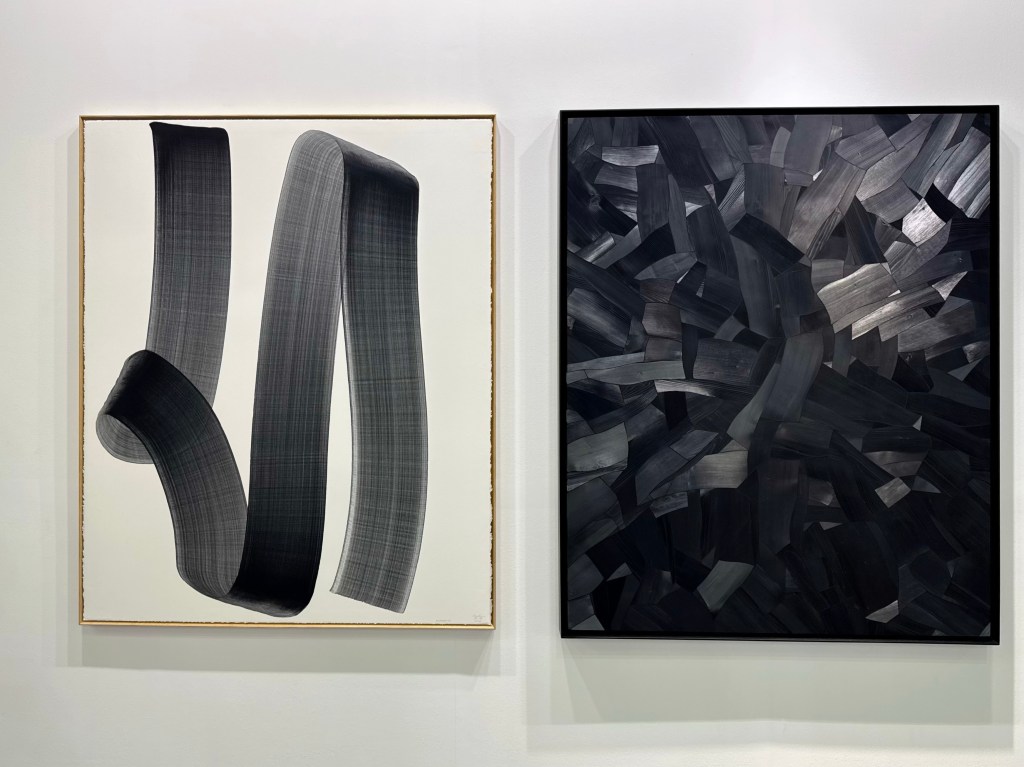
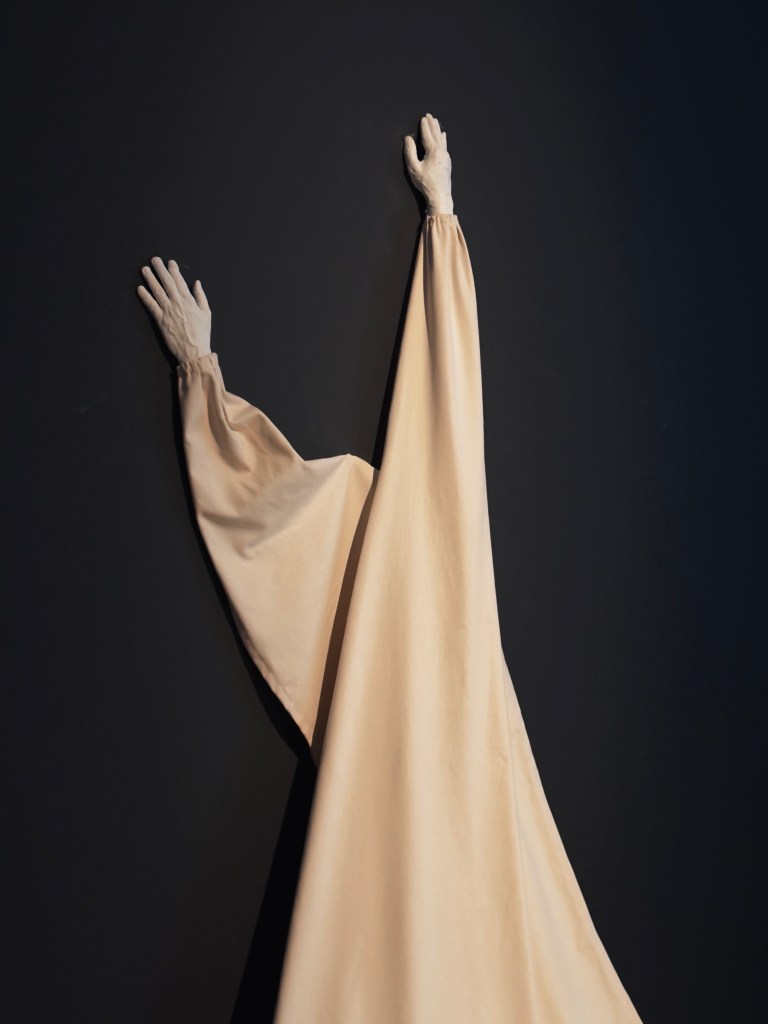
We had free tickets to the ART SG fair at the Marina Bay Sands over the weekend and dropped by for a quick look. It was crowded as hell and I was reminded why I don’t think these things are a great way for the general public to see art; it’s mostly a trade show geared towards buyers, and so the scale is too overwhelming for anything to really be appreciated. Not only that, but the selection this year didn’t really make much impact. I was looking out for more of the humor and playfulness I saw at the 2023 edition, something to make light and sense of the trauma we’ve normalized, but it was sorely lacking. I did like the pair in the featured image above, though, as they reminded me of some other works I’ve seen before, including the Act of Emotion digital series by Kelly Milligan.
Trump launched his own memecoin on Solana this weekend, days before the inauguration, and I believe it went up to a market cap of $70bn. That would qualify as a very funny and absurd art project, from ‘probably the greatest’ (scam) artist, if it wasn’t real and thereby depressing.
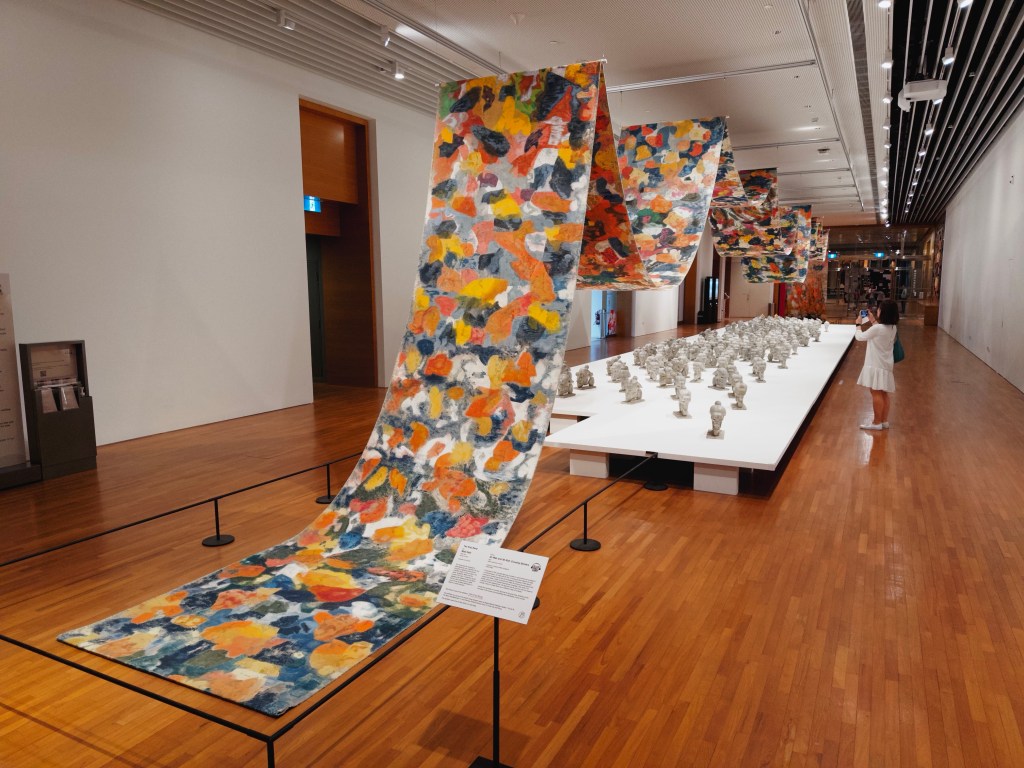
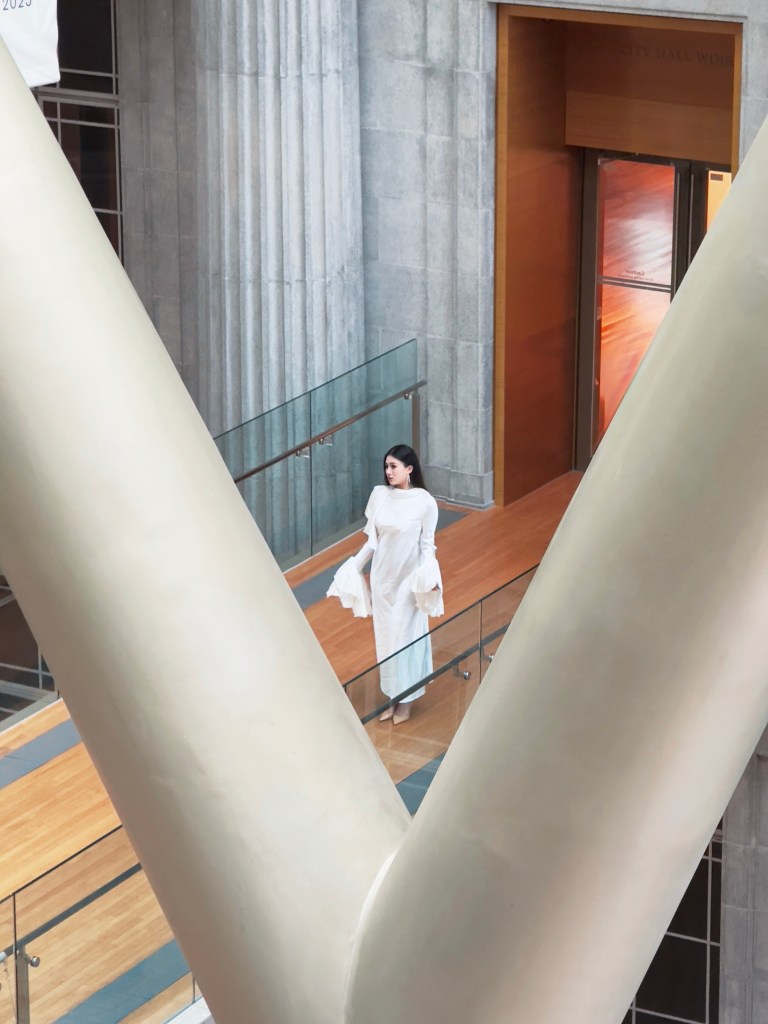
It’s been a minute since I checked the National Gallery out, so I wasn’t sure what Peishan and I would find when we dropped by on Tuesday afternoon. Fortunately, there were some new SE Asian pieces either freshly out on rotation, or that I’d forgotten, and there was enough to see without having to shell out for the special exhibits.
There’s plenty of time to see them yet, as they don’t refresh things very often. I looked it up online later, and some of the stuff we saw will be on display for 3–4 more years. Apparently only 10% of the total collection (stored somewhere in Jurong) can be on display at any one time, so I don’t know why they rotate so infrequently. Show me more of the stuff before I die, dammit.
We went by because Peishan took the day off and we’d planned to have lunch nearby. It struck me that I haven’t been appreciating the privilege of my free time enough — I should be doing things like this on my own more often.
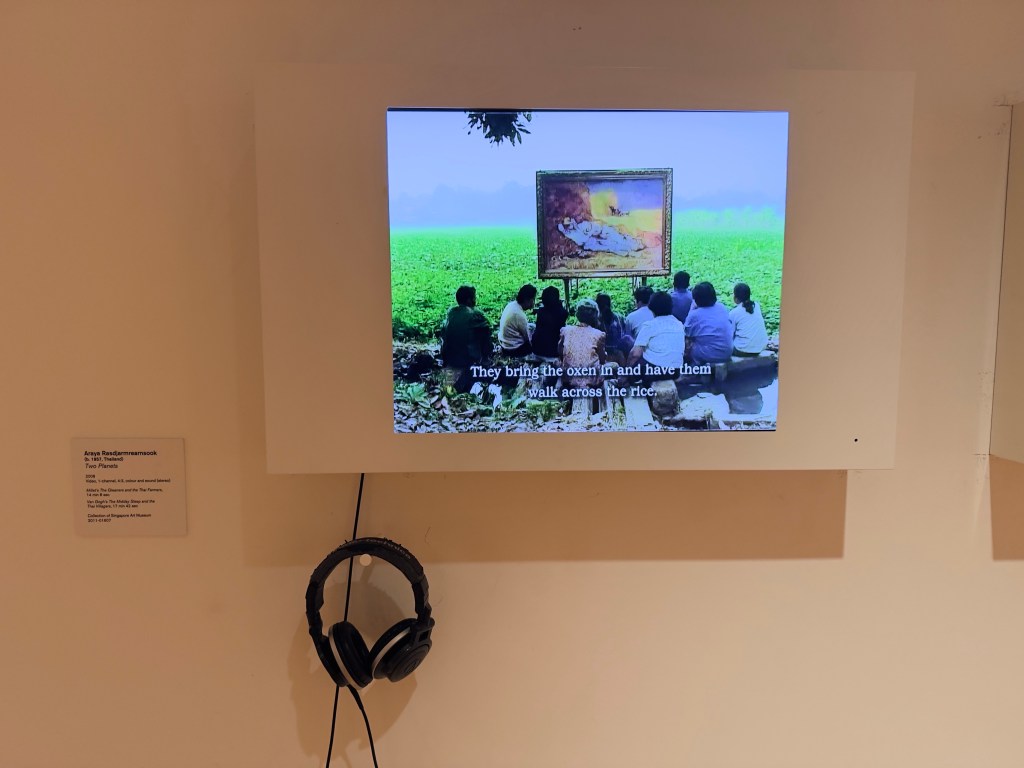
We saw a brilliant video artwork series of Thai farmers and villagers sitting on the ground out in the fields, contemplating large Western paintings set up in front of them, casually discussing what they saw. Just saying things like “The man is sleeping soundly. He looks happy because they’ve harvested so much food”. I wanted to stand there and watch it in its hour-long entirety when it struck me that there’s nothing stopping me from coming back another day to do that. To be one of those people who has a whole hour to spend sitting in front of one painting. So maybe I will!
===
My mother-in-law (who has no stomach for violence or misery) came to stay with us for a couple of days, which meant that I could only watch the family-friendly movies from my collection and MUBI watchlist. We started with Charade (1963), a classic I can’t believe I’d never seen before. Audrey Hepburn was a phenomenon — utterly faultless and impossible to look away from. With Cary Grant we’ve got our modern day version in George Clooney, but I don’t know who could ever be like Audrey.
We also watched Futura (2021), an Italian docu-feature where young people across the country were interviewed about their hopes and dreams. To me, it only reinforced the idea of Europe in decline, and yet maybe that’s… okay? What’s so bad about living in the shadow of a greater civilization and inhabiting what’s left of their magnificent buildings. Someone’s gotta do it.
And then a movie that has been so hyped up by everyone who’s seen it that there was little chance it would live up: Paddington (2014). Nicolette, whose cats we also visited this week (see below), was a major promoter and reckons it’s a five-star film. I gave it 3.5 but plan to watch the sequel soon—I think it’ll fare better now that my expectations are properly calibrated.
I was left to my own questionable watchlist on Thursday and Friday, which meant seeing Festen (1998), the first official ‘Dogme 95’ film (painful in its overall ugliness); Ema (2019), a dance-centric exploration of fucked up families and urban frustration starring Gael García Bernal and Mariana Di Girolamo as two assholes who adopt a kid; and In the Fade (2017), a German revenge story with Diane Kruger avenging her son being blown to bits by modern-day Nazis.
The absolute standout film of the week was So Long, My Son (2019), a Chinese language film by Wang Xiaoshuai with a three-hour running time. It follows two families over a period of three decades, living with tragedy and being tossed around by the rapid, true-story evolution of Chinese society. I expected the time to pass slowly but everything was handled with such authenticity and emotional power that I hardly noticed.
On TV, we caught up on season 2 of Netflix’s Rhythm + Flow rap competition reality show, and none of the contestants are really standing out the way Flawless Real Talk and D-Smoke did in the first season. It looks like Netflix decided to cheap out and rush the audition process, basically only holding one in Atlanta whereas S1 held them in three cities. So it never feels like you’re seeing the very best talent the streets have to offer.
The main effect of watching the show so far has been an increased desire to play Kendrick Lamar’s new GNX album on repeat. It also made look up Old Man Saxon from S1, so was delighted to find that he released a new EP and single recently.
===
It was Thanksgiving week in the US, and trust me I tried to find a Black Friday deal that I wanted to spend on, but the only things I’ve bought for myself on Amazon were cheap alkaline batteries from Japan (the Verbatim brand is alive and well there!) and several boxes of Yorkshire Gold tea.
It feels weird, spending hours online and hardly finding anything I want to buy. On Sunday we spent a few hours at the Paragon mall for some Christmas shopping and I found myself a new 6L Venture Sling by Bellroy. It was cheaper than the online Black Friday price, but only because they wanted S$16 for shipping.
I also considered this 4L Everything Sling from Moment, but I think it’s too small to be the Goldilocks bag I need. I have Uniqlo’s round mini shoulder bag like 98% of the world, but need something between that and a laptop messenger/backpack. Just enough to bring around some combination of e-reader, Switch, camera, power bank, umbrella, JisuLife fan, and water bottle.
The only things left might be digital game purchases that I might have time to play in December, such as Metaphor: ReFantazio, the latest masterpiece from the director of the Persona games, or Like a Dragon: Infinite Wealth.
While the Persona games are undeniable masterpieces, they’re also looooong. Sometimes it’s nice to just sit down and finish a game in one sitting, so that’s what I did with Thank Goodness You’re Here, which is published by Panic Inc. (Untitled Goose Game, Firewatch). It’s a cartoony comedic platformer set in Northern England, filled with authentic accents, dialects, and small-town imagery — what you’d expect from a British company named Coal Supper. I highly recommend it, especially if you can find it on sale during the holiday season.
Work progressed on my positive film LUTs — LUTs plural, because I now have four separate versions for different situations: regular iPhone photos, RAW files, ProRAW, and an additional one that’s brighter and punchier. I’m at that stage of the creative process where the original inspiration has been left behind and now I’m making something new (and possibly worse!), just going on vibes.
At the heart of these is a ‘color science’ recipe that makes the usual digital representations of reality subtly less realistic, without the global color grading that makes some filters instantly recognizable. Alone, it can’t make a photo look the way film does, which is why exposing for highlights, disabling Smart HDR if possible, and saving RAW files is still important. Anyway here are some test shots I made this week, most of them not following those rules.
===
Kim got back from a short trip to Vietnam and (cover your eyes if you’re squeamish about food safety as I usually am) brought me back a banh mi from a famous shop so I could try it — some five or six hours after it was made. She presented it as a “lesbian banh mi”, to which I said “excuse me?”, but it’s literally known to locals as the lesbian banh mi place. It’s run by a lesbian couple that has offered an LGBTQ-friendly work environment since the 1970s.
It was an insane sandwich, heavier and more packed with meat (and cilantro) than any sub I’ve ever had. I didn’t catch the exact price but I think it was a couple of dollars. The bread had gotten a little tough from the flight, but I can imagine how it’d be even more amazing fresh and hot. I’m afraid that if we ever move to Ho Chi Minh I’ll be eating these on a weekly basis.
Hey, earth systems scientist here!
We have absolutely no idea why this is happening. All of our models currently underpredict climate change, we never expected the carbon sinks to fail. Expect major ecosystem collapse w/i the next 5-10 yrs
Which, given this tweet, may not be a great idea anyway. Reading through the replies, you’ll learn that terrestrial carbon sinks have effectively stopped reducing CO2 levels, and equatorial areas around the world might become unlivable in the coming decades. The author says you/we should make plans to leave as soon as possible, because it’s better to be a migrant than a refugee. From this map of affected areas, there aren’t many viable options if you consider declining economies and areas of unrest/growing fascism? Becoming a billionaire and moving to New Zealand is looking like the best strategy, so I’d better get started now if I want to make it.
That’s too bad, because I was really beginning to like Singapore, cultural shortcomings, legal restrictions and all. On Friday night, we went out and saw a local adaptation of an Italian play, Accidental Death of an Activist/Anarchist, at the Wild Rice company’s Funan theater, which included a list of longstanding and mostly valid criticisms about this country dressed as constructive questions, playfully (and inconsistently) set in the faraway lands of Europe and definitely not about Singapore at all. I enjoyed it! It was very funny and the lead actor put in an incredible physical performance over its 2.5-hour running time.
My friend and ex-colleague Munz wrote a review for the Critics Circle Blog, which goes into more detail. I said to her that I was annoyed by one part where an actor, stepping out of character, comments that “it really won’t” cause society to collapse if certain things were allowed, because theater people just aren’t qualified to understand how delicate some systems are, to casually make promises like that. Just like how they don’t get that “a 5% investment return” is not the W they thought it was when they wrote it into the script as an example of the rewards that Singaporeans receive for tolerating injustices. It’s fine to agitate for something and to dream big, but being naive is the worst.
But don’t take my opinion for anything, because I’m just a moron who has only just discovered the Labubu craze, which Lisa from Blackpink kicked off earlier this year in April. Jesus Christ these fellas are cute! I’m a sucker for fuzzy things, especially when they have mischievously sharp teeth and deranged grins*. Can you believe some of the 58cm plush figures are going for S$500 now that they’re regularly sold out everywhere? I might start with one of the smaller $50 blind box figurines…
* There’s a painting that I saw years ago at an art fair and that I’ve wanted ever since, called Out For A Happy Walk. Kim cannot believe that I’m serious, and cannot see it in our home. It depicts a Garfield-like cat walking upright on two legs, with big dazed eyes, holding a flower in one outstretched hand. I tracked it down to a local gallery, and it’s currently about S$1,600. If I do become a billionaire, I won’t tell anyone but there will be adorable signs.
Media activity
Speaking of Blackpink, I asked in an IG Story post a few weeks ago which of the members people thought would have the most successful global solo career, and the winner by a mile was Lisa (65%). Jennie was in second place (22%), with Rosé and Jisoo getting nearly no votes. I didn’t weigh in myself, because I’m not sure any of them will have long-lasting solo careers. What’s would be the motivation in an industry that prizes youth and novelty? They peaked as one of the biggest groups of their generation, they’re all presumably filthy rich (and dating filthy rich, in Lisa’s case), and making music isn’t something I believe they’re passionate about (although am moron, as stated). Except maybe Rosé. I think she actually wants to make it as a singer/songwriter, and her upcoming album in December is the one I’m actually excited to hear.
The three of them have put out new singles within weeks of each other, and I can’t remember Lisa’s at all, Jennie’s Mantra is just a short chant repeated long enough to cut some flashy visuals to, and I haven’t been able to get Rosé’s APT out of my head for the last few days. Yeah it’s like a cosplay of a pop-rock anthem, sampling Toni Basil’s Mickey and seemingly interpolating Lady Gaga’s Bad Romance (although uncredited), but it still works. There’s an army of writers attached, including Amy Allen who’s behind some of Sabrina Carpenter and Selena Gomez’s biggest songs, as well as Rosé’s first single, On The Ground, which I also liked.
But you know who’s really killing it and only has 3M views after a month to Rosé’s 68M in three days? FKA twigs. I sat down to watch her 8-minute video for Eusexua, the title track of the album due next January (I’d been putting it off; wasn’t ready), and she’s landed an absolute moonshot with it. Don’t watch it at work, but make time for it. This is her reaching her artistic and physical peak and it’s beautiful to see. Like this exhausting-to-watch live set for the fitness brand ‘On’ where she seems to just be warming up. And just out this week, the video for second single Perfect Stranger is more of the same indescribable, nuclear-level visual impact.
Not in the same neighborhood but equally worth adding to your libraries are the new albums from Audrey Nuna and Brett Dennen.
We’ve been watching the new Apple TV+ show written and directed by Alfonso Cuarón, Disclaimer, starring Cate Blanchett, Kevin Kline, and Sacha Baron Cohen. It coincidentally features a book titled “The Perfect Stranger”. It’s seven parts, and four are out now. You should also not watch this at work or in public. But make time for it. I was somehow misled to believe it was science fiction or at least involved the bending of reality, and so was massively thrown (disappointed, even) when it turned out to be a character-driven drama. But it’s very very good.
I managed to get some sci-fi in anyway, by way of Naomi Alderman’s book, The Future. I enjoyed her last book, The Power, and gave that four stars. But this one, set in a recognizably tech-besmirched world much like ours, is way better. I gave it five stars.
It’s Monday, and for the time being, my schedule for writing these updates has shifted out by a day as Monday mornings now find me in a co-working space, and writing this gives me an opportunity to blend in better than, say, watching films or playing games whilst surrounded by people grasping their foreheads, stroking their chins, and sighing loudly. Yes, those things just took place around me.
It’s Monday, after a massive storm, and my feet are soaked from wading through puddles to catch the bus. You’d think this would be a common occurrence in Singapore, where the tropical rain gets heavy, but only a few occasions stick out in memory — those mornings where the office walkways are cluttered with umbrellas opened up to dry, like caltrops or anti-tank barricades; my damp, socked feet perched on top of sneakers I hope will dry before lunch; everyone else’s teeth a-chattering in vicious air-conditioning calibrated for sunny days.
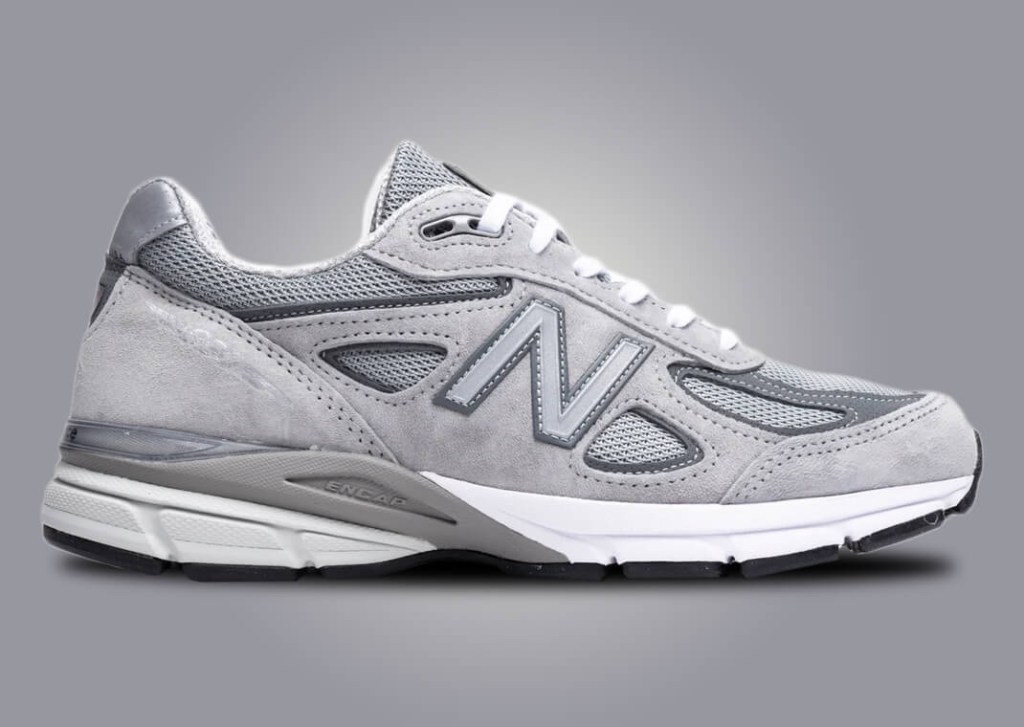
Earlier this week, I shuffled my feet while sitting here and felt something come loose: the right heel of my (only) three-year-old New Balance 990v4 sneakers. So much for ‘Made in the USA’! I borrowed some black plastic tape to conduct unglamorous field surgery, and they lasted till I got home. I have two newer pairs (v5 and v6), and sure hope they hold up longer.
iPads are pretty great, actually
My daily companion over the past four days here has been my 11” M1 iPad Pro with Magic Keyboard, somewhat neglected of late. I’ve found that it does everything I need to pass an entire day, from library books and magazines with the Libby app, to gaming, video, web browsing, chat, and photo editing. My MacBook Air would be better for watching movies, but that’s mainly it. If anything, that only makes me surer that my next iPad will be a 13” model.
Unfortunately the new iPad Pros with M4 chips are priced on par with MacBooks, making the choice between the two much harder (and in favor of MacBooks if I’m being honest). Recall that the original iPad launched for just $499 USD, and its marketing tagline was “A magical and revolutionary product at an unbelievable price”. That’s still how the iPad lives in my mind: a powerful alternative device that does way more than its price suggests. So it occurs to me that the iPad Pro is no longer the right choice for me, and the iPad Air is a truer heir to that original proposition. (Put aside the product now simply called ‘iPad’, because at $349 USD it’s actually even cheaper than the first generation and more like a budget “SE” model.)
We’re seeing Apple push its ‘Pro’ lines further this year, packing them with innovative features that are useful for a small subset of professional users, but which most customers won’t need or appreciate. Things like streaming multiple 4K video feeds from iPhone cameras to a single iPad for production in real time. Or recording LOG-format video to massive ProRes files, including studio-quality audio from four microphones.
Adding these capabilities and pricing accordingly means some current Pro buyers might want to downgrade to the ‘mid’ models. In order to avoid losing them, Apple would need to elevate those products, and avoid artificially holding back features for the sake of differentiation. We’ve seen that happen with this year’s iPhone 16, which packs an OLED display, Dynamic Island, 48mp camera with a 48mm focal length option for the first time (!), Camera Control thingy, and even things like next-generation Photographic Styles and Audio Mix which they could have reserved for the Pro phones. The only thing it needs is a 120hz ProMotion display. I’m expecting next year’s iPad Air and iPhone updates will finally include that.
I love that the iPhone 16 is now a great enough product for almost anyone’s needs, but I’ll likely keep buying the Pro models as long as they offer better camera features. I can entertain switching to an iPad Air because I don’t even know what camera hardware it has and won’t ever use it.
A quick word on cameras and my presets
I mentioned before that I’ve been beta testing an app called Fig Camera. It has two standout features: great “natural” processing options that dial back Apple’s aggressive defaults, much like Halide’s Process Zero mode; and the ability to process photos on-the-fly with your own custom look. As someone who somehow finds it fun to make photo filters/presets, and has fortunately had some success with them, I love that I can now take photos with my favorite styles directly applied. It’s like how Fujifilm cameras’ “Film Simulations” obviate the need for post-processing. I can now snap photos in Fig that look great to me and don’t need any further editing.
Shot on iPhone with Fig Camera and my work-in-progress film LUT
I posted a few recent photos using a film-style sim on IG and Threads and asked something like, ‘should I become one of those preset guys and offer my own as LUT files you can buy?’, to which several kind people said ‘sure’! So I’m thinking about it. This particular look is inspired by the “Positive Film” effect on earlier Ricoh GR cameras (they changed it for the worse with the GRIII), but slightly more “dry” like Fujifilm Classic Chrome. I’ve been using and tweaking it for over a year now, so the trick will be knowing that it’s DONE.
Immersive Video and Submerged
I’m still sitting here and my shoes are still wet. I’ve thought about bringing my Vision Pro to this open-plan space—not for the attention, but because it would be nice to have a huge screen that no one else can see. There are many things in my MUBI backlog that would not be cool to watch in public. And what’s even better than a 13” iPad? How about a thousand inches?
We watched Submerged (2024) over the weekend, Apple’s new Immersive Video release exclusively for Vision Pro. It’s the first film they’ve done that isn’t a documentary or music performance — I guess the right word is fictional? I’m sure I said early on that this new immersive format (a full 180º view) lends itself best to video that puts you somewhere incredible, and wouldn’t be good for movie storytelling, with fast movement (nausea hazard) and quick cuts. I’m here to admit I was wrong.
Submerged, by Academy Award winner Edward Berger, is only 17-minutes long but about a 12GB file when downloaded offline. You can view it as the first experiment in what filmmaking with this new technology could look like.
I wrote on Instagram:
Apple Immersive Video is a new medium. People will be experimenting with how to tell stories with it for years to come.
Submerged is a great first step, the only movie I’ve ever seen that felt like “being inside” of it. More than seeing Avatar in IMAX 3D even.
That’s different from the “being there” of POV video — it’s 100% a film with directorial intent. You experience it like a spirit summoned into the world and held down by a seance, without knowledge of your body. Your consciousness is pure camera.
What I was trying to say was that making films for this format will require inventing a whole new set of techniques. Regular immersive video is easy: plonk a camera down in one static location and let people experience what it feels like to stand there and observe the action. This is the courtside seat at a basketball game, the front row of a performance. It’s amazing to us anyway because the viewpoint is rare, but a film made like this would only be a play.
In the near term, we’ll see directors converging on a few approaches that work. Like how early 3D movies always had things flying directly at your face. The key question for me is how do you make an audience look at the thing you want them to notice, when they can look almost anywhere around the world you’ve built?
Berger answers that in three ways. The first is action; big movements. When something explodes and water gushes out of a pipe a second later, you’re bound to notice it. The second is depth of field; like how I remember Cameron pushing and pulling focus at several points in Avatar (2009) to highlight subjects. This goes against natural vision and is more jarring in a wide-angle format like Apple Immersive Video, since you’re choosing for your viewer what they can and cannot look at, but it’s a filmic device everyone is familiar with.
The third is a combination of Dutch angles and heavy vignetting that produces a novel effect in Immersive Video. When you watch a film like this, you are a disembodied viewer (what I meant above by a summoned spirit), without the ability to see even your own hands. You are severed from the real world. Your viewpoint changes according to the director’s will; sometimes a subject is extremely close and larger than life, other times they are small and distant. Berger often cuts to shots where the edges of your 180º view are shrouded in darkness, and/or where the camera is tilted at an angle, such that you feel yourself almost falling towards the zone of interest. This serves to direct your gaze, as to look in the opposite direction of gravity unconsciously takes more effort.
I can’t wait to see what else emerges as more filmmakers play with this.
Other media activity
I’m watching Lady in the Lake on Apple TV+, a 7-part series starring Natalie Portman that no one seems to be talking about. It’s rather good, but a slow burn and not one to be binged.
Another show that we discovered on a recommendation from Jose, and that no one seems to be talking about, is Ludwig, a 6-part BBC series starring David Mitchell as a reclusive professional puzzle-setter who gets enlisted to help the police solve murders. It’s very good, and sidesteps many of the elements that make other episodic murder-of-the-week procedurals tiresome. Well, it’s short enough that you never reach that point. I’m hoping they renew this.
I read Stolen Focus: Why You Can’t Pay Attention — and How to Think Deeply Again, by Johann Hari. This was inspired by an article in The Atlantic about how American college students today can’t even read an entire book anymore because their attention spans have been destroyed by social media, and book-reading on the whole is in serious decline. Utterly depressing. In order to get better sleep myself, I’m now trying to limit caffeine in the afternoon, alcohol, and phone use before bed. I’ve always detested multitasking—so much so that I avoid using external monitors with my laptop—and I’m now trying to be more mindful of distractions while reading or writing. As I made my way through the book, I was horrified to notice that I was picking up my phone every five minutes to check messages or look up completely unrelated topics.
“You’re really in your outdoor cat era”, said Nicolette, in response to my frequent excursions this week (I posted on IG Stories more this week than I have all year, because I realized they’re a convenient way to remind people that you’re alive). I also spent more time out of the apartment than I have in the past few months. I’ve had the freedom to go out early in the morning and do things all this while, but it took the threat of being deafened and annoyed by a neighbor’s renovations to actually make it happen. As it ticked closer to 9am each morning, I sensed the stirrings of men and machines on the other side of the wall, got my bag^ together and headed for the front door — see ya!
^ A quick word about said bag: I took the opportunity to get a new one for my upcoming sojourns in the out-there, and found this updated “2Way Utility Bag” from Uniqlo as part of their new lineup with creative director Clare Waight Keller (Givenchy, Chloé). It’s big enough for the stuff one needs to survive in a cafe, co-working space, or library all day: a laptop/iPad, umbrella, water bottle, power bank, camera, book, handheld fan, sunglasses^^, Nintendo Switch, or any of the things I’ve mentioned in recent weeks.
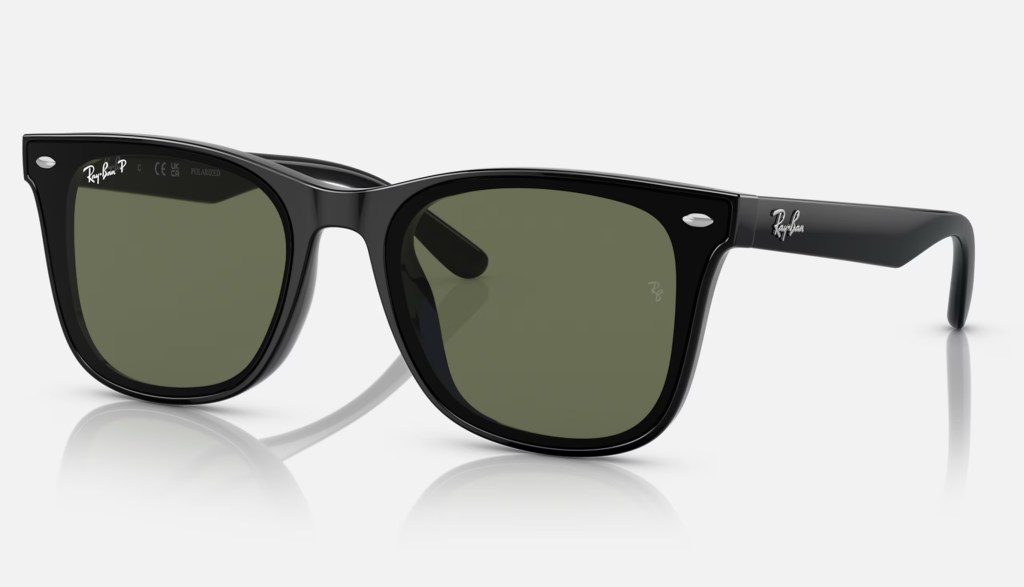
^^ A quick word about said sunglasses: I finally found a pair that fits my wide face and doesn’t slide down my low nose bridge. Admittedly I hadn’t tried Ray-Bans because the last pair I bought in Italy like, a decade ago, didn’t do so well on those two fronts and have gathered dust in a drawer. But Ray-Ban has since expanded their product catalog with inclusive new variants and I found some that fit. They resemble the classic Wayfarer model, but with some changes like flat lenses, and so are given a terrible product number (RB4391D) instead of a cool name. Oh and they’re made in China.
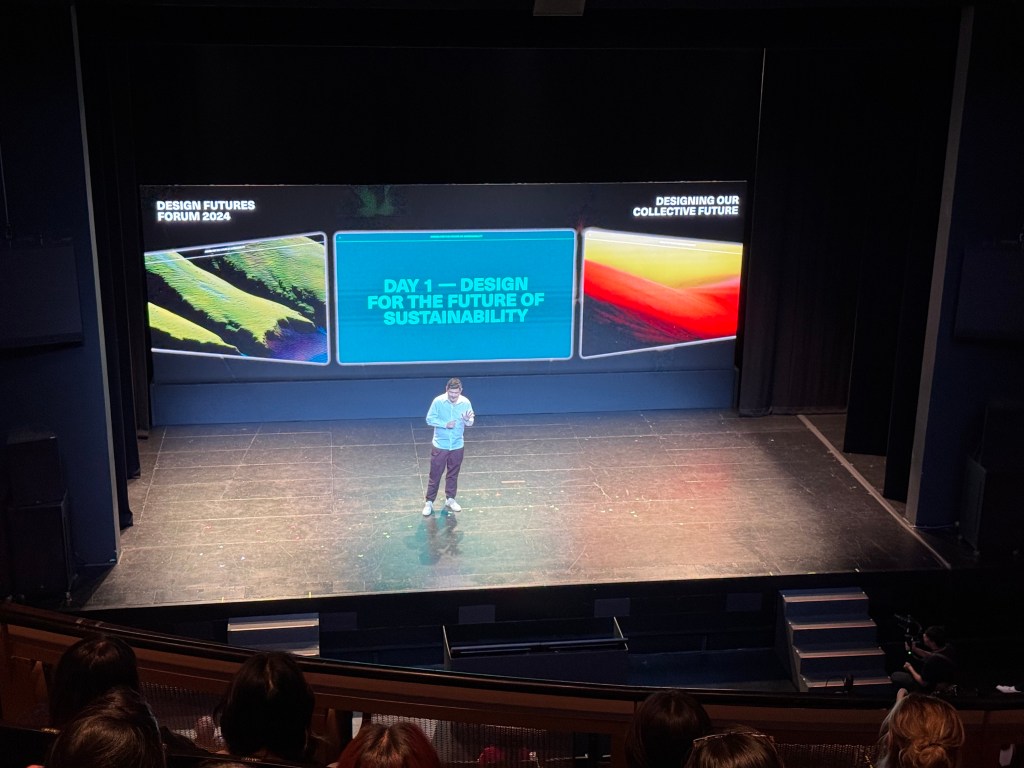
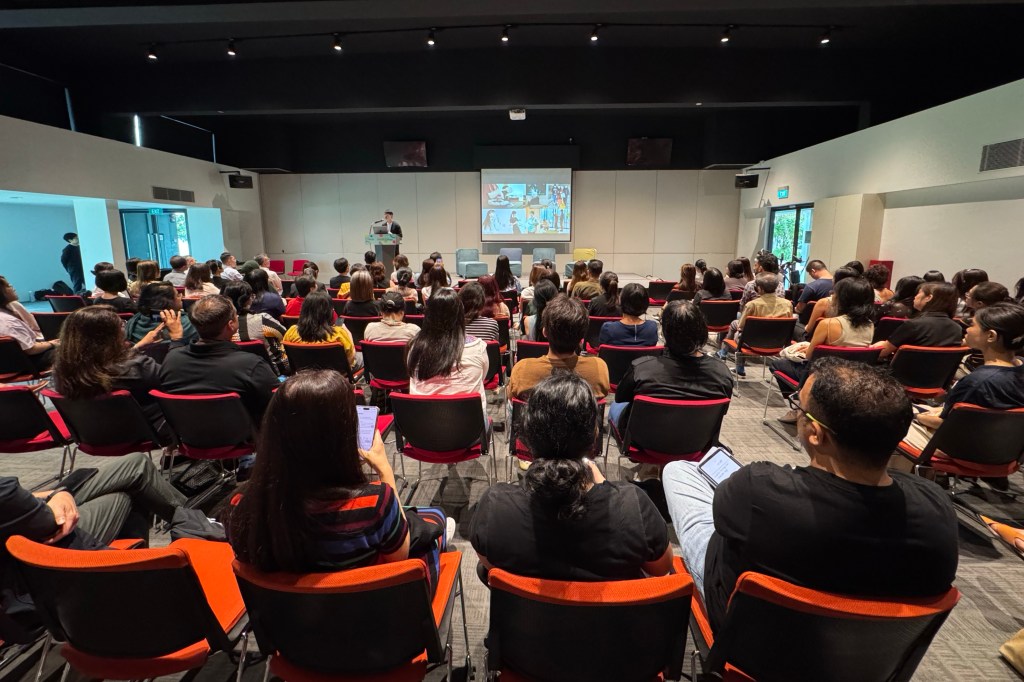
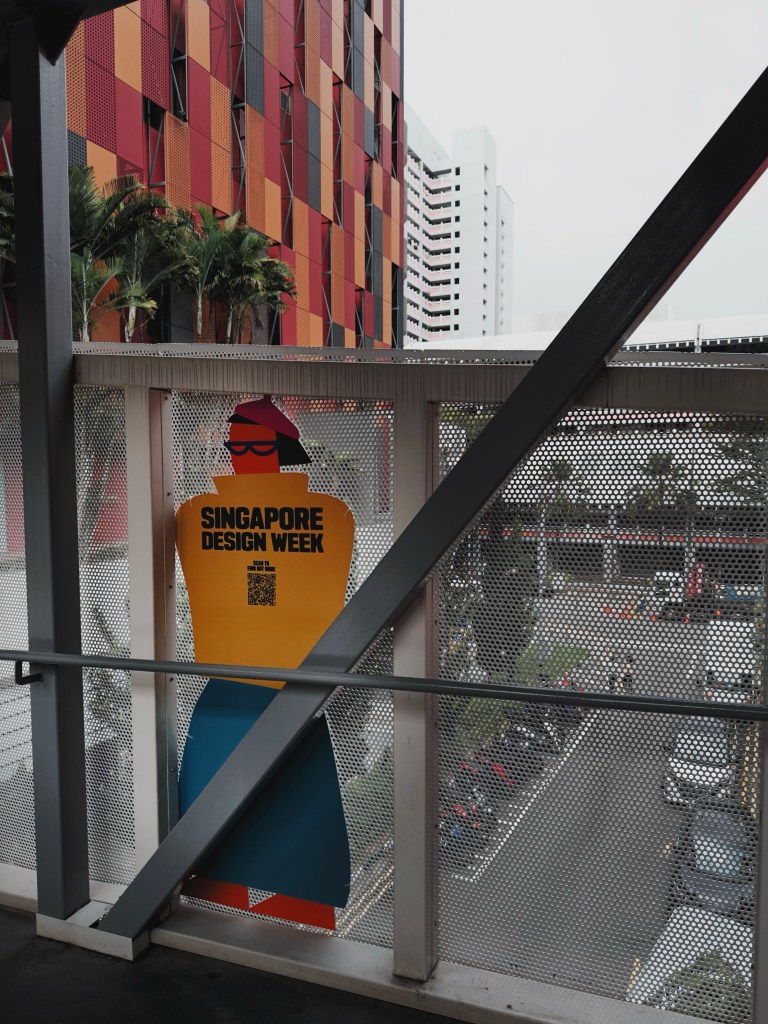
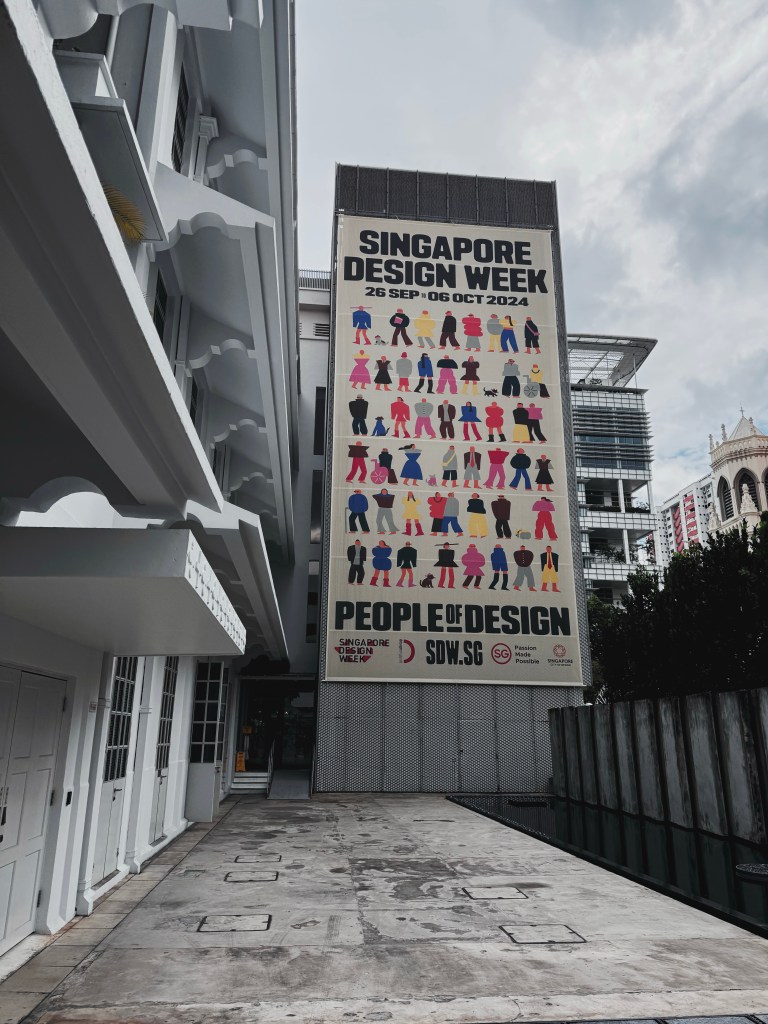
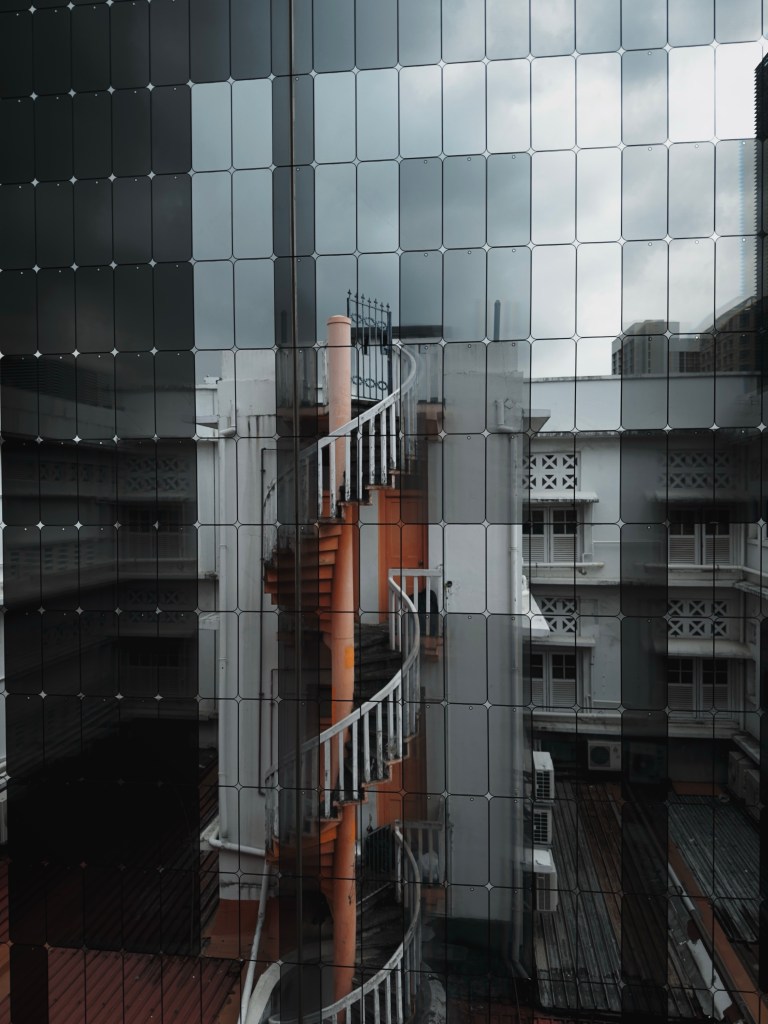
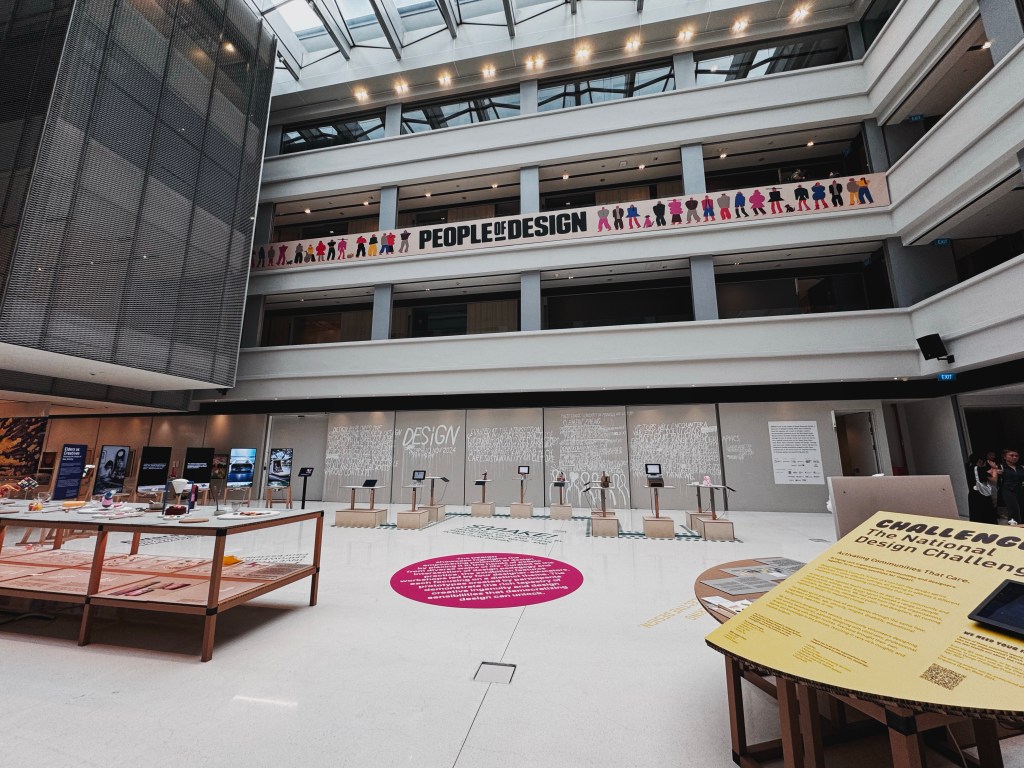
As mentioned before, this period of domestic exile coincided with Singapore Design Week, which gave me enough things to do and see. On Tuesday, I paid S$130 to attend Day 1 of what was called the Design Futures Forum, which was noted by other attendees to have very little to do with futures exploration (many things discussed were of the present moment), and disappointingly never unpacked the business/social/political challenges that an audience of designers would be thinking about. I overheard someone say, “I could have read this in a designboom article.”
For example, AI was a key topic as you’d expect in 2024, but presented with the breathlessness of a Forbes contributor piece from over a year ago; without offering contrarian viewpoints, sufficient interrogation of its costs and consequences, or thoughts on how its widespread use might be steered into balance with sustainable creative employment. The AI hype was pervasive, and if the audience played a drinking game triggered by every mention of it, the theater would have seen more vomit than the local ByteDance office. Some of the better speakers seemed to feel some responsibility to subvert the theme, and took genial pot shots at AI whenever they could. But I get it. We’re probably not the real audience for these events, and who knows what purposes they serve anyway? Me, I was only there to pass the time and meet old friends.
The next day, I visited the Enabling Village, which is described as “the first inclusive community space in Singapore dedicated to integrating persons with disabilities in society”. On top of just wanting to see the place, I attended a series of presentations on projects with inclusive design elements, including some interesting work from Sony. They’ve made prototype musical instruments such as a finger-free saxophone that can be played by humming into a mouthpiece. Your voice gets turned into synthesized sax tones. I wish I could buy one, then my neighbors would be paid back in spades (j/k).
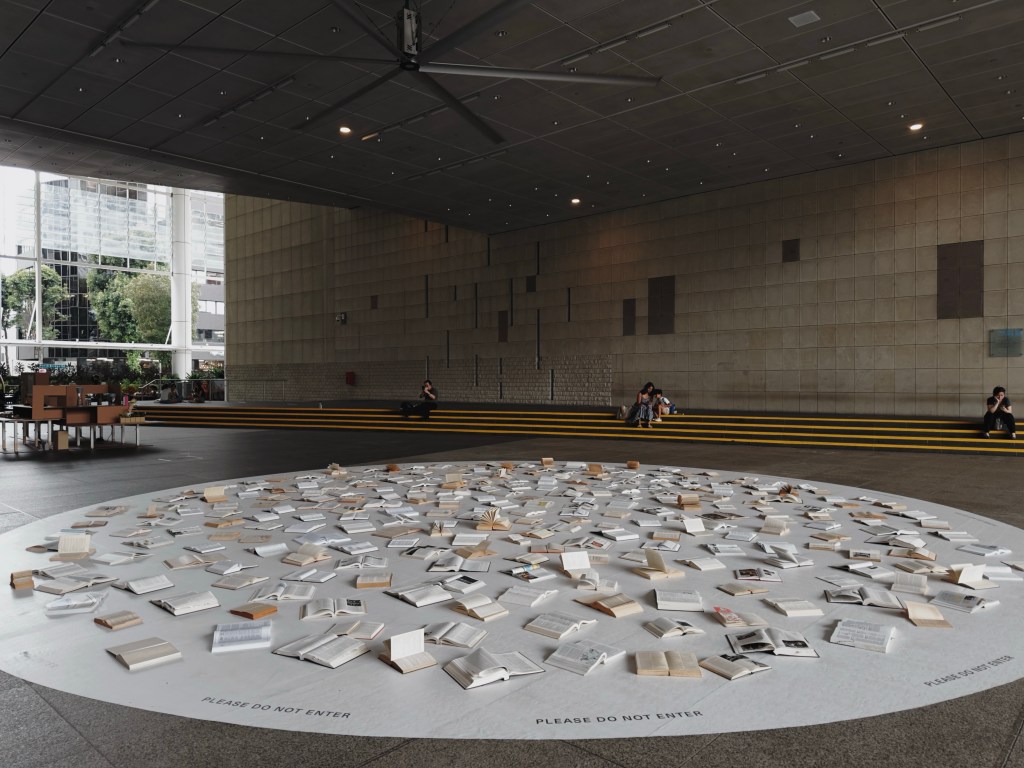
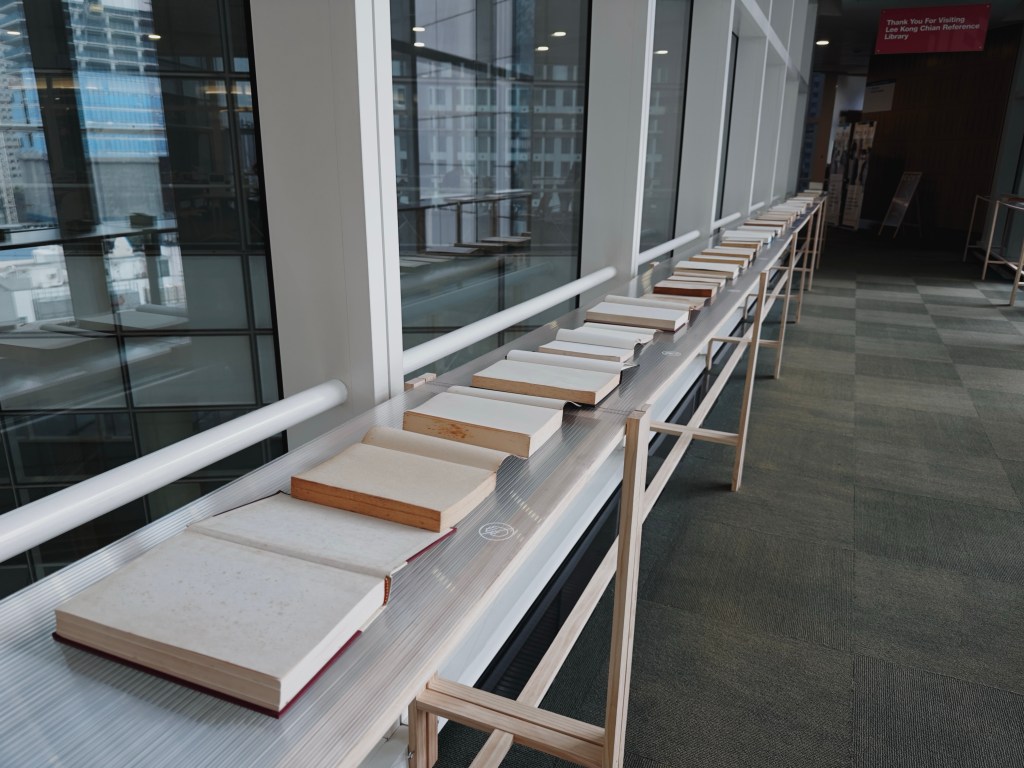
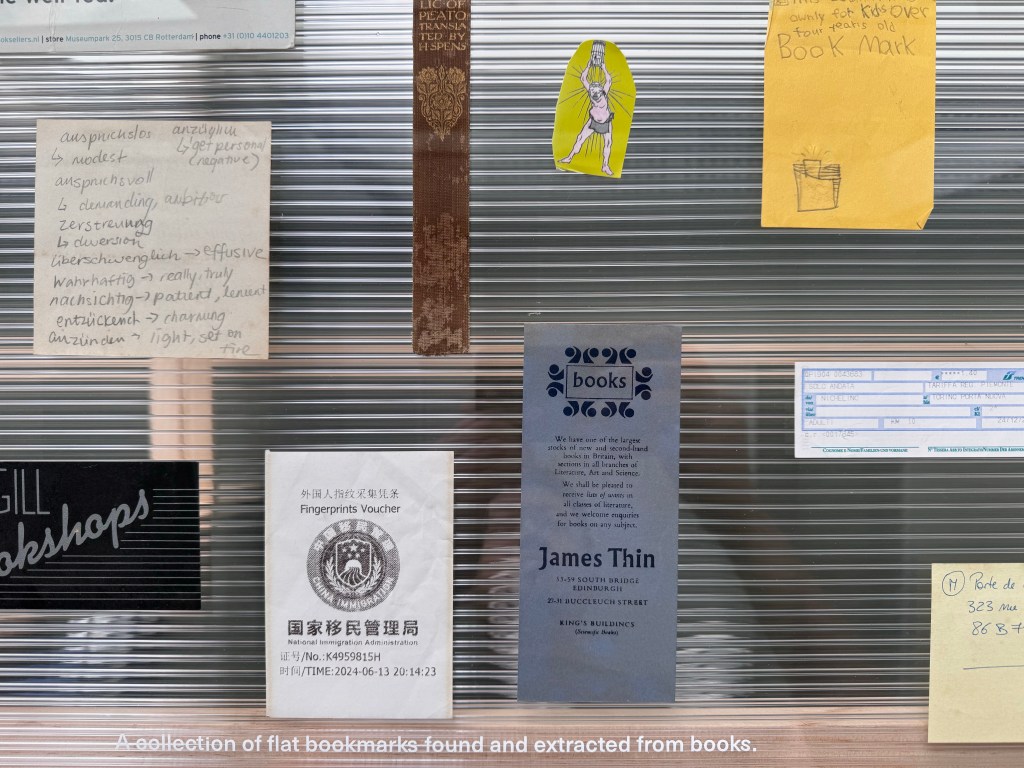
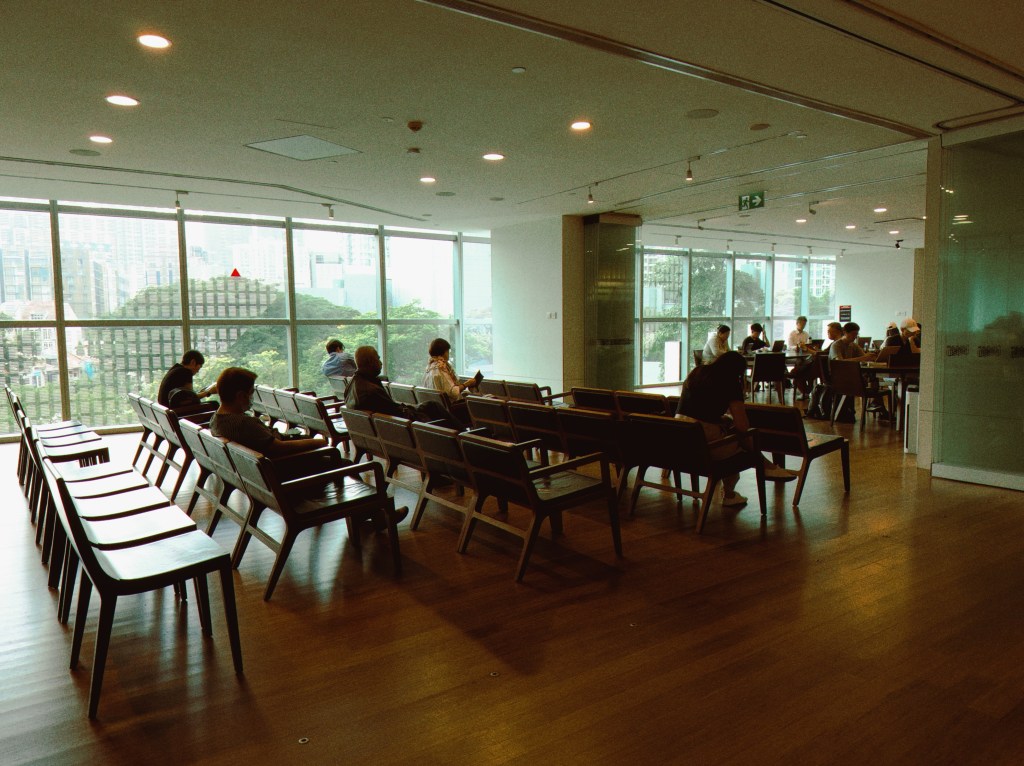
There were also many free events and exhibits across town, and I filled pockets of time by dropping in on the ones around Orchard Road and the Bugis district. My favorite location was probably the Central National Library building which hosted some thoughtful and playful meditations on books and reading: from the physical aspects of holding spines and flipping pages, to sensorial explorations like how smelling different types of paper can evoke long-buried memories.
It was my first time really checking out the Central Library, and it’s quite impressive. The reference section spans some five levels (from 7 to 11, I think), with the public lending library in the basement. Nearly every free seat was taken on a weekday afternoon, many by students of all ages who were… doing homework? I spotted someone doing math on the Humanities floor, so I guess it’s just an air-conditioned spot for some, nothing to do with the materials available.
I wanted to read some poetry, and found a copy of the collected works of Philip Larkin, in the exact same paperback edition I had as a student. I sat with that for half an hour, next to some senior citizens who looked very much at home.
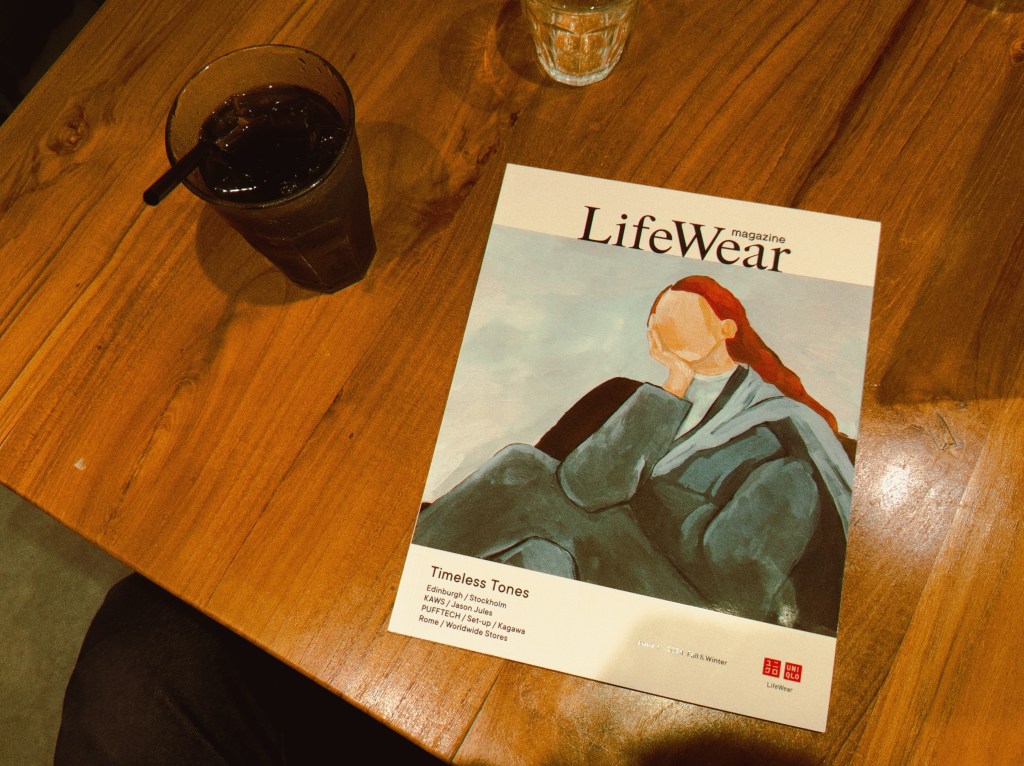
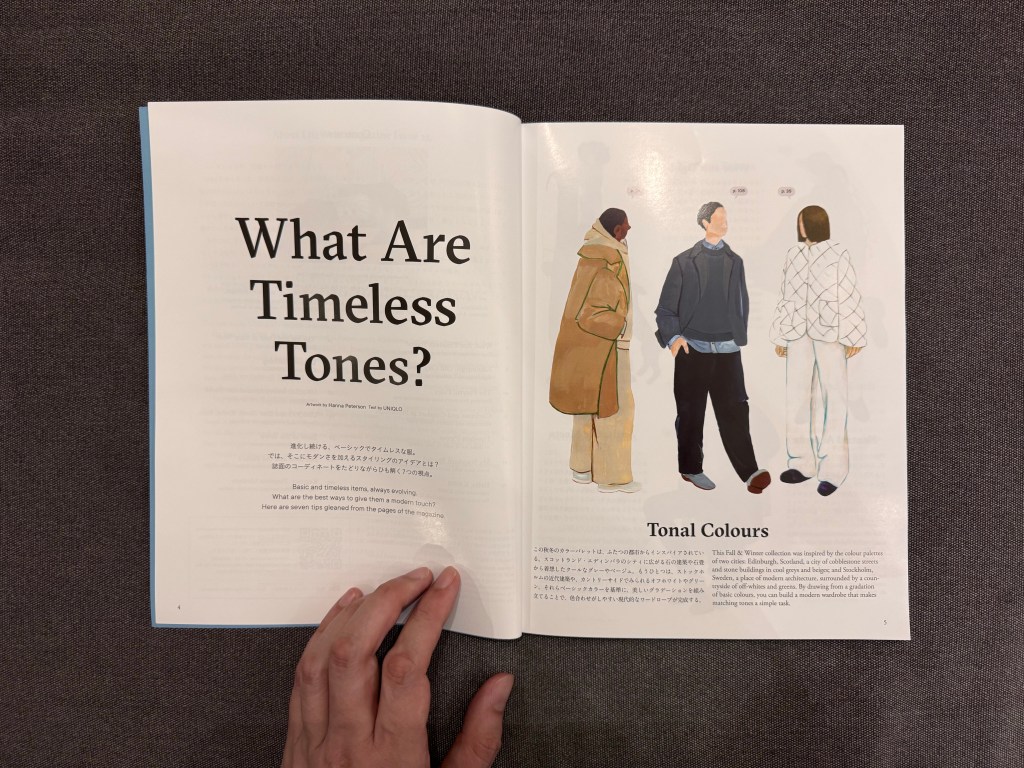
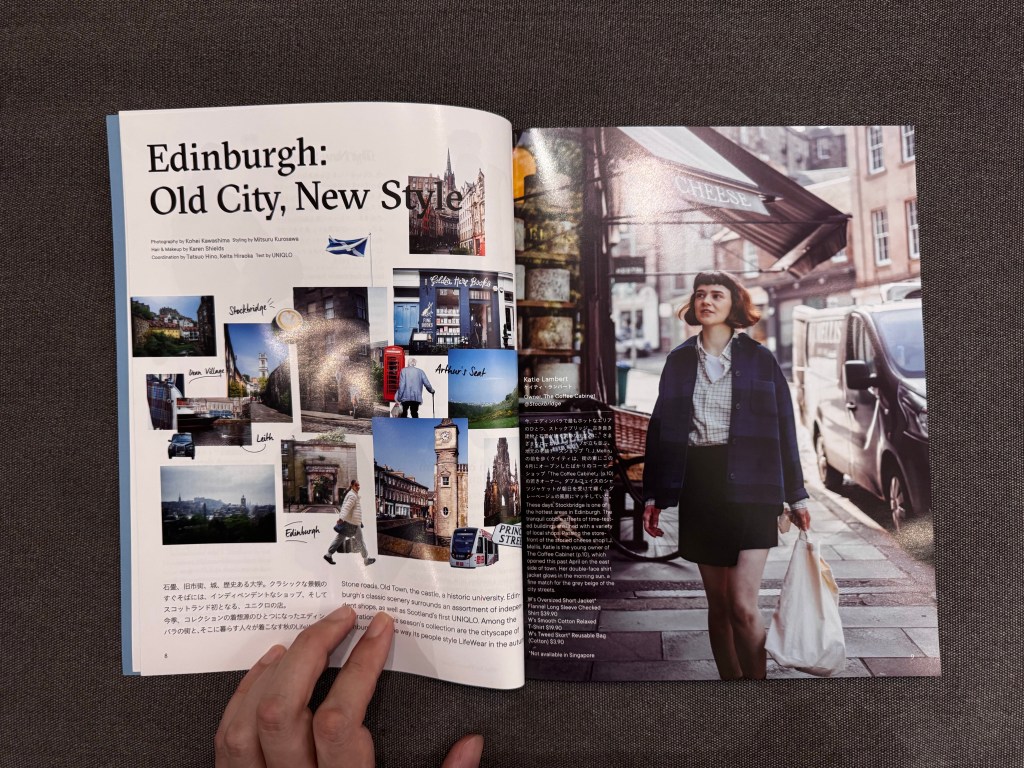
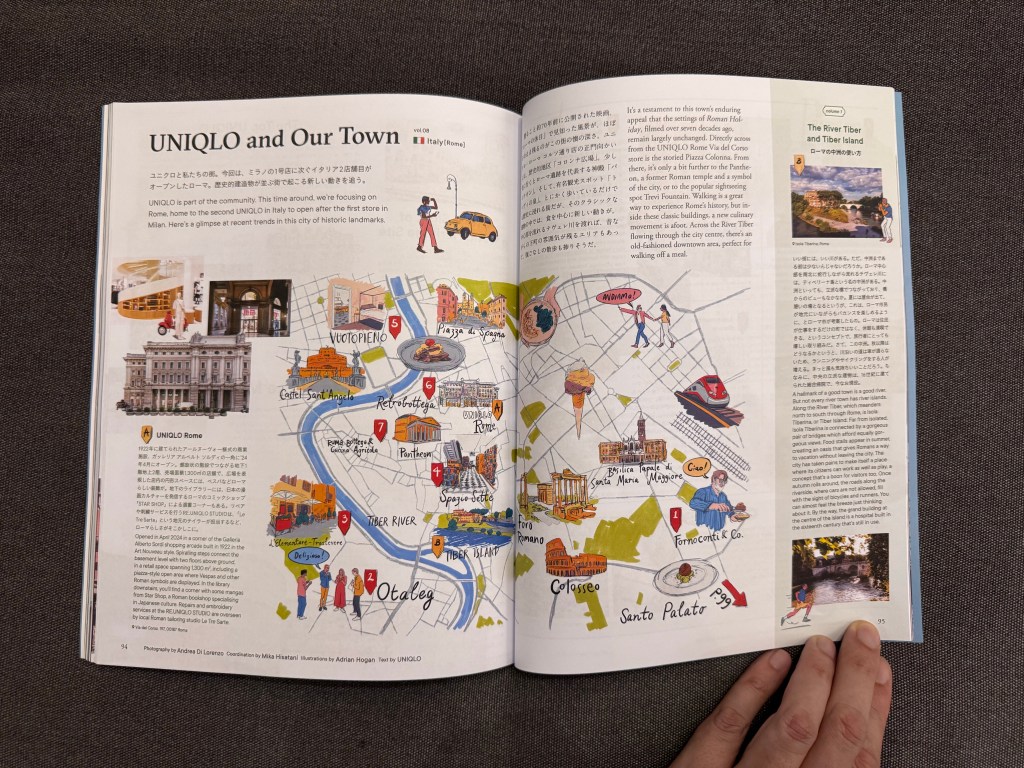
Let’s loop back to Uniqlo: I half-joked on Instagram that one of the best design artifacts I saw whilst out exploring Singapore Design Week ‘24 was in fact Issue #11 of the free Uniqlo LifeWear magazine they give out in stores. It’s in both Japanese and English, with elements of Japanese editorial design and whimsical Monocle-esque illustrations. In addition to the expected fashion spreads of their products on models, there are also recipes, features about their global stores and the cities they’re in, and profiles of artists they collaborate with. I wish we had more brand publications like this, where there’s no distinction between making something nice for customers and trying to sell things. You can also read it online.
On Thursday morning with some time to kill, I decided I’d best drop by the library@orchard to have a quick look before it closes down at the end of October for a lengthy renovation. It won’t be back until 2026, and the cynic in me thinks it won’t come back at all, much like how the Singapore Art Museum is now seemingly trapped in shipping port limbo, unable to return to its original downtown location because the land is now too valuable to allocate to the arts or whatever. I mentioned this before.
Then I spent the afternoon with Peishan and Cien at an odd cafe that identifies as a co-working space — essentially you are welcome to sit there all day and leech off their power and WiFi, with no stated minimum purchase amount or anything. I don’t get the business model, but they’ve survived for years somehow. Perhaps it’s guilt based, because I ended spending twice as much in food and drink than the cost of a hot desk would be for an entire day.
Media Activity
I presume the other two got some work done, but I spent my cafe time clearing email newsletters and watching an episode of The Old Man, a 7-part TV series from 2021 that I didn’t know existed until recently. It stars Jeff Bridges as an aged CIA agent in hiding whose past catches up with him (I know, I know! But I’ll always make time for a set up like this), and the first two episodes were directed by Jon Watts (Wolfs, Spider-Man: Homecoming). The whole thing is so well executed that I wish it was longer. I’m told the second season, running now, has lost the plot. But trust me, if you like spy stories at all, you’ll want to see the first.
Wolfs (2024) is now out on Apple TV+ and I enjoyed it just fine. For me, seeing George Clooney play a spiritual reboot of Winston Wolf, the fixer from Pulp Fiction (1994), is such a treat that it overrides other parts of the film being predictable or “small scale”. There’s also undeniable chemistry between him and Brad Pitt, who does that thing where he goes from smug, unlikable asshole to an alright guy after all, right before your eyes. Too bad he can’t do that with his real family. 4 stars.
I finished The Book of Elsewhere, a sci-fi/fantasy (really, I think it’s both) novel by China Mieville and Keanu Reeves. It was extremely enjoyable while sounding in many places like a thesaurus was devoured in the writing of it. Once you get past some of the “awkward” use of big words when smaller ones would do, the rest of the writing is good, and occasionally becomes deliciously unhinged. Phrases literally collide with one another and tumble down pages like experimental poetry in some places. Elsewhere, Mieville (I assume) manages to replicate the dreamlike quality of visual storytelling — this story first appeared in a comicbook series entitled BRZRKR, by Reeves and Matt Kindt — and narrates the immortal protagonist’s violent fugue states and how he experiences passing from death to rebirth with some of the most Class-A, Colombian-grade stream-of-consciousness I’ve ever seen.
It seems like there’s always something wrong, and I feel like it’s one problem after another these days. The same night as my near-death experience (previously on…), I came home to find that our bedroom’s air-conditioning had died instead. It would put out only semi-cool air, then just regular air, in a cycle that lasted all night. The next day, I dragged a standing fan into the room to make things a little more livable. A few nights later, when Kim returned from Australia, we started to sleep in the living room where the air-conditioning still works.
What followed was a series of visits by different servicemen, each finding something legitimately “wrong” but none ultimately solving the problem. There was the simple fact that the unit was clogged and dirty — despite another company just having “cleaned” it two months ago. They did a regular wash (S$66), but had to return on Wednesday for a deep chemical overhaul (S$150), and a washing of the outdoor compressors ($50). When that didn’t solve it, it was discovered that the outdoor compressor was flashing an error message, and the entire power PCB (printed circuit board) needed replacement ($711.50). FWIW it’s a Mitsubishi Starmex system; future buyers beware.
One week later, and the problem still hasn’t been addressed, and we’re still sleeping in the living room.
I need to mention how this has lived in my head as a much bigger problem than it objectively is. After getting home from the hospital, I just wanted to lie in bed and have everything be absolutely NORMAL. To have no outstanding problems in the world — just being in a state of calm to mentally recover. But immediately, something was wrong in the home, a psychological intrusion in my metaphorical safest space. This has just made me an anxious freak all week, feeling low and spiraling into worst-case scenarios. Like, what if they find there’s a problem with the piping in the walls and need to hack them out in our bedroom? What if this is going to cost even more money than what’s already been spent? I do believe this is all likely in the coming week.
Another source of anxiety is the actual repair visits themselves: not only is there cleaning up to do after (which I couldn’t really with a foot injury), but our compressor units are installed outside the bedroom window, over a fragile “roof” that probably can’t take a person’s full weight. To work on them, a technician has to climb out (one even did it without safety gear) and stand precariously on a tiny parapet, dangerously close to either tumbling into our living room or down several storeys. At work, seeing all the things that can go wrong is my superpower, but it’s not a useful one to have right now.
On the bright side, my foot is much better already, and I’m able to walk normally enough to go out for short periods. I expect I’ll be back to normal in another week. Whenever the feelings of doom reach a critical point, I remember that I’m actually alive and uninjured, and a lack of air-conditioning rarely (but not never) kills anyone, and then I get a spiritual HP reset. I just need to think like that all the time and take it easy.
===
Once I was able to hobble well enough, we went to see Trap (2024), which lived up to my expectations of a fun little outing. As of right now, Shyamalan’s second wind as a maker of tight little B-films based on killer elevator pitches is looking pretty sustainable, and I’m hoping for many more. Next, I’m gonna finish watching the final season of Servant, his series on Apple TV+.
We also had time for a quick lunch with Uma of Goggler Malaysia, a media criticism outlet after my own heart that I encourage checking out even if you, like me, have nothing to do with Malaysia on a regular basis. They do a fun podcast and publish spot-on film and television reviews. We talked about his new Apple Vision Pro and I outed myself as someone who’s never seen any of the Godfather films. But I’ve taken the first step: buying the entire trilogy on the US iTunes Store at the current sale price of US$9.99. I’m planning to watch it in the AVP’s Cinema environment someday soon.
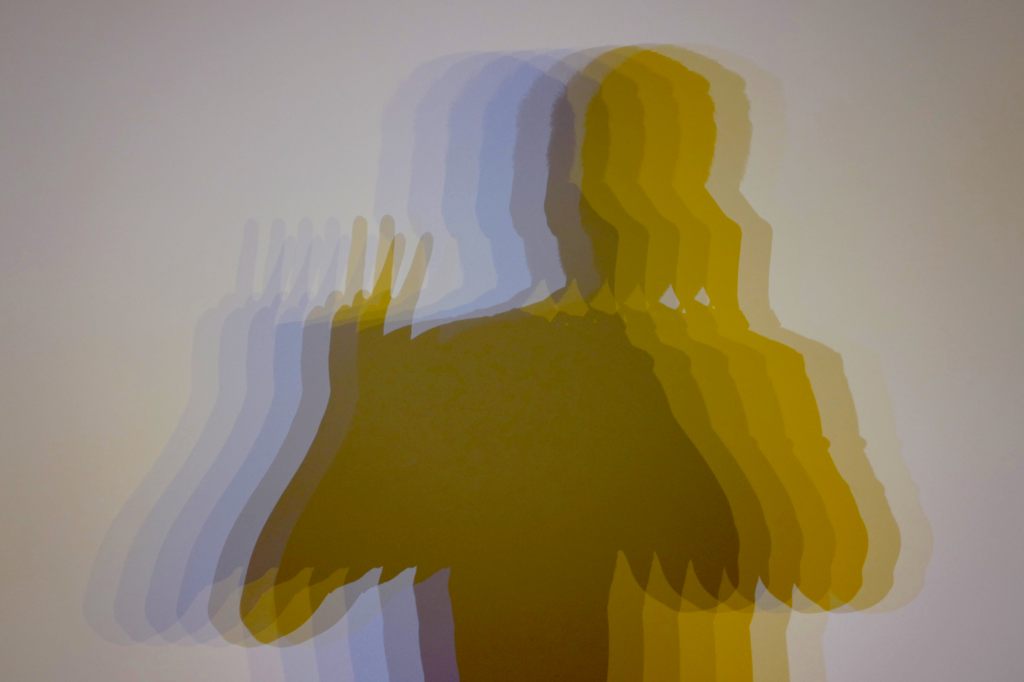
Finally, we visited the Olafur Eliasson exhibition at the Singapore Art Museum (Tanjong Pagar Distripark) with Cien, Peishan, and James. I say finally because this visit has been postponed three times on account of our various illnesses and accidents. Unfortunately I was not moved by anything, and it felt like a series of science experiments crammed into a small soulless space that lends no gravitas or beauty to an artist’s work.
I remember the original SAM fondly, and hope the museum will move back into its former space off Orchard Road although that’s looking more unlikely. The news can sugarcoat it all they like, but calling a remote concrete slab beside a container port ’eminently suited for contemporary arts purposes’ is a stretch. I’d love to see the so-called ‘positive feedback from visitors’ they’re receiving. Art doesn’t belong out somewhere you need shuttle buses for people to encounter it. The museum’s rightful place is wherever ordinary people are already going.
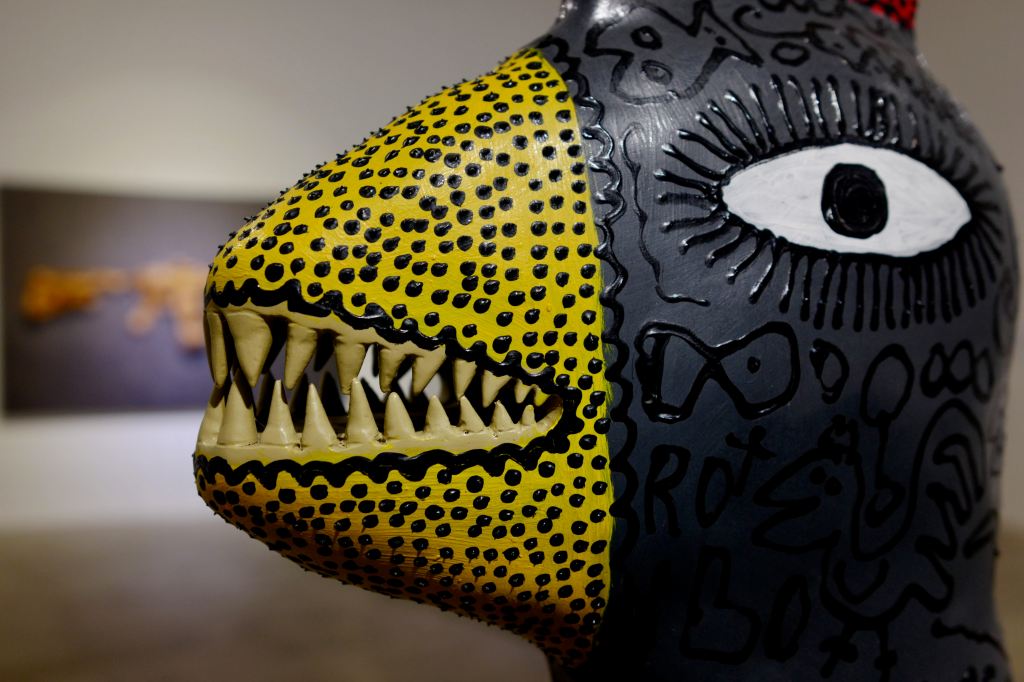
Olafur Eliasson’s ‘Your curious journey’ at SAMThese were from an Indonesian pop art collection at Gajah Gallery

































 sangsara.net