Tag: Books

  • Week 7.26

    Week 7.26

    One of my irrational fears that hasn’t gone away with growing older is that of going to the dentist. I’ve put it off over and over, and was pretty sure I’d make it last year but didn’t. I’ve done my best to handle things at home, even flossing daily which they always say you should do but I’m convinced no one actually does. This week I finally made an appointment to go, and it wasn’t as bad as I feared. They did find a cavity that needs patching up, but the appointment for that is only in a couple of months.

    One thing that felt off was a recommendation that I get a certain procedure done — not only because I’d like to avoid pain wherever possible, but because it was prescribed before they’d even looked in my mouth. I’d only just said that it was my first visit in a while, and they said ‘okay you should get this done’.

    Because it’s 2026, I uploaded my x-rays to Gemini 3 Pro for a second opinion. It analyzed the scans confidently (but of course) and told me the same things, but in even greater detail. It did not think the procedure was necessary, and gave me clarifying questions to ask the dentist next time. When it comes to a nervous person like me, it provided a better experience than a human dentist could because it was available to answer my many more follow-up questions, at all hours. This longer “consultation” made me feel better, although I’m well aware that taking medical advice from a machine that just says things isn’t the smartest move. But I know people do and will because it’s really easy, and so once again I’m saying this is really dangerous territory.

    Why am I using Gemini so much, and what happened to Claude? Google decided to play dirty, I guess. They’re offering three months of their Pro AI plan (essentially Google One with 2TB of storage + access to Gemini Pro, Nano Banana Pro, and Veo) at a 90% discount. That’s about S$2.80 a month. These models are all so incredibly close in raw performance, that for someone like me who’s not using them for coding, the main differences are down to tone, character, and perhaps ethical alignment. I’m already sold on Claude for text-based work, but I thought I should spend some time getting a feel for how Gemini differs. Especially since it’s going to be at the heart of Apple’s AI features at some point this year.


    Friend and former colleague Rob is back in town for Chinese New Year. I thought I’d last seen him maybe two or three years ago, but it’s actually somehow been closer to four. The quickening pace of time’s slipping through the fingers at this age is alarming. The last time he was around, I’d just printed off some stickers of my Misery Men drawings and given him one. I had just gone back to work after my brief sabbatical. We were still wearing masks indoors (as seen in the linked post’s featured photo). Is there a German word for how relationships can pause and park themselves outside of regular time, so that four years feels like so much less?

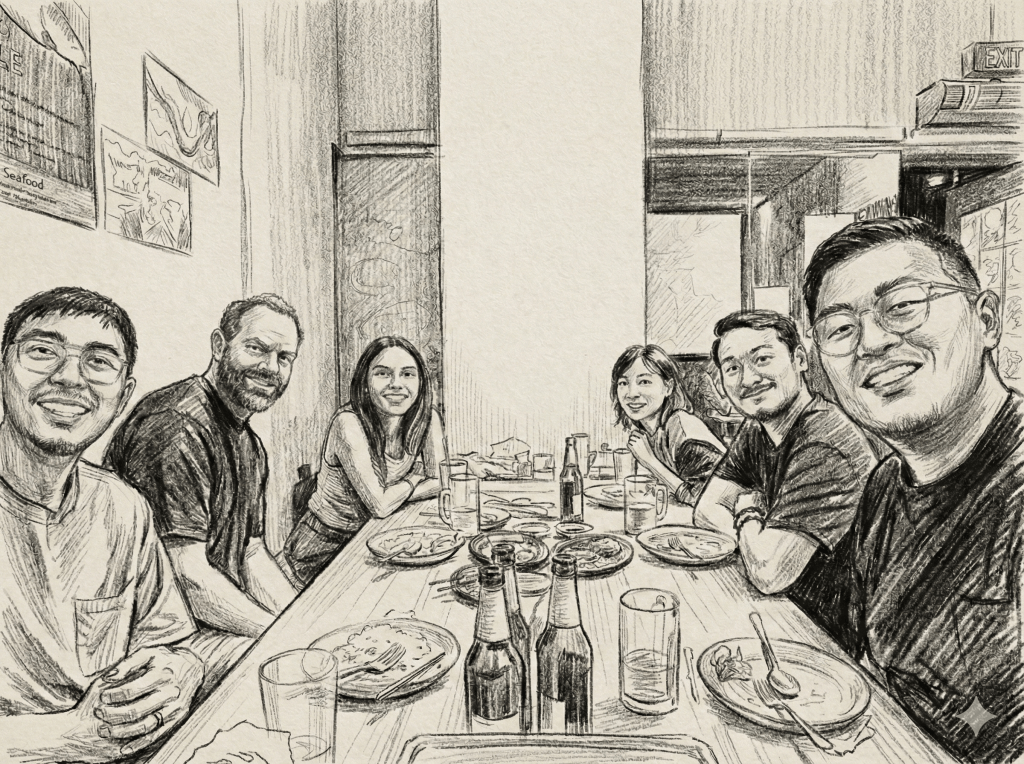
    A few of us met up for craft beers and Thai food on Sunday, with the reminiscing and catching up going past midnight. Here’s a privacy-preserving photo-turned-courtroom sketch made with Gemini’s help.


    Media activity

    • I finished watching all 48 episodes of The Apothecary Diaries anime series on Netflix. It’s about an unusually educated girl, raised in a red light district, who gets kidnapped and sold to the imperial palace as an indentured maid where she gets to flex her skill with poisons and medicines. It’s set in a fictional country resembling China in the Tang Dynasty. Nothing about this should appeal to me, but it was one of the more enjoyable low-stakes shows I’ve seen recently.
    • I still haven’t finished reading Sleeping Dogs. But I did finish playing The Hokkaido Serial Murder Case a few weeks ago but forgot to say so. As a faithful remake of a retro game, it can’t be blamed for some of the dated gameplay. The art could definitely be better though — it would be a fine game for $20, but unfortunately is priced at $44.99.
    • It’s been a year since we were in Tokyo and I bought the Japanese supernatural murder mystery game Paranormasight, largely because it was set in the Ryogoku/Sumida district where our apartment was. In last week’s Nintendo Direct, a sequel was announced and so I decided it was finally time to get started on the original. It’s turned out to be quite good, with a dynamic visual presentation that goes beyond the usual VN style of talking figures in front of different backgrounds. The gameplay is constantly breaking the fourth wall as well: one challenge where you die after hearing a cursed sound is solved by going into settings and turning the volume down.
    • While feeling stressed out about the dentist, I played Jusant on the PS5. It’s a beautiful, dialogue-free game where you slowly climb a massive mountain and put together what happened to the people who used to live on it. It was fairly quick to finish and now I’m curious about Cairn, another game about scaling a mountain, albeit more realistic about the physical difficulties involved. Jusant’s nameless hero is practically superhuman and his arms are way too skinny for the insane amount of climbing he has to do.
  • Week 6.26

    Week 6.26

    • A quick follow-up on one of last week’s topics: it turns out that some posts on Moltbook may have been faked because there were security holes allowing people to get on there and post directly (instead of being a bot-only place as promised). Doesn’t change the main point that future agents will collaborate not just on one computer, but sync up across wide networks with effects most of us can’t fathom. Look at the crowd that gathered to discuss Clawd a couple of days ago, to see how much excitement there is for this box that says Pandora on it.
    • I’m too tired to dwell on this much more today! Keeping up with the AI space is still a full-time job, and I’m not going to try. But Claude Opus 4.6 was just released, along with demos of what it can do in Cowork mode, which is very impressive if true. Apparently these models are also able to tell when they’re being evaluated by safety/alignment teams, which makes it very hard to know how they’ll really behave in the wild. Look at this example where a model can infer the user’s cultural background with just a few words, owing to the words they choose. These are tools, except other tools don’t do things like this.
    • I read a fantastic sci-fi short story that sort of involves AI: Julia, by Fernando Borretti. If you also enjoy fiction that drops you into a context and makes you swim, and then shows you strange and beautiful ideas as you break above the surface, you’ll love this. Like how China Miéville uses ornate language in The Book of Elsewhere to suggest Keanu Reeves’s… I mean the protagonist’s immortal, mystical otherness, Borretti uses a dense, intellectually dominating host of references here to illustrate the POV of an artificial mind at the end of humanity’s time. I haven’t stopped thinking about it.
    • What will we do when all the jobs are gone? A young entrepreneur in our neighborhood has started a home-based business selling smashburgers, and we bought some for dinner midweek. They were good, and I’m slightly afraid of what this proximity will do to my waistline. For those unaware, this was a bit of a trend last year and local media outlets like ChannelNewsAsia ran stories (example) about how such businesses were springing up as a result of low employment opportunities and rising rents.
    • Retreating further into the virtual world is another option. A bunch of new experiences became available on the Apple Vision Pro recently, and I caught up with some of them. The cutest is an immersive documentary on Apple TV called Top Dogs (two 15-min episodes), which looks at the annual Cruft’s dog show in Birmingham, UK. You get really up close to some of these beautiful animals, and the urge I felt to reach out and pet them was extremely strong. It wouldn’t be the same seeing this on TV. Here you get a sense of their size and presence, see them in incredible detail — everything but smell them. Apparently there are 25,000 dogs at the convention center each year, but I imagine these are all shampooed and much more pleasant than your average wet dog.
    • There’s also Retrocade, a game on Apple Arcade that uh… simulates an arcade. The game is playable on other devices, but on Vision Pro you get life-sized arcade cabinets standing in front of you, playing licensed retro titles like Space Invaders and Bubble Bobble. The only thing that breaks the illusion is of course that you can’t reach out to grab the sticks and mash the buttons. Instead, you have to use a connected game controller.
    • Speaking of emulating old hardware, I played and finished a game on Switch (also available on PC) called The Operator. It’s one of those where the entire UI is a computer’s desktop and you have to chat, look into files, and do hackery stuff to experience the story. I think this can be filed along with the other murder mystery games I’ve played lately. It’s fairly short at under four hours, almost completely linear, and not something you’d play twice. Wait for a sale, I think.
    • You know who else is a hacker? The lead character in Apple TV’s Tehran, a show that came out in 2020 and has since been renewed for a fourth season. We watched Episode 1 back when it came out, liked it enough, but for some reason completely forgot to go back until this year. It’s been topping the charts lately, maybe because of the recent civil unrest in Iran. Having just finished Season 1, I can say it‘s a really good espionage thriller, and we’re keen to keep going.
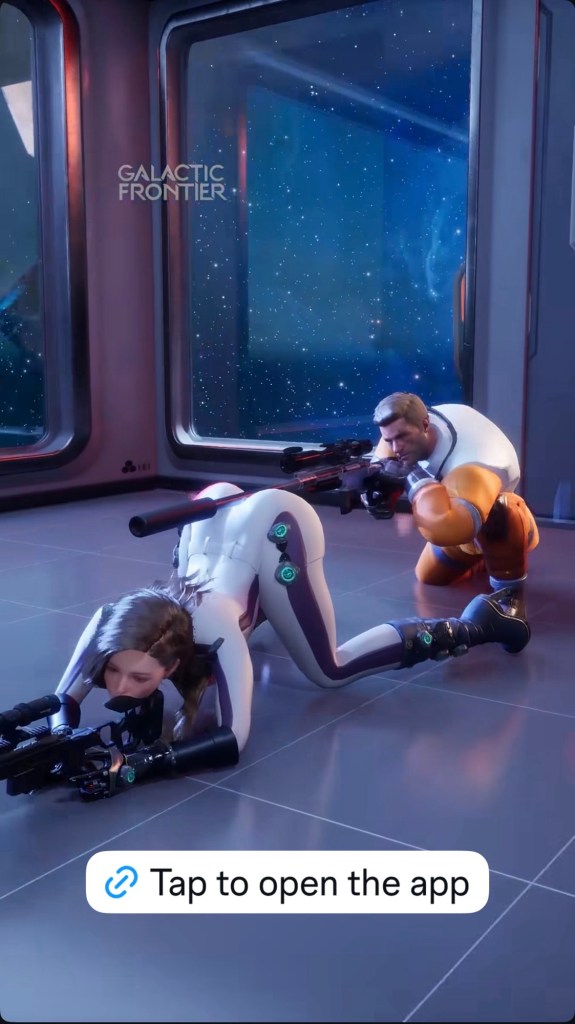
    • Oh and check this out. Someone has managed to license Isaac Asimov’s Foundation series and made a free-to-play (i.e. shitty) mobile game: Foundation: Galactic Frontier. It even has an Apple TV logo appear on startup?! And the next day, I saw this insane animated ad for it pop up on Instagram and couldn’t believe my eyes — I took a screenshot to prove it. In all fairness the actual game isn’t anything like this, it’s just a heinous misrepresentation that probably has Asimov spinning in his grave.
  • Week 3.26

    Week 3.26

    This week’s vinyl purchase was the album that restarted the whole idea of buying physical music again for me at the end of last year: Rosalía’s LUX. The digital/streaming version is intentionally incomplete, with 15 tracks instead of 18. Purportedly because she wanted to highlight the importance of ownership. The first thing I did after hearing that fact was to hunt down an MP3 rip of the CD and upload it to my Apple Music library. But it never felt right, and so I wanted to buy the CD, which led me to look at CD players, and then… you know the story. That’s it, no more. For real this time.


    You know which company or live service does the best Wrapped/Replay/Year-in-review thing? It’s Nintendo, because they actually wait for the entire year to be over before sending theirs out. I think Apple Music gives out the Artist of the Year award in November. As a borderline OCD pedant, that shit doesn’t sit right with me.

    So my Nintendo 2025 report says I played just 172 hours, spread across 43 games. I believe the first number but the second seems high. Maybe it erroneously counted some games I reinstalled after getting my Switch 2. In any case, that’s an average of half an hour per day, which is kind of a sweet spot: not high enough to be called a good-for-nothing bum, and not low enough that I’d question my life choices. My top game was The Legend of Zelda: Tears of the Kingdom, which I likely won’t return to and finish for another couple of years, if the previous game was anything to go by.

    I started on a new game this week and discovered that an old-school adventure game was just what I’ve been needing. The kind where you don’t have to physically walk a character around, but instead choose options from menus to prod at scenes and investigate murders. This is its actual full name, btw: The Hokkaido Serial Murder Case: The Okhotsk Disappearance ~Memories in Ice, Tearful Figurine~.

    If you remember the Famicom Detective Club games, this is similar in that it’s a remake of a classic NES-era Japanese adventure game, with updated graphics and music — albeit nowhere as lavish as the treatment that Nintendo and MAGES gave to their versions. Where the Hokkaido murder game justifies its asking price is in its scope. It’s actually two games in one; the original story set in the 80s, and a new sequel set in 2024 where your character returns to wrap up loose ends.

    Ah that reminds me, when I was in Japan around this time last year, I saw a similar Switch game for sale that I didn’t recognize. I took a photo of the cover to follow up on later, and found out it’s my kind of murder mystery but hadn’t been translated for global release.

    Then a few months ago, I remembered to look it up again. This is where that new feature in iOS that lets you tap and select text in a photo comes in super useful, especially when it’s a language you can’t read. I discovered that it’s been given a new title Path of Mystery (originally Mystery Walk in Japan) and a global release date: Feb 26, 2026.

    This one has a unique feature that I’m excited for: while the story unfolds in both the past and present (similar to the Hokkaido game I’m playing), there are two separate UIs and gameplay styles. The past has retro pixel art graphics, menu-based commands, and outmoded gameplay conventions; while the present portion looks like a new game with modern controls.

    Let’s round up all this game talk by making a list of the other titles I bought on sale over this holiday season. I fear there were quite a few, but I won’t know how many until I do this, and maybe this will keep me honest.

    Okay, maybe I do have a problem! It’s going to take me all year to get through these alone — this is who you’re asking to get a regular job, by the way.


    I read Network Effect, Book #5 in the Murderbot series for our book club, and I think this will be the last one I waste my time on. The writing is artless, soulless, and mainly serves to perfunctorily describe actions that the characters take. Surely reading this blog already gives you your recommended weekly allowance of that. Making matters worse is this installment being ‘normal novel length’ where the rest up to this point have been relatively short little stories. It’s definitely overstayed its thinly premised welcome.

    One of the fun things my book club does is watch film adaptations whenever a book we’ve read has one, and they recently read Ready Player One. I already read the book once when it came out, so I skipped this one, but joined for the movie watch party. Most of us rented the 3D version for Vision Pro from iTunes/Apple TV, which was worth the six bucks.

    The 3D presentation is spectacular, helped a lot by the fact that no one blocks action sequences like Steven Spielberg. Even when almost everything is CGI with billions of particle effects flying on screen, he’s an absolute master at keeping the eye focused on what matters. But time and growing up in general has not been kind to Ernest Cline’s writing.

    The dialogue was so cringe, the heroes have zero aura, and honestly I’d forgotten the story and was convinced the genius game developer god Halliday was a bad guy because of how toxically narcissistic he was. I mean, he built a library of his own life story for “scholars” searching for clues to win the in-game prize he left behind. And in one scene, he actually says the words “I’m a dreamer” to the co-founder who wants him to take more responsibility for the online world he created. If I’ve learnt anything in this life, it’s not to trust any douchebag who calls themselves a ‘dreamer’ or ‘visionary’, especially if they’re involved with a metaverse project.

  • Week 2.26

    Week 2.26

    I’ll say one thing about my vinyl collecting this week and move on to other subjects, promise. But I run these posts by Claude to get comments and catch mistakes, and it’s been saying that their money is on me owning 100 records by March since I’m weak. Well, joke’s on you, Bubbles, because I only bought one album this week! Yes, I said ‘no more’ but this one was justified because it’s only available on vinyl. The album: Dr. Dre’s 2015 Compton album’s instrumentals.

    Okay I said we’d move on, but this is related. An article about “friction-maxxing” in 2026 made the rounds this week, and Rob shared it with me saying buying records was kind of in the same territory. I jokingly replied, “things yo-yo so fast these days, I think the backlash to frictionmaxxing is gonna come quick and we’ll all embrace digital (convenience) again.” I sent him back this tweet, which argued that ‘ackshually, we have so much friction in modern life, and I’m happy for AI to take some of it away so I can be more intentional about the important things’ — which I fully agree with.

    Some time ago, I saw a video series on YouTube from a guy who decided to only listen to music through an old iPod again, instead of streaming. He was obviously effusive about how much better the experience was, and some other people I knew said they were going to try and do the same. The act of using an iPod with its wires and manual syncing struck me as adding unnecessary friction. It’s not friction that makes the music more enjoyable, it’s focus and intention, and friction is one way to induce it in an attention-deficit mind. But you can have that same experience on your iPhone with a little more self control; just prune your library, make a couple of playlists, pin six heavy rotation albums to the top of your list, and ignore the limitless catalog in the background.

    I got on my soapbox and continued to Rob, “I think many people struggle with doing things intentionally enough for their brains to become aware they are doing them, and form the memories. I saw a tweet the other day about how looking at your hands when you set something down, like your keys, increases the chance of you remembering where you put them.”

    “We just do a lot of things with minimal attention and focus now to get through the day, and not enough of it sticks, so we feel unsatisfied or unmoored from our lives. So you don’t really need a physical music collection, you just need to pay attention to the music you listen to rather than slap something on in the background with an algorithm. But that discipline is waning.”

    Let’s go on another tangent if you’re still here. Fujifilm announced a new product, and I literally did not believe it when I saw it. I was convinced the pictures were an AI hoax, and only began to accept it when I landed on the official press release.

    The Instax mini Evo Cinema is modeled on the form of an old Super 8 video camera, and takes photos and short video clips. It can print those photos on Instax mini film, of course, but it can also upload video clips to a server (they’ll stay up for only two years) and print a keyframe that has a QR code link to the video. This is objectively a stupid design if you care about media permanence, which the very idea of printing images on Instax is based on. I think the product is okay if you discard the Instax component altogether — it’s a cute, retro-styled digital camera that you can transfer photos and videos off onto your computer or phone. They could have just made that, but Instax makes Fujifilm a heap of money, so they bolted that on.

    The other thing that prevented me from ordering one on sight was the central “Eras dial” gimmick. You can turn a physical dial and add filters to make your videos look like they were shot in the 1930s, 40s, and all decades up to 2020. I like this in principle, but 100% doubt the ability of the Instax team to pull off the execution. Let me take a step back: the Fujifilm camera division that makes their X-series cameras (e.g. X100VI, X-T5, X-E5) is absolutely goated. They have brilliant people doing color science and their “film simulations” are basically software updates so good that people will buy new $2,000+ cameras when they come out with fresh ones.

    The Instax team, on the other hand, are like the Temu version. They make chintzy plastic cameras with clumsy industrial designs and even worse software. I have the Instax mini Evo camera and all its filters are so cheesy they would embarrass the most amateur of iPhone apps. Pulling off the processing required for the Era effects to look authentic would call for a powerful chip in the Cinema camera, and there’s little chance at all there’ll be one. But the counter argument is that this is all by design. The Instax/Cheki target audience in Japan significantly overlaps that of a purikura photo booth, where cheesy, over-the-top effects are the point. So maybe I’m just not the intended buyer here, but I’ll wait for the release to be sure.

    The ‘Season of Joy’ has been dismantled

    Why do I sound so grumpy this week? Maybe it’s the weird itching I developed on my arms. Maybe the new glasses I got made that turned out too tight. Maybe the six mediocre episodes of the UK series Red Eye that we decided to watch a second season of. Maybe the letdown of Sushiro’s “Claws for Celebration” crab promotion, where said crab legs were weird and mushy. Maybe the persistent pain in my right knee that says I’m getting old.

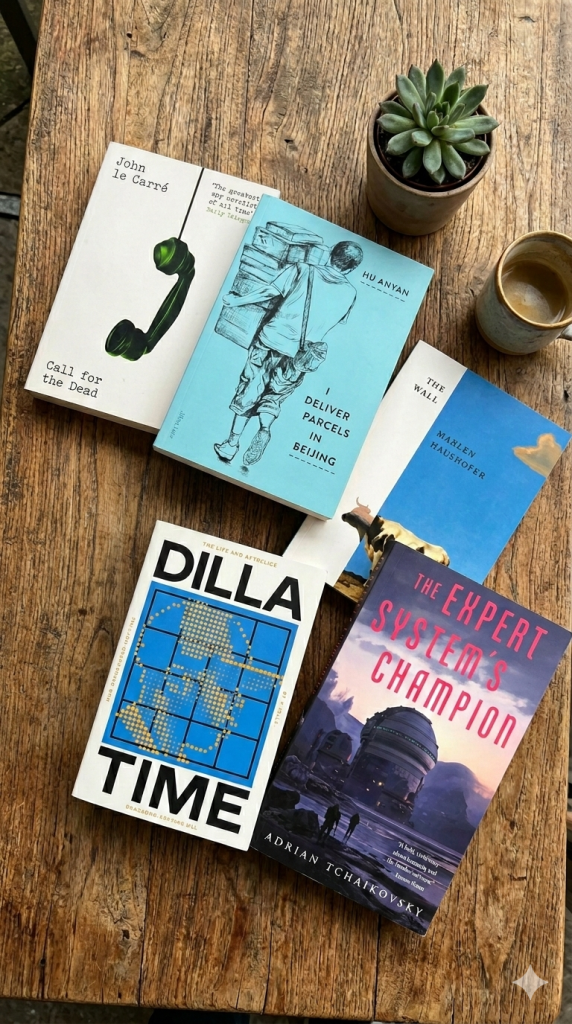
    But J Dilla’s music has been a bright spot. I finished reading Dilla Time, the very detailed and extremely readable biography by Dan Charnas that I started last week. As someone who’s always sucked at rhythm games like Rock Band, I now understand that my predilection for hitting the drums slightly before or after the beat could simply be a byproduct of listening to too much jazz and hip-hop and having a ‘swung’ sense of time. That’s my story anyway, and I’m sticking to it.

    Please enjoy this recent hour-long mix of Dilla’s music performed by one DJ Kenta in a Tokyo coffee shop that I’ll now have to visit the next time I’m in town.

  • Week 52.25

    Week 52.25

    Merry Christmas! For my main gift, I received a turntable, something that I’ve been very conflicted about wanting for awhile. Apart from the fatal hipster embarrassment, I know that the urge to repurchase all my favorite albums on vinyl is a road to financial ruin.

    Back in February, I was on the lookout for a CD player to bring home from Tokyo, but decided against it because digital streaming is identical, if not superior in the case of lossless and Spatial Audio, and I couldn’t see many instances where I would bother to get up and pop a CD on instead of just call out a request to my HomePod. And HomePods don’t accept Bluetooth or line-in audio, so I’d have to use my Sony soundbar or buy a third speaker for the living room. Too much hassle!

    But vinyl, goddamnit, just barely dodges the killing blow of that logical argument by having a different value proposition. One, the physical LPs are more collectible, more beautiful, more mentally stimulating in a world that wants to turn itself into ephemeral bits. People say that intentionally putting on a record for close listening deepens your connection with the music over just tapping a link. Two, the audio characteristics of an all-analog reproduction chain are surely different from digital. So if you can, why not have both options for home enjoyment? Three, it’s just kinda cool?

    So I asked Santa for an Audio-Technica LP70X, which has the option of Bluetooth output. I briefly considered buying one of those Marshall speakers to pair it with, but the idea was so cringe I couldn’t face it. Besides, that would nullify point No. 2 — why bother if you’re going to digitize it? So I hooked it up to an unused B&O Beolit 12 speaker (which has unceremoniously served as a stand for our bedroom HomePod mini for years) via RCA cable instead. Voila, money saved that can be used for buying records!

    But first, guardrails were needed. I decided that I would only buy absolute masterpiece, timeless, desert island discs. No new pop/rock stuff that wouldn’t benefit much from the analog format. And that my collection would 95% focus on jazz. The exceptions are things like LUX and J Dilla’s Donuts, maybe.

    After some laborious rewiring, we got it set up on Saturday and played some records that Kim bought as souvenirs many years ago. Radiohead’s OK Computer was one of them, and while I suspect much of it is down to the different speakers’ sound profiles, the analog version is bassier and warmer. When the HomePod plays a lossless digital version of the same song, it has an incredible immersive quality, so clear and bright that the band could be in the same room. A film camera versus iPhone’s computational photography. Room for both.

    Anyhow, it’s been wayyyy too addictive browsing records on Amazon — and the ones that ship from Japan are usually much cheaper than the US versions. Here’s what’s on the way but please recommend me your faves!

    1. Miles Davis – Kind of Blue
    2. Vince Guaraldi Trio – A Charlie Brown Christmas
    3. John Coltrane – A Love Supreme: The Complete Masters
    4. John Coltrane – Blue Train
    5. Chet Baker – Chet Baker Sings
    6. Ornette Coleman – The Shape of Jazz to Come
    7. Bill Evans Trio – Sunday at the Village Vanguard
    8. Bill Evans Trio – Waltz for Debby
    9. Sonny Rollins – Saxophone Colossus

    ===

    While we’re out here talking about physical artifacts and meaningful rituals, I want to point out that this final post of the year is also the 287th weekly update on this blog. About five and a half years of regular writing — all because I started one week with no idea how long I would keep going, just the hope that it would help me to write more often than a couple of times a year. Today, this weekly blogging of things that captured my attention has become my most meaningful routine, and produces a living artifact that I find quite valuable.

    Writing is thinking, and so putting time aside to articulate your feelings and actions, and reflect on the patterns within them, might be the best way to understand and recalibrate your own life. You don’t have to blog in public; journaling works too. Several times a year, I find myself reading an old post that I’d completely forgotten about, and recognize that something happening with me in the present began with something further back.

    Mark Curtis, one of the co-founders of Fjord where I once worked, has just started a Substack called Full Moon with a partner, and in their latest post suggest that everyone should start a habit of “externalizing their thinking”, because a personal archive of written thoughts and ideas has new applications with today’s LLMs. Having such a corpus can be an asset, and not just for training a soulless version of yourself who goes to work for the corpos while you stay home and watch vids. One thing generative AIs do well is find patterns across large amounts of data, and so with journal entries they provide a means of browsing your own brain over time.

    No stranger to this idea, I assigned Claude to read all 51 posts of the year so far, looking out for trends and threads that I might not have seen while posting in real time. What came back had a hint of that AI voice, but contained a helpful synthesis of several threads. Let me explain in my own words rather than simply paste the results.

    There were several recurring themes and obsessions, for instance deaths and funerals earlier on in the year, and it linked those to some musings on age and mortality when I started to feel old around my birthday, and when I recently said I should watch my purine intake for fear of developing gout.

    It suggested that I was doing something meaningful by making plans to meet up with people during this sabbatical, and that keeping in touch with ex-colleagues and helping grade college students’ presentations was part of staying connected to design culture and “keeping the ladder down”. There were also many words dedicated to creative experiments; chasing after the beauty in imperfections, from film grain to mistranslations; and of course, AI concerns.

    From that overarching theme, I ended up musing about the vulnerability of the junior designer pipeline, the commercial pressure to abandon not only proven methods but our values, and the dissonance caused by being a regular user of AI tools while knowing they come at some unknown but surely high cost.

    It also provided some insights into how I spent my time, calling it an attempt at presence over productivity. I certainly didn’t do any work I didn’t care about! I recall saying in Week 26.25, as I revisited my CliftonStrengths profile, that my natural inclination is to hate keeping busy and productive for the sake of it. I recently wrote something down in my notebook that sums up that energy: “I take tremendous joy in being able to do quite a few things extremely well and yet choosing to do none of them.” Perhaps underachieving is my passion.

    More acts of presence: I went overseas for about two months out of the year and chose a slow “daily life” approach over hitting up a flurry of tourist attractions. I deleted a bunch of games off my backlog — if it doesn’t spark joy, I decided, then I don’t have to finish it. I fell into a Japanese curry “research” rabbit hole in the first half, and now it’s sardines. I managed to make more time for reading, and am now starting on my 52nd book of the year, which is quite a nice achievement even if some entries were short stories and novellas.

    The last book I read was so good that I’m making it recommended reading for everyone who comes by here.* Make Something Wonderful: Steve Jobs in his own words is a free ebook by the Steve Jobs Archive, collecting in chronological order various speeches, emails, and interviews he gave. It’s not so much about Apple the company as it is about his views, spirit, and character that famously evolved between his ouster from that company and his triumphant return.

    I read it on the plane back from China, and maybe I was coming off an emotionally taxing time, but I had to stop reading several times because my eyes were tearing up. Don’t discount the beautifully cosmic coincidence of an adopted boy landing in the right family at just the right time in Silicon Valley. The result was that the whole world now enjoys thoughtful personal computers anyone can use. In another universe where the Mac never existed, there’d probably be no Windows either, and likely no smartphones as we know them.

    If you’ve ever heard him speak, you’ll hear his voice in all of these snippets. He had a way of keeping the forest in view, and often framed smaller moments (and even human life) against a vast span of time: what we’re doing here as a species, how it matters when we make things for each other, and thereby why we must carefully choose where we spend our time.

    *I’ll take this year-end opportunity to say thanks for reading, whether this is your first visit or you’ve been here all along. I get messages sometimes, and it’s always gratifying to hear something was a useful tip or interesting to someone else. Happy new year!

    ===

    I almost forgot. My seventh BLixTape playlist is done! Add it on Apple Music.

  • Week 49.25

    Week 49.25

    • Canned sardines are my latest obsession. Before you imagine those fancy imported ones from Portugal with the beautifully illustrated tins, costing $20, no — not yet. And honestly, even the $10 ones in the photo are aspirational. But you know how you’re meant to eat two servings of oily fish a week for the Omega-3 heart health benefits? I thought I’d try to do a better job of that, and ended up falling in love with the convenience and versatility of little fish in tomato sauce or extra virgin olive oil. I’ve been having them on their own, on toast, with pasta and a little pesto, whatever. I even joined the r/cannedsardines subreddit, where other weirdos discuss them all day.
    • It was during a chance conversation with my parents that I learnt these healthy fish (including kippers and mackerel) are very high in purine and can lead to gout flare ups. Sure enough, search Reddit and you’ll find many canned fish enjoyers suddenly finding themselves in excruciating foot pain after eating three tins a day. To stay on the safe side, I’ve sadly started to restrict myself to two, maybe three servings a week.
    • Japan-based writer and walking influencer Craig Mod occasionally does “pop-up newsletters” to accompany his projects — say, a cross-country trek. He walks and takes photos during the day, then writes and posts these thoughtful, downright literary journal entries at night. Once the walk is over, the newsletter ends. I sign up for them but don’t read them as they come in because, like delicious sardines you savor, they’re too good to have to rush or get through. This week I finally read his last series from back in October, titled Between Two Mountains. Because it’s now over, the only ways to find them are his members-only archives, or having someone forward you the emails. I recommend subscribing to one of his more regular newsletters anyway, and you’ll be notified the next time a pop-up begins.
    • I read Morgan Housel’s The Psychology of Money which is notable for being a personal finance book that doesn’t belabor its points. There are 20 individual “learnings” that he wants to pass on, and some take up as little as a couple of pages. His latest book, The Art of Spending Money looks to fill a gap in a market where many pages are devoted to helping people build good saving habits, but not as many on what healthy spending looks like. Unfortunately, it’s fully booked out at the library and I’m 1,110th in line.
    • It’s taken me from Week 31.25 till now to go from owning a copy of Donkey Kong Bananza to playing it. It’s supposedly by the same team that made Super Mario Odyssey, and like that game it’s charming, delightful, and perfectly tuned for fun over frustration. I’m surprised at how easy it is, but that’s not a complaint at all. There are no 30-minute boss fights here. Nothing overstays its welcome, much like the book I just mentioned. I was alone on Sunday afternoon and started playing at 2pm — it was 6pm before I managed to tear myself away.
    • Bugonia is out for home viewing and I watched its ending sequence again because I loved it so much. No spoilers, but it utilizes Marlene Dietrich’s cover of Where Have All The Flowers Gone to brilliant and satisfying effect. I’ve known the song for a while (since Massive Attack referenced it on their Mezzanine album, probably) but never thought about what it says until this particular incarnation. It’s been in my head all week.
    • Did you know Norah Jones has a podcast called Playing Along (YouTube)? It’s a simple concept: she has different musical guests come in each week (recently Sarah McLachlan, Alessia Cara, Sam Smith) and they chat and play together in the studio. The conversations are super interesting for anyone who loves music because you get to hear discussions about technique and inspiration from people at the highest levels of their craft. This is what every artist has had the opportunity to do with the internet for the past two decades, but I can’t think of many who have! Apple Music artist-hosted shows are probably the closest thing, but they’re very radio like.
    • Speaking of people at the highest levels, I hereby record for posterity that two interesting executive departures from Apple were announced this week, John Giannandrea and Alan Dye, which prompted Michael and I to hop on a call and yap about it for a couple of hours.
    • So it’s beginning to feel a lot like Christmas! The Vince Guaraldi Trio’s A Charlie Brown Christmas album has been pinned to the top of my Apple Music list where I can play it on every HomePod across the apartment — all is well.
  • Week 45.25

    Week 45.25

    I spoke too soon. Jinxed it. Stupidly counted my chicks. By which I mean I had another vertigo episode out of nowhere after thinking I was safe. It came just from tilting my head down to look at something, and suddenly it felt like the floor fell out from under me. I immediately put my head back, and it only lasted like half a minute, but it was enough to burst my bubble of security that maybe the earlier incident was a one-off.

    According to the online literature, recurrences are common with BPPV, and it’s just something you have to learn to live with and manage. Some lingering unsteadiness followed for the next couple of days, which is annoying but survivable. I’m mostly worried that I’ll get a bad case of it on a plane at some point, because pressure changes can apparently trigger it.

    PSA if you also have this: it seems people with vitamin D deficiencies are more susceptible. So I’m going to be more religious about taking supplements and see if that helps.

    ===

    For the second time in two weeks, I decided to break my weekday lunch routine by going further out to a Sushiro, followed by a little cafe reading time. Eating alone in a walled-off solo dining booth sounds sad and lonely but is surprisingly cozy; just ask Japan.

    Later, I came across a Reddit thread discussing local restaurants and when Sushiro came up, someone replied “if you’re in Bangkok, try it there — it’s a world of difference in quality, price, and size.” Well then! That’s something I’ll be in a position to verify next week because I’m actually going to be in Bangkok for several days (hence the airplane vertigo worries, pray for me).

    My itinerary as a traveling husband is still quite open — while Kim’s at work I’m planning to check out this new mall with a rooftop park, visit some exhibitions, and watch Predator: Badlands in a cinema superior to anything we have in Singapore. And depending on how I feel, maybe even stay in with my iPad and enjoy the very nice hotel for a bit.

    ===

    Speaking of touchscreen devices, I’ve been waiting for the full reveal of the Anbernic DS handheld emulation console, and now that it’s up for pre-order, my excitement has been considerably reduced. Enthusiasts online have been disappointed by the choice of a weak processor which, when paired with an Android OS, means it’ll struggle to run any 3DS games and maybe even some DS games. I’m not up to speed on DS emulation, but I’ll take their word for it that things could be much better here.

    The original DS Lite was my favorite handheld of all time because of its minimal clamshell design, which also housed its tiny stylus. The Anbernic DS does not include that critical feature. What’s the point of recreating the DS if you have a separate, chunky stylus to carry about and lose?

    Anbernic has also earned a reputation for releasing improved variants shortly after launching new products. So I’m hoping we’ll see a faster, more polished version out in six months. Wake me up when that comes out.

    ===

    Media activity:

    • I’m reading Wraith, which is Book 1 in the Convergence War series. It’s shaping up to be a fun if not-so-elegant “assemble a team and go on a big space adventure” action story. I’d recommend it if you’re looking for a palate cleanser in between more challenging fare.
    • I started watching the popular Apothecary Diaries anime series that Netflix has been aggressively pushing, and it’s not bad! Essentially a medical procedural set in ancient China, with other dramatic hooks like a super-competent main character who wants to stay invisible but can’t help stepping in to fix things, plus royal court politics.
    • After watching The Woman in Cabin 10 last week, we looked for more murder stories on boats and started on Death and Other Details (a murder on a cruise ship) before finding out it was canceled after one season. Still, it’s been okay and stars Mandy Patinkin as the detective.
    • If you’d asked me about Death and Other Details a few days ago, I might have said it was “pretty good”. But after watching the first two episodes of Apple TV’s new tentpole series, Pluribus, the bar is now insanely high. Don’t read anything about it, not even Hideo Kojima’s reaction tweet, just go straight into watching it on the nicest screen you can find. Based on what I’ve seen so far, this is looking like the kind of show I’ll think about long after it’s over.
  • Week 43.25

    Week 43.25

    Vertigo (1958) is a great film, because Hitchcock was a master. It’s also the title of a mediocre stadium rock song, because I love hating on U2.

    Unfortunately, vertigo is also something I experienced for the first time this week — I’m fairly sure I jinxed myself at some point earlier this year by saying out loud “I don’t have any problems”. It hit me on Friday night in the form of extreme dizziness and nausea, and even the walk to bed to sleep it off was difficult without support. It got better the next morning with the help of something called the Epley Maneuver, which I found online.

    Asking around, I discovered that this is a more common human experience than you’d think, with several people I know having suffered episodes. Some of them had dizziness lasting days, and yet it’s strangely not discussed like, all the time? From what I can tell, it’s probably something called benign paroxysmal positional vertigo (BPPV), where calcium deposits in your inner ear become dislodged and move around, screwing with your balance. I’ll be seeing a doctor next week to confirm it, but in any case there’s no known cure and it might keep happening for the rest of my life. It’s crazy that so many are just quietly living with this.

    Have I been self-diagnosing with the help of AI? Maybe? I did just sign up for Claude Pro after all, which I’ve mentioned finding more agreeable than ChatGPT. I made vibe-coded two little apps before being laid low: a primitive prototype of my long-gestating stealth game, Cat Creeper, and a tool for my book club to figure out how many chapters of any given book we should read in the coming week. That one is called Book Splitter, and I offer it here for any book clubs out there with a similar need to figure out stopping points conveniently near chapter breaks.

    It’s been a unique experience using Claude’s impressive capabilities alongside reading Asimov’s I, Robot, which foresaw many of our modern discourse around AI safety, and The Optimist at the same time, which has finally begun to chronicle some of Sam Altman’s questionable and unethical moves both at OpenAI and in his private life. The sections detailing his gaslighty, ungenerous, and cruel interactions with his sister Annie ironically reminded me of reading about Steve Jobs’s treatment of his daughter Lisa, in her memoir Small Fry.

    I just passed the part where Dario Amodei and other employees left to start Anthropic. Just as I try to avoid Meta and Google products because of their comparatively weaker stance on privacy versus Apple, it makes sense that some prefer Anthropic over OpenAI for a more cautious approach to AI.

    ===

    My mother-in-law stayed with us this week, which meant getting the newspaper in for her because that’s how some people still get their news. I was shocked to see how thin the physical Straits Times is these days — almost completely devoid of advertising, and on the whole maybe having 20% of the heft I remember from the 90s. It’s also S$1.10 now, up from the 50 to 80 cents I thought it was. Still, it was kinda nice (nostalgic) to sit at the dining table and read the paper in the morning.

    It was also the week where my favorite retro-game-hunting IRL streamer, 4amlaundry, went on a 5-day trip to Kansai, checking out thrift stores and exploring Osaka and Nara. I didn’t want to miss watching it live, so I tried explaining the whole concept of streamers to said mother-in-law, and got her to watch him with me for awhile on the TV, the whole time silently praying that he wouldn’t go look at the display cases of half-naked anime figurines that he sometimes checks out in those stores.

    Thankfully, that didn’t happen, and instead we watched him walk down countryside roads, eat at chain restaurants, and get knocked down by the aggressive deer in Nara. All of that made for some good conversation, so if you get the chance to introduce an elder to Twitch, it’s not the worst idea if you can avoid the NSFW aspects.

    Speaking of shows that you would hope won’t be awkward to watch with your parents or in-laws BUT ACTUALLY ARE, add the latest season of The Diplomat to the list. There’s a lot of cursing (I kinda expected that), and some sex scenes that maybe the producers thought were hot and their audience wanted, but are so unnecessary and desperate that they come across as unintentional comedy. Apart from that, it’s still a fun series that leans into unrealistic political drama, with some unexpectedly good writing (for a Netflix show). Just watch it on your own.

    ===

    I somehow forgot to mention the slate of new Apple products announced last week: M5-powered iPad Pros, a 14” basic MacBook Pro, and a spec-bumped Apple Vision Pro. The product lineup is designed to lead you to the conclusion that you should buy everything, because how do you choose between an 11” and 13” iPad Pro, and a 14” MacBook Pro?

    The 11” iPad size is portable for couch use, but the 13” becomes an advanced desk computer for creative work when paired with the Magic Keyboard and Pencil Pro. But if you’re going to be using it while deskbound, why not get a MacBook Pro with 24 hours of battery life (versus just 10 on the iPad), and the possibility of running local AI models and all kinds of other software that isn’t allowed on iPad?

    Making things harder is the fact that a 13” iPad Pro with accessories costs more than an “equivalent” 14” MacBook Pro, and they’re too costly for an average user like me to justify buying both. So the final decision was to hold out a little longer with my current M1-generation gear, and see what upgrades the 13” iPad Air gets next year — hopefully an M4 or M5 processor, ProMotion, and the aluminum Magic Keyboard currently exclusive to iPad Pro models.

    But bringing the M5 to the Apple Vision Pro makes it a better system to use and own for the next two years, while we wait for the next big leap forward in miniaturization. However as a casual user who only clocks a few hours a week, I couldn’t see myself upgrading for a faster chip alone. The more compelling improvement is a new “Dual Knit Band” that comes as standard, which sorta combines the previous Solo Knit Band and Dual Loop Band into one much-improved design.

    The best part is that this new band is also available as a standalone accessory, so I ordered one immediately for my first-gen AVP. It’s simply a marvel of engineering and feels incredibly premium. The build quality is off the charts, and the Fit Dial they’ve created to independently adjust both the back and top straps might be the most Apple-y thing they’ve shipped on an accessory since the Stainless Link Bracelet for the original Apple Watch.

    Thanks to this more comfortable and ergonomic band, I’d planned to spend more time with the AVP this week, until the vertigo and unusual weekly routine got in the way. Not gonna lie, my first thought during the vertigo attack, after “What if this never goes away and I’m disabled for life?” was “Does this mean I can’t use the Vision Pro anymore?”