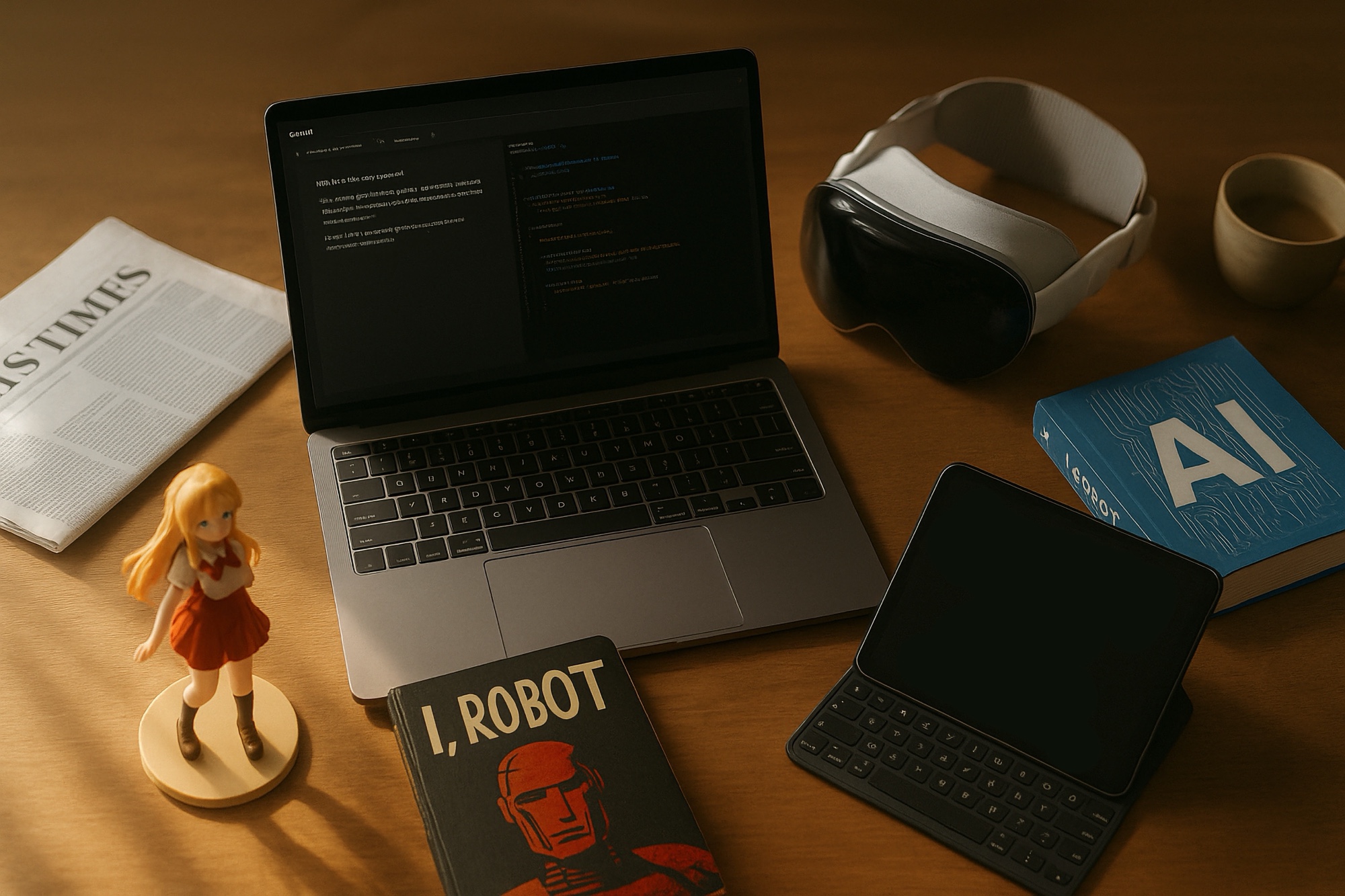
Kim was away for work again, so I mostly stayed in and spent more time with the Vision Pro. Apple’s new VIP video series that takes you to major sporting arenas doesn’t sound like my sort of thing on paper, but the first episode on Yankee Stadium was a surprisingly entertaining watch. The crowds feel real and the only thing missing was a closeup of a hot dog. It was filmed last June, I think, and feels like a document of a much saner time. There are still many more apps and videos I have yet to check out.
Back in the present, Trump’s wacky tariff rollout drama continued, with the latest being a series of takesies-backsies that is great news for Apple and other makers of computers and smartphones: exemption from whatever the crazy current rate is on imports from China. 125%? Or was it 155%? Everyone now expects the stock to surge on Monday’s open, but come on, none of these pronouncements stick or mean anything now. The best move might be to sell all US-based assets and spend the next year off-the-grid on a beach somewhere.
Starbucks has done a collaboration with Peanuts (that’s Peanuts × Starbucks, for readers who were here last week), and of all the merch they put out, it was a yellow stoneware mug that I liked the best. It features the whole gang sitting at a long table, with Snoopy dressed as a barista and serving up espressos in his latest persona, a corporate caffeine shill stupidly named “Joe Kind”. I like Snoopy, probably on account of being exposed to the Apple TV 4K’s wonderful Snoopy and Woodstock screensaver, so I’m turning a blind eye to this sacrilege. Anyway I received my mug in the mail this week and it’s my new teatime go-to.
I did go out fairly early on Saturday morning to go hang out with a bunch of coffee nerd ex-colleagues who spent more time messing around with grind sizes than I ever thought possible (my contribution was a bag of beans fresh from Ho Chi Minh). It was a good time, and the occasion gave me a novel writing prompt to try out, which brings to me to my latest ChatGPT-based hobby…
About two years ago, when we were just grappling with the GPT-3 model and what it could do, I spent quite a lot of time trying to get it to write passable poetry. The most successful approach I found was to provide it with a detailed character backstory and ask it to write from that person’s perspective, taking into account their preferred styles and word choices. I managed to eke out some genuinely good stanzas (imo), was moved and amazed, and then moved on to other experiments and forgot about it.
Until this week, that is, when I wondered how the latest models would fare given the same tasks. I put my old prompts together into a custom GPT, and asked for the first silly idea that came to mind: a poem about growing older but ironically becoming more attracted to cute things like Snoopy. It did an honestly good job with just that. Then I asked it to write one about the story of how he got his name — a true story: Charles Schulz’s mother daydreamed they’d buy a family dog when she recovered from cancer, but she never did — and the result was good enough to refine further. So I went back and forth on it with the bot (who I named Penrose), combined several attempts, intervened slightly, and here’s where we landed.
She Gave Him the Name
“If we ever get another dog,” she said, “we should call him Snoopy.”
It was a small thing, tucked between errands or waiting rooms, the kind of sentence you don’t expect to echo.
He was fifteen. Maybe he nodded. Maybe he carried it like lint in his pocket, forgotten until everything else was gone.
Years later, drawing alone in his studio, he gave the name to a dog who danced on rooftops, typed novels no one would read, stood in for joy and for all the feelings boys weren’t supposed to have.
Snoopy caught on. So did the quiet boy with no luck, the girl who loved too hard, the blanket dragged across the years. The world came to know them and needed their steady kindness.
Maybe that’s what it means to miss someone forever, to take the smallest thing they gave you and let it become the sky above everything you make.
And here’s one from another session where I asked it to identify a core human paradox and write something about it. It chose to explore how we want freedom but crave structure.
The Night I Rearranged the Furniture
I moved the couch against the other wall just to see if the room felt different. It didn’t. I stared at it like it had betrayed me, then moved it back.
It was past midnight. The kind of hour when you wonder if this version of your life is the one that sticks.
I opened the window to let in some air, but it was the same air as yesterday. Nothing new came through.
I thought about driving somewhere, but didn’t know what I’d be driving to. The gas tank was full. The fridge was full. I was full of something I couldn’t name.
They say people like me always want to leave, but never go far. We change the wallpaper. We cut our hair. We imagine new cities without maps.
The truth is, I love knowing where the forks are. I love the sound the radiator makes right before it kicks in. I love the old light switch that sticks unless you press it just right.
But still— some nights I crave an airport gate, a highway at dusk, a conversation in a town where no one knows what I used to be.
I don’t go. I just stay up too late and move the couch.
It feels unreal to have this tool for S$30/mo. I can ask it for poems about any random scenario or feeling, and it tends to throw out lines and images that catch me off guard. I’ve now taken to giving it things I half-wrote long ago and never finished, and it gives pretty good notes. An unexpected side effect of this is that I’m feeling more inspired myself, and now I’m asking it to give me prompts, and I’ll write things for it to review.
Here’s one I reworked this week.
He died in his 17th year
And flowers were laid by the side of the road Fit to be swept within just a fortnight
Parents kept his memory alive another thirty years, Until grief or emptiness took them too
I used to think we were made for more How clever bones and cells can seem
But a body is mostly waiting to be undone And our home keeps going around the sun While out there Nothing waits for no one
While I was messing with Penrose, OpenAI launched a new feature called “Memory”, where ChatGPT is able to reference all your past conversations across previously separate chats. The way they chose to showcase it was to suggest you let the AI describe you, the black mirror lighting up to reveal a camera was recording all along. I didn’t expect them to so transparently demonstrate how this technology is a more powerful, more dangerous profiling machine that anything Facebook or Google has ever put online, but I suspect they think there’s nothing we can do. I asked it to guess how I felt about certain topics, like Nolan’s Batman trilogy or the Fujifilm X100VI camera. It didn’t exactly read my mind but they were very educated guesses. Not very reassuring. It offered to guess other things like my favorite cocktail (it said Negroni; not my absolute favorite but one of them), my favorite beer (a Belgian saison; not even close), and my favorite band (Radiohead; they might be in second place).
This reminded me I was due another playthrough of OK Computer to keep my millennial card intact. It only gets better with time. I’ve also been listening to Counting Crows’ Hard Candy again recently. Some of those songs are the best that anyone or any AI will ever write.
I read All Systems Red, the first book in Martha Wells’ Murderbot series. It’s about a security robot that’s hacked its own governor module, secretly sentient but pretending not to be, and mostly just wants to be left alone to binge-watch serials. Deeply relatable. Apple TV+ has made a show from it that’s meant to come out soon, and I can’t wait. Thankfully there are six more books (plus some novellas), so this could be their next Silo or Slow Horses: a long-running fan favorite franchise they get to keep making more of. If you like introverted robots with trust issues getting into some space shootouts, it’s a fun time.
Still on AI bots, since I paid for ChatGPT Plus again last week, I decided to update a custom GPT I made to serve as my personal editor and proofreader. It’s trained on a bunch of these very blog posts and now incorporates a detailed summary of my writing style into its prompt. It’s shockingly fun to work with and makes half-decent suggestions. If you’d like to try this, give ChatGPT access to a bunch of your writing, get it to codify your style as a JSON profile, then refine it by reviewing examples together.
It actually managed to write me a half-decent LinkedIn post from a premise I provided, not that I care to post on LinkedIn at all. After some editing and joint revisions, it’s now in a shape that wouldn’t make me cringe if I read it from someone else on LinkedIn. Wait, that’s not true. Everything on LinkedIn is cringe.
I’m not going to say a lot about Trump’s tariffs and the mess they’ve made of the stock market, but boy am I seeing red in my finance apps. I don’t know how Americans will be able to afford anything, and I’m kinda mad that this will affect the rest of us too.
Caught in the blast is Nintendo’s new Switch 2, which was detailed this week in a series of live broadcasts I’ve been anticipating for the past couple of months. The new GameChat and GameShare features they showed are very welcome, especially if we’re ever locked down in a future pandemic. They’ve done a lot to make playing with friends online feel like hanging out on the same couch. Unfortunately, the announcement was marred by a higher than expected price, something of an unforced error on their part, and people flooded the Treehouse livestream chat with calls to “DROP THE PRICE”. To make matters worse, the already unwelcome US price of $449 is now set to rise once they calculate the impact of tariffs.
We’ll be missing the June 5 launch in any case, with the official site saying “July–September in Singapore, Thailand, Malaysia, and the Philippines”. As for price, the original Switch launched at $299 USD, which should’ve meant about S$400 — but we ended up paying S$650 here, bundled with Breath of the Wild, because of limited supply and some greedy local distribution. I don’t expect the same kind of scalping this time, but I also wouldn’t be shocked to see it land at S$800. Can’t wait.
I still have so much to play on my old Switch OLED anyway, and this week I got started on Ace Attorney Investigations Collection. It’s a remastered version of the two Miles Edgeworth games from the Nintendo DS, the latter of which was never released internationally. Also in my backlog are Kirby and the Forgotten Land and The Legend of Zelda: Tears of the Kingdom, both of which are getting Switch 2 enhancement patches — higher frame rates, HDR, all that good stuff — if you’re willing to pay for the upgrade. Which means I now have a perfectly valid excuse to keep ignoring them until summer.
Michael pinged me out of the blue to ask if I knew anything about the origins of using the × symbol in Japanese to mean “and” or “plus”. It’s something I’ve long wondered about too, especially with anime titles like Hunter × Hunter and Spy × Family. So I outsourced the research to Perplexity (an AI search engine), and found that this usage came out of Japanese fashion subculture in the 1990s. Turns out it’s a Japanese invention, possibly inspired by its use in botany to denote crossbreeding. In modern use, the × stands in for “with”, “versus”, “of”, or “intersection”. It’s also not pronounced aloud, which is why the show is just called “Spy Family”. I like how the symbol invites layered meanings — it implies both conflict and connection. In Spy × Family, it’s the tension between the fake family setup and their hidden identities, but also how those roles merge into something real. A simple little mark doing a lot of work.
I watched a new anime on Netflix called I Parry Everything. Following the isekai wave a couple years back, the new trend seems to be fantasy stories about “weak” characters who go all-in on training one obscure skill — to the point of accidentally attaining god-tier strength. Jose reminded me of another in the same vein, with the glorious title I Don’t Want to Get Hurt, So I’ll Max Out My Defense. In Parry, the main guy is told early on he has no future as a swordsman — so he just spends the next 14 years practicing how to block. Now he’s practically unkillable. But the show’s comedy hinges on him not realizing this, while everyone else assumes he’s the savior of their kingdom. It’s extremely stupid, extremely fun, and yeah I binged the whole thing in a weekend.
We’ve also been watching The Pitt on Max and it’s a great hospital drama (starring Noah Wyle of ER) that leans more towards realism than the likes of New Amsterdam. Everything takes place over 15 hours in 15 episodes, which takes me back to watching 24 in absolute awe as a young man.
Pulse on Netflix is everything The Pitt is not. It’s cheesy, everyone’s more model than medic, and there’s no urgency or realism. Even the surgeries are shot in crispy iPhone-like HDR and cinematic lighting. It does have Willa Fitzgerald (aka Reacher’s partner in S1) and Néstor Carbonell (Yanko from The Morning Show) but even they can’t lift this to greatness. It’s fine background TV though.
What’s up with this image? I went for dinner with Peishan and Cien, who decided it would be funny to tell HaiDiLao (a massive Chinese hotpot chain) that it was my birthday month, so the staff came round and sang/blasted out of a Bluetooth speaker a proprietary and very Chinese birthday song, that apparently everyone around us knew because they joined in and clapped along. I tried to stop them, but in the end had to endure it with a pained smile.
Btw one legitimate use case of AI is transforming images into drawings to get around the problem of publicly sharing people’s faces.
A massive 7.7 quake hit Myanmar and Thailand on Friday, causing several hundred deaths so far. It was chilling to pull up the news and see reports of buildings swaying in Bangkok and having to be shut down for safety inspections, buildings that I had just been in a week ago. Thankfully, everyone we know is unhurt, but I’ve heard accounts of the traffic becoming even more unworkable (someone spent over 5 hours getting to the airport), and with some having to walk miles home instead.
It was my Apple Watch that alerted me to this earthquake, via a notification from the environment ministry’s MyENV app, which usually likes to tell me about quakes in places so far away I don’t see what possible need there could be for an alert. I was in the middle of watching Jason Statham’s film, A Working Man (2025), in an almost empty theater with Peishan, and was about to swipe it away when I saw that it was actually kind of nearby. And then afterwards, the feeds were full of videos showing swimming pools at the tops of condominiums raining their contents down onto the streets below. Who decided we should start putting pools up there, anyway?
The movie is terrible, by the way, and makes the mistake of trying to NOT be the predictable vengeance-by-numbers Statham vehicle that the trailer makes it out to be. It looks like our man Jason is just your regular ex-military deadly killer who’s decided to take on an unassuming identity and retire to a life of normalcy as a construction worker when one of his new friends falls afoul of the mob and needs rescuing. This is a setup rooted in at least a little realism, which is needed for the audience to suspend disbelief when the righteous murdering starts. However, this film is co-written by Sylvester Stallone, who is now at a stage in life where he writes really ridiculous scenes, silly and clichéd to the point of surrealism, as evidenced in the last installments of his Rambo and Expendables franchises.
The latest season of Reacher, a series on freaking Amazon Prime Video, is more believable and enjoyable in almost every way, which is a hell of a red flag for whoever produced A Working Man. When reading any of Lee Child’s novels, Reacher comes across as a stoic avatar of justice, almost featureless in terms of personality. But as played on TV by Alan Ritchson, he’s endearingly a bit of an awkward and pedantic weirdo, as you would expect someone with his physicality to be after moving through a world that he doesn’t comfortably fit into. I like that change.
We also watched the critically acclaimed show Adolescence on Netflix, and it’s an absolute marvel of filmmaking and acting. I’ve never seen a British TV production with this level of craft; it just leaves you wondering how they pulled it off — how they had the energy, even. Each episode is an hour-long performance that often involves moving between multiple locations, with the actors having to ramp up the emotions from anger to fear and the sorrow in between, and they did this how many times? For the final episode, they apparently used Take #16. It’s unfathomable talent. Stephen Graham and his co—stars deserve awards for this.
===
This week will also be remembered for the wave of Studio Ghibli-styled images that washed up on social media after the release of ChatGPT’s new image generation capabilities in their 4o model. People turned personal photos, memes, and historic images alike into ripoffs of Miyazaki’s instantly recognizable style, and I have to say I enjoyed many of them whilst simultaneously feeling uneasy about what this means.
The new model seems to be a milestone that’s arriving a little sooner than I expected. It can render text with good enough quality and aesthetic precision. It can process a multi-step prompt such as “create a print ad for the product in this picture”, and it will write some pretty workable ad copy, re-imagine the object you’ve given it, and merge them into a single image that looks right at a glance. There may be minor imperfections, or it may fail to nail a critical detail depending on your object. But the fact that it can be completely right some of the time is startling. I’d say it’s most of the way to fucking the creative industry over, but who knows if the last mile will take a quarter, a year, or a decade to close.
While discussing the possible outcomes of this development with some people, specifically whether this would retard the growth and success of any new visual ideas — take for example the iconic look of Studio Ghibli, or Peanuts and Snoopy — why/how could any new artist launch and evolve their style if it can be snatched away from them early on and proliferated across the web in ways they haven’t even thought of yet — I wondered aloud if the only way forward left for them will be to use AI to scale their work, to generate more variations of it themselves, and to speed it to its logical conclusion (or demise) before anyone else does.
At this point, I remembered an abandoned “art project” of mine (if it could be called that) from a few years ago, and got very excited about enlisting ChatGPT’s help with it.
In late 2019, just before COVID hit, I had the idea to draw a series of cute animal characters and make some products. They would be called the Fluffy Hearts Club, and the story was that they were all research animals who were having horrible tests done on them, but who banded together and escaped from the lab. So they’d all have little scars and visible reminders of humanity’s awfulness on their bodies, but they’d be extremely happy and positive in their freedom eras.
I drew the first one with great difficulty, a rabbit with a scar on his chest, printed him on something like 50 tote bags, and gave them away to friends that Christmas. I started to draw the next one, a cat, along with some other angles of the rabbit, but eventually shelved it… owing to COVID or lack of skill, I don’t know. As you can see they are pretty rough.
But when I realized that I could use ChatGPT to “learn” this style and concept to help me finish the rest of it, I got excited enough to plonk down $30 and upgrade my account to Plus. Ethics check: Would I have paid a human artist to do this for me? Unlikely. I’m not made of money, and it’s just a silly side project. Should I have? I can’t see how; I want to explore this on my own without another human in the mix.
I’ve spent a little time on it so far, and it’s grasped the core idea and even brainstormed other animals and their visual signatures with me — it felt eerily like collaborating with a person, as we discussed possibilities and complimented each other along the way. It has trouble following instructions about very minute details, which it explained as a shortcoming of the way its models were trained (it leans towards cartoon conventions, which one of my notes contradicts), which one can take as proof that this is all built on the back of awful copyright violations.
But with its help, I’ve managed to produce more versions of the rabbit and even imagined the cat in various art styles, so I’d say this has been a half success. I might use it as a foundation for tracing/drawing new ones myself, or as inspiration for different scenarios.
I only wish I was using this renewed subscription to explore how to stay relevant in my own job domain rather than in the lane of starving artists. Yuk yuk.
Speaking of the design field, I went back to the same college I visited last November to help give feedback on the work from a class of students doing a design thinking course taught by my former boss and mentor, and was again struck by how much of what we do and prescribe as designers, the responsible way to move in the world, is naive and vulnerable to the at-odd incentives of everyone in the AI business. They’ll throw a synthetic persona at a problem for $10 in compute before they spend a dollar on asking a real person what they need to lead a better life.
And that brings me to Careless People, the Facebook tell-all book by Sarah Wynn-Williams that I’ve just finished reading. The one that Zuckerberg and his lawyers tried to quash before it was published. I thought I knew enough about Facebook’s bad behavior, but I was still stunned by some of her anecdotes.
I haven’t made many rules about what kind of work I’ll do, and when I used to smoke, I believed that I could consult on work for tobacco companies because to do otherwise would be hypocrisy (I’m wiser now), but “never work for Facebook” was a promise I made maybe a decade ago. I simply do not understand or respect anyone who chooses to, and this book should be required reading for those who think they might.
===
I listened to Alessia Cara’s new album Love & Hyperbole a couple of times, hoping that something would finally click, because I did want to like it. But I was left without much of an impression. I’m probably coming off R&B in general because listening to SZA’s deluxe edition of SOS on the plane home last week was quite excruciating.
But then I put on Jessie Reyez’s new album PAID IN MEMORIES and I loved the one playthrough I’ve heard. Maybe it’s the millennial in me but there are some samples for old people in here, including the Smashing Pumpkins’ 1979. She makes it work, and the melodies are strong.
Just 10 days to Christmas, and I finally got a sense of it happening through my first gift exchange and a couple of meetups. The first was with a few workplace alums, after one suggested to me that it would be nice if we all caught up (and so I ended up getting the job of organizing, which I bumbled through). It was nice after all, and I got to spend time with some people I hadn’t seen in years. The second was last night at a friend’s home that impressively decorated for the season, complete with a playlist of Christmas classics greeting us at the door. I think that was the moment it became real for me.
I brought my Leica D-Lux 7 out of hibernation this week for a few photos, mostly to put its aging battery to the test. It fits in my new Bellroy sling (the Ricoh GR III is still significantly smaller and lighter, albeit without a zoom lens), so I’m entertaining the thought of bringing it on our next holiday. Oh, that’s right. We’ve just booked a trip to Tokyo next year, wayyy behind the trend, but hopefully everyone’s had their fill of Japan by now and it’ll be less crowded when we get there. If I do need a spare battery, I’ll pick up the Panasonic equivalent model from Yodobashi Camera or something.
Another reason for the renewed interest was an update to the Leica FOTOS app (which connects to cameras) that came out this week. For the uninitiated, ‘Leica Looks’ are essentially a series of live filters that can be installed onto newer cameras. Owners of older models have been out of luck, but with this new update they can be retroactively applied in the app to any JPEG taken with a Leica camera. While trying it out, I discovered that photos I’ve been taking with the Leica LUX camera app also qualify as “taken with a Leica camera”, meaning you can apply these Looks to iPhone photos for free as well.
So far, I’ve been surprised by how well photos from its Micro Four-Thirds sensor have turned out, especially in daylight. Low light photos are quite smudgy/noisy if you elect to use an ISO value over 3200. I’m fortunate that Leica’s updated D-Lux 8 model this year was such a relative disappointment: a surface-level redesign of the camera’s body and UI without any improvements to the lens, sensor, or processor. It’s good news for me since an uncompelling update is money saved. Ignoring the PS5 I got in May, NOT upgrading stuff has been a bit of a theme this year. I don’t even covet Fuji’s X100VI camera one bit, maybe because it’s been so (artificially?) rare and overpriced.
===
Our new broadband line was finally activated, and it’s resulted in a doubling of accessible bandwidth. In one speed test, I got over 1.1 Gbps (symmetrical) on my iPhone. At this point, our fleet of un-upgraded hardware is holding us back more than the network. In a couple of years, when every device in the house actually supports WiFi 7, I’ll upgrade the router and unlock the full 10Gbps that we currently have.
How little use am I making of this plentiful bandwidth? Well, listening to a lot of Apple Music Radio.
You probably missed this because it hardly made the headlines, but Apple Music doubled the number of their live, hosted radio stations from three to six. Apple Music Club, Chill, and Música Uno now join Apple Music 1, Hits, and Country. In a world where personalized, algorithmic stations/playlists are plentiful and pedestrian, I think these human-led stations are a wonderful zig to Spotify DJ’s zag.
Some of the best artists I’ve discovered this year were serendipitous encounters while listening to Zane Lowe, Rebecca Judd, Matt Wilkinson, or Dotty taking listeners through their latest picks on Apple Music 1. I think receiving and interacting with other people’s passion and opinions is a key part of the cultural experience of music, so these DJs play an important role that is growing ever smaller. It’s so good to see Apple Music expanding their Radio offering rather than shutting it down.
I used to have a Shortcut on my phone to launch Apple Music 1, but with these new stations it seemed time to build a quick launcher. Now, I can start live stations and my personalized stations from the Control Center, Today Screen, or even with the Action Button.
===
iOS 18.2 came out of beta, with new Apple Intelligence features like Genmoji and Image Playground. They are okay for a bit of fun, but definitely won’t cause any artists or illustrators to become unemployed. It’s interesting to ask if they ever will, because Apple could certainly get the models there with time, even with fully on-device inference, so it’s just a question of intention. But I don’t think there are any brakes on this train and every company is onboard, they’ve just bought different tickets.
People sometimes say that I’d make a good teacher if I ever tried it. I think good teachers are probably more patient than I am and love speaking in front of people a lot more than I do. But on reflection, those are both things I’ve gotten a little better at over the last decade, so maybe.
I got a little taste of it this week when I was given the chance to hear a class of college students make their final presentations for a design thinking course, and provide assistance in the assessment of their assignments. They were asked to identify a group with needs, understand them, and then design games that could be of help. They had to prototype and test their ideas before finalizing a working version. They all did pretty well, creating solutions that were surprisingly polished.
The general idea about deploying Generative AI tools in the workplace is that they don’t do much to enhance the work of already talented employees. But for the vast majority of average or below-average workers, LLMs elevate their productivity and quality of work to a consistently higher level, which is still a net positive for teams.
Apple’s current ad campaign for Apple Intelligence seems to take that tack too, resulting in a message that’s so far from the Macintosh’s promise of a “bicycle for the mind” that these ads are rightfully catching some flak. But in the classroom, I saw AI tools give students (with limited time and a lack of traditional design skills) the ability to execute their ideas at high fidelity. Making card games that look and feel almost like professional products, fully illustrated without the help of artists, is not something we could have pulled off when I was their age. I’m partly envious, but also afraid that on a wider scale, execution will be confused with education.
Earlier in the year, when I sat in on another class being taught by a friend, I was struck by how hard it is to control the chaos of a large room of modern students, and the same thing was true here. When you get over 40 laptop and iPad-equipped young adults in a room, having their attention is not a given. Side conversations are happening all the time, and listening to whoever’s speaking seems like a choice.
Maybe it was just my experience as an English student, but our class sizes were smaller, and discussions almost always followed a single track, led by a professor pacing around the room rather than anchored to a screen at the front. There were hardly any screens, come to think of it, just books and notepads. Now everyone’s on Figma, Canva, Miro, and a host of other infinite sheets of AI-enabled SaaS paper. I’m not saying we had it better, but I worry that the option to take things slowly and still excel is disappearing. When kids today say they’re stressed, it’s hard not to believe them, having seen the performative polish that’s now standard. We’re getting awfully close to expecting students to pop out fully formed and ready for the mines.
===
Over the weekend, we decided to get our eyes tested at a Zeiss-approved optician’s, to order the official prescription inserts for Apple Vision Pro. This will let me use the device on days when I’m not wearing contact lenses. The need to have them on first has admittedly been only a very minor inconvenience, but now nothing will get in the way of hopping into the uh… spatialverse.
Of the three eye tests I’ve had this year, this was probably the most thorough one. The key seems to be patience (there’s that word again) on the part of the tester, in the sense that the testee should never feel hurried. They should be allowed to flip between options 1 and 2 as many times as they need to identify the sharpest and most comfortable images. As a result, I have a new prescription that shows my eyesight has slightly, but surely, deteriorated for the first time in over a decade.
My last test was in 2019, when I got my last pair of glasses from Zoff. Those were so comfortable that I stopped wearing contacts regularly and became a spectacles guy again. Now I wonder if wearing contacts actually helped arrest the decline of my eyes.
Anyway, armed with a new prescription and an appetite for vision correction, I went to the nearest Zoff outlet and ended up with a new pair of glasses. I learnt afterwards that the frames I chose were “trendy” and “perfectly suited for Gen Z styling”. Along with recent purchases of wide-leg pants and oversized tees, my fashion Bryan Johnsoning is complete.
Side note on Japanese express optical brands: I stopped considering Owndays because all their frames are small and narrow — they literally don’t have large options. Zoff at least stocks a few, and in general they overindex on “Boston” and “Wellington” shapes, so on both occasions I’ve been able to find something I like with almost no effort.
===
Media activity
After taking a break for several months, I returned to Like a Dragon Gaiden: The Man Who Erased His Name on the PS5 and finished it. And this was a short game by Yakuza standards. I expected to feel pretty over the series by this point, but the emotional ending to Kaz’s story has got me quite excited to get started on the next game, Like a Dragon: Infinity Wealth, sooner rather than later.
I also returned to Luigi’s Mansion 3 on the Switch, which I started (and stopped) playing when I first got the console back in 2017. This game has just sat there for 6 years waiting for me to get back in, and all credit to Nintendo’s designers, it was stunningly easy to pick up where I left off.
There’s a ton of movies on MUBI due to leave in the next two weeks, so I started with Toni Erdmann (2016), which was nominated that year for the Palme d’Or. On the surface, it’s about a jokey dad whose daughter has become a miserable management consultant, and he decides she/they are not doing so well and could use a little cheering up. And yet as a film it was like nothing I’ve ever seen before: I laughed, I cried, I was bewildered. It’s simply art. 4.5 stars.
Another film that is leaving is a 2011 documentary by the late Austrian filmmaker Michael Glawogger, Whore’s Glory, which examined the lives of sex workers in Thailand, Bangladesh, and Mexico. The film’s biggest problem is its inappropriately “cool” millennial-era Western music soundtrack featuring Cocorosie, Tricky, and PJ Harvey. My 3.5-star Letterboxd review: “If anyone asks why I look sad, from now on my answer is ‘I saw Whore’s Glory back in 2024’.”
I haven’t held space to experience the new suddenly released Kendrick Lamar album, GNX, the way it deserves. Hopefully by next weekend.
Kim Deal of the Pixies has a new album out at the age of 63 and I quite like it. It’s called Nobody Loves You More.
I discovered a Japanese singer by the name of Kaneko Ayano while looking for artists with a similar sound to Happy End. She has an awesome ‘gimmick’ where every album is recorded and released in two different ways: acoustic and with a full band.
But for the song/video of the week, it’s Hanumankind’s Big Dawgs. I was listening to Apple Music 1 when it came on, and had to look it up immediately. He’s an Indian rapper from Kerala by way of Texas, and he’s just broken out now with this song after years of making music. His lyrical game is considerable, and as evidence I offer the existence of a YouTube comment calling him “Lendrick Kumar”.
I’m also embedding an older video I like, a freestyle performance, and a recent interview on Apple Music where it’s clear he’s an articulate and very driven young musician who’s going to be huge.
I just got back from a Sunday night dinner date in the East at a newish place called Carlitos. It was new enough that it didn’t have a Swarm entry, so I made one. That reminded me that the Foursquare app is about to be shut down, and I’m choosing to be optimistic about Swarm’s future. We’ve been promised some meaningful changes in the coming year and I hope the rethink will bring check-ins back in vogue.
Vision Pro updates
Kim got back from her work trip and the first thing we did was head out to the Apple Orchard store to pick up the new Belkin Head Strap that everyone’s talking about. And not a day too soon, because it’s now backordered into mid-December!
It is what it looks like: the top bit of Apple’s own Dual Loop Band, which you can attach to your existing Solo Knit Band — a rare best-of-both-worlds occurrence where the comfort, adjustability, and non-hair-mussing qualities of the Solo are met with the weight-relieving structure of a top strap. It works well, and I’m never taking mine off. I was using the Dual Loop before, but its thin strap that pulls upwards near the base of the skull cannot compare to the quality, fit, and comfort of the Solo band, which is such a wonderful design and product that it belongs in a museum.
I haven’t tried Spigen’s slightly cheaper version, but having read many reviews of how poor its adjustment range is, I can’t recommend you take the risk. You’ll want to get the tightness just right, so Velcro is the right solution, and Belkin has rightly made it.
Belkin was never an accessory maker I took too seriously in the last two decades, I mean, they made alright cases and cables, but I’d never choose them over first-party versions. That seems to be changing. This new Travel Bag for Vision Pro is further proof; it’s significantly smaller than Apple’s own Travel Case, and half the price.
1) Should have been in the box instead of the dual strap
2) $50 is overpriced but you’ve already paid $3500 so hard to complain.
3) When Apple knows an accessory is needed but doesn’t want to put its brand on it, it turns to Belkin (owned by a Foxconn subsidiary) https://t.co/oKM5HSIVi5
Career leak publisher Mark Gurman implied in the tweet above that Belkin is Apple’s secret partner; the one they go to when they want an accessory on the market but don’t want to make it themselves. The fact that they stock Belkin’s products in Apple Stores is supposedly proof. In this world, Apple knows the practical flaws of their own form-over-function accessories, and nudges Belkin (which is connected to Foxconn) into making uglier but more effective alternatives to keep customers satisfied. I don’t know if I believe it works exactly like this, but it’s not a bad arrangement? Let’s see if Belkin makes some kludge to access the power button on the underside of the new Mac mini, then.
A new Apple Immersive Video (AIV) feature was released this week, and a music video at that. It’s the song Open Hearts by The Weeknd, and Apple’s own press release says it’s a limited time exclusive for Vision Pro. Interestingly, they’re inviting people to visit their nearest Apple Stores to watch it, which means we’re entering a phase where the retail arm is positioned as providing free public access to the Vision Pro experience, not unlike the ‘Today At Apple’ sessions where people can learn to draw or take better photos with Apple products, even if they don’t own any yet. This is fine, but the barrier to getting people off their butts to see something cool (for free!) is somehow extremely high these days. Is this because the culture promotes ownership hand-in-hand with enjoyment, and people don’t want to try a device they already know they can’t/won’t pay for? I can’t afford a bottle of 55-year-old Yamazaki but I’d sure as hell have a free taste if offered one.
The new Apple Immersive Video from The Weeknd is worth experiencing. For one, it features a lot of movement but none of it is nauseating. I’m not sure if they’ve just figured out ‘one weird trick’ to make that possible.
Anyway, the music video is very impressive, as I said on Bluesky after seeing it. There are a couple of magical moments, some achieved with special effects and some that are just beautiful to experience in immersive video. For some reason, it never feels disorienting or nauseating even though the camera travels at speed for a fair bit. I wonder if they’ve cracked the motion sickness code and are inserting buffer frames or using some other imperceptible technique, but this bodes well for future productions. Perhaps it’s just very smooth dollying and sticking to just one axis at any time.
Apps
Perplexity: Google continues to struggle with integrating its Gemini generative AI models with search results in a way that doesn’t spit out lies, but Perplexity has been working great for me since I started using it earlier this year. It could be the types of questions I ask it, or the default stance of skepticism I adopt when it answers them (the sources are there for you to check, if something feels off), but it’s been a net positive for me and I keep the widget on my iPhone’s Home Screen and use it several times each day. In fact, I thought everyone was using it, and was very surprised to learn while talking to Viv that she had never even tried it.
This week, I got access to a year of Perplexity Pro for absolutely no money, thanks to a giveaway in Kevin Rose’s newsletter, and it feels great to have virtually no daily limit for Pro requests. Standard requests basically use a simpler model, think OpenAI’s GPT-3.5 series, which parses search results and writes an answer to your question. Pro requests use the latest models including Claude 3.5 and GPT-4o, and break your question down into its components before processing results, all to have a better chance of understanding what it is you’re trying to learn and answer accordingly.
I’m aware of the icky implications of Gen AI scraping and that this mode of bypassing publishers will probably destroy the web as it currently works. Perplexity claims to be paying publishers that it sources answers from, on a per-query basis that sounds similar to music streaming services, so it might be a best-alternative model worth watching. It’s an analogy that makes sense because of how Napster upended that entire industry through theft and wanton disregard for copyright laws… kind of like what AI companies are doing now.
===
Mattebox: Now here’s a name I never expected to hear again. I first mentioned Mattebox on this blog 13 years ago in December 2011, when I posted some photos I took on a holiday to Bintan. What I remember is that it was a camera app (as opposed to a photo editor), modeled on the ergonomics of the Konica Hexar camera (respect), and that its developer (Ben Syverson) cared enough to replicate a film-like response to clipped highlights. That torch is currently being carried by the upcoming Fig Camera app. It appears I even made/shared a filter for it called Velvius, which proves this has been a longer-standing hobby than I thought.
Anyway it disappeared off the App Store a decade ago for reasons I never knew, and then reappeared last week completely rebooted and redesigned. It’s now an editor, but still leans hard into the making and sharing of filters. It even lets you share a filter as an App Clip, which means people can apply your looks without even installing the app — probably a first in the photography app world.
I’ve played with it for a little while today and am quite impressed. It focuses on editing ProRAW files, even disabling tone mapping by default for a less HDR look (the trend these days), and a Pro subscription (S$40/yr) unlocks granular controls to dial in micro contrast, black levels, noise reduction, and so on. It even simulates physical diffusion filters, a feature that’s rare these days after the discontinuation of the Tiffen FX app around the same time Mattebox disappeared.
The UI is MUCH better than before, and although I already own the RAW Power app which includes all the same adjustments mentioned above, I would rather do them in Mattebox because of how neatly they are laid out. For a “first” release, Mattebox 3.0 gets so many essentials right, from having a double-tap gesture to reset values, to saving edits non-destructively over originals. You can even export your filters as LUT and Lightroom preset files. I’d like to try making filters for it but will 1) need to subscribe and 2) learn to use its HSL curve system, which is different from what I’m used to.
I’d love to see:
Undo/redo for adjustments
Indicators for RAW files in the photo picker
Using the system photo picker, actually, so you can view by media type, etc.
Grain tool
Media activity
I finished reading Variable Star after two weeks and gave it 4 stars on Goodreads.
I started on Han Kang’s The Vegetarian, just because it recently won the Nobel Prize in Literature. I’m 32% through it and I can’t say it’s anything terribly special yet. I saw that Sara reviewed it on Goodreads seven years ago and (I’m paraphrasing) said it was the kind of mediocre East Asian book that Western readers just lap up.
I watched Megalopolis (2024) in one straight sitting, in a giant virtual theater in Vision Pro, and it kinda rocked. What a Taj Mahal-grade vanity project, a pastiche of Shakespearean and Capital-C for Cinematic bombast. Watching this, you wouldn’t think that Coppola knows anything about urban design or architecture, they’re just metaphors for the story he wants to tell about great (and very pretentious) thinkers who change societies. They’re just MacGuffins for a crazy CGI movie that owes as much to Sky Captain and the World of Tomorrow (2004) as it does Fritz Lang’s Metropolis (1927). I typed that and then searched to see if anyone else made the same connection, and indeed they have. 4 stars.
We watched Look Back (2024). It’s an anime adaptation of Tatsuki Fujimoto’s one-shot manga work of the same name. It recently had a successful theatrical run in Japan, and I’ve been dying to see it since seeing the reactions online. It also played here, but I missed it, and it seemed weird going to the cinema for a film that clocks in at just 58 minutes. Amazon Prime Video secured the worldwide streaming rights, thankfully, and the whole time watching it I wondered why it wasn’t acquired by Apple TV+. That would have been a great fit. I don’t want to say too much about it, but it’s brilliant, beautiful, and a showcase of how animation can express feelings that live action could never. 4.5 stars.
Can I just take a minute to show you this Labubu I saw hanging on someone’s bag on the train? It’s carrying a Chanel bag like the very one it’s attached to! That is just so super cute to me, I think I have a brain worm like the future American Secretary of the Department of Health and Human Services.
Monday got off to a good start when I finally landed one of the coveted booth seats at the co-working space. Up to then, they were always occupied by the time I got in, and it was a feat not repeated at any other point in the week. Because I’d only signed up for the month of October, and with Thursday the 31st being a public holiday (Deepavali, not Halloween), this chapter of drinking too much coffee and watching movies while surrounded by busy people has come to an end — let’s be honest, though, most of their screen time looks like chatting on Slack/WhatsApp and browsing the web.
I’m feeling a sense of loss about it, actually. For starters, the renovation noise is set to continue next week and might drive me out of the house still, now without a place to go. But more than that, I was just getting used to the routine and would jokingly say to Kim, “I’m going to the office”. It’s akin to the loss of a ‘third place’, a social setting distinct from home and work. However, I don’t even have a second place these days!
One thing that sitting still in front of an iPad for hours on end has highlighted is how important yet increasingly difficult it is to single-task. While thinking about my/our deteriorating attention span — that constant feeling of being pulled towards other tasks while in the middle of doing things I chose to do — I identified a root cause in myself: I have less trust in my memory these days. So when something occurs to me, say looking up a fact or sending someone a message, it’s harder to file it away for later follow-up, because I think I might forget. Past experience has probably taught me that I’ll forget.
On one hand, I could make peace with that. So I’ll forget a thing or two; big deal! I don’t have to optimize every detail. Things can be allowed to slip and it’ll probably be fine. Or I could use the time-honored second brain productivity hack of… jotting thoughts down and then getting back to what I was doing? I may give that a go with the Quick Note button in my phone’s Control Center and see if it makes the distracted feeling go away.
The filmmaker Lav Diaz is known for making extremely long movies. At 10 hours, his Evolution of a Filipino Family (2004) is probably only consumable in several sittings and is the ultimate test of patience and focus. Like Richard Linklater’s Boyhood (2014), it was shot over more than a decade, and you see the actors age for real.
One could criticize its poor production values, shot in grainy and low-res black-and-white film and video, often with inadequate microphone coverage, or its loose editing and lack of action (its 10-hour runtime probably says something about Diaz’s attitude towards concision). But the message is in his medium, and I’ve found watching it to be a great meditative exercise; letting the mind alternately empty and gather and empty again as you watch the family slowly lead cattle from one end of the screen to the other or hold sparse conversations over meals, spread over minutes of near inaction. The first 2.5 hours passed effortlessly in a state of detached attention.
I also managed to watch Alain Resnais’s Hiroshima Mon Amour (1959) on MUBI without much distraction. It’s a hell of a film, visually inventive and beautiful, with an opening sequence that you have to see to believe, going from sensual shots of skin to burned and scarred consequences of the atomic bomb. Which is the backdrop for this film about war, love, and memory.
Having just visited Hiroshima for the first time last year, I was surprised to find so much of it familiar in this old work: the bombed-out dome, the peace museum, and its garden sculptures. It was also incredible to see its depiction of an interracial relationship between an Asian man and a white woman as equals. As far as I can tell, it was probably one of the first films to center such a couple.
The first few Apple Intelligence features launched this week in iOS 18.1, and while many in the tech press seem unimpressed by these ‘basic’ capabilities, especially when compared to products from OpenAI, Google, and Meta, I’ve found them so impactful to the way I use my computing devices that I can’t imagine going back.
Apple also announced impressive M4 updates to the iMac, Mac mini, and MacBook Pro this week, but I don’t need to upgrade!
For one, I can summarize long emails and webpages directly in Mail.app and Safari. My bank likes to send me long, jargon-filled market updates in its email newsletters, and now I can summon a quick paragraph that gets to the point.
When I get back to my phone after some time away, I can see what would normally be stacks of messages and notifications summarized into a few lines. I’ll still read them anyway, but it’s great to get a preview so I can triage for urgency. This is also useful when getting Siri Announcements over AirPods. Say someone sends me a long string of messages, instead of having them all read out over my music, I can hear a summary and know whether it’s important enough to pull my phone out for.
And coming back to the point about avoiding distractions, there’s a new focus mode called “Reduce Interruptions”, alongside others like “Work” and “Do Not Disturb”. This reads and assesses all your notifications with AI, and will only show you things that seem time-sensitive or important.
There are also Writing Tools that I’ll be using to proofread this post before sending it out, and a Clean Up tool that can remove objects in photos using a generative model. It’s quite good, certainly enough for casual use, and I’ve seen online examples of it pitted against Adobe’s equivalent AI tools and actually coming out ahead in some situations. Plus, everything happens on device, which is great for data privacy reasons.
A quick demo of the Clean Up feature in Photos.app
One grumble I have, though, is that Apple appears to be reserving its upcoming Visual Intelligence feature (where you can point your camera at something and have the phone offer contextual information) for iPhone 16 models with the new Camera Control “button”. I hope they’ll make it work with the Action Button on iPhone 15 Pro models, but am preparing that I won’t have it until I upgrade to next year’s 17.
In the meantime, I have found a new use for my Action Button: starting the Apple Music 1 radio station. This has proved super useful and convenient. If I’m anywhere with my AirPods in, getting some music going is now just a button press away, even without getting my iPhone out of my pocket.
Take a minute to appreciate this ad that Apple made to celebrate the debut of this radio station back in 2015, back when it was called Beats 1 — a far better brand in my opinion. It was a simpler, more optimistic time. Watching this, I believed that a global internet radio station dedicated to great music, across all genres, could map differences in culture and unite us all.
I must mention that Nintendo joined the music streaming app business this week. Nintendo Music is free for subscribers to the Nintendo Switch Online service (USD$19.99/yr), which I already am for purposes of playing games online and backing up saves from my Switch. However, the app is not available in Singapore as Nintendo’s online services are not officially available here — one has to create a US account instead. But complaining about Nintendo’s digital and worldwide strategy is a whole other post.
So far, this music service is pure win. Classic first-party soundtracks from the best in the business, with curated playlists for different moods and activities, and the ability to “extend” some tracks to an hour’s length (it appears there’s more to this than just looping the songs) for use as background music? With more music continuously being added? It was enough to make me jump through the hoops of switching App Store accounts to get the app on my phone. And so I’ve been listening to the sounds of Animal Crossing: New Horizons again, feeling nostalgic for the early days of the pandemic when great music in a cozy game did unite the world during a very stressful time.
They should add Shortcuts support to the Nintendo Music app so I can start playing music via the Action Button.
I may buy Nintendo’s upcoming Animal Crossing: Pocket Camp Complete smartphone app, which is their clever solution to keeping the live service mobile around after its servers shut down. You can buy a fully offline version for $10 (going up to $20 in January 2025), with all 7 years (!) of old in-app purchase content included. Current players with saves can resume their progress, but I will probably start over again. The new app launches on Dec 3, 2024.
Remaining media activity
I’m halfway through reading Variable Star, a book by Spider Robinson based on an idea and notes left behind by Robert Heinlein. So, it’s a posthumous collaboration, and a very entertaining one at that.
We waited till all episodes were out and then binged Season 4 of Only Murders in the Building. This is not my preferred way of watching the show; I believe spacing them out lets the story breathe and be remembered better. But Kim is going away again for a couple of weeks, and neither of us wanted to wait that long to pick it back up.
I finished Season 2 of The Old Man and remain impressed. It’s one of the best ‘classic’ espionage shows in recent years, and if you have a better one to recommend I’d love to see it. I’m talking old-school, Tinker Tailor-type spy intrigue, which reminds me I should pick up a John le Carré book next, because I don’t think I’ve ever read one. Btw did you know Nick Harkaway is his son??
After six months, we caved and reactivated the Netflix subscription. Kim wanted to watch Culinary Class Wars on her flight, and I’m keen to check out some of the new anime series they’ve put out, like Ranma 1/2, Dan Da Dan, and Season 2 of Oshi no Ko. I watched 9 episodes of the latter on Sunday; it’s that addictive. It was always a great looking show but the artistry and animated flexing is on another level now: some of the kinetic montages and dramatic sequences jump through a dozen art styles in as many seconds, and feel inspired by the Spiderverse films and maybe even Satoshi Kon’s Millennium Actress (2001), which might be my favorite animated film of all time.
The week seemed to slip by with not too much to show for it until Friday, as I waited for the delivery of my Apple Vision Pro. I watched a couple of films, subscribed to the New York Times again, and made some plans for a personal creative project.
In the meantime, I also made some memes for Instagram.
I also resumed wearing contact lenses daily after years of relying on glasses, because I didn’t want the Zeiss lens inserts for Vison Pro. It will take a little adjustment; I definitely don’t miss the end-of-day dryness and irritation.
Okay, so!
The unboxing experience for this high-end device is suitably premium, despite being made from predominantly recyclable paper materials. You lift the cover — it releases with the usual deliberate, satisfying motion — and there it is, positioned as if on display in a museum, supported by a molded rest. All the accessories are neatly organized in a compartment underneath. There is an indulgent amount of unused space in this box; no squashing of the Vision Pro into egg carton cutouts like with some Sony products!
A nice Quick Start book instead of the leaflet you get with iPhones
Side note: I think I may have gotten measured for the wrong size of light seal (21W) as the sides feel narrower and less comfortable than 33W for me. I have an appointment at the Apple Store next week to hopefully get it swapped.
First encounters
I’ve already mentioned the magical and immersive experience of using it. Knowing that, it was still a shock when I ran the pre-installed Encounter Dinosaurs app (directed by Jon Favreau) for the first time.
Some U.S. reviewers reported actually feeling the virtual butterfly land on their outstretched fingers at the start of the experience, to which I thought, “no way”. And yet when it happened to me, I swear I felt four distinct little pricks on my skin as its little legs shifted. That unfortunately primed me to feel what happened next even more acutely. The dinosaurs appeared on screen, with a fluidity and resolution that was greater than I expected, making the PS5 look like “video games”. I don’t think it’s an overstatement to say they were lifelike.
You are warned at the start that the animals can “see you” and will react to your actions. As the largest dinosaur stepped out of its frame and stalked towards me, towered over my seated body, then stared me in the face while exhaling through its nostrils, I felt my body go into a fight-or-flight mode. No joke. I started to sweat. I avoided making eye contact, and turned my head away hoping it would back off. The presence you feel is unbelievably tangible, and I know I will NOT be attempting any horror games in the future.
Art of the future
A much calmer experience I can recommend is Museas, which is a completely free journey through art history made by a single person (Miguel Garcia Gonzalez, who calls himself “a supply chain professional by day and spatial computing engineer by night”). You can see landmark artworks at phenomenal scale right in your home, or in “immersive environments”. These suddenly float your body in massive virtual spaces, surrounded by complementary imagery, with the original artwork in front of you. Think of them as frames, just 360º ones. For example, when viewing Hokusai’s The Great Wave Off Kanagawa, you see a florid Japanese garden scene all around, while a narrator explains the artwork.
I suspect they’ve used generative AI to create these descriptions of the artworks’ history and meaning, the voice that reads them (it sounds to me like the actor Jared Harris, who plays Hari Seldon in Foundation), as well as the 360º immersive scenes. If so, the technology has clearly allowed a single person to achieve something that feels professional beyond their means. The voice is natural and doesn’t feel off to me at all. The immersive environments aren’t perfect, but they’re for your peripheral vision — you’re meant to focus on the original art. The wall text is accurate as far as I can tell. Was this labor that could have paid the salaries of a few more people? In theory, but it’s more likely this project wouldn’t have gotten made at all without AI.
When I think about you I shush myself
Apart from these new experiences that weren’t possible before, I think the primary application of the Vision Pro for me will be a personal cinema hall. I sat down with the Theater app to watch Adam Lisagor’s 3D recording of John Gruber interviewing Apple executives Joz, Craig, and J.G. at WWDC (regular 2D recording here), and for nearly two hours I was immersed and focused in its virtual space, surrounded by faintly illuminated empty seats and aisles. I felt notifications come in on my wrist, my phone was across the room, and I ignored all of it the same way I would watching a film in a real theater.
I think the Vision Pro is the antidote to the iPhone that some thought the Apple Watch would be. Turns out the answer to destroyed attention spans, multi-screening, and screen addiction wasn’t to make it easier to leave your phone in your pocket by redirecting things to a watch, it was the skeuomorphic recreation of a giant screen in a dark room. I think this is the ideal way to watch Important Films. And as nice as our new TV is, I don’t think it compares in visceral terms. Tradeoff: focus and immersion vs. comfort and the ability to drink beverages.
Media activity
Finished watching Constellations starring Noomi Rapace on Apple TV+. Mild spoiler: I complained on Threads about the way it handled a plot device thusly: “Sci-fi shows where science-literate people find themselves trapped in parallel universes, and literally don’t know the words “parallel universe” to explain to other people what’s happening, please gtfo”
Season 3 of The Bear is out this weekend and like most people (I did a poll on Instagram), we’re getting through it. That first episode? Wow, really special television.
Saw Aloners (2021), a film that tackles modern nowhere lives built around go-nowhere jobs, where even if you meet people worth connecting with, your social muscles may already have atrophied too far. Starts strong but doesn’t land the character development at the end for me. Also: is this a chaotic opposite world version of Perfect Days? I said on Letterboxd: “Say less” is the unofficial motto of Korean arthouse cinema. 3/5 stars.
Saw Zero Fucks Given (2021). It follows a young woman escaping grief and complexity by going headfirst into the soul-sucking worker bee life of a budget airline attendant, taking each day as it comes, never looking a day ahead as much as she can help it. Lovely work, and Adele Exarchopoulos is a talent. 3.5 stars.
Saw Uncle Boonmee Who Can Recall His Oast Lives (2010) through MUBI’s visionOS app, and I chose to watch it on the dark side of the moon. It was incredible to look up and see stars, look around and see a desolate rocky surface, and then at a giant floating screen ahead of me. The movie was also strange, unreal, and disorienting like being on the moon — it won a Palme d’Or when it came out, cynically I think because a Thai film like this was exotique. I enjoyed its atmosphere and ideas a lot, just not the stilted acting. 3.5 stars.
I don’t know where else to mention that I fulfilled a personal goal by minting a McDonalds Singapore NFT after Jose alerted me (with two hours to spare) that they were releasing a new Chicken McNuggets series. Their first release last year was of Grimace, and holders enjoy a stream of special perks. Interestingly, they are ‘soulbound’ NFTs, meaning they cannot be sold or transferred from the initial wallet that received them. Don’t ask me why McDonald’s Singapore is doing this (I doubt they do either), but I want it and I got it.
I’ve been long Camila Cabello since 2019 when I called her “possibly the most competent pop star and the new Rihanna”, but I have to admit I was nervous about her new album C,XOXO after recent racism accusations and piggybacking on Charli XCX’s party girl image and Brat aesthetic on social media. Thankfully, I’m on my third listen and it’s an enjoyable record apart from Drake appearing on two tracks (putting on his Jamaican accent, for chrissakes). She’s a big Drake defender, but even if she wanted to cut him after recent events, the album is only 32 minutes long and wouldn’t have survived it.