Tag: Mac

  • Week 11.26

    Week 11.26

    If you thought I was going to stop after last week’s two apps, I wouldn’t blame you. I’ve been having poor luck staying focused on new hobbies and pursuits over the past year; they all just seem like too much work for too little payoff and I drift off. Vibe coding seems different so far because it lets me start making weird things that I want to see, without being dependent on anyone else’s time or generosity.

    If you think in terms of music albums/careers, then Collagen was the mixtape that I put together to see if I could be a real musician. Urban Jungles was a big leap forward, the debut album, if you will. It had way more polish and was usable by almost anyone (whereas Collagen had what you might call a niche audience).

    Which brings us to the sophomore curse or slump. The second album tends to be over-ambitious, myopically conceived, and underwhelms audiences looking for more of what made the debut good. There are exceptions to this mythical rule, like Radiohead’s The Bends, Lorde’s Melodrama, and D’Angelo’s Voodoo. By this logic, my next app was statistically going to “fail” by being a harder one to get into.

    I ended up making two apps again this week: SkySpotter and Library Supercollider. Each one has a separate page on this site that shows and explains what they are, so you should stop here and go read them before coming back.

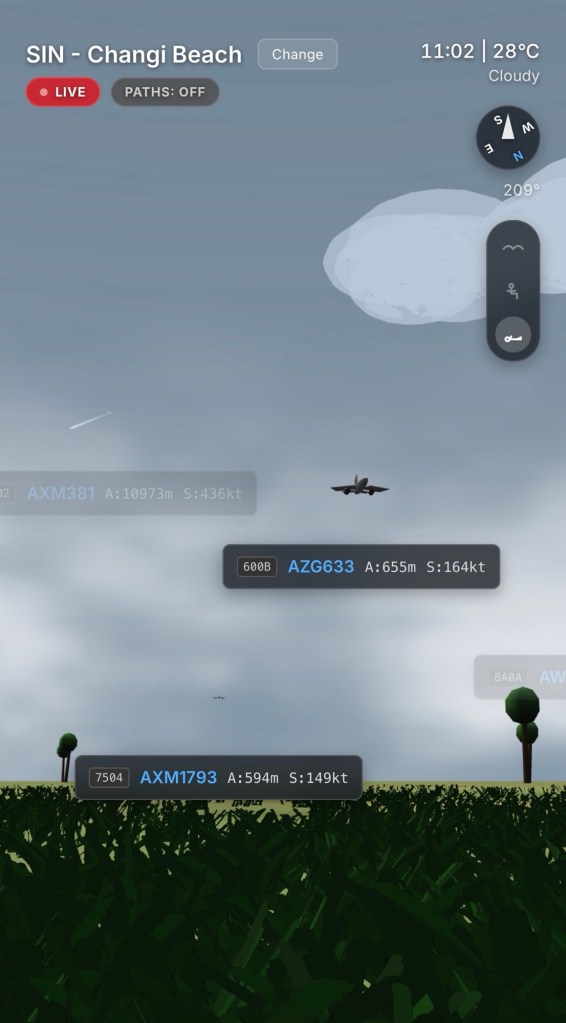
    Like a sophomore album, SkySpotter probably reached a little too far. It took the real-time weather data angle from Urban Jungles, added the more complex dimension of real-time air traffic data, and then threw in rendering a first-person 3D world as a bonus challenge. I started refining the concept and prototyping it on Sunday afternoon, and then worked on it for two full days on Monday and Tuesday. I literally forgot to eat lunch, and was still messing with it at 11pm both nights. It was like a job.

    Gemini 3 struggled. The Canvas chat became so long and convoluted that it won’t even load now in the iOS apps — I have to use the web interface. It hallucinated making changes, and introduced new bugs each time I made an improvement. It built planes with reversed wings and nose cones pointing backwards. Working with bugs in a 3D app was so blood-boilingly frustrating that I wanted to give up.

    I actually did give up… on implementing a VR mode for Apple Vision Pro. We got it to half work but the skybox sphere was too far away and would keep turning black. Rather than risk corrupting the working regular version any further, I decided to cut it.

    I’m proud of SkySpotter because it’s pretty damned cool to lie in the virtual grass and watch real planes go by. Even as someone who doesn’t care about planes more than the average person! But it was a technical challenge first and a passion project second. So if that was my over-produced sophomore studio album the label breathed down my neck for, then the next release would be its opposite: a scrappy, self-funded back-to-roots project recorded directly to tape in a Nashville studio over an inspired couple of days.
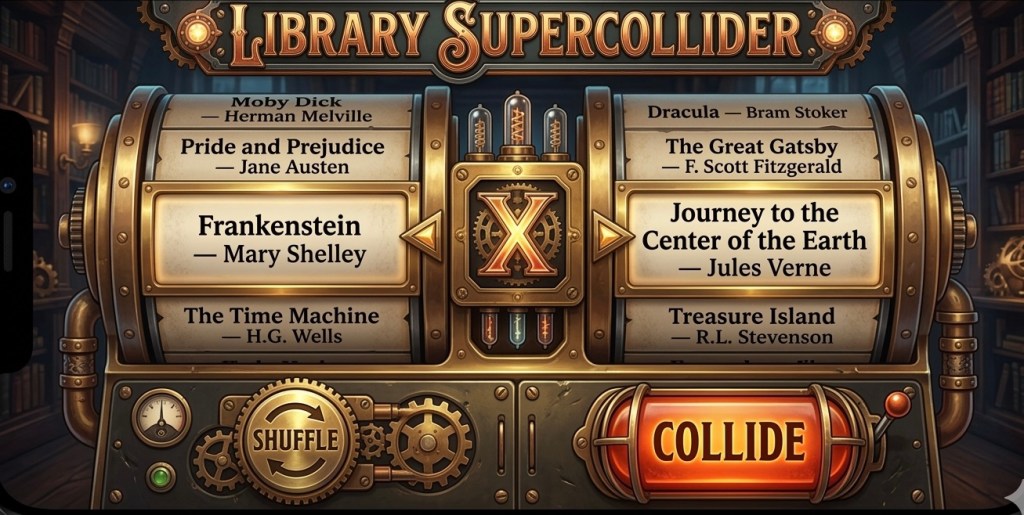
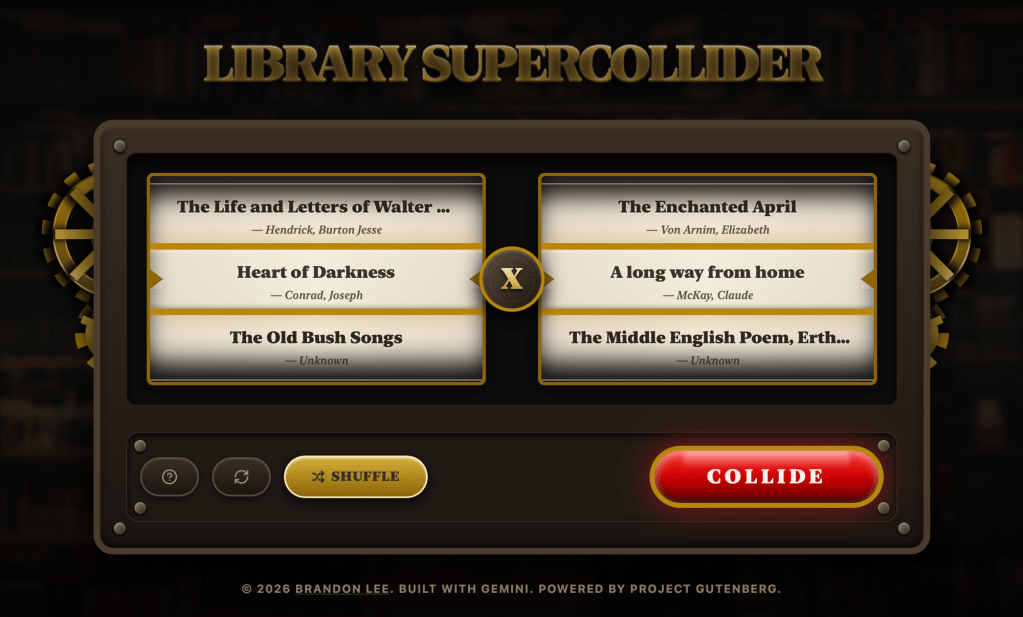
    Library Supercollider was an idea that came to me all of a sudden after I’d finished SkySpotter. I’d been interested in the concept of cut-up poetry since I was in university (popularized by Brion Gysin and William Burroughs around the 1960s), and I believe it occurred to me back then that someone could make a computer program to cut up and mash two classic texts. I just didn’t know it would be me, twenty years later.

    I expected it would take me the next couple of days to get working, being that it requires the somewhat complex-sounding downloading and processing of entire ebooks in the background of a web app. I didn’t know if it could even be done. So imagine my surprise when I had a working prototype by lunchtime on Wednesday. But between polishing the experience and overcoming download limits with Project Gutenberg servers, I wouldn’t be done until Saturday morning, making it a longer project with different challenges — comparatively less frustrating, more educational.

    I understand that it’s not an app for everyone — you might read a page and conclude that it’s worthless gibberish. Maybe it takes the sort of person who likes abstract art and free jazz. But personally I’m so pleased with this project that I’ve bought two domain names to go with it: librarysupercollider.com and the superior smashmybooksup.com, which I’ll retain for a year as a ‘marketing URL’.

    In all seriousness, I think this is the finest work of my two-week career as a builder of software! The user experience for remixing and reading the resulting texts is brilliant, if I do say so myself. The steampunk UI and animations are completely unnecessary but bring me joy (notice the moving gears in desktop view). I had to come up with caching and proxy solutions to make the app more reliable under load. I even got a little into the weeds: installing node.js and Vite on my Mac, running scripts in the terminal, trying to compile a macOS port to get around problems (eventually unnecessary).

    Even if I were a skilled and experienced developer, I can’t see how I would have made these apps in two weeks; from writing to designing and coding them up, plus preparing documentation and website copy (plus one very dubious video ad). Deploying Library Supercollider to its own domain made the reality click for me, a feeling kinda like publishing your first thing on the App Store. It says: this thing is now real and can be used by real people.

    Then I came across this article in the NYT Magazine, entitled “Coding After Coders: The End of Computer Programming As we Know It”. It notes an interesting inversion of what we’re seeing in other fields — AI is taking away the drudgery of programming and leaving the human, soulful (and fun) parts.

    “The work of a developer is now more judging than creating.”

    In that way, I may not have magically joined the ranks of coders overnight, but I could probably say I’m developing. At my job, I used to direct the form of apps in a way so removed that I could only claim the role of design, but not the larger making. Part of the handwringing in design circles today is precisely about how designing and developing are merging, and soon only making will remain.

    Not everyone will bother to turn their ideas into reality, and fewer still have the experience and vocabulary to prompt polished apps distinct from the models’ averaged-out defaults, but those who persevere will be bringing tools and toys into existence the likes of which you may have been waiting decades to see.

    What’s next? Well, I might have a couple of ideas…

    One thing all this app-making has done is bring me back to my Mac. I usually spend most of my computing time on my iPhone and iPad, but there’s no substitute for a Mac when it comes to managing local files, running scripts and compiling code. I’ve had coders like Michael make this point to me before, but I never got it because I never needed to sync a local repo with GitHub or anything before.

    So a side effect of spending long stretches of time on my five-year-old and long-neglected M1 MacBook Air is that I’m wondering “Why did I ever stop? This thing is great!”

    It’s worth noting that this week Apple’s newly released MacBook Neo has been getting a ton of praise on my social feeds for being an affordable and all-round capable machine at an unbelievable $599 price point. I got a tear in my eye as I read this essay by Sam Henri Gold: “This Is Not The Computer For You” — it perfectly encapsulates what it was like to grow up on computers and teach yourself things, even on PCs.

    Too much screen time is awfully bad for you, so on the weekend I touched some metaphorical grass by taking our niece out to Disney on Ice at the Singapore Indoor Stadium. It’s extremely well-timed, with the world still coming down from Alysia Liu’s gold medal, and Singapore being in the midst of a Disney craze — a Disney Cruise offering has launched after delays and is now at the local docks, with fireworks and drone shows along the bay at night.


    These were Live Photos of some stunts

    I have no deep affection for Disney IPs but appreciate the amount of effort and coordination that goes into making magic, and it clearly works with so many adults into this stuff. What’s interesting is that while ice-skating can get pretty boring after awhile — it’s all the same moves over and over, around a static rink — adding a layer of characters and storytelling works to keep it fresh over an hour and a half.

    Oh, and our niece is 9, and by way of introducing her to the MacBook Neo, I asked her what computer she uses. I swear, her response was not far off the punchline in that Apple ad that everyone but me seems to hate, in which a girl who’s been using her iPad all day for creative things is asked what she’s doing on her computer, and she responds “What’s a computer?” Will iPads become open enough to support kids learning to (vibe) code? Or will nature heal in a post-post-PC revival led by the MacBook Neo? In any case, that ad was prescient.

    Bonus: Steve asks the same question in a different context (around 1:30). You must watch this video, it’s breathtaking. He’s 28 at this point. In addition to confidently describing things like Street View, mobile wireless computing, LLM chatbots, and the App Store, there’s a part near the end where he says “What we need to do is get away from programming. People don’t want to learn programming, they want to use computers.” He was talking about providing more finished software products to customers, because writing custom software was the norm then, but it’s an eerily relevant quote!

  • Week 52.25

    Week 52.25

    Merry Christmas! For my main gift, I received a turntable, something that I’ve been very conflicted about wanting for awhile. Apart from the fatal hipster embarrassment, I know that the urge to repurchase all my favorite albums on vinyl is a road to financial ruin.

    Back in February, I was on the lookout for a CD player to bring home from Tokyo, but decided against it because digital streaming is identical, if not superior in the case of lossless and Spatial Audio, and I couldn’t see many instances where I would bother to get up and pop a CD on instead of just call out a request to my HomePod. And HomePods don’t accept Bluetooth or line-in audio, so I’d have to use my Sony soundbar or buy a third speaker for the living room. Too much hassle!

    But vinyl, goddamnit, just barely dodges the killing blow of that logical argument by having a different value proposition. One, the physical LPs are more collectible, more beautiful, more mentally stimulating in a world that wants to turn itself into ephemeral bits. People say that intentionally putting on a record for close listening deepens your connection with the music over just tapping a link. Two, the audio characteristics of an all-analog reproduction chain are surely different from digital. So if you can, why not have both options for home enjoyment? Three, it’s just kinda cool?

    So I asked Santa for an Audio-Technica LP70X, which has the option of Bluetooth output. I briefly considered buying one of those Marshall speakers to pair it with, but the idea was so cringe I couldn’t face it. Besides, that would nullify point No. 2 — why bother if you’re going to digitize it? So I hooked it up to an unused B&O Beolit 12 speaker (which has unceremoniously served as a stand for our bedroom HomePod mini for years) via RCA cable instead. Voila, money saved that can be used for buying records!

    But first, guardrails were needed. I decided that I would only buy absolute masterpiece, timeless, desert island discs. No new pop/rock stuff that wouldn’t benefit much from the analog format. And that my collection would 95% focus on jazz. The exceptions are things like LUX and J Dilla’s Donuts, maybe.

    After some laborious rewiring, we got it set up on Saturday and played some records that Kim bought as souvenirs many years ago. Radiohead’s OK Computer was one of them, and while I suspect much of it is down to the different speakers’ sound profiles, the analog version is bassier and warmer. When the HomePod plays a lossless digital version of the same song, it has an incredible immersive quality, so clear and bright that the band could be in the same room. A film camera versus iPhone’s computational photography. Room for both.

    Anyhow, it’s been wayyyy too addictive browsing records on Amazon — and the ones that ship from Japan are usually much cheaper than the US versions. Here’s what’s on the way but please recommend me your faves!

    1. Miles Davis – Kind of Blue
    2. Vince Guaraldi Trio – A Charlie Brown Christmas
    3. John Coltrane – A Love Supreme: The Complete Masters
    4. John Coltrane – Blue Train
    5. Chet Baker – Chet Baker Sings
    6. Ornette Coleman – The Shape of Jazz to Come
    7. Bill Evans Trio – Sunday at the Village Vanguard
    8. Bill Evans Trio – Waltz for Debby
    9. Sonny Rollins – Saxophone Colossus

    ===

    While we’re out here talking about physical artifacts and meaningful rituals, I want to point out that this final post of the year is also the 287th weekly update on this blog. About five and a half years of regular writing — all because I started one week with no idea how long I would keep going, just the hope that it would help me to write more often than a couple of times a year. Today, this weekly blogging of things that captured my attention has become my most meaningful routine, and produces a living artifact that I find quite valuable.

    Writing is thinking, and so putting time aside to articulate your feelings and actions, and reflect on the patterns within them, might be the best way to understand and recalibrate your own life. You don’t have to blog in public; journaling works too. Several times a year, I find myself reading an old post that I’d completely forgotten about, and recognize that something happening with me in the present began with something further back.

    Mark Curtis, one of the co-founders of Fjord where I once worked, has just started a Substack called Full Moon with a partner, and in their latest post suggest that everyone should start a habit of “externalizing their thinking”, because a personal archive of written thoughts and ideas has new applications with today’s LLMs. Having such a corpus can be an asset, and not just for training a soulless version of yourself who goes to work for the corpos while you stay home and watch vids. One thing generative AIs do well is find patterns across large amounts of data, and so with journal entries they provide a means of browsing your own brain over time.

    No stranger to this idea, I assigned Claude to read all 51 posts of the year so far, looking out for trends and threads that I might not have seen while posting in real time. What came back had a hint of that AI voice, but contained a helpful synthesis of several threads. Let me explain in my own words rather than simply paste the results.

    There were several recurring themes and obsessions, for instance deaths and funerals earlier on in the year, and it linked those to some musings on age and mortality when I started to feel old around my birthday, and when I recently said I should watch my purine intake for fear of developing gout.

    It suggested that I was doing something meaningful by making plans to meet up with people during this sabbatical, and that keeping in touch with ex-colleagues and helping grade college students’ presentations was part of staying connected to design culture and “keeping the ladder down”. There were also many words dedicated to creative experiments; chasing after the beauty in imperfections, from film grain to mistranslations; and of course, AI concerns.

    From that overarching theme, I ended up musing about the vulnerability of the junior designer pipeline, the commercial pressure to abandon not only proven methods but our values, and the dissonance caused by being a regular user of AI tools while knowing they come at some unknown but surely high cost.

    It also provided some insights into how I spent my time, calling it an attempt at presence over productivity. I certainly didn’t do any work I didn’t care about! I recall saying in Week 26.25, as I revisited my CliftonStrengths profile, that my natural inclination is to hate keeping busy and productive for the sake of it. I recently wrote something down in my notebook that sums up that energy: “I take tremendous joy in being able to do quite a few things extremely well and yet choosing to do none of them.” Perhaps underachieving is my passion.

    More acts of presence: I went overseas for about two months out of the year and chose a slow “daily life” approach over hitting up a flurry of tourist attractions. I deleted a bunch of games off my backlog — if it doesn’t spark joy, I decided, then I don’t have to finish it. I fell into a Japanese curry “research” rabbit hole in the first half, and now it’s sardines. I managed to make more time for reading, and am now starting on my 52nd book of the year, which is quite a nice achievement even if some entries were short stories and novellas.

    The last book I read was so good that I’m making it recommended reading for everyone who comes by here.* Make Something Wonderful: Steve Jobs in his own words is a free ebook by the Steve Jobs Archive, collecting in chronological order various speeches, emails, and interviews he gave. It’s not so much about Apple the company as it is about his views, spirit, and character that famously evolved between his ouster from that company and his triumphant return.

    I read it on the plane back from China, and maybe I was coming off an emotionally taxing time, but I had to stop reading several times because my eyes were tearing up. Don’t discount the beautifully cosmic coincidence of an adopted boy landing in the right family at just the right time in Silicon Valley. The result was that the whole world now enjoys thoughtful personal computers anyone can use. In another universe where the Mac never existed, there’d probably be no Windows either, and likely no smartphones as we know them.

    If you’ve ever heard him speak, you’ll hear his voice in all of these snippets. He had a way of keeping the forest in view, and often framed smaller moments (and even human life) against a vast span of time: what we’re doing here as a species, how it matters when we make things for each other, and thereby why we must carefully choose where we spend our time.

    *I’ll take this year-end opportunity to say thanks for reading, whether this is your first visit or you’ve been here all along. I get messages sometimes, and it’s always gratifying to hear something was a useful tip or interesting to someone else. Happy new year!

    ===

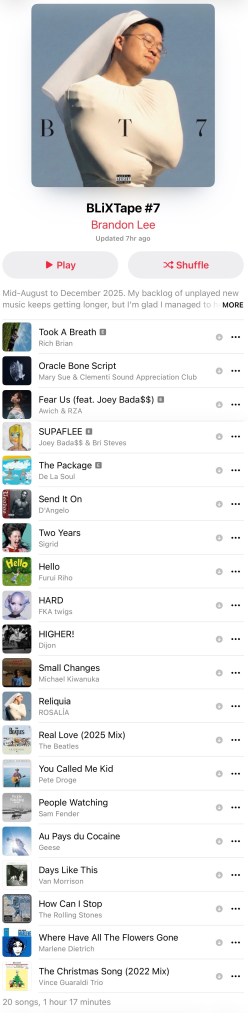
    I almost forgot. My seventh BLixTape playlist is done! Add it on Apple Music.

  • Week 43.25

    Week 43.25

    Vertigo (1958) is a great film, because Hitchcock was a master. It’s also the title of a mediocre stadium rock song, because I love hating on U2.

    Unfortunately, vertigo is also something I experienced for the first time this week — I’m fairly sure I jinxed myself at some point earlier this year by saying out loud “I don’t have any problems”. It hit me on Friday night in the form of extreme dizziness and nausea, and even the walk to bed to sleep it off was difficult without support. It got better the next morning with the help of something called the Epley Maneuver, which I found online.

    Asking around, I discovered that this is a more common human experience than you’d think, with several people I know having suffered episodes. Some of them had dizziness lasting days, and yet it’s strangely not discussed like, all the time? From what I can tell, it’s probably something called benign paroxysmal positional vertigo (BPPV), where calcium deposits in your inner ear become dislodged and move around, screwing with your balance. I’ll be seeing a doctor next week to confirm it, but in any case there’s no known cure and it might keep happening for the rest of my life. It’s crazy that so many are just quietly living with this.

    Have I been self-diagnosing with the help of AI? Maybe? I did just sign up for Claude Pro after all, which I’ve mentioned finding more agreeable than ChatGPT. I made vibe-coded two little apps before being laid low: a primitive prototype of my long-gestating stealth game, Cat Creeper, and a tool for my book club to figure out how many chapters of any given book we should read in the coming week. That one is called Book Splitter, and I offer it here for any book clubs out there with a similar need to figure out stopping points conveniently near chapter breaks.

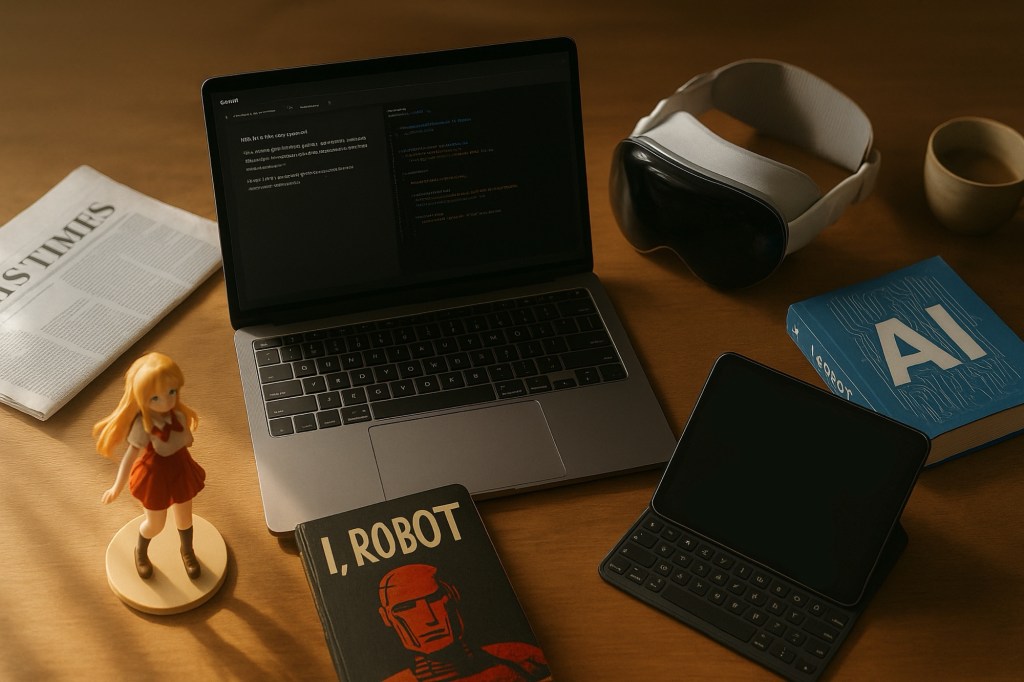
    It’s been a unique experience using Claude’s impressive capabilities alongside reading Asimov’s I, Robot, which foresaw many of our modern discourse around AI safety, and The Optimist at the same time, which has finally begun to chronicle some of Sam Altman’s questionable and unethical moves both at OpenAI and in his private life. The sections detailing his gaslighty, ungenerous, and cruel interactions with his sister Annie ironically reminded me of reading about Steve Jobs’s treatment of his daughter Lisa, in her memoir Small Fry.

    I just passed the part where Dario Amodei and other employees left to start Anthropic. Just as I try to avoid Meta and Google products because of their comparatively weaker stance on privacy versus Apple, it makes sense that some prefer Anthropic over OpenAI for a more cautious approach to AI.

    ===

    My mother-in-law stayed with us this week, which meant getting the newspaper in for her because that’s how some people still get their news. I was shocked to see how thin the physical Straits Times is these days — almost completely devoid of advertising, and on the whole maybe having 20% of the heft I remember from the 90s. It’s also S$1.10 now, up from the 50 to 80 cents I thought it was. Still, it was kinda nice (nostalgic) to sit at the dining table and read the paper in the morning.

    It was also the week where my favorite retro-game-hunting IRL streamer, 4amlaundry, went on a 5-day trip to Kansai, checking out thrift stores and exploring Osaka and Nara. I didn’t want to miss watching it live, so I tried explaining the whole concept of streamers to said mother-in-law, and got her to watch him with me for awhile on the TV, the whole time silently praying that he wouldn’t go look at the display cases of half-naked anime figurines that he sometimes checks out in those stores.

    Thankfully, that didn’t happen, and instead we watched him walk down countryside roads, eat at chain restaurants, and get knocked down by the aggressive deer in Nara. All of that made for some good conversation, so if you get the chance to introduce an elder to Twitch, it’s not the worst idea if you can avoid the NSFW aspects.

    Speaking of shows that you would hope won’t be awkward to watch with your parents or in-laws BUT ACTUALLY ARE, add the latest season of The Diplomat to the list. There’s a lot of cursing (I kinda expected that), and some sex scenes that maybe the producers thought were hot and their audience wanted, but are so unnecessary and desperate that they come across as unintentional comedy. Apart from that, it’s still a fun series that leans into unrealistic political drama, with some unexpectedly good writing (for a Netflix show). Just watch it on your own.

    ===

    I somehow forgot to mention the slate of new Apple products announced last week: M5-powered iPad Pros, a 14” basic MacBook Pro, and a spec-bumped Apple Vision Pro. The product lineup is designed to lead you to the conclusion that you should buy everything, because how do you choose between an 11” and 13” iPad Pro, and a 14” MacBook Pro?

    The 11” iPad size is portable for couch use, but the 13” becomes an advanced desk computer for creative work when paired with the Magic Keyboard and Pencil Pro. But if you’re going to be using it while deskbound, why not get a MacBook Pro with 24 hours of battery life (versus just 10 on the iPad), and the possibility of running local AI models and all kinds of other software that isn’t allowed on iPad?

    Making things harder is the fact that a 13” iPad Pro with accessories costs more than an “equivalent” 14” MacBook Pro, and they’re too costly for an average user like me to justify buying both. So the final decision was to hold out a little longer with my current M1-generation gear, and see what upgrades the 13” iPad Air gets next year — hopefully an M4 or M5 processor, ProMotion, and the aluminum Magic Keyboard currently exclusive to iPad Pro models.

    But bringing the M5 to the Apple Vision Pro makes it a better system to use and own for the next two years, while we wait for the next big leap forward in miniaturization. However as a casual user who only clocks a few hours a week, I couldn’t see myself upgrading for a faster chip alone. The more compelling improvement is a new “Dual Knit Band” that comes as standard, which sorta combines the previous Solo Knit Band and Dual Loop Band into one much-improved design.

    The best part is that this new band is also available as a standalone accessory, so I ordered one immediately for my first-gen AVP. It’s simply a marvel of engineering and feels incredibly premium. The build quality is off the charts, and the Fit Dial they’ve created to independently adjust both the back and top straps might be the most Apple-y thing they’ve shipped on an accessory since the Stainless Link Bracelet for the original Apple Watch.

    Thanks to this more comfortable and ergonomic band, I’d planned to spend more time with the AVP this week, until the vertigo and unusual weekly routine got in the way. Not gonna lie, my first thought during the vertigo attack, after “What if this never goes away and I’m disabled for life?” was “Does this mean I can’t use the Vision Pro anymore?”

  • Week 48.23

    Week 48.23

    Some things I asked the internet/AI this week:

    • Why do people never rinse their mouths out after brushing their teeth in the movies?
    • Isn’t it misleading and bad for oral hygiene education if directors leave it out for pacing reasons?
    • What’s the recipe for a Vesper martini?
    • How might a wealthy Indonesian put their billions of IDR to work beyond investing? (asking for a friend, I swear)

    Aside: ‘Asking the internet’ used to be our go-to phrase, but in an era where AI might be the one answering, does the term need revising? We used to be able to say ‘asking the internet’ but what about when you’re really asking an AI? They live on the internet and were certainly trained on internet content, but the old definition meant looking up content and new replies created by people; what do we call it when the answers AI generated? Keeping in mind that these answers may well be wrong, and in ways different from how a human might be wrong, it doesn’t feel like we should use the same terms. Or maybe we’ll keep referring to any hive mind as the internet?

    Can I go a week without talking about AI? I think those days may be behind us.

    Even iA Writer, the Markdown text editor I use for these updates, released a new update with an AI-related feature. No, it’s not automatically finishing your sentences or summarizing your essays. They’re all about the writing experience and process, and so they’re embracing how people use ChatGPT as a writing assistant, but helping them to preserve their own authentic voices. Text pasted from ChatGPT can be visually differentiated from text you wrote yourself, so you can see the Frankensteinian stitches on your monster. It also saves this info in the metadata for provenance.

    This suggests that many users send text back and forth to ChatGPT so often that they end up forgetting which bits they wrote themselves, which isn’t a problem I’ve had so far, but going forward, who knows? It’s a good idea and one I’m glad they’re testing, but iA Writer has always been a niche tool for a certain kind of user. I thnk word processors with integrated AI are going to be so widely used and loved by the end of 2024 that no one will care about who did what part.

    ===

    I made and released a new GPT, a game called Chrono Quest where you go back in time to improve humanity’s chances of beating an alien invasion. You can read more about it in my post here, but there are many ways to succeed, limited only by your imagination and problem solving inclinations. As a kid playing text adventure games, I never thought I’d see the day they could write themselves as you played. It even creates illustrations along the way, although those aren’t strictly necessary.

    I’ve got some other game ideas I’ll probably get on soon over the Christmas break. OpenAI announced yesterday that the GPT “App Store” meant to open in November was being delayed until early 2024. I guess that gives me more time to learn.

    ===

    It’s not accurate to say I didn’t get anything during the Black Friday/Cyber Monday sales. Pixelmator Pro for Mac was 50% off, and I thought it was time I upgraded to it from regular ol’ Pixelmator, which I must have bought over ten years ago for personal use as a substitute for Photoshop. Those were the days of per-once, use-forever software. To the developers’ credit, Pixelmator Pro is still offered through that model, although their newest app, Photomator, prefers a subscription pricing plan. The latter just won Apple’s Mac App of the Year award, by the way.

    Pixelmator Pro is more than just a Photoshop-type editor now, it’s also a video and vector image editor, and comes with lots of templates for creating posters, logos, and so on. And like Photomator, it has useful ML-based features for correcting color, removing noise, and increasingly resolution of photos. These are pretty old-school and conservative by the standards of generative AI — see the recent development of Magnific AI, a tool confusingly billed as “upscaling” when it’s really closer to hallucination. It can subjectively improve the quality of photos by generating plausible (but inaccurate) pixels.

    Check out this “upscaling” of Tomb Raider 1.

    ===

    Stumbling into the New York jazz scene by accident, I found two jazz artists I’d like to recommend: Brandee Younger and Samara Joy. Both already have a couple of albums out.

    Younger is a harpist who blends genres and leans modern. You’ll hear some hip-hop production, and it’s really not what you think when you hear the word “harp”. Her new album is Brand New Life, and is apparently based on and inspired the work of legendary harpist Dorothy Ashby, who I was also ignorant of. This is a weird observation, but hear me out. The opening track, the previously unrecorded, Ashby-written piece You’re A Girl For One Man Only, has a haunting melodic fragment that I think I recognize from… the soundtrack of the Japanese game/anime Steins;Gate of all things?!

    Samara Joy is a much more traditional vocalist, but what an incredible instrument her voice is. I’ll leave a video of her covering Lush Life below and you’ll see what I mean. I’m about to put her Christmas EP, A Joyful Holiday, on and get some lunch. See y’all later.

    (This week’s featured image was taken at a new mall that’s sprung up in Holland Village this weekend. It’s disconcerting; the massive development has been hidden behind hoardings for the past few years, and now revealed, it’s an unexpected contrast to the other old buildings and shopfronts, like a bionic arm of mediocre high street brands slapped onto an aging body.)

  • Week 1.23

    Creative Technologies’ founder and CEO Sim Wong Hoo suddenly passed away at the age of 67 this week, which was pretty big news locally. The Verge explained the significance of his career as creator of the Sound Blaster line of PC audio cards which put Singapore on the consumer tech map in the 1980s.

    My first PC was their homegrown Cubic CT, basically an IBM-compatible XT 8086 system, with a CGA (Color Graphics Array: just four colors) graphics card, 5.25” floppy disk drive, and no hard drive. I’m pretty sure my dad drove down to Sim Lim Square or somewhere like that and picked it up in person. After a few years, we upgraded to a non-Creative made system based on the Intel 386SX chip (how that SX suffix haunted me, making me feel like I had an inferior machine! The DX was the model you wanted; the SX lacked the dedicated math co-processor, not that I ever really knew which programs made use of it).

    Neither of these first two computers had proper audio capabilities, just the awful default “PC speaker”, as it was called back then. You could only get beeps and boops. One needed a dedicated audio card like an Adlib or Roland or Sound Blaster to hear proper music or sound clips. So every PC game I played had awful crude calculator music you wanted to turn off, but when I went over to play at my cousin Bryan’s house (he had a 286 with EGA graphics — 16 colors! — and a Sound Blaster), those very same games would have synthesized orchestral instruments and realistic sound effects. I wanted a Sound Blaster more than anything and wouldn’t have one until we upgraded to a Pentium system much later.

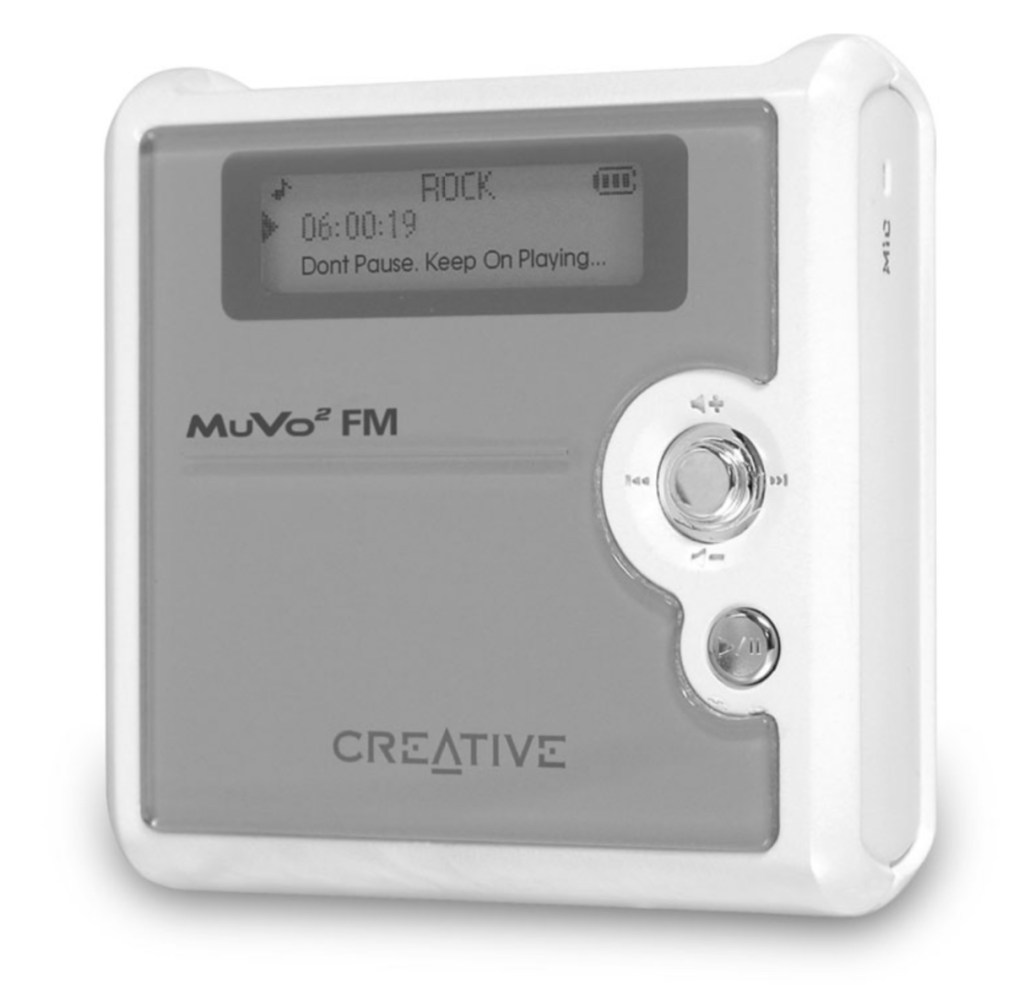
    The best quality image I could find of my old MP3 player, from the PDF manual

    Years before I got my first iPod and switched over to a Macintosh, my first MP3 player was a Creative-made device. The year was probably 1999 or 2000. I was looking to move on from the MiniDisc players I’d been using for years, and these new devices let you carry tons more music around without a folder full of discs in your backpack (this was really a thing we did). The model I chose was a Creative MuVo, a nondescript white plastic square with a tiny LCD screen and a soft joystick nub for control. It played WMA files as well as MP3s, which was a deciding factor for me as you could stuff more music in at an equivalent quality using the WMA format at the time. That little guy kept me company through two long years of mind-numbing administrative work during my national service.

    Years later, after graduating and stumbling into my first proper full-time job, the very first task they gave me was writing video treatments for a Creative Technologies product demo DVD. Creative happened to be one of the agency’s longtime clients, and the viral video above was one of the things that happened under their watch before I joined. I remember my partner and I excitedly pitching a direction to our bosses only to be shot down and told to try again. Weeks later, after going out west to Creative’s offices and getting their feedback, it turned out we had gotten it right the first time. That was probably the end of my journey with the brand, although I was intrigued by their attempts to bring a new version of their X-Fi surround audio tech to market in recent years. I almost bought a pair of their headphones to try it, but now Apple’s spatial audio on AirPods has one-upped their approach by delivering a massive library of professionally mixed Dolby Atmos music instead of relying on fake surround processing on stereo tracks.

    His death is a sad loss and I wonder what the company will do from here. Looking back on the various products I’ve owned or tried over the years, they offered unquestionable technical merit, above average build quality, and always great value for money.

    ===

    • The new year got off to a gluttonous start with an impromptu visit to one of my favorite buffets, followed by Chinese hotpot, and then an all you can eat Korean BBQ (these were three consecutive days). Then I rested for a day before hitting Mexican cocktails and an izakaya with 1-liter highballs on Friday, and then rounding off the weekend with a burger from Blooie’s Roadhouse on Sunday.
    • Incidentally, that last meal was my first time at The Rail Mall, which most Singaporeans are probably familiar with, and which I used to pass on the bus daily during the aforementioned two years of national service but never stopped at. There were a few other interesting places we’ll probably be back for, like a craft beer taproom and an all you can eat wagyu yakiniku (so, like, probably tomorrow).
    • I got into the hottest beta program around: Ivory, the new Mastodon client from Tapbots. It builds on their work for Tweetbot, and it makes using Mastodon as a primary social media platform very enjoyable. I’ve checked Twitter a lot less this week as a result.
    • I finished my first playthrough of Citizen Sleeper on the Switch and will probably not be back for more until a little later. So many games! I’ve started on Arcade Spirits, a Western visual novel about working in a video game arcade. Not to be confused with Arcade Paradise which is a business sim that lets you run an arcade cum laundromat. If Spirits doesn’t pick up soon, I’ll probably abandon it for Kathy Rain or the Monkey Island sequel.
    • In need of a new book, I picked up Eugene Lim’s Dear Cyborgs but it didn’t click. I cut my losses after about an hour.
    • King Princess’s Hold On Baby would probably have been my pick for Best Album of 2022, if I’d chosen an Album of the Year. I’ve played it through about four times this week and still can’t enough. As with quite a few things I really love, I kinda hated it at the start. I mean, I used to hate Macs and Korean food.
    • We did a deep clean of the fridge and freezer on Sunday. If you’re ever doing the same, Apple’s Cleaning The House playlist may help.

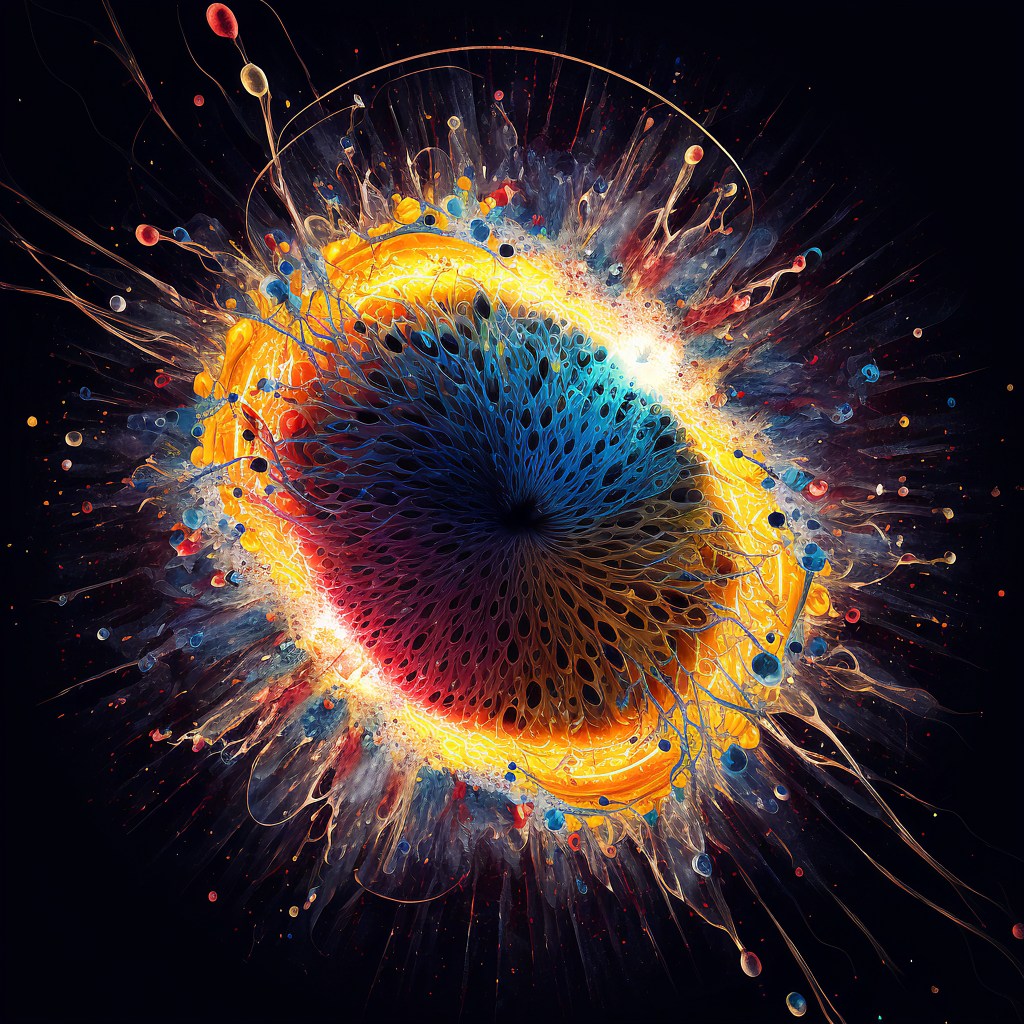
    Here’s some AI art I made this week:

  • Week 42.22

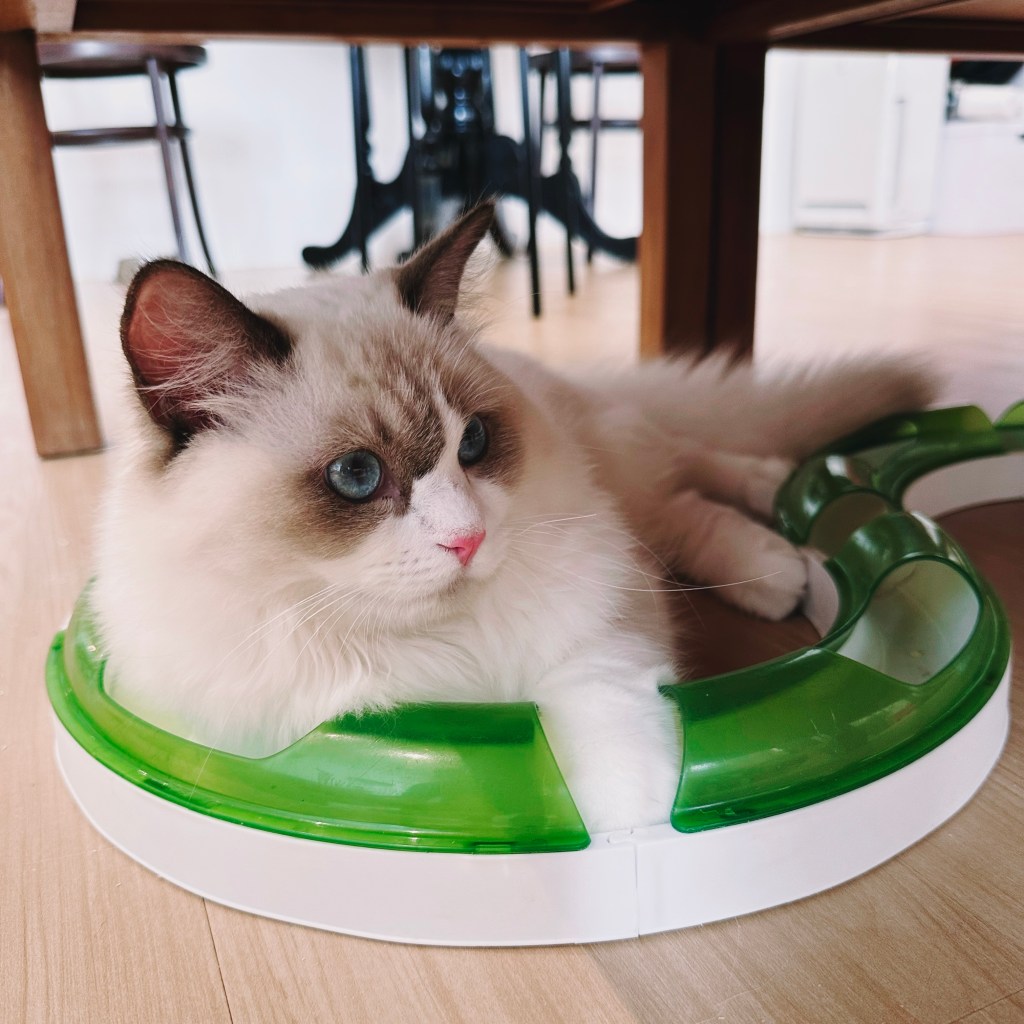
    We got a cat! Well, pretty close to it, more accurate to say that we have reserved a kitten from the breeder we were previously speaking with. The next few weeks will be spent buying essential equipment, clearing up some of the mess around the house that she might destroy, and then she should be with us by the end of the month.

    Appearance wise, she is what’s known as a seal bicolor ragdoll, white with brown markings on her face and tail. I’ve discovered that this combination combines the most popular and most common traits in these cats, so in gachapon terms we’ve pulled a three-star kitten. Although you wouldn’t know she was a kitten from looking at her; several people who’ve seen photos have remarked “oh, so you’re not getting a kitten?” They grow up to become large cats, with females possibly reaching 6 kg and beyond.

    We’re still thinking of a name (her dead name is Dewey) but already have a strong contender. In branding terms, this phase is what’s known as “writing the rationale after having found a name that sounds great but isn’t especially meaningful”. Aside: is it a bad idea to name your cat after a Microsoft product?

    ===

    Darkroom (a photo editor I’ve used since it came out for iPhone — it now works as a universal app on iPad and Mac too) released their new update supporting the sharing of filters/presets. Early users of the app will remember that you could always share filters via a QR code, but this feature was removed a few years back when they switched to a new architecture. The way it works now is the preset’s details get uploaded to their server, generating a link that you can share. Anyone who clicks the link can see how your preset looks applied against four standard photos, and install the preset in their copy of Darkroom with a single click.

    As someone who enjoys making presets in Darkroom, I’ve got a few that I would like to share with other users. I went through a phase of copying film looks from other apps like VSCO and RNI Films, as a sort of pastime, as I found it quite a soothing and mindless activity to switch back-and-forth between two photos and gradually nudge them closer together by adjusting sliders. Someone should make a game around that mechanic!

    I’ve posted a few on Twitter already, but have quite a few more that I’ll put soon — “better” ones that I’ve done on my own without referencing existing film stocks or looks. I even wrote about wanting to share a new preset last October!

    Darkroom presets shared so far:

    ===

    This week’s update was written via voice dictation on my Mac — with a few minor corrections. And that’s with a sore throat, stuffed nose, and raspy voice! As far as I can tell it’s not Covid, just this drawn-out flu that’s been getting quite a few people. On that note, Covid cases are once again rising here in Singapore due to the new XBB variant.

    I can’t wait to upgrade to Ventura, assuming that it will have the same voice dictation enhancements as iOS 16. I wonder if this post reads differently, stylistically, given that I am saying this out loud rather than typing it. Related to that, I am now reading the book Because Internet by Gretchen McCulloch (oh my God I can’t believe dictating that name out loud worked — I await the day this happens for Asian names). It’s about how language has been changed by the Internet and Internet culture (one of the things that involves is not capitalizing the word Internet, but macOS has seemingly not been informed).

    What a good week it’s been for reading: I finished Adrian Tchaikovsky’s One Day All This Will Be Yours and went on to finish Blake Crouch’s Upgrade two days later. With this post-Seveneves sprint, I should be able to finish the year with a not-embarrassing 12 books or more.

    I recommend both books by the way, the former being an unusual and fun time travel/time war story, and the latter another one of Crouch’s written-for-film-rights thrillers (his earlier novel, Dark Matter, is in production for Apple TV+). It is better than the film Limitless, but nowhere as great as Ted Chiang’s (dictation failed here) short story Understand. As you may already have guessed, the story is about a man whose genetic make up gets altered, giving him new abilities.

  • Week 38.21

    Media diet

    • I picked up Jordan B. Peterson’s 12 Rules For Life after coming across a few of his videos on YouTube. It’s a combination of anecdotes from his experience as a clinical psychologist, insights from his study of Christianity as a pillar of Western culture, and long-assed tangential stories and did-you-knows, the kind that only a supremely confident and self-interested extrovert can tell at a dinner party, padding it out for the sheer enjoyment of the storytelling process. 3 stars, I suppose.
    • Went out and saw Dune Part 1 in a plush cinema, where most of us were eating and drinking with masks off for the majority of the two hour and forty minute runtime. If I got Covid from this, would the movie have been worth it? No, of course not, but the length of the pause indicates the film’s score. This warrants a prolonged “Hmmm” at least. It’s something I’d happily watch again, and it didn’t feel long at all — I’d happily have sat through the next half right there.
    • Foundation comes to Apple TV+ next week as a series, and while I can’t recall a damned thing about the first book which I read as a teenager, I’m really looking forward to seeing Apple spend that iBegotten cash on some epic space shit instead of real-world dramas and comedies. Prior to seeing Dune, I was often mixing up the two franchises in conversation because I probably read them around the same time in my life, as one does.
    • Zookeeper World on Apple Arcade has not been as addictive as I’d hoped. Perhaps it’s the landscape orientation, or the UI for managing your zoo. Maybe I don’t want to manage a zoo at all. In what must be a data-driven programming decision, Friday saw the release of another match-3 game on Arcade, Temple Run: Puzzle Adventure. This one plays in portrait, more closely resembles Bejeweled’s proven gameplay and power-ups, and with a streamlined approach to story and progression. I find it much harder to put down as a result.
    • I “pre-ordered” World Flipper on my iPhone as soon as I heard about it, because it’s a F2P mobile gacha game with pinball as its gameplay mechanic. But I left it untouched and didn’t start playing until I saw this review pop up on Twitter. It’s a 2019 Japanese release from CyGames, which made Dragalia Lost with Nintendo, so it could be pretty good. I’ll put more time into it soon and find out if it’s the one for me.

    Patrick Kleplek, Vice/Waypoint:

    I’ve spent the last week thinking about this comment made by a follower on Twitter and the dark energy that surrounds it: “Everyone is just waiting for the gacha made just for them.”

    The gacha game that grabbed a lot of new people was 2020’s Breath of the Wild-esque Genshin Impact. The gacha game for me is, apparently, World Flipper, a pinball RPG that had its “global release” this week.

    ===

    Apple gear stuff

    I’m writing this week’s update from a new MacBook Air and boy is it nice to have a full-sized keyboard again! The last Mac I bought was an 11″ MBA back around 2011, as a complement to my iMac at the time. Big mistake, trying to have two Macs; it hardly got any use and was eventually handed down to my mom.

    Then I went down to zero Macs around 2017, my work laptop aside. It was with the advent of the Files.app on iOS and the sufficient stability of iCloud Photo Library that it became semi-feasible to use an iPad as one’s main computer. Now and then I still relied on my work laptop for a few tasks that you just can’t do on an iPad, e.g. updating firmware on external devices, using Calibre for managing a library of ebooks, web apps like Figma or Miro that don’t perform well in Mobile Safari.

    Over the past couple of months, I started to think about getting the cheapest, most basic MacBook later this year or next for infrequent personal use. But it was not a priority or a pressing need — I really enjoyed living off an iPad, perhaps masochistically. Then an opportunity to get a good deal on the M1 MBA suddenly presented itself ahead of schedule (thanks, Robyn!), and I found myself saying okay before I could overthink it.

    I understand that many reviews rate the M1 MacBook Air a great computer, but I haven’t read any of them because I’d “left the Mac world”. So I wasn’t really ready for how amazing this is, especially for a base model, which doesn’t feel compromised to meet a price target in any way. It feels more capable and responsive than the top-end 16″ Intel MacBook Pro I was using just months ago.

    As a result, I find myself using it more each day than I’d planned. Theory: the device with the biggest screen mentally becomes your “main computer”. And the windowing UI of a Mac just makes it natural for you to sit down, get comfortable by getting every app and document open, and then watching hours disappear just goofing off. The iPad’s multitasking limitations kinda protect you from that by requiring conscious intent at every turn.

    Of course, it was also the week in which the device with the second-smallest screen got updated, and in my opinion these new iPhones are meaningful updates. Certainly the XS was the slightest and maybe the worst value, and I got one that year even. But most years I go through this dance of setting out to resist upgrading — last year was an exception because I’d been waiting years for a return to flat edges — and then the FOMO increases hourly until pre-order day where I inevitably capitulate. The same happened this year (13 Pro in Silver), and I’m now resigned to just being that fool, that insufferable self-debater, that joke of a justifier, balancing insincere buyer’s remorse and tainted consumer delight in a joyless game of self denial. I should stop getting in my own way and just sell the kidney with a smile from next year on.

  • Week 46.20

    • Time has felt a little broken this week, in that 11.11 feels like it happened long ago. In case you’re wondering, that’s Nov 11, or Singles Day, which is now an official shopping day in these parts after having been imported from China. We never really had a tradition of Black Friday sales, so this is it.
    • I bought several bottles of bourbon and yet another pair of headphones: the Sony WH1000XM4s, which, in further evidence of a fault in time’s mechanics, launched back in August at the list price of S$550 and was now purchased by yours truly for just S$385. That’s a full 30% off for a brand new product; perhaps a year ahead of when it would have normally been discounted to such levels. The Sony brand just doesn’t hold value like it used to.
    • I bought the Mark 1 model about four years ago, intrigued by its DSEE HX (Digital Sound Enhancement Engine) feature which claimed to upsample compressed music and restore “near Hi-Res Audio levels of fidelity”. Great headphones, but the Mark 4 promises a more comfortable design, the best noise canceling tech on the market, and DSEE Extreme which now has AI magic dust all over it. Was it a necessary purchase? No… but I love a good bargain.
    • The PS5 also launched this week, but I have no interest in replacing my PS4 Pro just yet. Apart from sentimental value (it was a farewell gift, bearing the signatures of my former colleagues), it’s small and discreet. The PS5 is decidedly not, and seems to be launching with no extraordinary games. Looking back, all my Microsoft and Sony console purchases only happened years into the cycle. Nintendo consoles, I buy the day they come out. I can’t say why.
    • Oh yeah and Apple announced the first Macs with their own silicon this week, exceeding everyone’s expectations of what the M1 chip does for performance and battery life. It was an exciting event to watch, until I remembered that there’s no place in my life anymore for a personal Mac.
    • Doesn’t this feel like it happened ages ago? How messed up was work this week for it to feel this way?
    • In the early days of lockdown and working from home this year, I was hooked on Animal Crossing: New Horizons. I and many others joked about it being like a virtual vacation in lieu of being able to go anywhere. And I think the little controllable/knowable world, gentle soundtrack, and sense of community amongst everyone playing at the same time created to a sense of calm, routine, and positivity that got me through that period with little fatigue or stress. And then after about 200 hours or something, I put it aside and didn’t return even after the Summer and Fall and Halloween updates launched.
    • Prompted by the fact that some friends have picked it up again, I think I could use a return to my island now. Hopefully there’ll be time for that this week. In other gaming news, I’ve graduated to that next level of Call of Duty Mobile addiction: buying a “Battle Pass” for USD$4.99. It’s completely unnecessary, but gives you cosmetic upgrades and more of a reason to play in the form of a ladder of rewards to unlock. Play enough, and you’ll earn enough currency to buy the next season’s Battle Pass without any real world money. It’s a trap? I’m bored? But I also want to understand the mobile gaming economy better?
    I left the house exactly once this week, to see my parents and eat this lovely Japanese beef.