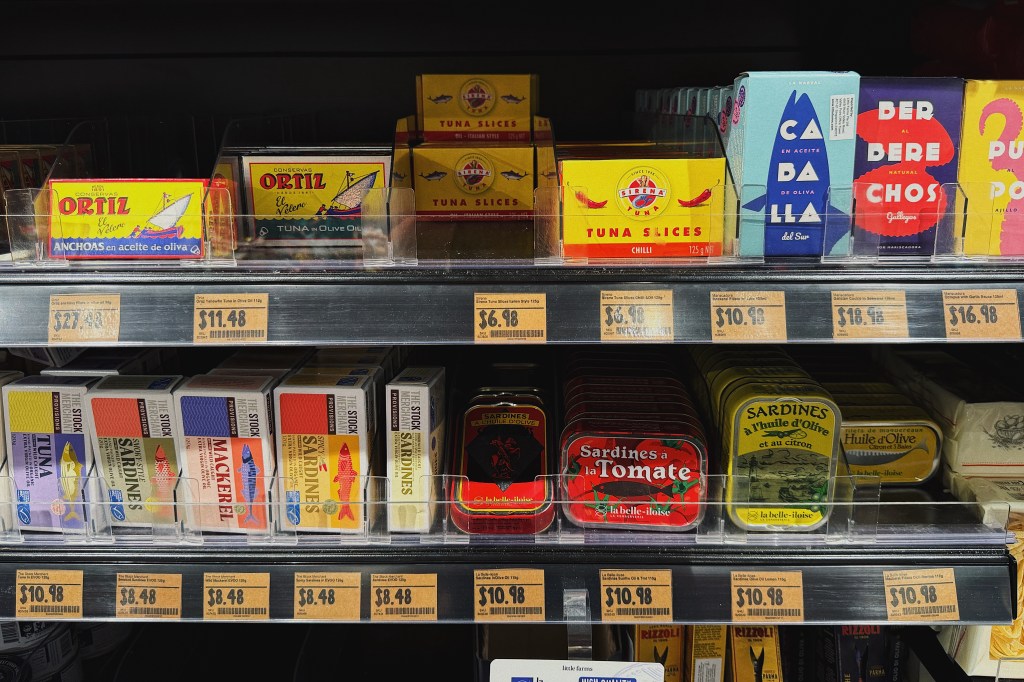
Canned sardines are my latest obsession. Before you imagine those fancy imported ones from Portugal with the beautifully illustrated tins, costing $20, no — not yet. And honestly, even the $10 ones in the photo are aspirational. But you know how you’re meant to eat two servings of oily fish a week for the Omega-3 heart health benefits? I thought I’d try to do a better job of that, and ended up falling in love with the convenience and versatility of little fish in tomato sauce or extra virgin olive oil. I’ve been having them on their own, on toast, with pasta and a little pesto, whatever. I even joined the r/cannedsardines subreddit, where other weirdos discuss them all day.
It was during a chance conversation with my parents that I learnt these healthy fish (including kippers and mackerel) are very high in purine and can lead to gout flare ups. Sure enough, search Reddit and you’ll find many canned fish enjoyers suddenly finding themselves in excruciating foot pain after eating three tins a day. To stay on the safe side, I’ve sadly started to restrict myself to two, maybe three servings a week.
Japan-based writer and walking influencer Craig Mod occasionally does “pop-up newsletters” to accompany his projects — say, a cross-country trek. He walks and takes photos during the day, then writes and posts these thoughtful, downright literary journal entries at night. Once the walk is over, the newsletter ends. I sign up for them but don’t read them as they come in because, like delicious sardines you savor, they’re too good to have to rush or get through. This week I finally read his last series from back in October, titled Between Two Mountains. Because it’s now over, the only ways to find them are his members-only archives, or having someone forward you the emails. I recommend subscribing to one of his more regular newsletters anyway, and you’ll be notified the next time a pop-up begins.
I read Morgan Housel’s The Psychology of Money which is notable for being a personal finance book that doesn’t belabor its points. There are 20 individual “learnings” that he wants to pass on, and some take up as little as a couple of pages. His latest book, The Art of Spending Money looks to fill a gap in a market where many pages are devoted to helping people build good saving habits, but not as many on what healthy spending looks like. Unfortunately, it’s fully booked out at the library and I’m 1,110th in line.
It’s taken me from Week 31.25 till now to go from owning a copy of Donkey Kong Bananza to playing it. It’s supposedly by the same team that made Super Mario Odyssey, and like that game it’s charming, delightful, and perfectly tuned for fun over frustration. I’m surprised at how easy it is, but that’s not a complaint at all. There are no 30-minute boss fights here. Nothing overstays its welcome, much like the book I just mentioned. I was alone on Sunday afternoon and started playing at 2pm — it was 6pm before I managed to tear myself away.
Bugonia is out for home viewing and I watched its ending sequence again because I loved it so much. No spoilers, but it utilizes Marlene Dietrich’s cover of Where Have All The Flowers Gone to brilliant and satisfying effect. I’ve known the song for a while (since Massive Attack referenced it on their Mezzanine album, probably) but never thought about what it says until this particular incarnation. It’s been in my head all week.
Did you know Norah Jones has a podcast called Playing Along (YouTube)? It’s a simple concept: she has different musical guests come in each week (recently Sarah McLachlan, Alessia Cara, Sam Smith) and they chat and play together in the studio. The conversations are super interesting for anyone who loves music because you get to hear discussions about technique and inspiration from people at the highest levels of their craft. This is what every artist has had the opportunity to do with the internet for the past two decades, but I can’t think of many who have! Apple Music artist-hosted shows are probably the closest thing, but they’re very radio like.
Speaking of people at the highest levels, I hereby record for posterity that two interesting executive departures from Apple were announced this week, John Giannandrea and Alan Dye, which prompted Michael and I to hop on a call and yap about it for a couple of hours.
So it’s beginning to feel a lot like Christmas! The Vince Guaraldi Trio’s A Charlie Brown Christmas album has been pinned to the top of my Apple Music list where I can play it on every HomePod across the apartment — all is well.
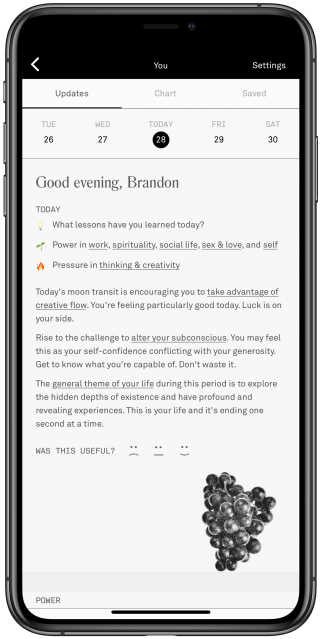
I was surprised to learn that astrology is experiencing a comeback amongst millennials, thanks to an app called Co–Star that has been steadily growing beneath my radar. When a decade-younger friend sold it to me over drinks last week, the most interesting thing about it to me was its inexplicable use of an n-dash in the name. I installed it for a look, saw a personality trait in the natal chart* that didn’t quite match my self-image, and promptly forgot about it until the push notifications started arriving.
These nudges are titled “Your day at a glance”, and are so iconic to this audience that the Instagram filter creator known as autonommy has made one that superimposes Co–Star notifications over your head. They’re usually a single mysterious line or proverb that you’re meant to contemplate as things happen to you.
Yesterday (an uneventful day), I was assured, “You don’t have to be afraid.” Today, it asked, “What lessons have you learned today?” Tapping into the app unleashes a torrent of AI-assembled advice that tells you how to deal with the challenges of existence as per the day’s astral alignment. The tone of voice is often surprising: acerbic, blunt, even dark.
Instead of deleting the app as I meant to do, I discussed it with some people around me and shared a Verge article about the team behind it, and now I’ve got irl friends on this astrology social network, and we can see each other’s fates and compatibility, and I think I’m keeping it? It’s not like I’ve suddenly taken horoscopes at face value, but perhaps it fills a gap — I need someone to regularly kick my ass on personal development, and whether I agree with the “advice” or not, these prompts might get me to work a little harder at things. They’re challenges.
Coincidentally, I spent much of yesterday reading through the backlog of email newsletters I subscribed to and then got overwhelmed by. When someone’s thoughts on screen are a year old, making reference to events that you and the internet are so over by now, but the words remain productive, insightful, and capable of inspiring you to look back at your old email newsletter project from 6(!) years ago and maybe start writing on your blog again, they can have all the paid subscription money. If you’re in need of a couple recommendations: try Dan Hon and Craig Mod’s.
There’s always a voice gently suggesting I “write more”. Sometimes I think I write enough at work as it is. As the activities that make up my day job changed over the last few years, so did the emphasis on actual writing as a vehicle for Client Value Delivery. It took awhile to join the dots between the kind of writing I did in advertising, publishing, side projects, and now in a design/consulting context, but that still leaves out the “pleasure writing”, as one acquaintance recently called it.
Right now, I’m feeling out of practice and clumsy when it comes to this stuff. I don’t know how to write to you anymore. Maybe I cut down on tweeting and blogging because we all entered a digital privacy crisis, but the net result was falling out of the public writing habit altogether. I lost imaginary friends.
So. Why not try again? What do I have to be afraid of? What lessons am I learning today?
*Those natal charts: You plug in your date/time/location of birth, and it pulls historical NASA data to see where celestial bodies were when you were born, and interprets their deviations in space each day to produce your horoscope. Are these even called horoscopes? I don’t know; that word seems dated and quacky, like something in a crinkled copy of Reader’s Digest, whereas Co–Star feels like something new — a bit of not entirely serious millennial wellness — dressed up in ancient clothes.
A couple of years ago, we had a colleague from Hong Kong in town who would do the exact same thing as a party trick, except she manually read and interpreted the natal charts which she generated using a Chinese app. Co–Star has simply scaled this with technology and a content team.
 sangsara.net