Tag: Products

  • Week 14.26

    Week 14.26

    An update on my app addiction

    On Wednesday morning I woke up and saw that my last app DataDeck was getting a bunch of likes and reposts on Bluesky, which was a nice surprise. If ever there was a place where people would appreciate a wacky, nerdy idea, I guess that would be it.

    My Instagram Story on Wednesday

    I made a couple of post-release updates to my magnetic poetry non-game, CommonVerse. There are now two new themes, one called Label Maker that resembles those little Dymo stickers we used to make, and another called Zine which is like a random note of cutout words. The UX has also been improved in subtle ways that might make it easier to manage making sentences.

    My “main” app project now is one that I can keep noodling on in the background, with no real endpoint — it’s done when I think it’s done — and the idea was that would help me slow down and spend less time with this vibe coding stuff. Guess what happened? That’s right, if you design something that can sit on the back burner, it will sit on the back burner. I started work on another app instead.

    Defying time and gravity

    I’ve known that the next step was to play with agentic coding tools like Codex or Google’s Antigravity. These are code editors with integrated AI that can look across all your project files and manage multiple agents working on simultaneous tasks. It’s a far cry from the way I’d been working: getting advice and instructions from a single chat, and then doing everything myself in a code editor. So I finally got started with Antigravity, and it blew my mind.

    The productivity increase is hard to describe. I could just describe stuff and it would get done without further work on my part. The tool can use the system’s terminal and Chrome browser to install packages, click around and test the app, figure out why things aren’t working, and fix it while you watch. Stuff that took me days over the last month could have been done in hours. It was automating so much of what little I, the non-programming human, was doing and considered my job, that it made me feel kinda redundant, to say nothing of real programmers.

    With Antigravity, the MVP of my app concept was done in three hours on a Friday. The good/bad news was that it blew through most of my token allocation for the week. So I went back to the “old” way of working and made subsequent changes manually. What I discovered was that I much prefer getting hands on with the project files, looking through the code to understand what was going on and what went where. I think I’ll use these agentic tools to get started fast and figure out a working architecture. After that, it’s more fun to get involved and make improvements slowly.

    Ate and left the Crumbs

    So the new app is called Crumbs, as in breadcrumbs, as in leaving a trail of them so you know where you’ve been. It’s a private location journal that lets you mark where you are on a map with a single button push. Over time, you can see the path of your journey(s).

    I made this because I’ve always wanted something like this for logging holidays, and no app really does what I want. Foursquare’s Swarm is based on Places, so you have to find the business listing or entry in order to check in. If you’re in the middle of a national park, or in a country where no one has created Places, or you can’t read the names, you’re out of luck. Google Maps has a Timeline, but it tracks your location all the time, and it only shows your trail on a day-by-day basis. Your data is also locked in their app and you can’t get it out to visualize in other ways.

    Crumbs is private, and you can take the data out in JSON format. It logs the time and weather along with your location, and you can write little notes. You can save an image of your map, or export a PDF of your journal.

    A big breakthrough (for me)

    Unfortunately, because it’s a web app and not a native iOS app, it can’t permanently store data on your device. The OS may decide to purge all your data if you haven’t used it in a week. That’s a dealbreaker for any app intended to be a life-logging tool. That really bummed me out, and I thought it would just have to be a personal tool that I couldn’t distribute to anyone else — since remembering to do manual backups/restores of the JSON file would be a massive PITA for any user.

    And then I had a Eureka moment! I thought of a possible solution and asked Gemini if it was feasible, to which it answered “Yes, this is an ideal solution”. I wanted to scream “Well, then why didn’t you suggest it all this time we’ve been discussing how to get around the problem!?”

    The answer was Dropbox integration. I can’t make a web app read/write files locally, but I can do it in the cloud. So now Crumbs is as useful as a “real app”, provided you connect a Dropbox account.

    As of Monday morning this post is late and I think Crumbs is ready, so here it is.


    Other thoughts

    • Here’s a free idea: I was inspired by this stamp journal that went semi-viral, and wanted to make some sort of digital Instax photo album. It’d be kinda nice to keep a virtual scrapbook of interesting images, right? Well, turns out you can just use Apple’s Freeform app and Dazz Cam. It’s as simple as making a board and dropping in images, then arranging them however you want. All stored locally and synced to iCloud, easy peasy. Just because you can vibe code it doesn’t mean you should.
    • My iPhone’s MOFT Snap Case developed a cut/tear in its faux leather surface, and so had to be replaced after just six months. Its replacement is a Caudabe Sheath, which fits my requirements of being neither silicone nor slippery, with full edge coverage and a Camera Control passthrough button. It’s a hard plastic material with a rough, pebbled texture that makes it feel secure when held. It also came in second in MobileReviewsEh’s roundup of the year’s best cases. I got the version with the ‘open’ cutout for the 17 Pro Max’s camera island, not the ‘precise’ covered design.
    • Kim managed to finish reading Project Hail Mary and we went to see the film on Sunday (non-IMAX). Apparently there’s a longer cut, nearly four hours, which will be released on streaming in August when it comes to Amazon Prime Video. Yes, this is billed as an Amazon original film from the very first frame, coming even before the MGM logo (which they own), and I don’t think that will ever stop being weird. The film is good, a mostly faithful adaptation of a fun but slightly flawed book. I just think they glossed over a lot of detail in the final act, which lowered the stakes and made it less exciting and rewarding than it could have been. Hopefully the extended cut’s extra run time is concentrated at the end.
  • Week 13.26

    Week 13.26

    I finished my sixth app: DataDeck. It simulates a fictional hardware music player called the DataDeck SG-01, or more accurately, a music generator. It reads live, open data feeds from the Singapore government’s data.gov.sg portal and translates them into unique musical compositions.

    My first prototype ingested the tourism stats for International Visitor Arrivals to Singapore since 2008, and when I first experienced the silence of the Covid years, with the beat gradually building back up again after 2022, I knew I was on to something. Data sonification is a cool term for nerds, but hearing the stories stored in the numbers is something anyone can understand and appreciate.

    At about ten days of development time, it’s the biggest project I’ve delivered so far with the help of AI — there’s no saying how long it would have taken me to do on my own. A million years? Instead, in just 10 days: parsers for 10 different datasets, 10 varied musical styles, and 10 switchable themes.

    The inspiration for its interface was the kind of hardware devices my dad had in the 70s and 80s: calculators, microcomputers, and tape decks from companies like Braun, Sharp, Sony, and Texas Instruments. A sort of Rams-ian, Bauhaus-ish modernist school of industrial design. The different color schemes you can choose from evoke specific brands or devices, like Apple’s Snow White-era or the original Nintendo Game Boy (DMG-01) and the Roland TR-808. I especially enjoyed working within the constraints of an imagined hardware UI, so when you switch to a dataset mapped to Singapore’s physical geography, the drum pad buttons get remapped to move a reticle around the map. It makes it feel more real, imo.

    The idea of playing with procedurally generated music using software-synthesized Web Audio was probably seeded years ago when I collected the 0xmusic series of art NFTs, which generated endless musical sequences from code on the Ethereum blockchain. I dare say that DataDeck is more advanced, and with better sounding musical output than those. Plus I’m making it free, and you don’t have to risk social judgement by going anywhere near crypto.

    I’m especially proud of the app’s design and musical qualities. There are a hundred little details in this thing I could mention that were cool to implement, but users don’t have to know or care about. Although it’s an app made for myself by myself, I’m still inordinately satisfied with and impressed by it. I’ve helped deliver a few apps in my career (some of them even won awards), but DataDeck already feels like one of my favorites.

    I think that’s because designing in the real-world is all about the navigation of compromises — technical debt, financial limitations, organizational will, and a lack of time all get in the way of polishing features you know could be great, or fixing annoying bugs that other stakeholders don’t seem to mind. Personal projects are not like that, and acceleration with AI makes them even less so. I made this thing how I wanted, and was able to tweak the mix or rebuild a cassette’s music logic from the ground up twice a day if I wasn’t happy with it.

    I’ve also been thinking about how narrow the term “vibe coding” is. On one hand, one-shotting an app by asking Claude to “build me a kitchen timer” is vibe coding. But using AI to create a complex tool where humans design the screens, sweat the UX, and look after the details is also kinda vibe coding. I talked recently about how the distinction between designing and developing will fade, and making stuff is all that will matter, and so it stands to reason that eventually coding with AI will just be called coding.

    I spent Friday afternoon with Jussi meeting up with two separate friends, both also middle-aged men, who are similarly interested in this evolution of design/development work, and who are working on their own projects with Claude Code, OpenAI Codex, and other tools. We’re all at different levels of familiarity and sophistication, but it was good to meet for a little co-working + Show & Tell time at cafes on a weekday. I think there’s value in forming a little “late boomers’ coding club” for fellow initiates.

    In any case, I’m hella tired, guys. I started on my next app idea but immediately got hit by fatigue on Saturday afternoon and needed a nap. Switching gears from audio generation to working on more visually-oriented functions was too much context switching to do over the weekend. Think I’ll finish reading a couple of books first before getting back to it.

    I know it’s been app-this and app-that around here for the last month and so maybe some readers (or a future me who’s been thrown in ethics jail for AI use) will appreciate hearing about other things. Let’s zoom all the way out then, into outer space.

    The film adaptation of Project Hail Mary is getting such great reviews and most people in my book club have already seen it. Unfortunately, I have to wait because Kim has finally started reading it, about three years after I told her to. Hopefully she’ll finish before the local IMAX run ends, but nothing in this life is guaranteed.

    There’s just something about stories of people in space, either lost or stranded, alone or in a small team, solving problems with limited resources, all the while confronted by the massive universe-facing perspective of being so small and meaningless. Andy Weir’s The Martian really resonated with people, and Project Hail Mary is having its moment too. I also enjoyed Daniel Suarez’s two Delta-V books a few years back. But the ultimate one that has yet to be beaten for me is Neal Stephenson’s Seveneves.

    The book I’m reading now might be a serious contender though. I’ve had Samantha Harvey’s Orbital on my list for the better part of a year, knowing very little about it, except that it’s about astronauts. Now that I’ve started, I don’t want it to end, I want more of everything, more words from this magnificent brain. You’ll know by the end of the first three pages whether this is a book for you. It’s intensely beautiful, unusual writing. It borders on poetry — perhaps too melodramatic for some — actually it steals over the border by moonlight and maps the territory. I don’t know how Harvey knows what it feels like to be in space, and what astronauts think about as they look down on Earth, but she absolutely does. You can’t write like this unless you’ve stowed away on an ISS mission and been through it. It’s a monumental work, and the best book I’ll probably read all year.

    Literally on the other end of that spectrum, the book club has decided to read Michael Crichton’s Sphere, which is set at the bottom of the ocean and probably isn’t very beautiful or philosophical. I read it once, maybe thirty years ago, and thought I only remembered the contours of its plot, plus flashes of the 1998 film adaptation starring Dustin Hoffman. As I read its opening pages, I was shocked at how familiar some of the writing and scenes were. It must have made an impression on me.

    Since the moratorium on spoilers has probably passed, I think it’s okay for me to mention what I recall: it’s about a mysterious ship that a bunch of scientists are trying to study in a deep sea lab. As time passes, they experience unnatural events, and it’s revealed that the titular sphere onboard has been “having an effect on them”. It’s a mashup of The Abyss and Solaris, essentially. I don’t want to rush Orbital, so I’m going to put that aside and work through Sphere as quickly as I can.

    Speaking of space, the deep sea, and being packed into tight metal containers, I picked up a can of my usual Ayam-brand sardines in extra virgin olive oil the other day and felt a weird “thunk” as I turned it over. I’ve handled enough of these cans now to know when something feels off. Opening it, I discovered only two fish instead of the usual three. That sensation was them loosely rolling around in the oil. It wasn’t like these were two large ones and there wasn’t room — someone on the packing line simply neglected to fill the available space and closed it up. At first I was incensed, and then I tried to let it go. We all deserve to make mistakes, and some sardines should get to enjoy a little more personal space. Be good to yourselves, and I’ll see you next week.

  • Week 12.26

    Week 12.26

    Another busy week, and I’ve been like a caffeinated creature hunched over its keyboard with bloodshot eyes. You may notice I’ve updated the navigation bar on this site to point to a dedicated page listing all my apps. This takes the place of a page that pointed to all my custom GPTs on ChatGPT (that never really took off, did it?) and before that, my NFT experiments. Those are still around, though!

    You may call it AI slop but I’ve generated key images for each of the apps on that page, which I like to think of as analogous to game box cover art, those evocative artistic representations that used to stretch truths to their breaking points, back in the days when games looked like Lego.

    Here they are, just so you can admire them.

    The latest for now is CommonVerse, my daily magnetic poetry app. Give it a go!


    I’m writing this paragraph on Thursday after another failed attempt to stop vibe coding and focus on other pursuits. So far I’ve mostly finished one project and started on another that I meant to leave aside until next week. What is this feeling? This need to actualize a new ability that I’ve always wanted but never had to worry about not having?

    Instead of being able to recognize that I’ve already accomplished a lot, and “taking the rest of the week off” to go watch movies or something, I’m sucked into continually iterating and improving upon these apps like I’m on a deadline. It’s that paradox (mentioned here last May) where new technologies don’t decrease our workloads but only make us busier instead.

    Productivitymaxxers will say this is fine. This is how it’s supposed to be: you can do more, so you work just as hard and get twice as much out of it. Why would you want to work half as much? And they’re not wrong — that’s the engine of progress. But it’s also how you end up making six apps in three weeks and treating it as some kind of baseline rather than a miracle. As predicted, my capability has grown but I got desensitized to the satisfaction.

    The discomfiting shock to the system as I struggle with this resetting of scale, and feeling addicted to realizing more ideas, is an adaptation crisis. Adapting to life at a new speed and learning to balance capability with sensibility. Astronauts and pilots have to train to handle G-forces, in which the G stands for gravitational. I’m suggesting that working with AI has its own G-force, where the G is gratification. You can suddenly manifest many of the things you can think of. That’s a very powerful impulse to get under control. How do you engage with life’s responsibilities, appointments, or your growling stomach, when there’s always just one more prompt and revision to make? After getting home from a few drinks on Friday night, I found myself on my laptop in bed after midnight, fighting with a procedural audio generation engine that wouldn’t trigger drum sounds for any obvious reason.

    The next night I did the same, staying up to 3:30 AM because I had some new ideas that just could not wait. My Apple Watch sleep score is in shambles. But App #6 is certainly shaping up to be my best work. I’m going to sit on it for a whole week and keep polishing, instead of putting it out and moving on to the next one. That’s my strategy for slowing this down — it’s all I’ve got.


    Over the weekend, I also attended an Apple Store photo walk activity on a sweltering afternoon (up to 36°C next week) with Cien and Peishan. I hadn’t done one of these in years, but always keep meaning to. This one was conducted by the staff at Apple Orchard, and was a walking tour of Emerald Hill — which in reality is just a tiny street off Orchard Road. I’ve been there dozens of times over the years, but never saw the details just sitting there in tiles, old paintwork, and ornamental doorframes. Going to a small area with the intention of taking photos, and giving it more time than you’d normally allocate, can be a really fun and creative exercise.

    There’s no reason one couldn’t do this themselves any time, anywhere, of course. But these free ‘Today At Apple’ sessions are a good excuse to get off the couch. The other two local stores have their own programs, and I might check them out someday: Apple Jewel Changi Airport looks at the indoor waterfall, and Apple Marina Bay Sands has a night photography focus.

    Another nice touch is that they’ll lend you an iPhone 17 or 17 Pro if you don’t have one, and they’re incredibly relaxed about handing them out. No paperwork to fill out or deposits to pay. That’s the great thing about Find My protection, I guess. A comment was made that in the UK, those phones would disappear the instant the group left the store — even if just for parts. But they must do these sessions worldwide, so I’d love to know how it’s dealt with.

  • Week 11.26

    Week 11.26

    If you thought I was going to stop after last week’s two apps, I wouldn’t blame you. I’ve been having poor luck staying focused on new hobbies and pursuits over the past year; they all just seem like too much work for too little payoff and I drift off. Vibe coding seems different so far because it lets me start making weird things that I want to see, without being dependent on anyone else’s time or generosity.

    If you think in terms of music albums/careers, then Collagen was the mixtape that I put together to see if I could be a real musician. Urban Jungles was a big leap forward, the debut album, if you will. It had way more polish and was usable by almost anyone (whereas Collagen had what you might call a niche audience).

    Which brings us to the sophomore curse or slump. The second album tends to be over-ambitious, myopically conceived, and underwhelms audiences looking for more of what made the debut good. There are exceptions to this mythical rule, like Radiohead’s The Bends, Lorde’s Melodrama, and D’Angelo’s Voodoo. By this logic, my next app was statistically going to “fail” by being a harder one to get into.

    I ended up making two apps again this week: SkySpotter and Library Supercollider. Each one has a separate page on this site that shows and explains what they are, so you should stop here and go read them before coming back.

    Like a sophomore album, SkySpotter probably reached a little too far. It took the real-time weather data angle from Urban Jungles, added the more complex dimension of real-time air traffic data, and then threw in rendering a first-person 3D world as a bonus challenge. I started refining the concept and prototyping it on Sunday afternoon, and then worked on it for two full days on Monday and Tuesday. I literally forgot to eat lunch, and was still messing with it at 11pm both nights. It was like a job.

    Gemini 3 struggled. The Canvas chat became so long and convoluted that it won’t even load now in the iOS apps — I have to use the web interface. It hallucinated making changes, and introduced new bugs each time I made an improvement. It built planes with reversed wings and nose cones pointing backwards. Working with bugs in a 3D app was so blood-boilingly frustrating that I wanted to give up.

    I actually did give up… on implementing a VR mode for Apple Vision Pro. We got it to half work but the skybox sphere was too far away and would keep turning black. Rather than risk corrupting the working regular version any further, I decided to cut it.

    I’m proud of SkySpotter because it’s pretty damned cool to lie in the virtual grass and watch real planes go by. Even as someone who doesn’t care about planes more than the average person! But it was a technical challenge first and a passion project second. So if that was my over-produced sophomore studio album the label breathed down my neck for, then the next release would be its opposite: a scrappy, self-funded back-to-roots project recorded directly to tape in a Nashville studio over an inspired couple of days.

    Library Supercollider was an idea that came to me all of a sudden after I’d finished SkySpotter. I’d been interested in the concept of cut-up poetry since I was in university (popularized by Brion Gysin and William Burroughs around the 1960s), and I believe it occurred to me back then that someone could make a computer program to cut up and mash two classic texts. I just didn’t know it would be me, twenty years later.

    I expected it would take me the next couple of days to get working, being that it requires the somewhat complex-sounding downloading and processing of entire ebooks in the background of a web app. I didn’t know if it could even be done. So imagine my surprise when I had a working prototype by lunchtime on Wednesday. But between polishing the experience and overcoming download limits with Project Gutenberg servers, I wouldn’t be done until Saturday morning, making it a longer project with different challenges — comparatively less frustrating, more educational.

    I understand that it’s not an app for everyone — you might read a page and conclude that it’s worthless gibberish. Maybe it takes the sort of person who likes abstract art and free jazz. But personally I’m so pleased with this project that I’ve bought two domain names to go with it: librarysupercollider.com and the superior smashmybooksup.com, which I’ll retain for a year as a ‘marketing URL’.

    In all seriousness, I think this is the finest work of my two-week career as a builder of software! The user experience for remixing and reading the resulting texts is brilliant, if I do say so myself. The steampunk UI and animations are completely unnecessary but bring me joy (notice the moving gears in desktop view). I had to come up with caching and proxy solutions to make the app more reliable under load. I even got a little into the weeds: installing node.js and Vite on my Mac, running scripts in the terminal, trying to compile a macOS port to get around problems (eventually unnecessary).

    Even if I were a skilled and experienced developer, I can’t see how I would have made these apps in two weeks; from writing to designing and coding them up, plus preparing documentation and website copy (plus one very dubious video ad). Deploying Library Supercollider to its own domain made the reality click for me, a feeling kinda like publishing your first thing on the App Store. It says: this thing is now real and can be used by real people.

    Then I came across this article in the NYT Magazine, entitled “Coding After Coders: The End of Computer Programming As we Know It”. It notes an interesting inversion of what we’re seeing in other fields — AI is taking away the drudgery of programming and leaving the human, soulful (and fun) parts.

    “The work of a developer is now more judging than creating.”

    In that way, I may not have magically joined the ranks of coders overnight, but I could probably say I’m developing. At my job, I used to direct the form of apps in a way so removed that I could only claim the role of design, but not the larger making. Part of the handwringing in design circles today is precisely about how designing and developing are merging, and soon only making will remain.

    Not everyone will bother to turn their ideas into reality, and fewer still have the experience and vocabulary to prompt polished apps distinct from the models’ averaged-out defaults, but those who persevere will be bringing tools and toys into existence the likes of which you may have been waiting decades to see.

    What’s next? Well, I might have a couple of ideas…

    One thing all this app-making has done is bring me back to my Mac. I usually spend most of my computing time on my iPhone and iPad, but there’s no substitute for a Mac when it comes to managing local files, running scripts and compiling code. I’ve had coders like Michael make this point to me before, but I never got it because I never needed to sync a local repo with GitHub or anything before.

    So a side effect of spending long stretches of time on my five-year-old and long-neglected M1 MacBook Air is that I’m wondering “Why did I ever stop? This thing is great!”

    It’s worth noting that this week Apple’s newly released MacBook Neo has been getting a ton of praise on my social feeds for being an affordable and all-round capable machine at an unbelievable $599 price point. I got a tear in my eye as I read this essay by Sam Henri Gold: “This Is Not The Computer For You” — it perfectly encapsulates what it was like to grow up on computers and teach yourself things, even on PCs.

    Too much screen time is awfully bad for you, so on the weekend I touched some metaphorical grass by taking our niece out to Disney on Ice at the Singapore Indoor Stadium. It’s extremely well-timed, with the world still coming down from Alysia Liu’s gold medal, and Singapore being in the midst of a Disney craze — a Disney Cruise offering has launched after delays and is now at the local docks, with fireworks and drone shows along the bay at night.

    These were Live Photos of some stunts

    I have no deep affection for Disney IPs but appreciate the amount of effort and coordination that goes into making magic, and it clearly works with so many adults into this stuff. What’s interesting is that while ice-skating can get pretty boring after awhile — it’s all the same moves over and over, around a static rink — adding a layer of characters and storytelling works to keep it fresh over an hour and a half.

    Oh, and our niece is 9, and by way of introducing her to the MacBook Neo, I asked her what computer she uses. I swear, her response was not far off the punchline in that Apple ad that everyone but me seems to hate, in which a girl who’s been using her iPad all day for creative things is asked what she’s doing on her computer, and she responds “What’s a computer?” Will iPads become open enough to support kids learning to (vibe) code? Or will nature heal in a post-post-PC revival led by the MacBook Neo? In any case, that ad was prescient.

    Bonus: Steve asks the same question in a different context (around 1:30). You must watch this video, it’s breathtaking. He’s 28 at this point. In addition to confidently describing things like Street View, mobile wireless computing, LLM chatbots, and the App Store, there’s a part near the end where he says “What we need to do is get away from programming. People don’t want to learn programming, they want to use computers.” He was talking about providing more finished software products to customers, because writing custom software was the norm then, but it’s an eerily relevant quote!

  • Week 10.26

    Week 10.26

    Last week I got started vibe coding with Gemini 3 Pro and was happy enough with the collage-making app I made that I deployed it to Netlify and posted a separate writeup for it here on this site. I also decided to rename it to Collagen, as in Collage-Generator, thanks to a suggestion from Michael.

    For my second project, I wanted to go much further and test the LLM’s ability to code up something more complex, with real-time 3D modeling and rendering. But what to make? One shower later* and I had a concept I was excited to try out: An app called Urban Jungle that would be a weather visualizer, depicting a world where humans have disappeared and our cities have been reclaimed by nature.

    I could see it clearly in my head, and had the idea (in retrospect, a brilliant one that you should absolutely steal) that vibe coding projects should start just like real ones — with concept art. Taking the time to visualize what you want is the first test of whether it deserves to be built. It aligns the team behind a single vision, with fewer chances for miscommunication and wasted time.

    I prompted Nano Banana 2 to generate a screenshot of Urban Jungle as if it were a finished product, describing it exactly how I wanted. The result was astoundingly close to what I’d imagined. With this visual in hand, I was able to brief the coding AI that much faster. Sure enough, the first prototype it spat out nailed the isometric view angle, UI, and core functionality.

    That it could achieve a pseudo-3D effect with CSS and standard web technologies, writing the whole thing in a minute, was already blowing my mind. But like any difficult client, I thought “why not ask for more and see how far I can push my luck?”

    The next version (v1.0) was a total rewrite of the graphics engine, now in full 3D using three.js. Each city is procedurally generated to be unique, with different forest/jungle topographies depending on the region. The increased detail meant I could add decaying buildings, pylons, and roads. When you tap on the trees, flocks of birds scatter. When it gets cold, the vegetation dies, and below 0ºC the ground becomes covered in ice and the birds disappear. I thought… ‘this is great! I think we’re done!’

    But I should have known projects like this are never done. Next came v2.0 which rewrote the architecture to allow it to act like a proper weather app. You can now simulate the weather for any city over the next 24 hours, scrubbing through time with a slider. As you do, the lighting and climate effects change dynamically. It generates live sound effects for wind, rain, birds, and thunder. You can pan and zoom around the model with your fingers. There are now drifting clouds and proper lightning that strikes the earth during storms.

    Comparing the concept art with the ‘finished’ product, and I’d say I got as close as one could hope with a web app contained in a single HTML file. Here’s a standalone post about the app, which brings me to another advantage of vibe coding with an LLM: these things write their own “App Store”-like product copy!

    Try Urban Jungles at urbanjungles.netlify.app

    Edit: I couldn’t leave it alone and after writing the above, made so many changes I had to implement a version history link on the front page. Now in v3.1, there’s an animated starfield in the night sky, and a freakin’ VR mode for Apple Vision Pro! It uses WebXR to place you inside a 3D environment with the city model floating in front of you. And after a couple of people suggested I add iconic landmarks like the Eiffel Tower, I decided that we could have a few as Easter eggs in major cities. Customizing every city to get full landmarks coverage of the world would be too much, even for me. But err check back next week, you never know.

    It strikes me that generative AI vibe coding is modern day Lego. It lets kids and adults alike build silly (or serious) things straight from their imaginations. It’s extremely fun and educational to express yourself in this way, if you just look at it as an advanced toy. The difference is that no one is using Lego to build a working car, or furniture, or anything that can be exchanged for money. But LLMs are already used in the building of most commercial software, and the proportion of their contributions is only going to grow.

    But as a hobbyist with little coding experience, I’m afraid about how desensitizing this new ability can be, and how it will dull our ability to wait for good things. It will heighten our time preference, in other words. While it was downright exhilarating to see my idea come to life in minutes instead of weeks, or never, I know it has already rewired my brain. I expect this now. The next app I make will be judged more harshly — they all will, now that I know how “easy” this is. Patience is going to be impossible, and that’s bad for everyone.

    *But what was that asterisk up there with the shower thought? It occurred to me later that maybe I came up with Urban Jungle because of The Wall which I read last week. To reiterate, it’s a survival story that takes place after an Event seemingly decimates all of humanity save for our female protagonist. She lives in a lodge in the Austrian Alps, getting by on limited matches, ammo, and medications. She’s constantly battered by storms and weather conditions, fighting a slow, losing battle against nature. That imagery must have stuck in my head.


    After that recent aggressive reading spell, I slowed down and decided to chill with one of those cozy Japanese books that are still so popular — you know the ones, set in convenience stores, or bookstores, or cafes, or the backseats of taxis, where absolutely nothing important happens apart from a mild mental breakdown brought on by social anxiety and ennui, aka living in Japanese society. I’ve semi-enjoyed a few of these before, most notably Michiko Aoyama’s What You Are Looking for Is in the Library.

    But even those lowered expectations could not have prepared me for the absolute waste of paper/pixels that is Atsuhiro Yoshida’s Goodnight, Tokyo (translated by Haydn Trowell and published by Europa Editions). I mention all involved parties because the blame for this should be shared. Multiple people started work on this, knew what they had, and decided to keep going. I can only guess the motivating factor was profit and cashing in on this cozy Japanese book trend. I hope it was worth it.

    I am now reading Olga Tokarczuk’s Drive Your Plow Over the Bones of the Dead (translated by Antonia Lloyd-Jones), and it is soooo much more deserving of your time. Then again, she’s a Nobel laureate — perhaps not a fair fight. But that’s the thing about books versus things like Michelin restaurants: the good ones cost about the same.

    I’ll leave you with some non-AI photos I took on a walk yesterday as a palate cleanser.

  • Week 9.26

    Week 9.26

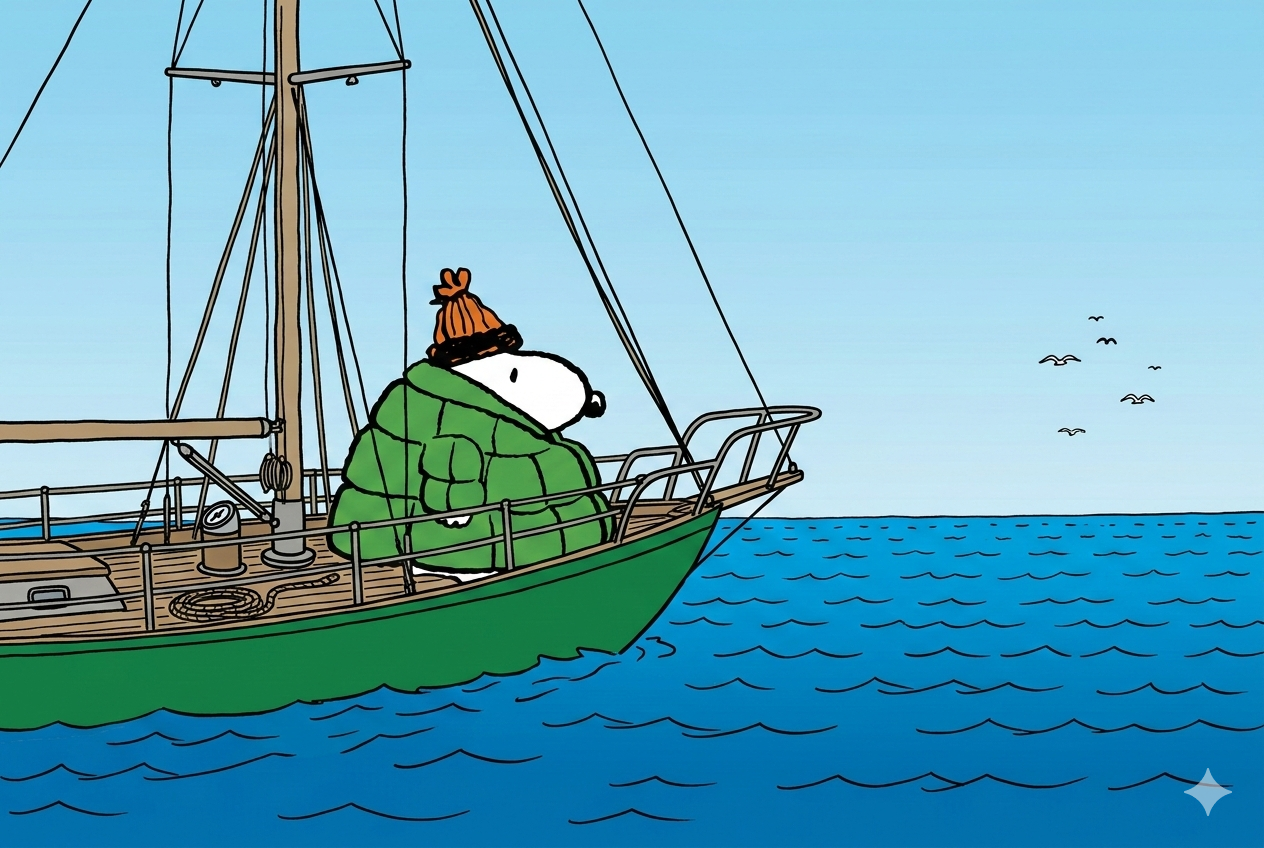
    • The featured image above is the result of having Geese’s Au Pays du Cocaine in my head all day. The line about a sailor in a big green boat and a big green coat made me think of Puffer Jacket Snoopy, and of course I had to realize the joke.
    • We got the sad news that Deliveroo is shutting down operations in Singapore. This comes on the back of an acquisition by DoorDash who must have run the numbers and decided that a 7% share of the local food delivery market after a decade wasn’t worth investing further in. We use it all the time and prefer it over Grab and Foodpanda — it is by far the better app and their subscription service is better value for money, but we’ve seen this movie before. It’s like how Uber lost out to Grab; the market doesn’t always choose efficiently.
    • I will probably switch to Foodpanda because Grab as a brand has the same icky halo as, say, Facebook or Spotify.
    • Google released Nano Banana 2, the new version of their hit image generation model. This one is cheaper to run and kind of almost as good as Nano Banana Pro, so they’re making it the default for everyone. Paid users can still access the Pro model, but it’s hidden behind some menus. It’s a regression in quality, a slight improvement in speed, and most importantly, a boost to Google’s bottom line. Since I only do silly things with these tools, it doesn’t bother me tremendously, but imagine the same happening at an enterprise level for more important work.
    Screen recording of an AI panorama
    • One of the new things Nano Banana 2 can do is generate very wide panoramic images, so I asked it to render some “panoramas taken with an iPhone” in various locations. I then upscaled those and opened them in my Apple Vision Pro. They don’t have the photorealistic quality of images from Nano Banana Pro, and the resolution leaves a lot to be desired, but they’re still immersive and impressive when viewed in this way. You can see where this might go.
    • There’s been a lot of talk lately about how AI vibe coding could upend the SaaS market, if not replacing dependable enterprise tools with individually created ones, then at least giving IT departments a billion more unapproved apps to worry about. A viral essay from last week posited that AI coding could kill DoorDash, though I’d say they did a good job of that themselves out here. The other oft-discussed idea is that AI could replace the App Store, and everyone will just make their own apps instead of buying them from developers. Michael has been blogging about vibe-coding his own to-do list app based on Clear. I’ve been wanting to try this myself, making more little tools of my own to solve niche problems, but the opportunities have been slow to materialize.
    • This week the right idea presented itself and I made a web app using Gemini: an album cover collage maker that searches for the artwork or lets you upload your own. I’ve looked online for something like this before but only found a few that were quite lacking. Making one to my own specifications took maybe five minutes of prompting and testing. Then I thought it would be nice if you could drag the images to different locations. Gemini added that feature like it was nothing. I’m pretty hyped that even someone like me with zero current coding knowledge could will this into existence. If you’d like to try it, I’ve deployed it at usecollagen.netlify.app.
    • Otherwise it was a sort of decompression week where I just read a lot, listened to the records I bought/ordered last week, and was regrettably glued to my phone watching day trading losses (Chekhov’s gun has fired!) and social media feeds.
    • It took a couple weeks of dawdling but I finished John Le Carré’s Call for the Dead, his first novel featuring the spy George Smiley. I may continue reading the series, seeing as his son Nick Harkaway (whose work I really enjoy) has decided to continue his father’s legacy and written one more already: Karla’s Choice. This one was a little dated and not particularly thrilling, but a fine introduction and scene setter.
    • It was immediately followed by Adrian Tchaikovsky’s The Expert System’s Champion, sequel to The Expert System’s Brother which I read at the end of last year. I recommend both as examples of sci-fi stories set so far in the future that humanity has looped back around to the beginning. It reminds me of the “middle chapter” in Cloud Atlas, if you remember that.
    • Then I read Hu Anyan’s I Deliver Parcels in Beijing, a modern memoir that reportedly did well in China when it came out in 2022. It details the author’s dual career as a writer and on-and-off gig economy worker, which is made more interesting by also being a portrait of what it’s like to live in the lower brackets of Chinese society today.
    • I also had time to tackle Rob’s recommendation of Marlen Haushofer’s The Wall, which was written in the 1960s but doesn’t feel that way, unlike Le Carré’s spy novels. He called it the best book he read last year, so I could hardly say no. It starts off like an intriguing sci-fi novel: a woman visiting friends in the Austrian alps wakes up one morning in the log cabin to discover she’s alone, and there’s an invisible wall separating her from the outside world. Things then focus on survival and what it means to live and be human in solitude, and in nature. Which, given that I’ll be home alone next week while Kim is away again for work, means I’m already in the appropriate headspace.
    Some of the better books I’ve read this year
  • Week 4.26

    Week 4.26

    Trump spoke at the WEF in Davos, and we watched it live despite wanting to turn it off many times. I intermittently tuned into Bloomberg TV over the week to try and keep up with all the repercussions. It’s something I haven’t done in a while, and the memory of watching last year’s Davos coverage came back clearly — has it really been a year? Time flies when you’re watching chaos porn.

    My main accomplishment for the week, in which admittedly little else happened, was acting on an impulse to make a sardine-themed t-shirt. If you were here back in Weeks 49 and 50 of 2025, you’d know they’re kind of my current food obsession.

    How sad I was, then, to discover that canned fish has actually become a trendy thing now. Read this piece on the Taste Cooking site about how it’s hit the mainstream and now faces a backlash. It turns out that Big Sardine has been aggressively courting women. See the pretty illustrated boxes and tins coming out of Portugal and from new brands like Fishwife; they’re perfect for social media. As a result, prices for what was once a humble working man’s lunch are soaring.

    Sidebar: As a man on the internet, you have a non-zero chance of being targeted for red-pill radicalization by algorithms, and it’s something I try to be hyperaware of and on the lookout for on platforms like Twitter. Despite that, at one point this week I was told by friends that I’d said something borderline manosphere-y. It was an observation that dating someone older and wealthier in your 20s could lead to lingering lifestyle inflation (spending above your means, simplistically) after you broke up with them. And seeing how women date older more often than men, I thought it might be another reason for the statistical gap between men and women’s retirement savings (alongside lower wages, caregiving duties, parenting). I just want to record this observation in case you notice me starting to blame women for all of society’s ills.

    But back to the t-shirt I was talking about. I had the idea to draw a sprat, which is a species of fish commonly grouped under the sardine umbrella. I wanted to place it under with its Latin scientific name, Sprattus sprattus, on a black tee. I also had a mental image of what the lettering would look like, and managed to bring it to life with my own two hands (and an iPad). I’ve ordered a couple of shirts from a print-on-demand service for myself and Kim, thinking that maybe if they looked good and I felt like having more problems in life, then I could try selling some online.

    As soon as I had that thought, I got excited and started mocking up a product page. I had a defunct Etsy store for my Misery Men project, so I renamed it “Maison Misery” to serve as a brand for all of this as-yet unrealized merchandise.

    Next, I wrote up some funny copy for the sprat shirt, and then decided to put Gemini through its paces as an assistant copywriter to improve it. I wanted to spend more time with Gemini given this week’s rumor that Apple might not only use Google’s technology for the Apple Foundation Models powering New Siri, but also for an integrated chatbot debuting in this year’s OS updates.

    And yeah, it’s really not looking good for junior copywriters. Five seconds after being given the brief, Gemini came back with three options that made me laugh and then compliment it with “Fuck me, these aren’t bad!” Now, each one wasn’t really usable on its own, but there was enough there that I could cobble together a good result along with what I’d already written. And that’s really all a creative director wants a junior employee to do: produce a range of half-formed ideas to pick through and refine. Unfortunately for humans, the fastest and cheapest LLMs today can already do that for things like product descriptions. And they’ll be running locally on your iPhone by the end of the year. This would be great technology if we had a shortage of copywriters, but instead we have a surplus, all looking for work.

    But since I’m the writer Maison Misery is replacing with AI, it’s okay? Here’s the augmented final writeup that I’ll put next to this t-shirt.

    At Maison Misery, we believe in celebrating the small things — mostly because the big things are too overwhelming to think about. Enter the sprat or brisling: a tiny fish harvested in its delicate youth, then tucked into cozy tins of extra virgin olive oil to dream of the Portuguese coast. These are the fancy ones you bring out to impress a date you’ve just brought home. If they don’t like the ‘deenz’, then that’s a bullet dodged.

    This original tee pays homage to Sprattus sprattus with a hand-illustrated and lettered design placed over the heart, providing a conversation starter for marine biologists and a conversation stopper for everyone else. It’s a way to wear your passion for canned sardines on your sleeve, though technically we put it on the chest because sleeve printing is prohibitively expensive and we have a lifestyle to maintain.


    Media activity

    • Netflix pushed the show His & Hers onto us last week, claiming it was an “addictive” thriller. I say give it a miss, because I can’t remember a damned thing about it today. Instead, their self-declared “top tier” thriller The Beast In Me, starring Claire Danes and Matthew Rhys, is a much better production. We finished it over the weekend, and while it’s no timeless classic, I’d agree it’s what you would find on the upper shelves if Netflix were a Blockbuster.
    • I watched the French animated film, Mars Express (2023) and came away very entertained. It’s a sci-fi story about robot/AI rights, a murder that defies the Three Laws, uploaded consciousness, and so on, borrowing from many existing works while having enough original ideas to justify itself. It premiered at the Cannes Film Festival, and doesn’t seem to have gotten wider attention since. Check it out if you can find it.
    • We also finally saw Brendan Fraser in Rental Family (2025), a Japan-through-American-eyes sort of film that doesn’t come close to capturing Lost In Translation’s magic, but has enough heart to reward your time. Fraser plays a down and out actor living in Tokyo who falls into a job playing stand-ins for people who need to tell white lies. Except some of them are kinda gray. I appreciated how the film leans into the moral ickiness of these assignments and rejects smoothing them over completely.
    • I swore I wouldn’t buy any records this week, and lord it was hard. J Dilla’s Donuts album went on “Limited Time Sale” on Amazon, dropping about $15, but I still didn’t cave! It’s in my cart, though. Instead I played some vintage cuts from my dad’s collection: War’s The World is a Ghetto and Rudolf Serkin’s Beethoven Piano Concerto No.5 with the New York Philharmonic.
    • If you want to know how close AI-generated music is getting to turning out radio-friendly bops, check out this album I came across by Japanese technologist Tom Kawada. I don’t think many people would realize what it was if they heard it in the background of a store, or a movie scene, or their own living rooms.
    • Then, to restore your faith in the messiness of human artistry, watch the new HBO Music Box documentary, Counting Crows: Have You Seen Me Lately? It covers the creation of their first two albums with a focus on Adam Duritz’s struggles with fame and mental illness. AI will probably write a chart-topping hit this decade, but can it ever write A Long December?
  • Week 6.22

    A happy Lunar New Year (previously called Chinese New Year but LNY is more inclusive) was had, as much as was possible under the circumstances. Where once we could have a reunion dinner with 30–40 of my closest relatives (some still unknown), thanks to still burning pandemic fires — we recently hit 13,000 cases in a day — now just immediate family members around one table. Instead of large and raucous household gatherings on Day 1, now intimate sit-togethers. Still, having a spectrum of different LNY experiences in one lifetime is not a terrible thing. Never thought I’d miss those reunion dinners though.

    I got some more samples of Misery Men merch in and made tweaks to improve print and product quality. The recycled cotton “eco tote bags” in particular were not very sturdy, so they’re gone in favor of regular ones with denim handles that can apparently hold 20kg of stuff. Take a look.


    My shirt was clinging to me in the pre-rain humidity as we trudged out onto the field. I would later find that I’d stepped in literal horseshit. The people running the place wore masks and dark sunglasses under hats and visors, so you really couldn’t see them at all as they looked you over. Were they wondering if I had any prior experience? Why I was so sweaty? No, they’d overlooked our booking and had forgotten we were coming.

    We were bringing our nephew out for an introductory archery experience as part of his Christmas gift. He was running around and excited for it. Kids seem to be impervious to environmental discomfort when they’re having fun. I shot a few arrows. It’s a disturbingly easy weapon to operate. After about half an hour and 20 tries we were markedly better than when we began, hitting the middle of the target often enough. Thanks to our strict gun laws, I never worry about encountering an armed lunatic in everyday life but now I may have to start worrying about bows and arrows in the wild. There were little Korean children, no more than eight years old, practicing beside us and consistently hitting targets maybe 30 meters away. Frightening.


    Media activity:

    • We saw Simon Kinberg’s latest disaster, The 355. I don’t know how the script got approved, or why the actors agreed to be in it. An utter waste of about two hours.
    • Unfortunately, Mamoru Hosoda’s new animated film Belle did not live up to expectations either. In direct contrast to Summer Wars, it spends too much time and exposition establishing the world and not enough on the characters, so I didn’t care at all for the story, which was sadly a mess.
    • I finally finished Plum Rains by Andromeda Romano-Lax, which mashes up elements of Pachinko and I, Robot with a heartbreakingly dry core about the migrant worker experience.
    • As a palate cleanser, I’m now reading Jack Reacher #18: Never Go Back. I’ve been waiting for this one a long time, because a couple of books back, Jack started flirting with an army major over the phone (she’s currently occupying his old job at his old unit), and he’s been making his way across the country to see her, interrupted by several books’ worth of coincidentally encountered wrongdoing that needed setting right along the way. Of course, as soon as he arrives on the army base, she’s missing and he’s being framed. Good times!
    • Still playing Hades, but have started a new visual novel on the Switch: Worldend Syndrome. It was on sale for USD$10 and reviewed well. Positives include nicely animated backgrounds and fully voiced dialogue, while the main negative would be a supernatural horror element that I hope is just misdirection and it’s only a regular ol’ psychotic, murdering schoolgirl that we’re dealing with.