Tag: Social Web

  • Week 46.22

    This one week with the new cat has felt like the longest week of my life. My brain cannot square the fact that it was only last weekend that we brought her home. I’ve aged significantly from worrying all the time!

    I spoke too soon last Sunday when I said she was comfortable enough to use the toilet here. She went another three and a half days before pooping again — three and a half days in which I became obsessed with wondering why, and with when she would go again, during which I poked my head in to check the litter box, like, every hour.

    I went and got some pumpkin to be boiled and pureed and mixed into her food for extra fiber; I made sure she was calm (I wasn’t); I think I even tried to talk her into it. Eventually it happened on its own, and my relief was as warm and palpable as the final product.

    After being told that they have finicky gastrointestinal systems and raw/unprocessed food is best, I got her some 100% freeze dried salmon treats. That are literally chunks of recognizable salmon meat. You wouldn’t think a cat could turn down fish, but I found one. As I brought the uneaten treats to be flushed down the toilet, Asian parent as I am, I reminded her there were wild cats starving in sub-Saharan Africa.

    Anyway it’s now Sunday and she hasn’t gone in three days — the cycle begins anew!

    ===

    Speaking of cycles, this season of Crypto is jumping the shark. The news this week was the sudden collapse of FTX (the world’s second largest exchange after Binance), which was seemingly caused/engineered by Binance’s CEO, starting with a couple of tweets that caused a bank run that FTX was not prepared to cash. Then it turned out that FTX had secretly transferred billions of dollars of its customers’ funds to Alameda Research, its sister trading company, who lost it all on a series of gambles.

    So FTX declared bankruptcy, its CEO Sam Bankman-Fried went from poster boy of the industry to most hated, dirty laundry about sex cults and drug addiction in the company got aired, and then on Saturday hundreds of millions of dollars started being transferred out of their accounts and liquidated on decentralized exchanges in a purported “hack” — surely a euphemism for insider theft. The great thing about on-chain finance is that this was visible to all, and unfolded live on Twitter and Etherscan.

    ===

    Twitter, of course, is also going through an existential crisis. The last time this happened and we thought it might be time to leave was likely in 2017, because that’s when I set up a Mastodon account (that hasn’t been touched since). I can’t remember what happened then, possibly a post-Trump disinformation deluge or boycott? It sounds more serious this time, with the company falling apart thanks to the mismanagement and ego-driven strategy of you-know-who.

    If that does happen, you should follow me at @brandon@mastodon.cloud.

    In the meantime, the chaos has been fun to watch: blue checkmarks given to fake brand and celebrity accounts for $8 a pop, resulting in hilarious fake tweets. There was speculation that one tweet about a medical company making insulin free was the reason behind a huge drop in its stock price (who cares if it really was, what a great story!).

    ===

    In gadget news, we’ve been using a handed-down Dyson v8 vacuum cleaner for the past few months. It’s a pretty good product but with the amount of fur we’re dealing with now, I couldn’t shake the feeling that we needed better.

    So I was keen to get a new one at this year’s Singles Day sales on 11/11 but somehow their latest model, the v15, has been sold out for weeks even on Dyson’s own site. To compensate, there were pretty good bundles and deals for their last model, the v12, which is better in some ways than the v15 (lighter, has a proper on/off switch) and worse in ways I can deal with (smaller bin, slightly less suction).

    It arrived on Sunday and while not in the same league as Apple, the unboxing and set up experience was pretty damned good for a household appliance. Everything was self-explanatory with minimal assembly. The laser “detection” module on the fluffy head makes cleaning up like a game: you see dust on the floor ahead literally light up, and sucking it up is so satisfying. They made housework fun.

    All other 11.11 purchases in our household were also cat maintenance related; still no AirPods Pro for this big ape.

    ===

    The Singapore Writers Festival is back again and we went to see Ted Chiang speak at the Victoria Theatre on Sunday. It was a little strange, in that he basically delivered a (very entertaining) lecture on time travel in fiction and film, but it was the sort of thing you’d expect to hear from a guest lecturer at a university. I was grateful for the chance to hear it, of course, but I suppose my image of a writers’ festival is one of writers talking about their own work. But if what our beloved authors really want to do between books is travel the world and give lectures on their pet subjects, I’m down.

  • Week 22.22

    Singapore grappled with a potential poultry problem this week as Malaysia banned the export of chickens to protect its domestic market from rising prices. We get just about all our fresh chicken over the causeway, which leaves only frozen supplies (mainly from Brazil and Portugal, I think). Despite frozen chicken making up the vast majority of consumption today, people panicked and smash bought all the chilled chicken off supermarket shelves, some buying hundreds of dollars worth; I don’t know how they intend to eat it all either. The greatest threat is to our national dish of chicken rice, which seems hard if not impossible, to achieve with frozen fowl.

    I did what had to be done and ate two large servings from my neighborhood chicken rice stall, all at once, as a farewell to our precious perfectly poached plucked poultry. I’d love to say that I’m now sick of it and won’t want any for a while, but honestly I could eat it Very Regularly if it wasn’t a terrible idea.


    Went out for another drone flying session with my dad, no crashes this time. It was an extremely warm day, but I discovered that if you hover it above your head, the down thrust is just incredible, like a fresh breeze on a cliffside, and it cools you off in a minute. Are mini drones the best portable fans in existence? I think so!


    The digital artist Tabor Robak launched his latest project, Colorspace, as an NFT series on Artblocks. I’ve been excited for this: they are tiny interactive, animated programs reminiscent of the 64K demo scene from the earlier days of PCs. Thematically they are matched to that era, simulating a desktop computer experience gone haywire, overtaken by swirling virus-like growths that break through the 2D plane and take over UI elements.

    I got up in the middle of night to mint one, but all 600 went so quickly that my transaction failed. Thankfully they’re now on the secondary market for not much more. The NFT art scene still seems to favor static images closer to traditional art, which strikes me as missing the potential of this new format. I’ve mostly been collecting generative pieces that couldn’t exist traditionally: favoring those that are ephemeral, ever evolving, or at least in motion.

    Drifting by Simon De Mai is one such project. By animating layers of simple geometric shapes over each other, and then adding cinematic lighting and shaders, it creates extremely cyberpunk scenes that can be read as anything from an endless descent down a megacorp’s elevator shaft, to a microscopic examination of advanced microchips.


    The second season of Ghost In The Shell: Stand-alone Complex 2045 was released on Netflix, and I had to watch the recap movie they cut together from bits of Season 1 to remember what happened before. I think it came out before the pandemic! After that I binged the whole new thing over the weekend. In general agreement with the critics, it’s not quite classic GITS, but it’s still good to have something. S2 definitely of overall higher quality than S1.


    I was getting a lot of Instagram ads for a game called Peridot and skipping over them without thinking… until… it dawned on me that this is Niantic’s new AR game which isn’t supposed to be out yet. Turns out Singapore is one of their guinea pig (ahem, soft launch) markets!

    So I installed it and have been impressed by the leap forward that this is versus Pokémon Go’s AR mode. For one, it hasn’t made my phone too hot to hold. My creature also navigates the physical world very realistically with rock-steady positioning and impressive foreground occlusion (I have an iPhone 13 Pro so I assume LIDAR and ARKit are doing the work here). They’re also doing something neat with computer vision, so not only can the game tell the difference between grass, soil, sand, water, and other surfaces that your creature can dig into, but it also gives you tasks like “show your creature a dog or a cat” or “bring it to a tree trunk”, and will know when the camera is pointed at one.

    It actually made me go out and take my new pet for a walk, and it ran ahead of me and beside me just like a dog would. When I brought it beside a body of water, it ran ahead and jumped in (complete with splashing animations). And this all ahead of what Apple’s going to show at WWDC. The AR glasses life is going to be something.


    My WordPress.com plan for this site came up for renewal and I learnt that they recently changed up their pricing structure to be more expensive while giving fewer benefits, which has gotten the community a little upset. Thankfully, I’m able to keep my legacy premium plan and so I have.

    But this is all indicative of the current sad state of the web. Blogging is not popular, and there are few good options left for anyone wanting to start publishing in their own corner of the net, away from social networks. WP probably needs to start making more money from their hosting business, and I’d still much rather pay them for it than run/rent my own server and muck around with the open-source version.

    I’m still hopeful for some catalyst in the near future that will bring decentralized self-publishing back into the mainstream.


    This is the last post of my sabbatical era. It’s been great! Going back to work is bittersweet. My next update will probably be brief.

  • Week 15.22: Location apps

    I’ve been a user of Foursquare, and then Swarm, for many years. Since November 2009, says my profile page. I know that I’m giving an advertising company too much information about my location, movements, and preferences. But there’s definitely a value exchange here. Without this “lifelog”, I couldn’t remember everywhere I’ve been, or the last time I was at such and such a place. And there have been occasions where I was able to, quite magically, summon the name of a great restaurant in another city and immediately see how it’s been doing since, so that I could recommend it to a friend.

    I’ve been a fan of location-based apps and social networks since maybe 2006 or 2007, when I got my first Nokia that qualified as a smartphone. I especially recall an app named Brightkite that existed briefly. It allowed for serendipitous moments like going to a foreign country and seeing tips and reflections left around the city (maybe in your hotel!) by a friend who’d come the same way years before. Swarm still allows for this experience today, and it evokes a kind of love.

    One day, Brightkite malfunctioned and read my GPS location as being in Tokyo, just for a moment. I think it allowed me to see people and their check-ins in the mistakenly assumed area, and so I interacted with some of them… giving them stars or a follow or whatever. One such stranger became part of my permanent friends’ list, and when I migrated to Foursquare, she ended up on my list there too. It’s now over a decade later, and we are still weirdly and peripherally aware of each other’s lives, on Swarm and Instagram, without ever having spoken. It’s a distanced closeness that could only happen with the internet. Once, when I happened to be visiting Tokyo on holiday, we were both checked in around the Ginza area at the same time. We may have crossed paths; I’ll never know.

    Screenshot of the Superlocal app, taken off their website

    This week, an app called Superlocal came to my attention via a crypto/web3 newsletter called Milk Road that’s worth subscribing to, if that’s your thing. Suoerlocal seems like an attempt to remake Swarm with a new revenue model. Like many web3 ventures, instead of selling your data to advertisers, it tries to support itself by being intrinsically financial: checking in and providing quality photos earns you tokens called LOCAL (which may someday have value), and being the mayor of a place doesn’t only earn you derision/respect, but also some LOCAL whenever people check in. How does money enter the ecosystem? Becoming the mayor of a place means minting an NFT for it. It’s currently in an early access phase, which also requires an NFT (or invite from a friend) to gain entry.

    I have mixed feelings about all this, as I do with NFTs and web3 in general. We should definitely explore new business models and build services that don’t rely on users making a privacy compromise. If a small group of super engaged users can fund the experience on behalf of everyone, and be happy doing it, all the better. But at least in this iteration, we’re just trading one problem for another. For instance, holding a bunch of mayorship NFTs in your Ethereum wallet doxxes your location and behaviors too, and probably in a worse way because they’re public for anyone (instead of just Foursquare Inc. and a couple hundred of their favorite clients) to see. This stems from the poor privacy design of Ethereum, of course, but it’s now the biggest smart contract blockchain so what are gonna do? There are still so many things that need to be done differently for this technology to scale and be safe and easy enough for everyone to use. That means I don’t believe Superlocal is going to become ubiquitous any time soon, but hopefully we’ll all learn what and what not to do as they keep building.

    Until then, I’ll still be checking in on Swarm.

    PS: I’ve been told about the virtues of using Google Maps’ Timeline, which also lets you keep a log of your movements each day, but without the social and gamey elements. I tried it briefly, but it was less fun, and I’ve been quite successful so far in cutting all the Google out of my life. Yes, I’m aware my rules seem arbitrary and illogical.


    Media activity:

    • Finally finished the book How To Do Nothing after about two months, which isn’t the positive review it appears to be. I found it such a joyless and obtuse slog that I fought myself every time I thought to pick it up and finish it. And because I have a dumb rule about not reading two books at the same time, that blockage has fucked up my Goodreads annual challenge for the year. A lot of catching up to do and I don’t think I will.
    • Started a new book anyway, Grace D. Li’s Portrait of a Thief, which is billed as Oceans Eleven meets The Farewell.
    • Watched Kenneth Branagh’s Death on the Nile. Dreadful. He’s done some work in the past that I truly loved, but this has little to recommend it. The art direction is slipshod, with CGI background compositing that looks straight out of the CD-ROM FMV games era, and the radioactive Armie Hammer is in one of the lead roles. Branagh’s Poirot is also mysteriously unlikable and inconsistent, with a couple of rude and temperamental outbursts that feel like if Superman suddenly gave someone on the street a middle finger.
    • Severance on Apple TV+ is not dreadful. Mild spoilers follow. I wasn’t expecting to be impressed, and the first episode takes awhile to get going, but it’s really excellent. This despite veering a little close to corny with some scenes on the “severed floor”. The sinister, faux 70s megacorp with forced cheerfulness felt copped from the environmental storytelling of games like Portal, Fallout, and Bioshock, and maybe the Dharma Initiative out of Lost.
    • Now out on Apple Arcade is Gear.Club Stradale which was teased during their last online event, and I’m very much enjoying it with my Backbone One gamepad. The original Gear.Club was an okay free-to-play racer on iOS which was later released on the Nintendo Switch as a premium game (no in-app purchases). It also got a sequel on consoles, but I don’t know how that went. This new iteration is streamlined: it’s all set in Italy, and the UI lets you move quickly around the workshop and upgrade your cars without having to fiddle around in too many submenus. Instead of the usual giant catalog with tons of cars to swipe through, a small selection of up to three cars for sale, refreshed daily. This is a superior design for a game intended to be played in short bursts over a period of time. Ping me if you want to join my crew!
  • Week 29.21

    • Don’t try this at home: Kim is away in the UK this week; not the most advisable travel idea. Cases there are rising sharply and I oop, I suppose the same could be said for Singapore. A couple of clusters have formed around illegal KTV operations (the comedy of that phrase!) and a fisheries port, which has led to fishmongers and wet markets across the country becoming danger zones. We had 88 local cases on Sunday, the highest since August last year. For the record, the UK had about 56,000 cases on Saturday alone. The mind boggles.
    • So until she gets back and clears the quarantine process 🤞, I’m on a sort of Sabbatical+, where I have more freedom to eat junk food and play games well into the night. I didn’t leave the house all weekend and it was the best.
    • I finished Root Film on the Switch, and while I still enjoyed it on the whole, it became needlessly convoluted and improbable in the final acts. Pick it up on sale maybe, but bear in mind it offers no challenge whatsoever. In any case, Root Film was always going to be the appetizer for the two games under Nintendo’s Famicom Detective Club banner, which I’ll try to buy and play next.
    • Thanks to the NYT’s SF Summer reading list curated by Amal El-Mohtar, I discovered the joys of the CatNet series (just two books at the moment). Catfishing On CatNet is the first, essentially about teens hanging out in online chat rooms and getting pulled into an adventure, and it was so much fun that I blazed through it in about a day.
    • I then missed hanging out in chat rooms so much I decided to give Discord another try and joined a few servers. The quality of conversation in most was a step down from what I remember of IRC in the early days of the net. Then, spending time in chats was a main attraction, not an alleyway off the main boulevard of social media. So I was disappointed until I found a server dedicated to older people, a distasteful category I now find myself in. Ah! There, I found people speaking in complete sentences and actually communicating with one another. I may continue this.
    • I saw Black Widow and felt it unnecessary and stupid. I’m kinda over Marvel the way I’m over Star Wars, except the first episode of Loki on Disney+ worked well with the pairing of Tom Hiddleston and Owen Wilson — I thought I’d be annoyed by his usual mannerisms but it’s actually been a long time and we’re in a pandemic, so you do your thing Owen, we’re here for it.
    • Installed iPadOS 15 Public Beta 3 on my main iPad. Haven’t run into any issues yet, and I’m relieved at finally being able to customize my home screens with only the icons and widgets I want, leaving everything else in the App Library. You can also have two of the same app icons up as well, so I have Photos on my first Home Screen but also on the page I’ve dedicated to photo editing apps a few swipes away. It’s the little things!
    All in a day’s work with Dreams
    • A feeling of being useless, sitting around consuming all the time without making anything, has been fermenting and I’ve consciously allowed it. Over the weekend, I made it my mission to begin prototyping a game I’ve had in mind for awhile, let’s give it a code name… Feline Fiddler? Nintendo’s Game Builder Garage was going to be where I’d learn the basics and try to start, but upon investigation, you have to use its built-in asset library, and if you can’t find what you need in there, too bad. So I ultimately went with Dreams on the PS4, and oh boy, is it a stupendously powerful tool for 3D modeling, animation, and visualization.
    • On Saturday, I started playing the demo game project that comes as part of it, Art’s Dream, which showcases what you can do with it. And then started doing a few tutorials. By Sunday afternoon, I was able to assemble something close to the scene I had in my head using models others have built and shared on the platform, light it, and walk around in it with a character. And it’s all achievable on a PS4! I don’t see any reason why there couldn’t be something like this on iPads, apart from the App Store rules. Maybe Roblox is something like this? I should check it out…
  • Week 27.21

    Mon, 28/6, 9:31 PM

    Today’s the 28th day of my sabbatical, so I guess it qualifies as a full month now. It may be premature to declare, but guys, I’m sure I could do this for a year or two, no sweat. If I didn’t have a fixed period planned, I wouldn’t even be counting the days.

    But since I am, it feels like the first phase is over. As occupied as I’ve felt, it’s only been the equivalent of lying about listlessly, eating empty calories, and falling asleep in the sun. There’s a feeling beginning to stir that I should be doing more. That a pen should be on paper, a sprite on screen, or a running shoe on pavement. Okay definitely not the last one.

    Am I being too ambitious? Wasn’t the point to do nothing? I’d better let this creative despondency build up a little bit more just to be sure.

    Tue, 29/6, 3:02 PM

    My iPhone 12 Pro is less than a year old and its peak battery capacity has already dropped to just 90%. For comparison, my iPhone X still retained 97% after more than a year of service. I’m wondering if it’s because I almost exclusively charge wirelessly these days? In any case, I don’t seem to be alone in this.

    7:15 PM

    Have I always had such noticeable mood swings? Stupid question. If they were noticeable before, I’d have noticed them. Now I’m keenly aware of how I can go from low-energy miserable to happily fascinated and back again in one afternoon.

    As the saying goes, “the devil makes work for idle thumbs”. I potted around my finances for a little bit and realized StashAway’s cash management offering performed abysmally in June against already low expectations, like 0.8% APR. For small amounts of emergency cash, I don’t see why one wouldn’t just employ stablecoins and yield farming to get closer to 10%. So that’s what I’ll focus on doing next.

    Earlier today I had a chat with an old friend that I haven’t talked to in probably a decade. But we’ve known each other for… 25 years? Long enough that memory is less like a map and more like a stack of snapshots of road signs. But of course we live in the post-Facebook days, so I often see updates on Instagram or Twitter. Quite recently, I clicked on a link in one of her tweets. Then last week as I was going through my blog archive and saw her name come up, it seemed natural and easy to just reach out and say hi. Then she tells me she’s also seen my online activity lately, and even came by to read this blog. Huh.

    Listen, I believe there are no coincidences when marketing algorithms are involved. Someone you know checking something out on a platform is quite likely to put it in your feed as well. As unintended consequences go, I’m really happy with this one. But if they can prime my antisocial brain to reconnect after years and years, you’d best believe they can make you buy that Cheesy Zinger Double Down meal from KFC.

    Wed, 30/6, 6:19 PM

    I’ve spent the last four hours playing Call of Duty Mobile and absolutely slaughtering what I hope were other players half my age. Two people checked in with me today and asked how things were going. I told them I was basically larping as the deadbeat, couch-dwelling boyfriend they probably had in college. I have FPS headache now, but god it feels good.

    Fri, 2/7, 4:07 PM

    I’ve done little else but Call of Duty since Wednesday and am now Level 80 in the game, which sounds like a big deal. Only now that I’ve hit this watershed achievement, the game is exposing me to other players up to Level 150. They keep moving the goalposts.

    I’ve even ended up paying real Singapore Dollars for the current season’s (really just a month-long themed event) Battle Pass, which gives me all sorts of useless gear as I keep progressing. Other games’ in-app purchases give you collectible characters and items that impact gameplay. In Call of Duty Mobile, you get outfits and wacky paint jobs for your guns (!) that no player will ever see except if you shoot them in the face from two feet away. When I saw this before I got addicted, I thought skins for guns was the pinnacle of dumb. Now I’m Level 80 and won’t be caught dead with a plain black assault rifle.

    Sat, 3/7, 5:48 PM

    I’ve just been dosed with the second shot of the vaccine and am now waiting in the observation room. I don’t know if I’m imagining the slight lightheadedness.

    Almost everyone I know has had side effects after the second dose, some quite vicious. I’m already expecting to spend the next two days in bed with a fever and headaches. I wonder if I can still play Call of Duty Mobile in that state.

    When I did some quick maths to estimate how much I’m spending per day on this sabbatical, that is to say net outflow on housing and taxes and expenses not being offset by income, it was a slight shock. While I was always fine with the idea of effectively paying for this break, I hadn’t framed it as “pay $x daily to play Call of Duty Mobile”.

    Epilogue

    OOF. That second dose of Moderna hit hard. I wanted to post on Sunday but I couldn’t even bring myself to look at a screen all day. It started 9 hours after the shot with chills in the middle of the night. All day I had a high fever, headaches, an elevated heart rate of 110–120 bpm for about 18 hours, and all the delirious dreams that come with those. It was extremely stressful trying to sleep but being plunged into a maze of nonsensical images and incompletable tasks instead. At one point I woke up and tried to explain what I had been seeing, and it felt like I had brain damage because the words just weren’t available.

  • The Trouble with Instagram Stories

    I enjoyed reading this TechCrunch interview with Kevin Systrom where he openly gave credit to Snapchat for their ‘Stories’ feature, and talked about how copying it for Instagram inevitably created something different.

    What I’ve observed matches much of what’s been said: it gives most people a much larger starting audience compared to what a new Snapchat user has, which increases the likelihood of success; it’s really well implemented (I especially like that switching from one user’s Story to the next has a different transition animation than skipping a scene, making it much clearer that you’re on another person now); and it makes Instagram a more complete place to look into the two sides of a person’s life: the imperfect moment and the photograph worth sharing.

    BUT one early side effect has also materialized, and it’s already changing the way I use Instagram. In short: I don’t want to see many of these Stories! I follow a variety of different accounts, from brands, obvious social media influencers/shills, dogs, cats, interesting strangers, and friends. It’s Day 2 since the launch, and many of them have flooded my feed with too much uninteresting stuff. For many of these accounts, I want their photographs worth sharing, but not their imperfect moments. And there doesn’t seem to be a way to only follow one type of content on a per user basis.

    So I’ve started to unfollow people. Which I’m sure Instagram doesn’t want.

    In fact, the last major feature they added (an algorithmically sorted timeline) was probably aimed at getting people to follow more accounts. It let me add people without cluttering up my feed to the point where I’d miss posts from those I really really liked. For example, I could follow Canon cameras’ account for their occasional spectacular photos, but still see more personally interesting updates from my friends first. No problem. This morning, I unfollowed Canon because their chatty video Stories were getting in the way of my seeing life updates from friends.

    There isn’t this problem right now on Snapchat, which makes me think it might eventually win out if people want to keep these separate. I’m not sure how Instagram might resolve this, but there’s definitely a difference here. Namely, not all social content is created equal.


    The one other reason why I’ll continue to use Snapchat is their new Memories feature. Instagram Stories doesn’t let me do the same things.

  • LINE Pop-Up Store Singapore, May 2014

    LINE Pop-Up Store Singapore, May 2014

    Japanese-Korean messaging app LINE has opened their first pop-up store in Singapore, on a prominent stretch of the core shopping boulevard of Orchard Road. It will run for a month and reap immeasurable marketing value from the high visibility and sure-to-grow lines of fans eager to buy their cleverly designed character merchandise.1

    I dropped by on its first evening tonight with some colleagues, and we spent between $20–60 each. I would have spent $100, but put down a pack of 100 art postcards ($55) at the last minute. This is on top of the $40 I’ve spent on in-app purchase stickers over the last year or two of being on the platform. I don’t think any other messenger currently comes close in terms of having built brand loyalty or monetization potential that doesn’t involve serving ads or selling personal data.

    Standing outside and watching the crowd, I remarked to a UX designer colleague that no other messaging app could pull off something like this in the middle of town, not WhatsApp, not WeChat. He correctly observed that none of the others have strong IP from which to make their own merchandise to even sell in a store.

    “And it’s all this bloody kiddy stuff!”, I said, clutching a plastic bag filled with stickers and a pair of mugs that look like the faces of a bear and a bird. “It’s not kiddy,” he started to protest before going, “Oh alright, I guess it is.” Takeaway: “Kiddy” is largely irrelevant in Asia.


    18-to-29-year-old females are its “core target,” says (U.S. CEO Jeanie) Han, explaining that in Asia, once girls were using Line, boys followed – and then this young “hip” user base helped bring in older users “like a domino effect.”

    “People, especially young folks, are really adopting our stickers,” she says. “The ratio of people who are buying things online like our stickers is actually quite high in the U.S., as well as the people who are using our games inside our platform relative to the total number of users, so we’re quite optimistic in terms of our market in the U.S.” — Techcrunch, March 2013


    The crowd lining up tonight was about 2:1 female to male, which seems in line with LINE’s targeting strategy. There were a few people who definitely looked over 40, and everyone present was walking out with stuffed toys, diaries, notebooks, plastic folders, tote bags, mugs, badges and the like, all emblazoned with Brown, Cony, Moon, Leonard, Sally, James, and other characters I can name because I see and employ their images in chat conversations on a daily basis. LINE is lovable, obsessionable. Few others are by design.

    Against Facebook Messenger’s 200M monthly active users, LINE is said to have virtually the same MAU (out of 400M registered accounts). In comparison, WeChat (dominant in China) has 355M MAU, and WhatsApp has over 500M. I don’t consider WhatsApp and Facebook Messenger users to be the same thing2, and LINE has the greatest growth potential outside of its home country, especially in Asian countries with an affinity for Japanese culture, whereas the Chinese WeChat is likely to have a harder time. I’m pretty bullish about LINE’s success, even if their apps have a lot to improve on. For the record, LINE also reports significant revenues — $338M in 2013 — versus about $200M for KakaoTalk and $20M for WhatsApp.


    1. Within minutes of our arrival, I overheard a mom asking her two teenaged daughters, “What’s this about?”, to which they replied, “it’s kind of like WhatsApp.” ↩
    2. For one thing, WhatsApp is not functionally part of a platform, and probably won’t be merging with Facebook’s in the near future for various reasons. All the other messaging networks are at some stage of offering content, ecommerce, games, and enhanced communication services such as video-calling. ↩
  • One Week with the Jawbone UP: How its Design Inspires Behavioral Change

    up-by-jawbone-lowres-015

    I bought one of the newly revised Jawbone UP wristbands a week ago. For those not following the rise of wearable activity trackers such as the Nike+ FuelBand, they are essentially pedometers you put on your wrist as you go about your business each day (and wear to sleep at night, in some cases), that connect with your PC or smartphone to give you more insight into your health. The UP was one of the first products on the market, but suffered from design and manufacturing defects that led to a hasty recall and another year on the drawing board before it was finally re-released last Christmas.

    It all started with using the free Moves iPhone app (by the Finnish company ProtoGeo) for about a week, during which I got a taste for recording and quantifying my movements. When I saw the UP on sale locally, it was an easy purchase. It’s only been a week, but it has been a behavior-altering experience for me so far. Along with its companion app, the UP provides a couple of key features.

    • Activity reports
    • Food logging
    • Sleep quality tracking
    • Social network awareness
    • Fiddle-free design
    • Comfort and style

    Activity reports

    carousel-2-3

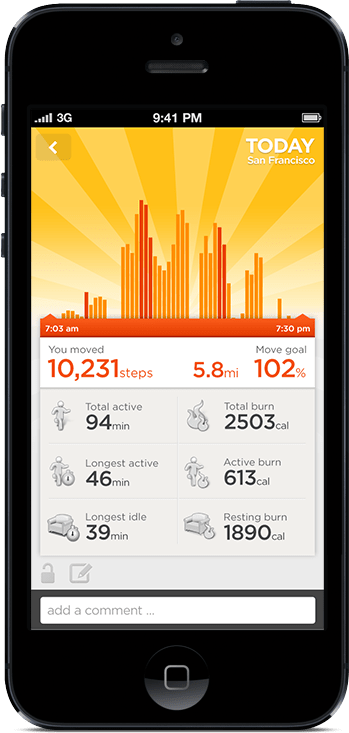
    Open up the app and you’ll see at a glance how you’re doing against your set objectives. A healthy target is 10,000 steps a day, but few sedentary workers can meet that. Because UP is an internet-connected service, it’s able to tell you what others like you (in age, gender, height, and weight) are averaging. In my case, the average most do is about 5,500 steps a day. I decided to set myself a high but achievable goal of 8,000 steps.

    What’s happened since? I’ve found myself striving to reach that by alighting one bus stop ahead of my destinations, taking the long way around the office, and going for more short walks whenever I can.

    It translates your activity into calories burnt, which it shows you alongside an estimate of how many calories you burn just resting, and a total for each day. Every now and then, the application shows you “Insights”; pre-written facts and advice tailored to your own performance. Examples include deciphering hidden patterns in your behavior and mood, and helping you understand terms like “you walked 8,000 steps” with statements such as “equivalent to walking across the Golden Gate Bridge and back”.

    Food logging

    This part is optional, but you can enter your meals (or just photos of them) to keep a record of what you’ve eaten. If they’re available in the online database, nutritional information is attached. It has the same effect as using an expense tracking app: it makes you acutely aware of every little bit you put into your body, and alerts your conscience to the unnecessary.

    In practice, having a vague idea of how many calories I’m consuming, coupled with the knowledge of how much I’m burning (or NOT burning, on idle days) has been powerful. If I know that I’ve only moved a minimal amount all afternoon, any random urge to snack quickly meets a mental roadblock — “Why would I need more calories?”

    Sleep quality tracking

    Like the popular Sleep Cycle app, the UP band can monitor your movements in the middle of the night, and map out your light vs. deep periods of sleep on a graph. And then at the best possible time close to your intended waking hour, it will silently vibrate in the morning.

    You are asked to set a sleep goal for yourself, and along with all the other data it collects, this is plotted over a timeline of days, weeks, and months, which illustrates how good you’ve been at getting the sleep and exercise you need.

    Social network awareness

    carousel-2-1
    This is easily one of the best features of the UP. Other people can be added as “teammates” and their activities populate your Home screen, turning it into an Instagram of physical activity. You’re encouraged to inspect their details, leave comments, or react with a small selection of emoticons. You might see that a friend had a healthier lunch, or walked far more than you, or slept better than you. These events nudge you into behavior change.

    When I started, one of the only people it found for me to add to my “team” was someone living in Japan that I only follow on Twitter and YouTube. I asked, she said ‘Sure’. I don’t know her personally at all, but I’ve found that reading UP’s activity feed is a unique interaction different from regular status updates. Being able to correlate your own physical state with another person’s through shared metrics, leads to a different sense of awareness; any encouragement you receive resonates that much more. Her most active day blew me away at over 24,000 steps, followed by 11 hours of sleep. It really spurred me on to try and find the time for activity. Multiply that by the number of people you follow, and the social features become an extremely compelling component.

    On my second day, two more people I interact with online bought their own. On the third, my girlfriend joined in.

    Fiddle-free Design

    While the UP is not designed to be worn and forgotten — its constant presence serves to remind you of your goals — it is designed to be worn and left alone. Its long battery life (about 7-10 days) is one of the ways in which this is obvious. Charging via USB only takes about 80 mins, which you can easily do while idle.

    In chasing this long battery life, the UP eschews Bluetooth syncing, which other products like the Fitbit and Nike+ FuelBand have. To sync the UP, one must remove it and plug one end into a smartphone’s headphone jack. Jawbone recommends doing this about twice a day to keep up with your own stats and update your team. On the other wristbands, one only has to start the app, and they sync wirelessly.

    I actually think this omission is a strength.

    Like how shooting on film frees you from constantly checking how the photo came out on the little digital screen, thereby letting you take more photos and experience the scene you’re in, not continuously syncing the UP creates mystery, anticipation, and actually lets you get on with it and not fiddle with tracking apparatus every spare minute.

    In his excellent essay about using a FitBit, Paris and the Data Mind, Craig Mod described looking at the LED display and seeing that he had climbed 96 flights of stairs one day. The next thing he did was walk halfway across the flat town of Palo Alto to the nearest flight of stairs he knew of, so that he could shift that number to read 100. It sounds like great exercise, but I don’t want to obsess over live numbers or end up conducting accuracy tests each day over how many steps it’s counting.

    The UP way, you’re wondering things like “will I break my record today?”, and if you’re extra competitive, “I hope I don’t lose to so-and-so,” as you go about your business. Sometimes, by not knowing, you exceed your targets. And then you sync at the end of the day, and it’s like waiting for lottery numbers to be called out. It’s its own kind of fun.

    Comfort and style

    up-by-jawbone-lowres-016

    The UP is available in 8 colors, of which 3 are available here in Singapore right now. I got the Black (sorry, Onyx), and it’s pretty nondescript and unlikely to draw attention. The brighter colors pop more, and show off a subtle zig-zag texture that identifies it as part of the company’s product range under design chief Yves Béhar. None of them are what you’d expect a “wearable computing device” to look like. The only button is cleverly hidden, looking like an integrated design feature. Two LED lights are embedded beneath the hypoallergenic rubber surface, and only visible when lit. It’s much thinner than the FuelBand, and could easily be mistaken for one of those Livestrong-type charity support wristbands from a few feet away.

    These things help with making the UP an invisible part of daily life, which gives it potential to succeed at being adopted by more. But as the wearer, I always feel its presence (at least in this first week). The routines I’m developing around the app, around thinking about moving more, burning more, eating less, around how my teammates improve themselves, are the very definition of behavior change.

    If having visualized, connected, and actionable data on your own body and movements sounds interesting to you, the UP will probably be a great addition to your life.