Tag: User Experience

  • Week 35.25

    Week 35.25

    • We lost a grand aunt at the close of last week, and attended her funeral and cremation on Tuesday. It got me thinking about qing ming, which is a day in early April (I had to look this up) where Chinese families traditionally visit their ancestors’ graves and do some neatening up. I have vague memories of being dragged along to do this as a kid, and even being allowed by my parents to skip school for it. I mostly remember the smell of burning joss sticks mixed with the dewy morning air and damp soil. For some reason we stopped going by the time I was a teen.
    • I talked about this with Cien and Peishan and they seemed to still be in touch with the practice of visiting graves, or in these days of diminishing real estate, a columbarium. If you asked me where my family members are buried or stored as ashes, I wouldn’t be able to tell you. I assume many of them have been scattered, either into local waters or some faraway favorite destination. Honestly, I like the idea of not being tethered to a single spot. If your spouse is still alive, maybe they’d like to keep you near, in some vessel at home. But if too many, or too few, people are sharing you then it’s better to be everywhere. A memory triggered by some food, place, or figure of speech. An algorithmically assembled photo collage tossed up by a personal computing companion one morning. A mention in some dusty book on a top shelf in a library, waiting to be seen by a future student or recycled into a supermarket receipt. I’d be fine with any of that.
    • Back to the funeral: it was held at the Mandai Crematorium and Columbarium, one of only three cremation facilities serving the whole of Singapore, and I was upset by how much it is in need of some design intervention. I wonder if any of the people managing the place have tried to look at the process with fresh eyes, or at least through the tired and grieving eyes of the people passing through it. Because they’d see so many moments that could be made kinder, more understanding, more dignified. The script could use a rewrite. Playing ‘Amazing Grace’ out of tinny $40 Bluetooth speakers in the final viewing halls is not it. For Chrissakes, please also remove the ugly MS Word-designed notices plastered on the viewing room windows, they obstruct the view of the caskets as they’re delivered (by industrial forklifts!) into the flames. I’m not exaggerating.
    • My shoes fell apart. They were the second pair of New Balance 990s to do so, doing nothing more strenuous than supporting my occasional walking about town. The last pair lasted three years; these only made it to two. At around S$300, these are supposed to be the best shoes that NB makes, but I’m beginning to think their ‘Made in the USA’ label is more a statement of liability than superiority these days. The Chinese-made models could probably survive a decade. Alas, with my big feet and aversion to swooshes, the 990s are some of the only shoes I’m comfortable in, so I’ll be buying yet another pair — online, too, since they stopped local distribution of the wide sizes.

    • Google upgraded Gemini with the Nano Banana image model that’s been trending on Twitter, and the bar for impressive generative AI has been raised again. It’s extraordinarily capable (and fast) at combining images with accuracy, as well as reimagining them in different styles and from different perspectives. A few months ago, Gemini was an also-ran, but maybe something’s shifted at Google and they’re an actual contender again. As much as I try to avoid Google services, I suppose I find them preferable to OpenAI and Meta. Take a look at the example above where I asked it to redraw a scene I photographed last month in Melbourne, but from above.
    • On Thursday I met two friend-couples, who I’ll call Mong and Jogina because it sounds amusing, for a rare weekday afternoon lunch where it was made abundantly clear that I’m behind the times for not having seen K-Pop Demon Hunters yet. Circumstantially, we’ve all got the time and flexibility to do these weekday catchups more often than once or twice a year, and maybe we should.
    • Aside: I did see the movie later, and it’s really good! My main gripe is the use of stuttering frames for the character animation, which worked fine in Sony’s Spiderverse films but break immersion here. The frame rates also seem uneven from scene to scene? Speaking of Sony, I’d hate to be the person who decided to sell this to Netflix for just $100M.
    • Afterwards, some of us went on to check out a nearby Crocs store (hear me out!) because a new collaboration had just launched: Animal Crossing! I just tagged along for a look, but became increasingly afraid as we got nearer that I would end up buying a pair. Kinda like how I bought the first iPad at Funan mall in 2010, that I absolutely wasn’t interested in… until I joined the line. Thankfully, my senses returned, and they only carried the smaller women’s sizes. God bless my big feet!
    • The book club is still reading Cloud Atlas, and at one point, a character mentions Carole King’s Tapestry album playing at a low volume in the background. I realized that I’ve known about this album forever but never heard it. So I put it on while reading. And boy did I know half the songs on this. I was beginning to wonder if it was a covers album, that’s how familiar they were. Incredible work, and a deserving #38 on Apple Music’s Top 100 Best Albums list.

    And finally, a little gaming episode:

    As previously mentioned, I’ve been playing the first Shinchan game on Nintendo Switch as a way of marking the summer — never mind that it’s always summer here in Singapore. It started well but I found it increasingly repetitive and uninteresting, and have been trying to just get it over with. The game features a time loop, where you replay the same week over. I spoke to Evan about it while I was on the second week, and he told me to hang on until the fourth week.

    >> I was like, “there’s four fucking weeks??”

    >> He said, “the real game BEGINS after week four!”

    >> “How is that possible?”

    Reader, I’ll tell you, I was ready to delete the game then. At the end of the third week, it seemed that I had all but completed the game. All my tasks were done. Then as the credits rolled, I texted him back:

    >> “Dude, I’ve finished the game, what’s going on?”

    >> And he says, “You haven’t, that’s just the beginning, get ready.”

    >> “I don’t believe you, don’t mess with me!”

    By this point, I had put in about 7.5 hours and couldn’t take it any more if this was just an extended prologue. There was just no way. The game was surely done! Then he asks me if I’ve done a certain thing yet, and I’m like:

    >> “Uh yeah… long ago? In the first week?!”

    Suddenly, I realized he’d spent the first three weeks mucking around and not doing any of the main game’s tasks, and only got started on the story just before time ran out. So yes, I had finished the game. Thank fuck for that.
  • Week 43.23

    Week 43.23

    Bacheloring, breakdowns, and beverages

    Kim was away again for work most of the week. This effectively gave me the gift of freedom from our Beyond Deck addiction, cold turkey. So I played a little Super Mario Wonder, drank too much bourbon, watched Bitcoin YouTube, and lazed around unproductively on my iPhone.

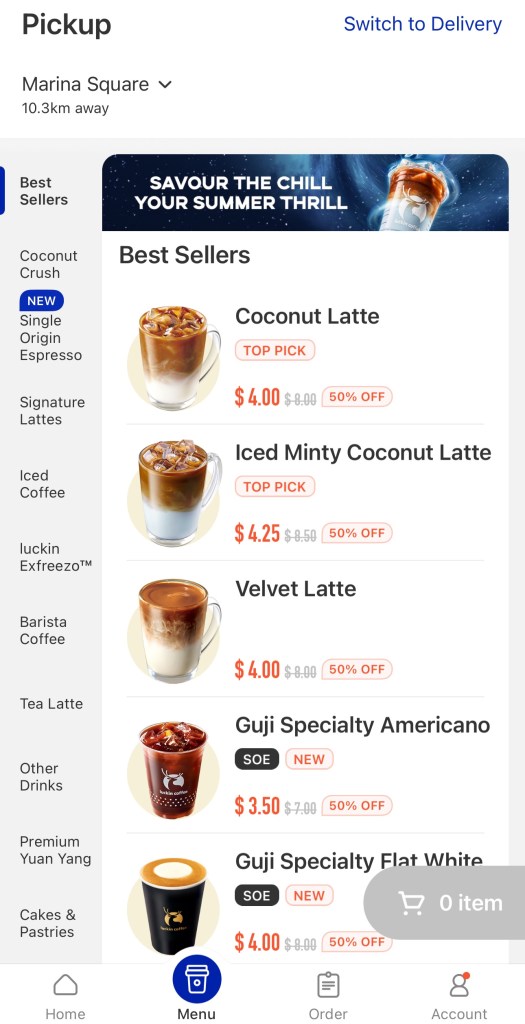
    And on the days I decided to work from the office, I was richly rewarded with elevator breakdowns, mall escalator maintenance, and other inconveniences that made me wish I’d stayed home. I don’t think I’ve mentioned my recent obsession with Luckin Coffee, the Chinese chain that’s been expanding nationwide, including an outlet in my office building. Bosses forcing a return to office take note, getting one of their iced coconut lattes in the morning is one of the reasons I head in. I was looking forward to my fix one of these cursed mornings but found the branch closed for upgrading.

    Luckin’s model is fully app-dependent and most branches are just pickup counters, with no seating. You order on your phone, pay via card or Apple Pay, and pick it up by scanning a QR code. You don’t interact with staff, and they don’t handle any filthy cash. For comparison, you can do the same thing with Starbucks’s app, as well as order in person like a boomer. To get you past the friction of downloading the app and setting up an account, your first drink at Luckin is just $0.99. Subsequently, you’ll get hit with a barrage of discount vouchers ranging from 35% to 60% off, so much so that I haven’t paid full price for a coffee yet.

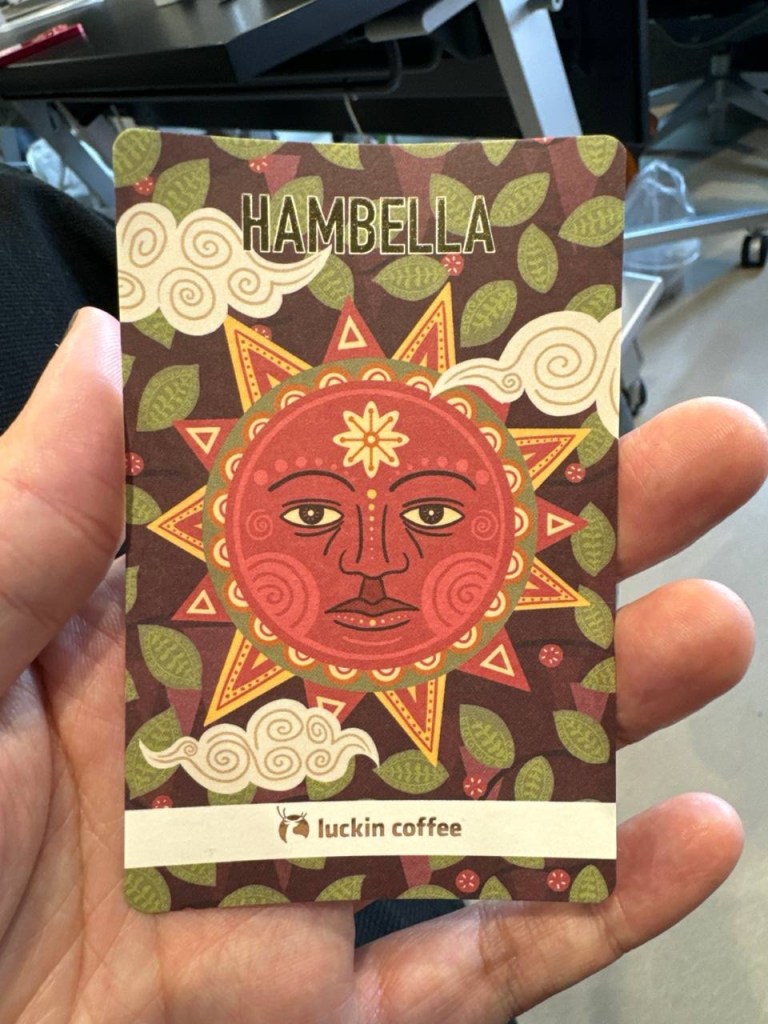
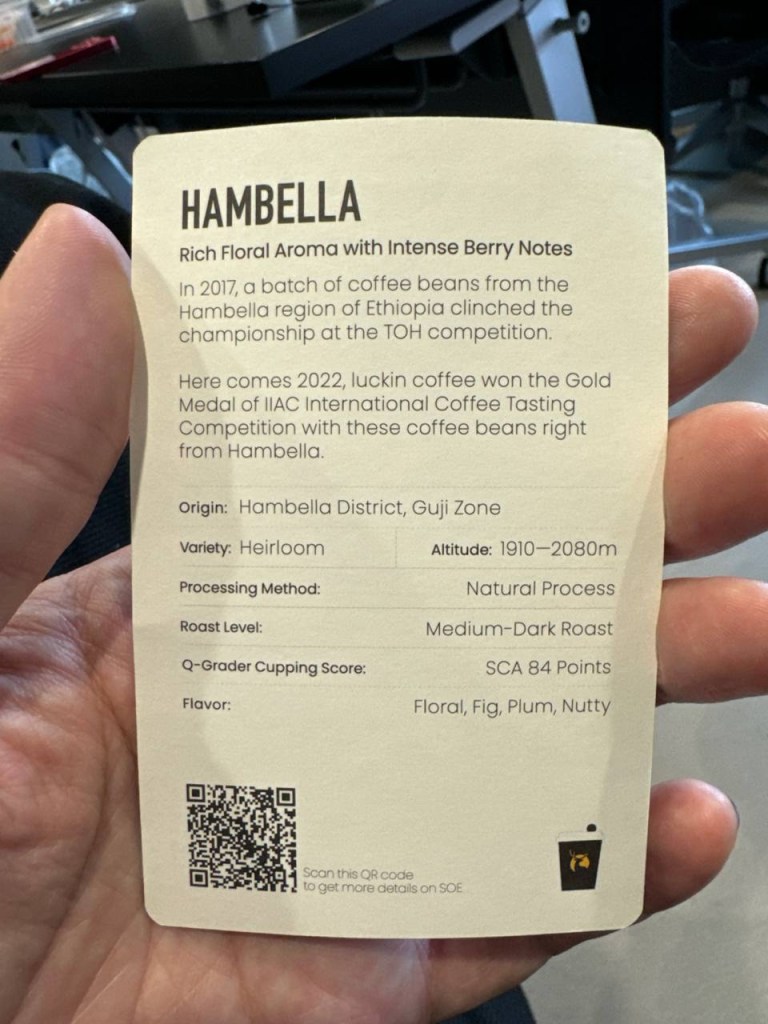
    For the record, their drinks are priced around $8 each, and they’re somewhere between a Starbucks tall and grande. The discounting is an aggressive acquisition play, of course, but I’ll take low margin coffees while they last, not least because they’re actually pretty tasty! Like Starbucks Reserve, they offer a range of single-origin specialty coffees, and even give you beautiful little info cards with tasting notes. The absurdity is not lost on me, given their quick-service image it’s like if McDonald’s gave you facts on the cow in your Quarter Pounder. Nevertheless, on that day my Luckin outlet was closed, I went to a Starbucks for the first time in quite a while, and it felt like comparatively much less value.

    ===

    From clicks to chats

    I went over a new trend report my company put out, and there’s a large focus on generative AI as one might expect, which led to a couple of interesting conversations about how much work is ahead of us when it comes to overhauling the touch points we use to deal with merchants, service providers, and even governments.

    In a way, the graphical interfaces we use today evolved as proxies for “natural” verbal and gestural communication. Similar to how we used mouse cursors because we couldn’t touch displays directly, we have menus and buttons and screens filled with data because we can’t directly ask computers for complex outcomes. The promise of large language models is that now we might.

    There have been think pieces this week about how Apple was “caught off guard” by this gen AI wave and is now scrambling to catch up. I think they have plenty of time; here’s why:

    What’s at stake isn’t smaller-scale improvements like the transformer-based autocorrect in iOS 17; it’s about whether gen AI can bring a more radical change in how we use computers. You can already see the hunger for this — the dream of J.A.R.V.I.S. — in a dozen half-baked AI-powered product announcements. We’re not far from Humane’s wearable phone alternative, Rewind’s Pendant which will process everything you say or hear, and Meta has great-looking new “smart” Ray-Bans which can put their new AI voice assistant(s) in your ear (US-only).

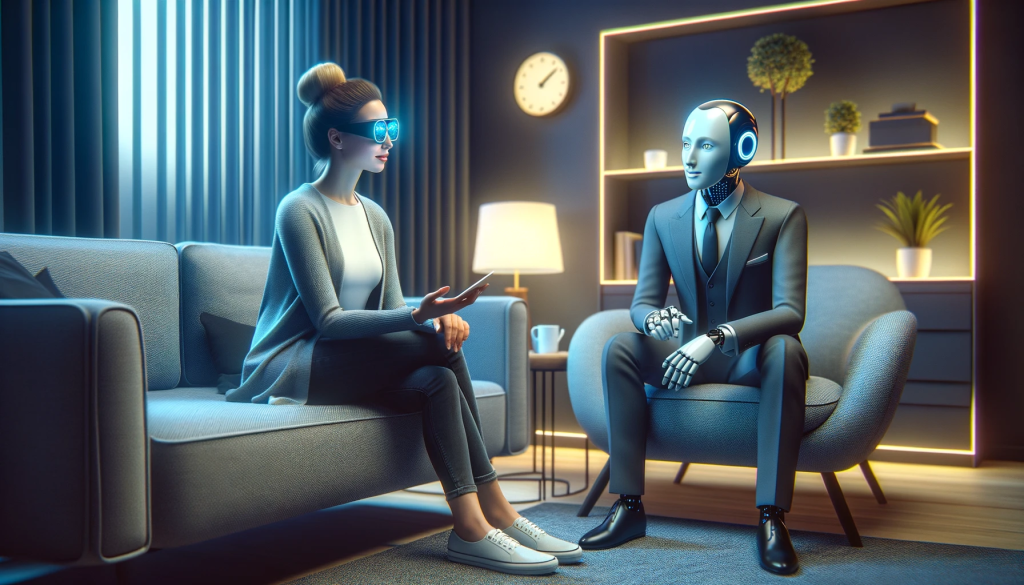
    The basic version of conversing with AI looks like a text chat, and on the other end of the spectrum is a “multimodal” natural chat that takes a user’s body language, tone, and facial expressions into account. Putting aside the fact that such a model hasn’t been trained yet, just the massive amount of personal data this would involve means only a company positioned to put privacy first might get any traction. And then there’s the staggering hardware requirements of doing this in real time. If only someone was working on a new kind of computer equipped with industry leading silicone, and biofeedback sensing that can even predict you’ll tap a button before you do it

    Assuming this is the right thing to do at all, the Apple Vision Pro with its microphones, retina scanners, and hand-tracking cameras should be well positioned for a future where you can simply sit down in front of an AI relationship manager from your bank, have a free-flowing discussion, and see the appropriate figures and charts pop up — instead of poking around a UI to find out how your money is doing. But the stated purpose of the Vision Pro is spatial computing, which is only a step towards natural computing.

    So like every other time in history, Apple will wait while others jump the shark first, and hopefully clean up after with a more sensible execution. They have the time; it’s just a shame for impatient people that the hardware looks so ready. But as a wise man once said: technology moves fast, while people change slowly.

    ===

    Pints and pop music

    Ex-colleague and friend Bert is back in town for the first time in over four years, so we met up twice to catch up and see some other faces we’ve missed in recent years. This meant many pints of Guinness (if ever I associated a person with one drink only, it’s Bert and Guinness), which compounded with the aforementioned bourbon and a gut-busting, sodium-loaded visit to Coucou hotpot for a physically taxing week. Every organ is straining to detoxify and I really felt the effects all weekend.

    • We watched half of the third season of Only Murders in the Building and I’m happy to report it’s much better than the second. I think there’s even a self-effacing joke at one point about how the first season of the in-show podcast was more likable than the second. It comes down to a clearer story with fewer detours, the kind I’ll probably remember a year from now unlike, say, season two’s.
    • Sigrid has a new four-song EP out: The Hype. It is extremely Gen-Z in that it has a shoddy photograph on the cover and looks like it was made in Canva. The music is much better, but she’s just doing more of the same, which I won’t complain about because if Coldplay just kept doing the same thing as in their early albums maybe they wouldn’t be so insufferable today.
    • Taylor Swift’s 1989 is finally out in (Taylor’s Version) form! I think this was the first album of hers to ditch the country pop style and just go straight pop? Did it have something to do with leaving Nashville for New York? In any case, it was the first album of hers I played for myself, and also the one Ryan Adams liked enough to cover I guess. I’ve been mostly playing both versions this weekend and came across a debate I never knew I needed: is 1989 a beach album about the Hamptons or a city album?
  • Hold up, HEY

    Hold up, HEY

    The debut of HEY email has been an interesting case study in launching a new service, in part because it took place on social media — a two-way street that led to them getting public feedback that’s already led to significant changes. As others have done in recent years, the launch was a staggered rollout with invite codes and a waitlist, and the resulting members-only feel and scarcity drove tens of thousands more to join the waitlist. Some say this is intentional marketing, but it’s also legitimately done to manage the experience when someone isn’t sure how much interest there will be.

    I took notes on my hands-on experience in a previous post, and have spent a week now getting to grips with it, trying to picture it as my primary email service for the foreseeable future. The commitment isn’t just a new email address to inform people about; it’s also paying a perpetual premium service fee. After 16 years of “free” Gmail, that’s a big decision. Yes, you’re free to leave any time and they’ll forward all emails sent to you anywhere else you’d like, but I wouldn’t use a @hey.com address if I wasn’t actually using HEY.

    Everybody’s got opinions

    But before the details of my decision (like, who cares, right?), I wanted to comment on the fascinating public launch of HEY that we’ve been spectators to, and how its creators have had to walk back some of their design decisions after product met reality.

    As my friend YJ says above, Basecamp and HEY are heavily opinionated products by opinionated people; it’s what allows them to take a well-established thing like email, with its standard organizing paradigms of Inbox, Outbox, Sent, Spam, and Trash folders, and try something new. It’s only meant to satisfy a certain type of user with certain needs and preferences.

    It’s not easy building something out of new ideas, at huge scale, and making sure it’s robust enough to carry the personal and business correspondence of paying customers who’ll depend on it for time-sensitive messages. By Basecamp’s account, they’ve been working quietly on HEY for two years before this month’s semi-public launch. I think they deserve a tremendous amount of credit both for attempting it and for how stable it has been.

    When we design services, we know we won’t catch everything or get it right the first time. It’s about having priorities and principles, and optimizing against them every step of the way. If you’ve defined and studied your target audience, and care about pleasing them to the exception of everyone else, then you can make decisions based on their needs. If you put in the work to develop a core experience that will set your business apart, then that becomes the thing you protect even if Apple or anyone else tries to make you change it. Some companies famously put speed over certainty, and while it dazzled a lot of CIOs and inspired them to try and do the same, its pitfalls are now well known.

    We don’t know what HEY’s development process looked like, or what they prioritized, and so we can only guess from what they actually shipped and what they’ve done since. Upon contact with the wider marketplace, some of those opinionated ideas are now being challenged as problematic or discriminatory. Could more user research and testing have caught them before launch? Probably. Was catching them before launch a priority for the team, or did they intend to test them in public and fix unintended consequences as they were discovered? To their credit again, they’ve fixed a lot of things very fast in the past week. From adding disposable functionality suggested by Apple to dumping fully built, non-trivial features… their responsiveness has been impressive.


    Things that came broken

    Let’s look at a couple of Twitter exchanges and changes I’ve spotted. On my first day with HEY, I noticed an unusual option in the “More” menu on every email thread. It was a button labeled something like “Generate Public Link”. This actually published the entire email conversation thread to a public webpage, allowing any third party to read and follow the exchange. I used it to help share a problem I was seeing with their support team, which is a nice way of enabling them to help customers without giving full access to all mail. And while you could always share private emails to a third party with copy/paste, screenshots, PDFs, etc. there was something unsettling about this. None of the other people would receive any notification that they were being “listened in on”, and anyone with the link would be able to see not just all previous emails, but any new ones added to the thread for as long as it was publicly shared.

    You could be in a conversation with 20 people and not know if any one of them had generated a link and leaked it. When I explained this in a group chat, there was some disbelief. One person called it a “built-in whistleblower feature”. After others complained on Twitter about the potential for abuse, this feature was completely removed.

    (more…)
  • Ten Days with Android & the Samsung Galaxy S III


    Fulltype7

    I’ve been an iPhone user since the first day it was possible to be one in Singapore. I love the platform, but I’ve been intrigued for awhile now by the larger-screened Android devices that I see every day on public transport here. Anecdotal evidence suggests that these enjoy greater acceptance and penetration in Asia than elsewhere in the world. The comments thread that begins here on an Asymco post are quite enlightening, for further reading on the Korean market.

    The short version of those insights, from memory: the Korean market is heavily dominated by Samsung, which predominantly makes Android devices. Koreans (and other metropolitan dwellers in areas of low urban crime must fall into this category — e.g. Singapore, Tokyo) spend a lot of time commuting on public transport. Large screen phones are more suitable for information consumption than tablets in such situations, where one stands in a crowd and holds a handrail; in some cases a single session may last 1-2 hours. An interesting phrase in one of the comments called Koreans “diligent information sponges”. It’s hard not to imagine a face glued to a large 4.8″ screen, hoovering up the day’s news and social media updates on the way to work. Games and movies are also better — I see many a Chinese drama series being watched on large phone screens whenever I take the subway. My theory is that personal security concerns may deter commuters in some cities from being fully immersed in such devices. I’d love to hear more opinions on this.

    More so than for users who drive or walk or have shorter commutes, where typical smartphone sessions throughout a day are counted in minutes and not hours, the impracticalities of a large screen are tolerated here. Women I’ve spoken to say they wouldn’t mind at all if the next iPhone had a screen that was as big as or nearly as big as the Samsung Galaxy S III (4.8″). They ‘can’t put the iPhone 4S in their pockets anyway’. The Galaxy Note seems impractically big, even to me, but I see many women here on a daily basis who appear to enjoy using it. The difficulty of one-handed operation does not seem to be a deal-breaker for the Singaporean/Korean/Asian user.

    So having managed to resist the urge to buy an unlocked, off-contract Galaxy S II a year ago at full price, just for research, I recently found myself fixated on the idea of getting the new Galaxy S III at a subsidized price as my contract comes to an end. Note that my first reaction to the phone was amusement, followed by dismissal. Their launch presentation was absurd, and had more than a couple of WTF moments (for example, one of the presenters slipping and using the word ‘bizarre’ to describe it). But within two weeks, I’d convinced myself I should get one. I don’t know how this always happens to me. I figured with 4.0 Ice Cream Sandwich, Android was finally ready for prime time.

    It’s been 10 days. Here’s what I’ve experienced.

    Almost immediately, I noticed that battery life wasn’t what it’s been promised to be. Android gives you plenty of ways to break down the battery meter (and plenty of ways to have a nervous breakdown watching stats). You can see exactly what percentage of power consumption is going to the screen, the cellular radios, applications, and so on. I discovered that my phone wasn’t going to sleep when the screen was turned off. It was actively trying to do something, but I didn’t know what. So I shelled out 4 bucks and bought BetterBatteryStats, which promises to identify what those behind-the-scenes “wakelocks” are. If you’re thinking that this is already sounding like more trouble than you want from your phone, out of the box, you’ll know how I felt coming from the iPhone.

    It turns out that it was a problem with Google Backup, a feature similar to how the iPhone will back itself up to iCloud over Wi-Fi each day when you plug it in to charge; except this phone was trying to do it all the time, apparently even over 3G. I turned the feature off, and things seemed to get a little better. The next big battery drain problem came from a background process associated with switching networks to find a good signal in areas of low coverage, except this was happening everywhere. My “Cell Standby” usage was at 30%, when Android users on other phones see numbers closer to 5-10%. Because I’ve encountered this complaint consistently from other Galaxy S III owners on forums, it could be a design or software fault.

    I then spent another day reading up about a feature called Fast Dormancy, which may or may not have been the problem, depending on whether or not my phone provider has optimized their network for it — all of the above a moot point, I eventually found, because Samsung disabled the secret menu option in Android that would have allowed me to turn it off like some American users found was improving their battery life. Oh yes, I spent a few hours messing around with these secret menus too. Remember typing in stuff like *#*#49090** into feature phone dialers, pre-iPhone? That’s still around.

    There also also many apps you can get for optimizing your battery life. Some seem to be nothing more than placebo task killers; others are more intelligent and can disconnect the mobile data network in intervals to save battery life. Unlike iOS, where push notifications are delivered via a single Apple-managed connection that’s probably kinder to battery life, many Android apps have to run in the background and do periodic checks. New tweets and emails, for example, can only be set to come in at 15, 30, 60 minute intervals, depending on the app.

    The built-in keyboard has pretty bad word prediction. You can install third-party keyboards. I’ve tried like four. They all have their own flaws. Don’t like the way the homescreen works? You can install third-party launchers. I’ve tried like four. You can guess they all have flaws. Android defenders point to this ability as a key strength. I’ll admit I had a little fun. I used to waste a lot of time on my PCs futzing around and hacking solutions to problems. But it’s far from optimal for most users. Speaking of touch controls, capacitive buttons are as bad as I’ve heard they are. The “Back” button area is extremely easy to nudge when holding the phone in landscape position, such as when you’re watching a film or playing a game. Even in portrait orientation, if you hold the phone tight, it’s easy for the fleshy bit of the palm under your thumb to creep over the edge and trigger it, exiting you from your current screen.

    Charging: The phone charges via a standard Micro USB cable, but when connected to a USB power source such as a computer, it charges very slowly. I’m talking upwards of 10 hours for a full charge. Online research suggests that for some reason, it only takes in a fraction of the power being delivered to it, if it detects that data could also come down this cable. There are instructions to DIY mod your cable so that it charges as quickly over USB as via an AC adapter. This was just too much for me, so I spent even more of my valuable time tracking down a cable that does the same job out of the box. It’s the McKal MM83A Supercharger cable. You’re welcome.

    After having gone through the things I have in 10 days, where the state and maintenance of my phone has been constantly on my mind, I think the drawbacks outweigh the large and beautiful screen on this phone (quality-wise, it’s not better than the iPhone’s Retina display). I haven’t even mentioned the lack of really solid Twitter applications on this thing, or how Path’s Android app is so inferior to the iPhone version, or how scrolling is still nowhere as fluid or as natural from a physics standpoint as it is on the iPhone, THROUGHOUT the iPhone experience. I believe scrolling can be quite different on Android, from app to app, but I’m not entirely sure at this moment.

    But when I hold my iPhone now, it feels wrong. It feels more like a little camera than a phone (the camera on the iPhone is tons better, as is the selection of photo apps on iOS — I have yet to find a credible, well-designed photography app on Android. There is nothing in the league of Hipstamatic, Camera+, VSCO Cam, Infinicam, Noir, TiltShift Generator, and many others I have happily paid for on iOS. The best ones are the ones that are also available on iOS: Pixlr-o-matic, Instagram, AfterFocus). The screen feels cramped, and it’s a little heavier and thicker than I’d like. I miss having the glanceability of Twitter/Facebook widgets on my homescreen alongside app shortcut icons (something that Windows Phone 7 gets a lot of praise for too). But other aspects of the iPhone user experience are beyond comparison. I don’t want to mess with battery settings and tweaks. I don’t want the ‘freedom’ to spend hours scouring the web for ways to make my phone better. I want a phone made by a solid company that I trust, optimized to the best of their ability in a combination of software and hardware design, so that I cannot possibly believe that I could do better myself. Because that frees me to do everything else. But I also want that phone to have a larger screen.

    Essentially, I’ve been paying to relearn a lesson I already did back in 2007 with the first iPhone. I’ll keep using it for now and see what else I can learn about Android (it’s beneficial for my work, anyway), but I’m crossing my fingers that whatever iPhone comes next will give me every reason to sell this off, and restore my sanity. When someone asks me if they should buy an iPhone or an Android phone, my new answer is “If an Android phone is right for you, you’d already know it.” It’s the right choice for those people, but not most, not the way it is now.