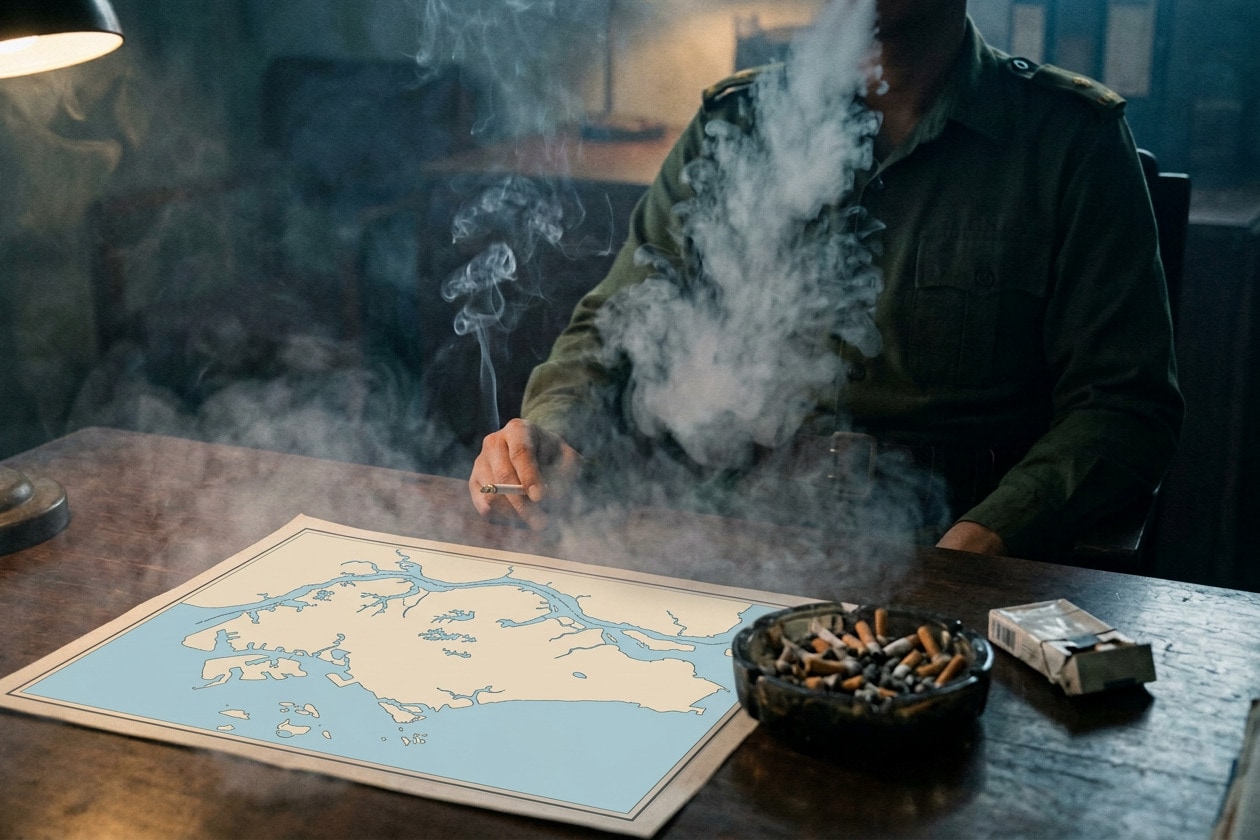
October 2026 — It’s that hazy time of year again here in Singapore, and lots of air quality apps have been popping up thanks to this being The Year of Vibe Coding. But I hadn’t yet seen one that puts these esoteric numbers into terms we can all understand: like smoking. It’s also fitting, given how this is second-hand smoke from a country that loves its cigarettes. So here’s my contribution to the pool.
SecondHand takes the live 24-hour PM2.5 reading for your part of the island and converts it using Berkeley Earth’s rule of thumb (22 µg/m³ over a day is roughly one cigarette). Then it puts that number in your hand! Stay indoors my friends, and keep those air purifiers humming.
Changelog:
Added a map view (hold down to pop it up)
Added a haze-free state for better days
Significant optimizations to size and performance
Copy changes for clarity
PSI and 24hr PM2.5 figures now scale with the simulation slider
Max cigarettes upped from 12 to 20, with room smoke effects
I published Subconscious Samples and wrote up the app page myself instead of starting from an AI draft like I often do. The thinking is that since the agent already knows the app intimately, I just need to give it a concept and it’ll do an okay job of filling in the essential info, which I can then edit. Ironically, I don’t think many people can tell the difference between the two, and I worry that maybe I’ve internalized more of AI writing’s stylistic hallmarks than I’d like.
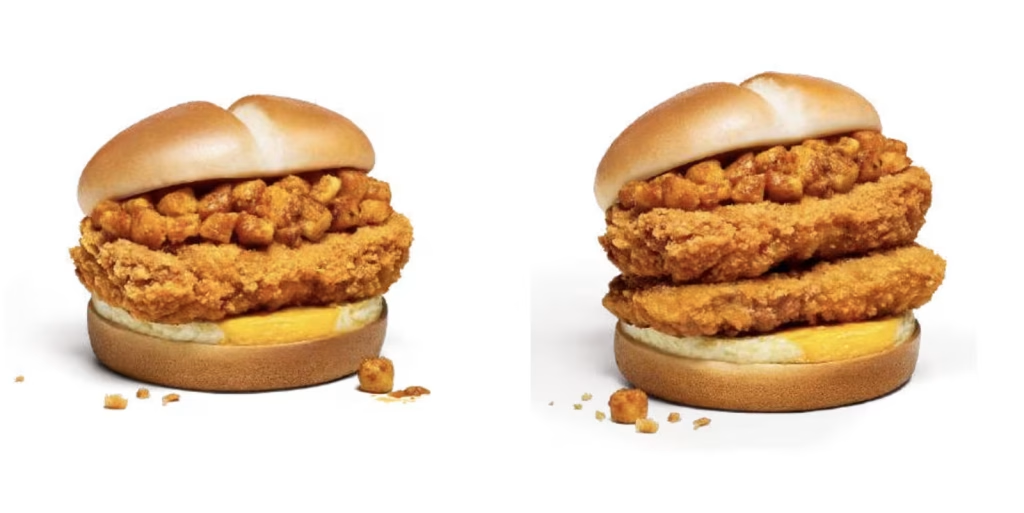
Speaking of slop, McDonald’s Singapore has a couple of new menu items to celebrate our upcoming National Day in August. One of them is a collaboration with my favorite curry puff brand, Old Chang Kee. The burger has a fried egg, a deep-fried chicken cutlet, and a thick curry paste with diced potatoes that’s reminiscent of OCK’s signature Curry’O filling. It’s as messy to eat as it sounds, and the top bun gets soggy and falls apart as you’re eating it. What makes Old Chang Kee work for me is the texture and mouthfeel of their crusty pastry, so the soft bun is a weak substitute. To make matters worse, I had the double version with twice the oily fried chicken, and felt like absolute crap afterwards. Speaking with Jose and Henry, who also ate this on the same day, I got tripartite agreement that this creation results in more regret than reward, and none of us will be having it again.
Michael’s collaborative crossword game, Crossmate, is finally out on the App Store! It’s free, open source, and I highly recommend it. You can import puzzle files, or use NYT’s puzzles if you have a subscription, then invite up to two other friends to play with you. It’s just like working in a live Google Doc, but funner. I’m not especially good at crosswords, but I’ve completed quite a few with him and others during the beta testing period and had a great time with it.
I read what was probably my first Philip K. Dick novel, as far as I can recall, Time Out of Joint, and came away slightly disappointed. Something about its style reminded me of other books from the same era, where you can almost smell the fumes from whatever they were huffing. The core ideas are good, and have been replicated in other works (including a particularly big Jim Carrey hit), but somehow the sum is less than its parts. In contrast with Rendezvous with Rama, a sci-fi classic I recently reread that explores big ideas with prosaic, forgettable writing, Time Out of Joint somehow comes away looking worse because Dick’s writing is too opinionated and rooted in his time, neither of which serves to elevate the story or its ideas.
I finished watching the Three Colors trilogy on MUBI with White (1994) and Red (1994). I believe White is often called the ‘weird’ or ‘different’ one out of the three, as it’s tonally and structurally quite a farce. For that reason, I enjoyed it but probably have to rate it lower relative to the emotional power of its siblings. What’s also impressive is how the director began with the legendary Juliette Binoche, and then went on to cast leading women of escalating beauty in Julie Delpy and Irene Jacob. Next up is The Double Life of Véronique (1991) which also stars Jacob, who I’d never heard of before this.
Despite believing that I don’t watch or enjoy horror, I think Widow’s Bay empowered me to believe that maybe I can do horror lite, so I bought a ticket to go see Backrooms (2026) on a weekday afternoon. I could have waited for a home release, but I wanted to test myself with a big screen. I have vivid memories of seeing Drag Me to Hell (2009) in a theater that was way too loud, and being so terrified by the sensory overload (despite it being quite an outlandishly funny film) that I felt like I was going to have a heart attack.
Thankfully, Backrooms was more fun than fatal, and I had a good time. I’ve seen the short film that this expands on, but the final result still feels a little thin. Rather than doing more expansive world building around the infinite labyrinth (ha ha) and its place in our world, it keeps the scope small, presumably for future sequels. This screening was the “Everything Must Go Edition”, with an extra 15-min segment tacked on after the credits. This strategy seems new — a way to further milk a film near the end of its theatrical run, either gaining repeat viewings from fans or convincing stragglers like me.
It was perhaps due to this ‘training’ that I not only endured, but enjoyed, a particular sequence in Christopher Nolan’s The Odyssey (2026) when we saw it in IMAX over the weekend with Peishan and James. I said before that I wasn’t particularly in a hurry to see this, and that I was anticipating Disclosure Day (2026) much more. In retrospect, it’s almost a crime to draw any comparison between the two. The Spielberg film seems made with decades of Hollywood muscle memory, and probably under healthy conditions that allowed everyone to have a life at the same time. Nolan’s film comes across more like a monumental undertaking, a transfer of life force from human bodies onto 70mm celluloid through back-breaking effort.
Afterwards, in trying to rank my favorite Nolan films, I decided that Interstellar (2014) is still my favorite, but this might come in second, followed by Inception and Tenet. The Batman films are dead last. When someone brought up how they were flawed, but Heath Ledger’s turn as the Joker was great, I said that I never understood the big deal about that performance: “For me it’s like if Freddie Prinze Jr. died after turning in a passable Zorro remake”.
Subconscious Samples is a generative art tool that turns patterns in your photos into new, abstract compositions.
The human brain notices and retains a lot of visual information — not just traumatic images from childhood or the great moments of your life (insert dead wife montage here), but all sorts of patterns you’re not even aware of. These interact with each other in the unknowable cauldron of your subconscious, and are synthesized into forms that affect your actual life: the doodles you draw as your teacher or managing director drones on and on, the paintings you buy because they just speak to you, the brilliant shower idea that saves your bacon the night before a deadline.
Creative people draw on these inputs with varying degrees of control — connect the dots too well and it earns a name, plagiarism — but what about machines? We’ve been trying to give them artistic instructions for a long time. Harold Cohen spent decades building AARON, a program that drew and painted according to rules he wrote but couldn’t fully predict the output of. Vera Molnár was plotting geometric abstractions on a computer in the 1960s, before “generative art” was even a term.
Well, generative AI is the greatest plagiarizer ever invented, and yes it was employed in the coding of this tool. But Subconscious Samples is not powered by any AI model; it uses only the images you supply, and gives a fair amount of visibility into how it produces new imagery from inspiration. In that sense, you get to direct and watch the process happen inside its transparent brain.
Step 1: Deconstruction
Feed it some pictures, and then supervise a process in which short sections of lines and contours are traced. Fill the waiting palette with as many ’tiles’ of these samples as you want, add up to three manually selected ‘cutout’ areas (think scissors and a magazine), and then it’s off to the races.
Step 2: Reconstruction
After you hit “Generate”, the system takes those lines and rearranges them into abstract compositions. Mostly random, but often with loose rules. For example, the Mona Lisa might be reduced to a handful of curvy lines, which then get drawn as a spaghetti monster in 3D space. Is the pastafarian blob the equal of Da Vinci’s masterpiece? Obviously not. But could you say it came from it? Hmm, maybe? In a manner of speaking?
If the human brain is a supercomputer, then this program isn’t even an abacus. It’s possibly a pile of stones in a circle, drawn in sand. You could produce some interesting pictures with it, you might even use them as desktop wallpapers for a short time. But it’s no artist. Like AARON and those greater predecessors, it only exists to make you think about where our art comes from.
Related: I made a series of 39 artworks called Subconscious Heirlooms in the summer of 2022, the hand-drawn precursor to this idea. You can read about them on this page about my NFT projects.
I’m not usually the clumsiest person in this household but I got my turn this week when I slipped on the stairs (wet feet) and fell/slid down to the bottom, on my bottom. Fortunately nothing seems broken, and the bruises aren’t visible, but it hurts! I narrowly avoided landing on my tailbone and took most of the impact on my left side, shoulders, and hands. My first thought was, “if I was in my 70s, this would be real bad.”
Ex-colleague Jianjia was in town for a short stopover and we met up for a coffee on Tuesday. She’s about to make a big move across the world, so it will probably be many years before we meet again. Although we last saw each other two years ago, meeting her this time reminded me of the people we were back in 2017, and how much has changed. I think we’re both calmer, a little more jaded, but less to prove.
Afterwards I decided to bite the bullet and go watch Supergirl (2026) at a nearby GV theater. I’ve seen talk online about how it’s bombing and people are unfairly blaming Milly Alcock for it, and it’s another example of misogyny among comic book nerds or Hollywood or whatever. I can tell you that the movie has problems and none of them are her; she’s fantastic to watch and brings most of the life to be found in this dreck. I mentioned last week that Craig Gillespie directed this, but I don’t see enough people blaming him. It’s a film that not only fails to carry the baton that Superman (2025) passes it, but fails to achieve anything of value cinematically. It’s a pastiche of boring plot points and cliches. Its needle drops and beat ‘em up fight scenes lack emotional impact. Jason Momoa doing an impression of Jack Black is probably the second best thing about this film. 2.5 stars.
After that I came home and fired up the MUBI app like a thirsty man crawling towards a desert oasis. I decided it was finally time to watch the first of Krzysztof Kieslowski’s Trois Couleurs series: Three Colors: Blue (1993). No point saving all the good films for someday that never comes, because you never know when you’ll fall down the stairs and break your neck. Maybe it was the contrast whiplash, but what a glorious experience it was. In its first five minutes, it does more than Supergirl manages with a hundred and eight. 5 stars!
Not having learnt my lesson, I agreed to watch The Devil Wears Prada 2 (2026) with Kim on Saturday. It was okay, but a far cry from the fun of the first film, too focused on making current moment social commentary but then (unintentionally?) winds up being a downer because it can’t find a silver lining to this shit cloud we’re in. The only way to stop a billionaire is… begging another billionaire. There is a moment near the end that echoes the first film’s resolution where Andy reminds herself Miranda’s life isn’t worth what it costs, but any anti-work sentiment is swept aside and nullified almost as soon as it lands. Miranda’s victorious closing line, “I love working. I really do. Don’t you?” is one hell of a message for the establishment to lob at the general public; a naked admonishment from those boomers who complain “nobody wants to work anymore” without bothering to ask why that is. 3 stars.
You know what else was gross? The actions of ex-Apple design team leads which were revealed in a suit filed against them and their current employers OpenAI/io. I’ll leave you to look them up on your own, but I didn’t think it was possible for me to have even less respect for that group than after Jony Ive appeared in his partnership announcement video with Sam Altman. Ive isn’t named in the suit, but whether he knew what his closest lieutenants were doing or just has terrible judgment about who to partner with, it doesn’t look great. What is the point of all that money which lets you do anything you want, if what you choose to do is unethical and stains the only name you have? Absolute loser behavior.
Selection from Subconscious Heirlooms (2022)
I suppose my latest coding project also has something to do with “copying”, if just barely. It’s called Subconscious Samples, and borrows conceptually from the Subconscious Heirlooms series of drawings I made a couple of years ago. The idea is that your mind is always noticing and storing lots of visual patterns and ideas without you knowing it, and when you draw ‘mindlessly’ in a state of flow/play, some of them will emerge. This new software attempts to replicate the process, with a more transparent brain. You add some images, extract contours and shapes, and then it’ll compose new abstract forms out of them, in 2D or 3D space. I’m almost done with it but am still undecided if anyone but me will enjoy having a go.
App UI: a vaporwave take on classic Mac OS stylingSome 2D outputs from Subconscious Samples
The Rolling Stones’ new album Foreign Tongues is out, and I’ve been listening to it over the week. There are some good songs here, and it’s astounding how good they still sound. One of the comments on the music video (below) starring Anya Taylor-Joy and Charles Melton notes that she was born when the Stones were already 34 years into their careers, and that was 30 years ago. I’m in the middle of the hour-long Zane Lowe interview they’ve done, and hope to be even half as lucid as Mick Jagger is if/when I get to 82.
I may have lost a sticker collection when I upgraded my laptop a couple of weeks ago, but I’ve already got some new ones going from my last visit to the B-Side Label store and Village Vanguard in Shimokitazawa. The “How To Enjoy?” #StayHome one is actually from a series of three, with the girl reading a book and playing videogames in the others. What can I say? They spoke to me.
Whew, I’m still buzzing from the fact I managed to place my order for a new M5 MacBook Air just before Apple raised prices (thanks to AI firms driving up the cost of RAM). When Tim Cook gave the WSJ a heads up, I thought we had maybe a month, but decided to bite the bullet sooner rather than later. I don’t have the cost breakdown to know exactly what I paid for my upgrades, but I think that decision saved me over S$500.
It was Amazon Prime Day and I got some accessories: a Belkin USB hub, and a 1TB Sandisk external SSD for the same price I paid to get a better 2TB Samsung one just two years ago. This chip crunch is the worst.
The computer arrived yesterday and restoring my old system to it via Time Machine on an external SSD was surprisingly quick and painless. Under an hour, I’d say. One of the first things I did was to install Geekbench and compare it to my old M1 model. It’s true: the M5 is twice as fast. Old habits like picking up my phone to reply because opening Messages.app on the Mac took too long will need to be unlearnt. I also installed ollama and did some local AI inference using a Gemma model, just ‘cause.
Farewell to my old sticker collection
One of the things I never relied on my old M1 MacBook Air to do was play games. I was a PC gamer until I switched to a Mac, at which point I became a console gamer out of sheer necessity. They fare a bit better today thanks to technologies like Apple Silicon and Metal, but it’s not something I’ve paid attention to. This week I decided to fire up Steam for the first time in years and discovered 1) games on sale go even lower in price than they do on consoles, and 2) I can play games on my Mac and view them on a giant screen in Vision Pro. HMMMM! I picked up Sleeping Dogs: Definitive Edition for just S$4, and will find some time later next week to play it for the first time since the days of my Xbox 360.
I finally got access to the new Siri AI on my iPad Pro running the iPadOS 27 developer beta. I did a few tests, like recreating the 2024 WWDC scenario by asking it when Kim would be returning from her business trip — it aced it, finding her hotel stay in our shared calendar, and although there were no flight details, it correctly assumed that she would be returning the same day she checked out.
One of the things I was excited to use Siri AI for was as a general purpose research/answers service, like, you know, a little app called Perplexity that allegedly planted rumors in the press that Apple wanted to buy them. I redeemed a free year of Perplexity Pro at some point and have become accustomed to using it several times a day. But that’s yet another USD$20/mo AI subscription I’d be glad to be rid of. It reminds me of when Steve declined to buy Dropbox and told them they were ‘a feature, not a product’.
So did Apple succeed in making Siri AI work just as well by licensing Google’s homework instead of buying Perplexity’s wrapper? Signs point to yes. I tried to trip it up by asking who the man appearing in the new Utada Hikaru music video was, just a day after it landed on YouTube. I fully expected it to fail, since the question involved very current information that probably wasn’t in its indexes or training data (remember, Apple says Siri doesn’t rely on Google’s search or world knowledge). But it answered correctly! It cited info from a fan site, and was even able to answer a follow-up question about his (Hiroto Kohmoto) career highlights.
On the weekend, we took a few nephews and nieces to see Toy Story 5 in a theater, and I’m happy to report that some of that Pixar magic is still alive. Well, another way to put it might be that Andrew Stanton (Finding Nemo, Wall-E) is still alive and working at Pixar. As you may already know from the trailers, this installment has old-fashioned toys going up against today’s attention and confidence-destroying tech, in the form of gaming on tablets, socializing on the internet, and even generative AI. The tech toys start out looking like villains, but the film seems to contend they’re here to stay and can support an existing, healthy imagination (should your child be blessed enough to have one).
An old idea came back to me as a possible new vibe coding project, and I’ve started working on the prototype. It’s a generative art concept, and maybe I’m overthinking it and there’s a simpler way than how I’m approaching it, but at present it’s doing my head in. This one might take a while.
New shareable bookshelf images, for 1–12 books.
I also decided to revisit my Shelf Expression project and changed up the approach so that all assets like book covers are fetched and cached just once on build, rather than loading them from internet sources each time a visitor arrives. This dramatically sped up the experience, to the point where I can’t recall why I did it the other way to begin with. I also made a collage tool so users can create shareable images of their shelves, support for custom covers, better AI summarization, and other stuff. So my Bookshelf page (and yours, if you use it) should be much nicer now.
What am I reading? I finished Ted Chiang’s Exhalation and am now on R.F. Kuang’s Katabasis. I loved Chiang’s first collections of sf short stories so much that I kept Exhalation on my list for years, too afraid to read it and have nothing left to look forward to. But there’s the risk of suddenly dying and never getting to do all the things you were saving up — so I read it, and it was worth the wait. Katabasis, like Babel, is a book that draws on Kuang’s time at elite universities. Cambridge, Oxford, and now Yale. They say you should write what you know, but it’s beginning to feel like trauma dumping rather than a deliberate choice to set her stories in academia.
Howard mentioned that he was using Claude or Codex to remake an old game called Little Computer People for his own amusement. That gave me a sudden brainwave: I could remake High Seas Solitaire, a simple Windows-based game I used to love. I’ve tried several times in the last decade to find something like it, or get it running on my Mac — one attempt involved setting up Boot Camp and installing/patching Windows, which took up most of a day.
It’s actually simpler and more fun to just make a whole damned game than to deal with Windows. Here’s a post about Island Solitaire, my recreation of the same game mechanics with some of the vibes. Or you can play it directly at solitaire.sangsara.net.
Tim Cook spoke to the WSJ and set expectations for Apple to raise prices because of the rising cost of RAM and chips. I took that as a sign that this is the year for me to finally upgrade my 2020 M1 MacBook Air. The order has been placed, and I hope to welcome an M5 model next week. The irony that this is indirectly happening because of people making shit with AI is not lost on me.
I was thinking about AI art while in the shower yesterday and came out with some thoughts I figured I should write down, so here’s a little interlude.
A shower thought on valuing human art against AI art
When we buy human-made art, we’re not just buying someone’s vision. We’re buying the time put in — a slice of their life that can never be recovered. It’s the process of trying to put a price on a year spent realizing and perfecting a single idea. This much is already obvious.
AI art works from a different equation. It’s less produced with time than with compute — GPUs, data centers, and electricity. We pay for electricity constantly without a second thought; as an input, it carries no inherent meaning. But when you pay for human art, you are purchasing the accumulated experience of a life. The conversations they had with their parents as a child. The mistakes they made in their twenties. Every influence, decision, and accident that shaped their way of thinking and seeing.
Generative AI models “think and see” through a distillation of civilization’s digitized products. One process is organic and irreproducible, while the other is probabilistic and derivative. Both are magnificent in their own ways, but we more deeply value the one that speaks to how we are built.
Collecting art satisfies two deeply human impulses: the urge to possess and the desire to appreciate. When you purchase a work, you are claiming a piece of someone while simultaneously declaring, “This life had meaning.” Even in AI-generated work, the most interesting component is the human intent — the prompter’s editorial choices. An idea is only a nucleus. Yet an entirely human-made work is a whole atom: not just the nucleus, but the colossal mass of time that surrounds it — years of practice and application. An artist may emerge who creates AI works so intricate they’ll take years to complete. That would be a different story because the effort imparts the value.
When an artist makes many things, we call it a body of work. Each piece informs the next, and narratives emerge; some are easier to see than others. It is a curious coincidence that art uses the word “cycle” to describe a sequence of related works sharing a purpose. But in AI generation, cycles run in the opposite direction: millions of GPU cycles are spun up to produce a single output. Human cycles accumulate meaning through experience over time, while machine cycles search for probabilities through brute force.
We watched Alice and Steve on Disney+, a six-episode comedy about what happens when one 50-something man starts dating the 26-year-old daughter of his 50-something female best friend. It’s uncomfortable but funny, which I suppose is the kind of setup for which you cast Jermaine Clement as the older friend. I’d say it’s worth watching although they never quite sell the mutual May–December attraction, and it doesn’t end as satisfyingly as I’d hoped.
I went out to see The Furious (2025) with Jose and Reg. This is a martial arts film you cannot help seeing mentioned online this month, in part because the legendary Jet Li talked about it on his podcast (what a world we live in). It’s a Hong Kong production with a Japanese director, and is set in an unnamed South East Asian city that mashes up the entire region. The streets look like they’re in Thailand, but you hear characters speaking Tagalog, Bahasa, English, and Mandarin. It’s designed for maximum relatability, although, as someone pointed out, most of the baddies are brown and the good folks are Chinese coded.
I ate two hot pot-based meals and got food poisoning from the sukiyaki (I suspect their handling of “Japanese raw eggs”), but the Chinese one was fine. Coincidence?!
It’s the middle of June, which means I listened to Glass Animals’ 2020 song, Heat Waves, quite a few times. This of course is because it contains the line, “Sometimes all I think about is you / Late nights in the middle of June”. I’ll bet it’s a very good week for their global streaming royalties.
For many years, I’ve wanted to go back and replay this old freeware Windows PC game called High Seas Solitaire. It was there for me when I had hours to pass at my desk job in the military and then later in college, over two decades ago.
The charm of HSS for me was its simple and relaxing gameplay, accompanied by a sparse soundtrack of wave sounds, bird calls, and the creaking of your wooden ship. Its variation on pyramid solitaire was also unique: matches are made up of cards with the same number, or numbers adding up to 14. I’ve never found a similar game mechanic since.
It was supported by advertising, and is now considered abandonware. Its creator, ZapSpot, has long vanished. Even if any of the copies online were still working, they wouldn’t run on a Mac.
I decided not to recreate HSS’s presentation, but pay homage with a similar nautical and nature theme. Where HSS had a predetermined set of puzzles to clear, Island Solitaire randomly generates layouts each time, using a full deck of cards. You are given a draw pile of 26 extra cards to help you make matches.
A concise “How to Play” panel can be found in the bottom-right corner, and I guarantee it will make perfect sense once you start. I hope this is half as fun for you as the original was for me in those simpler millennium days.
Summer is suddenly upon us. Like an overbaked Instagram filter stacked on top of an already eye-searing Photoshop edit, the heat in Singapore has been turned up to unglamorous levels. It is impossible not to be sweaty; we are at SWEATCON 1; omnisweat, eversweat, permasweat; we have always been in sweat in Eurasia. It was 31.5ºC and 79% humidity in my living room one afternoon, according to my HomePod. Somebody on Reddit worked out how much it costs to run the AC, in a bid to justify their own use. They say it might last till October.
It’s WWDC next week and I’m looking forward to seeing what Apple’s AI story has evolved into. I don’t envy their position — if I were in charge of a billion devices owned by all sorts of users, I wouldn’t want to put an AI assistant across all their data either. I doubt it’s possible to get 100% accuracy at scale understanding people’s appointments and emails in all their permutations, to say nothing of more complex use cases. The result is someone somewhere will lose something important and learn that their phone can’t be trusted. Is that worth it? Should everything AI have a permanent “(beta)” tag?
Even when it comes to writing code with AI, you have to be willing to accept bugs or only build simple, generic things. I think letting AI generate small pieces of functional code for people has some promise. Google and the ‘Nothing’ company are doing vibe-coded widgets on Android, so it would be nice if Apple copied that feature along with the long-rumored Shortcuts upgrade (the idea being that a more capable Siri would use Shortcuts and App Intents to control the system under the hood).
I was minding my own business this week when an idea for a website suddenly hit and I started to see if I could make it. Within four hours, I had a working version and decided to just publish it and walk away. Big mistake to think that, of course. I spent the next two days fixing bugs, expanding its data sources, and adding more features. What is it? It’s called Chinese Era and it creates random pairings of classical Chinese art and poetry. Some combinations are fittingly beautiful, others make you work to find a connection. I think that challenge makes the poetry even more powerful. I’m very happy with it, because it has the feel of a museum visit, albeit one curated purely by chance. I have no idea where the idea came from — did I see some Chinese artwork recently or read a Chinese poem? Not that I can remember.
How does it work? I read some translated Tang Dynasty poetry from Project Gutenberg many years ago, so I knew books were out there in the public domain for the taking. I didn’t know if I could access the necessary paintings, but it turns out institutions like The Smithsonian happily provide their collections via APIs. There’s also a free radio livestream of traditional Chinese music that I was able to incorporate for more atmosphere. Appropriately, the app was created with an open-source Chinese AI model: DeepSeek V4 Flash.
In terms of media activity, it’s been a week of tying up loose ends. I finished a bunch of shows that have been lying about half-watched for months: Lioness S1 on Amazon (S3 starts in August), Drops of God S2 on Apple TV, and the anime Tengoku Daimakyo (Heavenly Delusion) on Disney+. I even attempted to finish Carole & Tuesday, a Netflix show I remember watching back in 2019 (!) on my iPhone 11 Pro Max hooked up to my hotel room’s TV in Manila. But it’s just not very good.
Later edit: I spoke too soon. C&T has some really prescient stuff going on, with a police squad called MICE (Mars ICE) violently deporting illegal immigrants, and the central plot is about AI artists replacing human musicians? This was in 2019!
Keeping with the theme of unfinished business, I started Yakuza Kiwami 2 on the PS5, a game I bought during my first sabbatical in 2021 and never got around to playing before I went back to work. I hope this time I finish it before the next paycheck lands.
Speaking of unemployment, Peishan had an afternoon off and we went to the IKEA restaurant I wrote about last week so she could see the situation for herself. This time it was like a full-on retirement village. People sat there in their groups for hours, chatting over bottomless cups of tea and the remnants of their salmon and meatball lunches. Apart from worrying about whether this is actually sustainable, I found it shameful that a Swedish furniture company might be subsidizing a better community center for our seniors than the government’s organizations. More imagination is needed.
I read (re-read?) There is No Antimemetics Division, in its proper final form — the first version of the book I read last year was self-published, and it was completely rewritten for release by Penguin Random House. The old version can hardly be found now, which is very fitting for a story about disappearing memories and unknowable artifacts. The new version reads very well, and it’s much clearer what’s happening at all times. However, I rated the original 5 stars on Goodreads and this one felt like 4 stars. It’s undoubtedly a better version for mainstream release, but I enjoyed the original because its concepts were so vaguely sketched, its images so hazy, its atmosphere so oddly suspended between science, fantasy, and eldritch horror.