Category: General

  • Thoughts on Apple Watch’s Pricing, Upgradability, and Luxury Positioning

    Thoughts on Apple Watch’s Pricing, Upgradability, and Luxury Positioning

    Neil Cybart, at Above Avalon on Apple Watch’s Secret Weapon:

    Several luxury watchmakers have given hints that they think a smartwatch’s lack of timelessness guarantees traditional luxury watches will not be threatened by this new crop of wrist gadgets. I’m not so sure that logic will stand the test of time.

    The discussions to come after the Apple Watch arrives and sells in numbers (and at prices) alarming to existing watch brands will be focused on luxury as a notion in flux, affected for the first time by technological utility in the form of personalization. Valuing features over the intangible lies in opposition to the definition of luxury, but the wrist may be where the two worlds come together. After all, you can only wear one watch at a time, and a smartwatch’s absence from one day to the next is glaring once its features have become habit. Apart from providing large margins for Apple, the Edition watch exists to allow luxury watch customers the  benefits of a smartwatch. It opens the door of their resistance a crack, but won’t debut in a position to steal meaningful profit share, which is the real danger to a complacent luxury watch industry — it’s a time bomb with years on the clock.

    The post concludes with the suggestion that a hypothetical $7,500 Apple Watch Edition will not be designed to last long; predicting that it will not be upgradable as some have suggested it needs to be. In other words, its class of buyers (inference: rich, Chinese, digitally savvy, all of the above) will get a new one every few years despite the price. Despite being made of solid gold, you will not buy one as an investment or potential heirloom.

    I don’t think Cybart backs up this assumption very well, leaning largely on the cottage industry that has sprung up around customized gold and wood iPhone 6es, but I am inclined to believe in the same outcome: success whether Apple Watches are upgradable or not, although my personal preference would be for upgradable, owing to the size of my wallet.1

    That they’ve announced the opening price of an Apple Watch Sport at $349 signals a belief that it will be a significant mass market seller, regardless of its sporty positioning. A large group of people will choose the Sport version because they want an Apple Watch/are curious, and it’s simply the one within their reach. If the price difference between the Sport and the standard model were relatively insignificant (say, $349 vs. $499), they would probably have announced the standard pricing too. That they didn’t, could suggest a belief that pricing is less relevant in the decision making of Apple Watch and Apple Watch Edition customers.

    My guess is that the standard model will be in the range of $800-1200, possibly upgradable for at least one future generation, and the Edition model will be easily upwards of $8000 and upgradable as well. As a point of differentiation, I expect the Sport models will not be upgradable.

    I’d like to believe that the straps and their locking mechanisms are also designed to be used for many generations of Apple Watch, which would mean dimensions such as the thickness of the case will be stable for years, but we’ve seen Apple revise accessories/standards without hesitation if it means allowing a better product to come to market. Hence, I wouldn’t be surprised if a third-generation Apple Watch mandated all new straps.

    In terms of mix, I’d wager an approximate 60% Sport, 30% Apple Watch, and a maximum of 10% Edition in the first year. At the prices above, the 10% sales of Edition watches will probably drive half the overall revenue.

    But I could be wrong about upgrades. In conversation about this a few months ago, as part of an office podcast we’re still trying to get off the ground, I recall speculating that the Chinese luxury factor could be bigger than anyone expects right now. It’s well known that tens of thousands of dollars are nonchalantly dropped on leather bags and other so-called Veblen goods on a regular basis by Chinese customers, and this no doubt includes timepieces costing 10x more than Apple would ever charge for an Edition watch. If the Edition series was expressly designed to take advantage of conspicuous consumption in China (in volume, followed by the rest of the world), then we’ll see it when they announce that the watch cannot be upgraded, and is inherently disposable. What’s flashier than wearing a gold watch that says you can afford to get a new one every year or two?


    1. As I understand it, the recent release of WatchKit details suggested that almost all processing in Watch apps will take place in the CPU of the companion iPhone, not the Watch’s S1 processor. But in a release of the software scheduled for late 2015, the Watch will gain the ability to run native apps. The delay may be down to the software not being ready now, although the shipping hardware may already be equipped to handle it. But it’s hard to believe this later update won’t lead to a degraded experience such as shorter battery life. Having the option of bringing a new and expensive Apple Watch in for a relatively low-cost hardware upgrade in early 2016 seems like a fair proposition. This could mean an annual tech refresh cycle, but a biennial hardware (body) cycle. 
  • Hipstamatic Vault Reopens — Old Friends for Sale

    Hipstamatic Vault Reopens — Old Friends for Sale

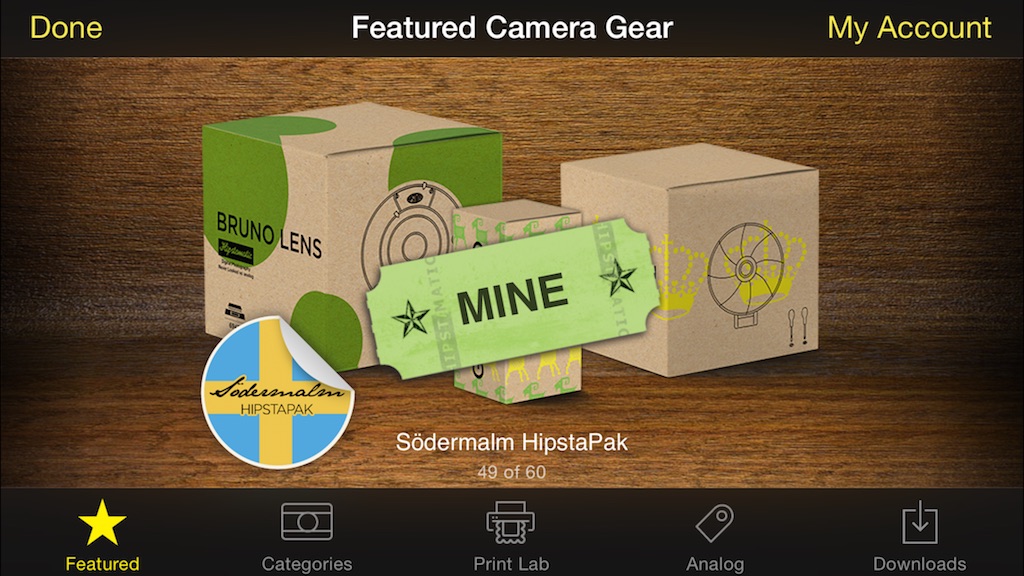
    The Hipstamatic iPhone camera app is in the habit of releasing new “HipstaPaks” of gear (each one typically has a new “lens” and “film”; occasionally a “flash”) every month. Some of these disappear awhile later, to keep the available collection manageable and, I suppose, to create some artificial scarcity around their releases.

    I discovered this a couple of weekends ago when I wanted the Swedish-themed Södermalm Pak and discovered it missing. I regularly buy everything they offer, not the idea of not having some drove me crazy. I promptly bought the remaining two or three I did not already have, proving their marketing technique works.

    So if you also have an obsessive nature and need to have a complete Hipstamatic pack collection, this weekend will feel like Christmas has come early because they’re opening their “HipstaVault”, with almost everything from the past available once more.

    As far as I can tell from Googling, the last time this happened was in 2012. I didn’t know it would actually happen again, so… predictably, I’ve now bought everything I missed.

  • BEAMS Pop-Up in Singapore

    BEAMS Pop-Up in Singapore

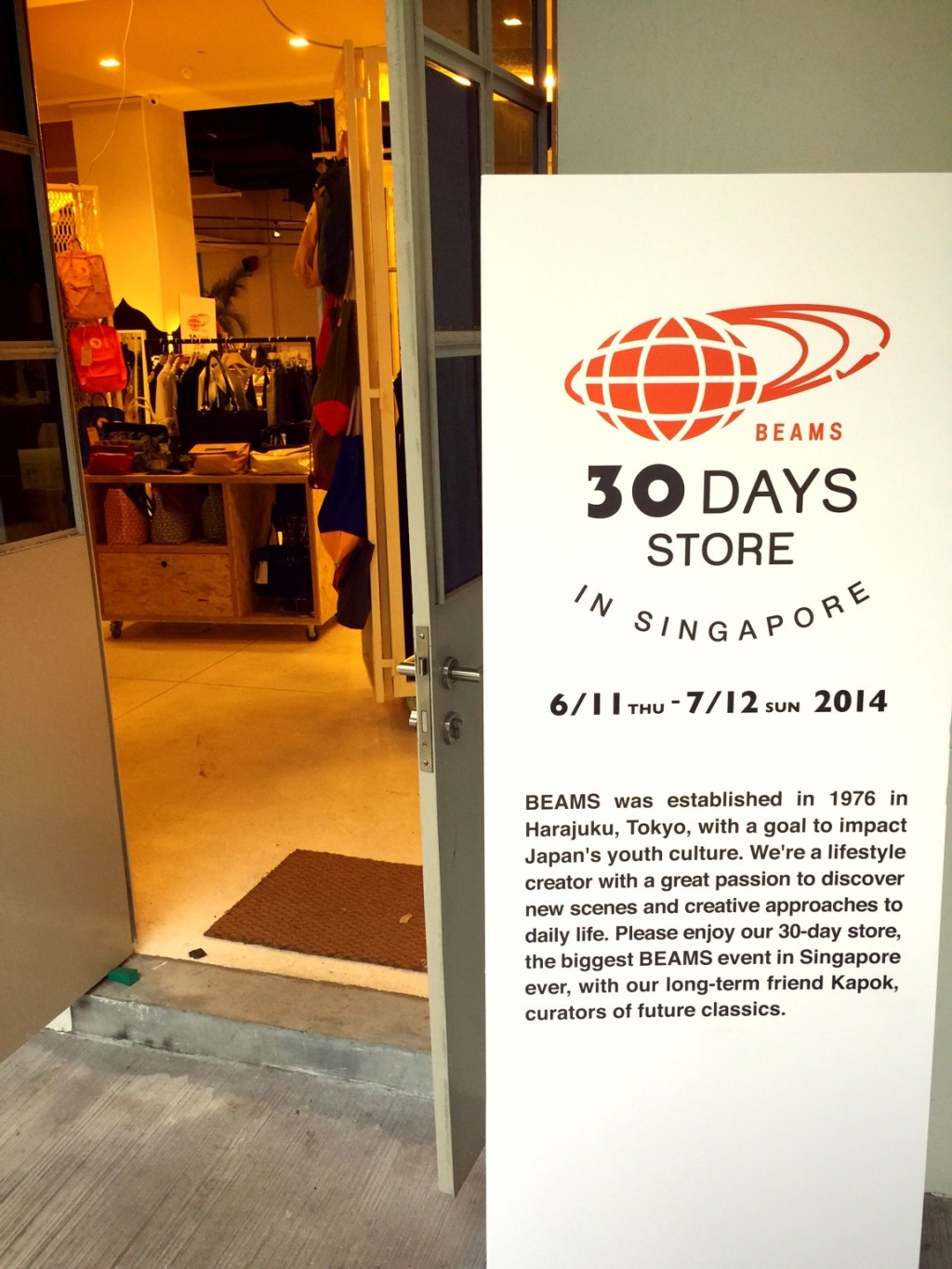
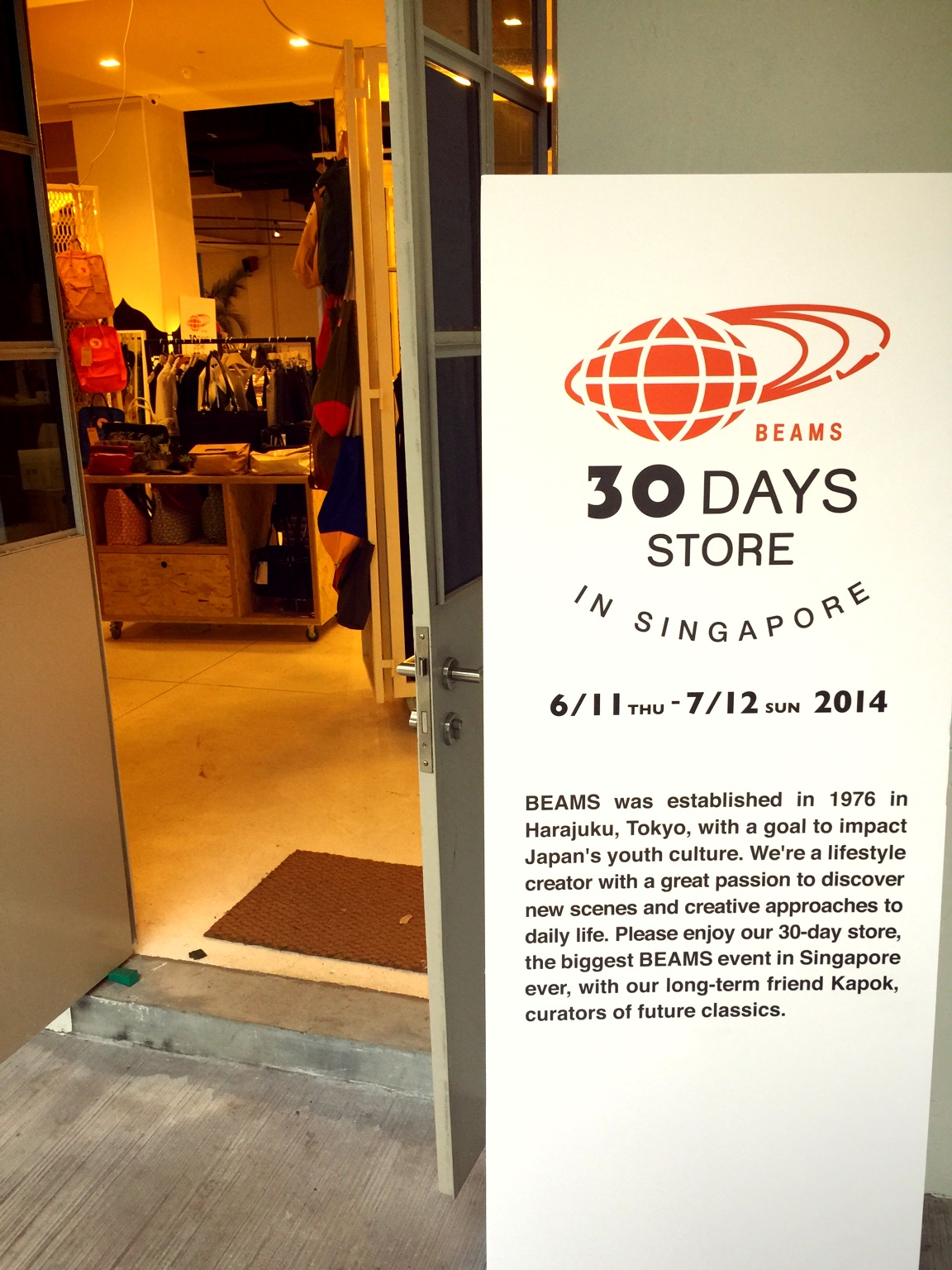
    Beams pop-up store in Singapore! – with Kimberly at Kapok Popup Store

    View on Path

  • An Old Man Tries Snapchat

    If you have even a passing interest in social media and haven’t seen Casey Neistat’s video on how “Snapchat Murders Facebook”, you should.

    Like my friend Vicki notes in this post, Snapchat wasn’t something that I immediately saw any value in. I installed it once ages ago, didn’t have any friends on it (a combination of age and geography), and promptly left. Then Instagram’s Bolt soft-launched in Singapore and got some interest going around ephemeral photo messaging, but it still isn’t something that friends in their 30s seem to want.

    We’re a generation of digital hoarders; the people who abandoned other providers for Gmail en masse because it promised never having to delete an email again. Cleaning out my harddrive the other day, I found a folder of interesting photos I’d saved off the net in the early 2000s: movie posters, album cover art, photos of global landmarks, and the like, simply because the sight of them were scarce and valuable pre-internet! You have to imagine what it was like to live in that time. I ended up deleting almost all of them because these days, if you can put a name to it, you can find it online.

    So behavior is changing slowly amongst older people, and much faster amongst those in their teens, but photo messaging still wasn’t something I needed Snapchat for. Every messaging app offers it now. The ephemeral twist is a footnote.

    Snapchat’s Stories feature changed the way I look at the product. It turns it into something of a lifelogging and broadcast platform. I can’t name another app (still) on the market that lets you grab video snippets of your life, and share them in a stream that your friends can tune in to. The fact that clips disappear after 24 hours is actually the part I like LEAST. It seems Vicki’s with me on this, as she’s set up a YouTube channel to archive these Stories to after they’ve been erased. I may soon do the same1.

    There are some other nascent thoughts I have on Snapchat’s bizarre UX; the more I think about it, the more brilliant it is — breaking many of the rules we use to design interfaces for users of all ages, in order to create an exclusive, obtuse, game-like experience (inviting the spreading of knowledge by word of mouth) that seems intended to make it a success with a younger crowd. I may be wrong, and it may simply be like this as a result of being designed by a younger team. Additionally, its overall visual clumsiness (check out that ghost icon) encourages you NOT to take it seriously, which makes it totally okay to fire off imperfect, portrait-oriented, poorly-shot, but authentic moments without too much thought.

    If you’d like to follow me, I’m on there as “sangsara”.


    1. Sharing these vertical videos on another platform poses a slight challenge. I tried every video editing app on my iPhone, and just about all of them failed to stitch the short clips together without cropping, unexpectedly rotating, or distorting the videos. Even Apple’s own iMovie produced only a black screen with audio playing, probably because Snapchat’s video encoding/metadata in non-standard in some way. Amusingly, the app that finally managed to do the job perfectly was YouTube’s own Capture app
  • Tumbling Lots

    Why is Tumblr so easy to post to? I rebooted mine a scant 11 days ago, and so far I’ve managed 101 posts, with 7 more in the publishing queue. Why have I never used this WordPress blog in that way?

    Does the word ‘blog’ carry some kind of expectation? I know why I don’t tweet that much: I’m a bit of a long-winded person. I’ll share a link or two, but it’s unsatisfying to say just one little thing beside it. Tumblr feels like a long-form Twitter, occasionally visual, and the Dashboard really feeds interaction and inspiration by giving you things you like and would want to pass on. Retweeting on Twitter draws a line between the things you saw and the things you said. The character limit, again, prevents you from adding your own words. I don’t see Pinterest as anywhere the same thing, although people tend to think Tumblr and Pinterest are playing in the same space. Pinterest is nothing like Twitter, for example.

    Anyway, really enjoying it so far, even though posting from the mobile app isn’t very good. You can format far better (such as grabbing a photo from a site you’re linking to and using it as the image) on the desktop using their bookmarklet.

    Visit if so inclined: http://sangsara.tumblr.com until I buy a domain for it.*

    * My friend Ci’en made a great observation: we start projects, then we buy a domain name to get serious, then we feel the crushing and boring weight of commitment, and then we abandon them completely.

  • The Project Graveyard is Adjacent to the Project Factory

    The Project Graveyard is Adjacent to the Project Factory

    20140618-000434-274970.jpg

    I have a bad habit of jumping into projects without thinking them through, and then wrestling with whether to abandon them or work with what I’ve gotten myself into. Some don’t really matter too much, because they don’t matter to anybody else.

    The Round Down newsletter was a blast to do for a year, and then we had to take a break as free time to do unpaid work quickly ran out with new family commitments on both sides. I don’t know yet when we’ll renew its metaphorical print run. The job of finite, packaged news gathering and delivery has been picked up by a few more professional outlets since we started, and I enjoy a few of them myself.

    I also wanted to do a blog called T-Axis for a little bit, and started posting a few things to a Tumblr to get a feel for it. The T being for Tech, and the idea being a look at stories of transformation in various markets and professions as a result of technological advances. That impulse will now probably continue as a research project at work.

    But I liked getting back into posting at Tumblr, and longed to produce with it the way tumblelogs are meant to: a mix of wordless visuals, reflexively reblogged elemental units of interest, links, quotes, and dumb GIFs. It never felt right doing that here on my personal blog, although I’ve tried it out several times over the past 13(?) years.

    So now I’ve rebooted my main Tumblr at http://sangsara.tumblr.com, tentatively called “Business Suit and Cat Ears”, which is also the general editorial direction. Do follow if you like the sound of UX design and apps rubbing up against pixel art of Mt. Fuji.

    The other current project I’ll be a little busy with right now is getting a house furnished and moved into ASAP. The recent photo above was from a somewhat fruitless day of visiting warehouse showrooms, looking for the perfect couch (3-seater with chaise, dark fabric, raised off the ground, firm cushions, wide armrests). I’m beginning to think it doesn’t exist. Consumer electronics makers take note: I’m not even going to consider a next-gen console or 4K TV until your friends in the furniture industry get their act together.

  • LINE Pop-Up Store Singapore, May 2014

    LINE Pop-Up Store Singapore, May 2014

    Japanese-Korean messaging app LINE has opened their first pop-up store in Singapore, on a prominent stretch of the core shopping boulevard of Orchard Road. It will run for a month and reap immeasurable marketing value from the high visibility and sure-to-grow lines of fans eager to buy their cleverly designed character merchandise.1

    I dropped by on its first evening tonight with some colleagues, and we spent between $20–60 each. I would have spent $100, but put down a pack of 100 art postcards ($55) at the last minute. This is on top of the $40 I’ve spent on in-app purchase stickers over the last year or two of being on the platform. I don’t think any other messenger currently comes close in terms of having built brand loyalty or monetization potential that doesn’t involve serving ads or selling personal data.

    Standing outside and watching the crowd, I remarked to a UX designer colleague that no other messaging app could pull off something like this in the middle of town, not WhatsApp, not WeChat. He correctly observed that none of the others have strong IP from which to make their own merchandise to even sell in a store.

    “And it’s all this bloody kiddy stuff!”, I said, clutching a plastic bag filled with stickers and a pair of mugs that look like the faces of a bear and a bird. “It’s not kiddy,” he started to protest before going, “Oh alright, I guess it is.” Takeaway: “Kiddy” is largely irrelevant in Asia.


    18-to-29-year-old females are its “core target,” says (U.S. CEO Jeanie) Han, explaining that in Asia, once girls were using Line, boys followed – and then this young “hip” user base helped bring in older users “like a domino effect.”

    “People, especially young folks, are really adopting our stickers,” she says. “The ratio of people who are buying things online like our stickers is actually quite high in the U.S., as well as the people who are using our games inside our platform relative to the total number of users, so we’re quite optimistic in terms of our market in the U.S.” — Techcrunch, March 2013


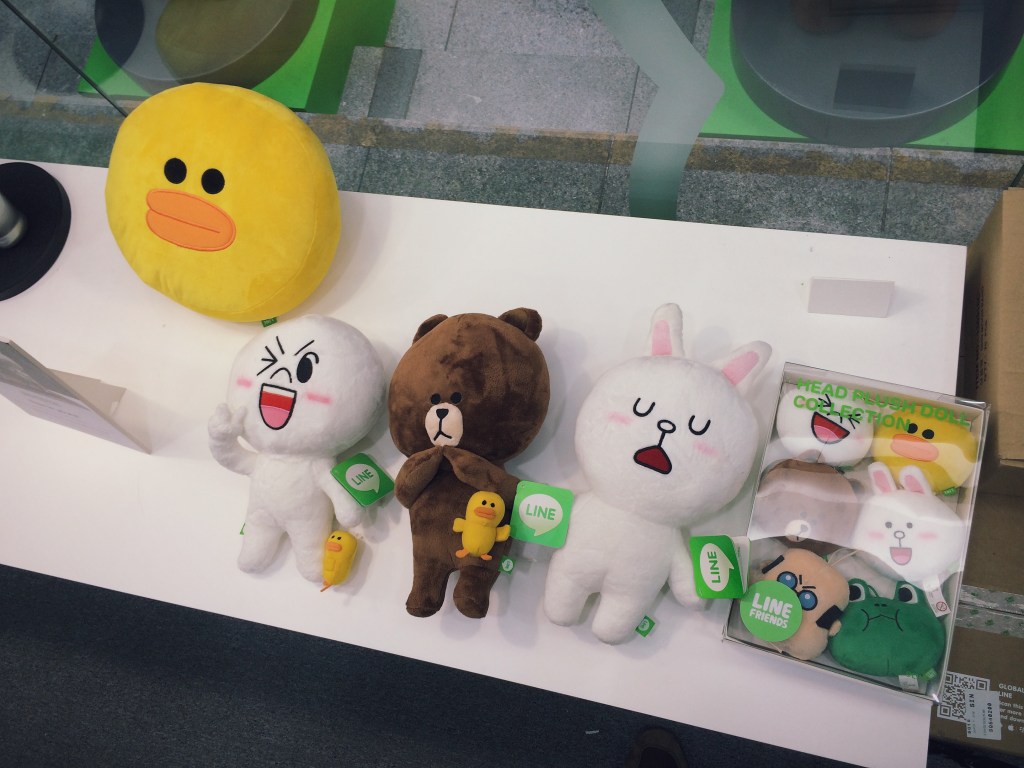
    The crowd lining up tonight was about 2:1 female to male, which seems in line with LINE’s targeting strategy. There were a few people who definitely looked over 40, and everyone present was walking out with stuffed toys, diaries, notebooks, plastic folders, tote bags, mugs, badges and the like, all emblazoned with Brown, Cony, Moon, Leonard, Sally, James, and other characters I can name because I see and employ their images in chat conversations on a daily basis. LINE is lovable, obsessionable. Few others are by design.

    Against Facebook Messenger’s 200M monthly active users, LINE is said to have virtually the same MAU (out of 400M registered accounts). In comparison, WeChat (dominant in China) has 355M MAU, and WhatsApp has over 500M. I don’t consider WhatsApp and Facebook Messenger users to be the same thing2, and LINE has the greatest growth potential outside of its home country, especially in Asian countries with an affinity for Japanese culture, whereas the Chinese WeChat is likely to have a harder time. I’m pretty bullish about LINE’s success, even if their apps have a lot to improve on. For the record, LINE also reports significant revenues — $338M in 2013 — versus about $200M for KakaoTalk and $20M for WhatsApp.


    1. Within minutes of our arrival, I overheard a mom asking her two teenaged daughters, “What’s this about?”, to which they replied, “it’s kind of like WhatsApp.” 
    2. For one thing, WhatsApp is not functionally part of a platform, and probably won’t be merging with Facebook’s in the near future for various reasons. All the other messaging networks are at some stage of offering content, ecommerce, games, and enhanced communication services such as video-calling. 
  • Teas’ Tea at the local 7-Eleven (why doesn’t it say New York?); I welcome this new influx of Japanese beverages!

    View on Path