Tag: Apps

  • An Old Man Tries Snapchat

    If you have even a passing interest in social media and haven’t seen Casey Neistat’s video on how “Snapchat Murders Facebook”, you should.

    Like my friend Vicki notes in this post, Snapchat wasn’t something that I immediately saw any value in. I installed it once ages ago, didn’t have any friends on it (a combination of age and geography), and promptly left. Then Instagram’s Bolt soft-launched in Singapore and got some interest going around ephemeral photo messaging, but it still isn’t something that friends in their 30s seem to want.

    We’re a generation of digital hoarders; the people who abandoned other providers for Gmail en masse because it promised never having to delete an email again. Cleaning out my harddrive the other day, I found a folder of interesting photos I’d saved off the net in the early 2000s: movie posters, album cover art, photos of global landmarks, and the like, simply because the sight of them were scarce and valuable pre-internet! You have to imagine what it was like to live in that time. I ended up deleting almost all of them because these days, if you can put a name to it, you can find it online.

    So behavior is changing slowly amongst older people, and much faster amongst those in their teens, but photo messaging still wasn’t something I needed Snapchat for. Every messaging app offers it now. The ephemeral twist is a footnote.

    Snapchat’s Stories feature changed the way I look at the product. It turns it into something of a lifelogging and broadcast platform. I can’t name another app (still) on the market that lets you grab video snippets of your life, and share them in a stream that your friends can tune in to. The fact that clips disappear after 24 hours is actually the part I like LEAST. It seems Vicki’s with me on this, as she’s set up a YouTube channel to archive these Stories to after they’ve been erased. I may soon do the same1.

    There are some other nascent thoughts I have on Snapchat’s bizarre UX; the more I think about it, the more brilliant it is — breaking many of the rules we use to design interfaces for users of all ages, in order to create an exclusive, obtuse, game-like experience (inviting the spreading of knowledge by word of mouth) that seems intended to make it a success with a younger crowd. I may be wrong, and it may simply be like this as a result of being designed by a younger team. Additionally, its overall visual clumsiness (check out that ghost icon) encourages you NOT to take it seriously, which makes it totally okay to fire off imperfect, portrait-oriented, poorly-shot, but authentic moments without too much thought.

    If you’d like to follow me, I’m on there as “sangsara”.


    1. Sharing these vertical videos on another platform poses a slight challenge. I tried every video editing app on my iPhone, and just about all of them failed to stitch the short clips together without cropping, unexpectedly rotating, or distorting the videos. Even Apple’s own iMovie produced only a black screen with audio playing, probably because Snapchat’s video encoding/metadata in non-standard in some way. Amusingly, the app that finally managed to do the job perfectly was YouTube’s own Capture app
  • ➟ The Beats Question

    Apple’s Pursuit of Beats May Foretell a Shift
    By BEN SISARIO, nytimes.com

    If Apple makes a major marketing push for Beats’s subscription model — or, even better, if Apple integrates Beats into its ecosystem of online services and physical products — it could mean a big lift for streaming.

    Apple entering the streaming music market (virtually overnight) with the clout and installed user base of iTunes would be massive, and it’s probably not an exaggeration to say Spotify’s days as currently structured would be numbered. Looks like we’re in for the next phase of music industry economics.

    Since the rumor surfaced a couple of days ago, people have tried to rationalize why Apple would buy the headphone and services company. Some good theories and analysis of both brands have resulted; I think it’s fantastic to have lots of smart people simultaneously indulge in a thought exercise, the answers to which we will probably have in the near future.

    My resistance to the idea has largely been because I’ve heard several pairs of Beats headphones myself, and haven’t been impressed. It’s not about being overpriced, but being bad experiences, functionally. A pair of BeoPlay H6 headphones at S$700 is subject to many of the same criticisms one might use against Beats: they’re too expensive, they’re made in China, the margins are criminally high, you’re paying for the brand, and so on — except the H6s really do deliver on the music experience. I suppose many Beats owners will say the same, but there are an awful lot of people with taste who disagree. Apple’s brand, to me, has always been on the opposite end of that spectrum. Perhaps this is an effort to change who we currently think of as their customers.

    The Beats Music service, on the other hand, has been really impressive in my short time testing it out. There’s a feature called “The Sentence”, where you fill in a statement that defines the mood and situation you’re in, and Beats Music provides the appropriate soundtrack. I wish Spotify had something like it. I said in a tweet the other day that $3.2bn was the complacency tax of being asleep at the wheel of the world’s largest digital music store, and @craigmod noted that it was a rather low price to pay, in that case. Quite true.

    The iTunes reluctance to play the streaming library game appears to be a legacy of Steve Jobs’s (and the senior executive team’s) approach to music as a tangible possession. He used to rationalize the download model by explaining how people prefer to own their music, and have collections, possibly informed by his own experiences with vinyls and CDs and so on. While it may have been true in the early days of the iTunes Store, I’ve observed even in my own listening habits as an older person that it’s no longer true. Collections matter, but song access is becoming ubiquitous and hence irrelevant. In a world where everyone pays $10/mo for music, we can build all the collections we want, without having to think about first buying a digital copy or worry about losing access. Why should you? It’s $10/mo for the rest of your life and everybody stays afloat and happy. Sold.

    I wouldn’t be surprised if Beats Music became the backbone of a new iTunes Unlimited offering, and the headphones remained a standalone brand, sold prominently (as ever) in Apple retail locations.

    [I first wrote this entry on my experimental blog about technological change, entitled T-Axis. I’ll be cross-posting stuff here for awhile.]

  • ➟ Turning Paper to Pixels with a New Game Design Tool

    From Paper to iPad, Pixel Press Turns Drawings Into Videogames
    Bonnie Cha, recode.net

    I loved play­ing videogames as a kid, but I can’t say that I ever spent any time sketch­ing out ideas for my own games like my broth­er and his friends did. (My doo­dles usu­al­ly involved cute ani­mals or spelling out my crush’s name in bub­ble…

    The core concept is every kid’s dream: designing their own games for friends to play through, or just for the heck of it. But without some serious inspiration, what you can do in a short platformer level is very limited. I remember a D&D game maker tool for PCs in the 90s; that was infinitely better because you could create a STORY, and set up narrative funnels for your players. 20 years later, our idea of imaginative play can’t be restricted to letting kids carve out crude worlds in 3D chunks and 2D lines.

  • LINE Pop-Up Store Singapore, May 2014

    LINE Pop-Up Store Singapore, May 2014

    Japanese-Korean messaging app LINE has opened their first pop-up store in Singapore, on a prominent stretch of the core shopping boulevard of Orchard Road. It will run for a month and reap immeasurable marketing value from the high visibility and sure-to-grow lines of fans eager to buy their cleverly designed character merchandise.1

    I dropped by on its first evening tonight with some colleagues, and we spent between $20–60 each. I would have spent $100, but put down a pack of 100 art postcards ($55) at the last minute. This is on top of the $40 I’ve spent on in-app purchase stickers over the last year or two of being on the platform. I don’t think any other messenger currently comes close in terms of having built brand loyalty or monetization potential that doesn’t involve serving ads or selling personal data.

    Standing outside and watching the crowd, I remarked to a UX designer colleague that no other messaging app could pull off something like this in the middle of town, not WhatsApp, not WeChat. He correctly observed that none of the others have strong IP from which to make their own merchandise to even sell in a store.

    “And it’s all this bloody kiddy stuff!”, I said, clutching a plastic bag filled with stickers and a pair of mugs that look like the faces of a bear and a bird. “It’s not kiddy,” he started to protest before going, “Oh alright, I guess it is.” Takeaway: “Kiddy” is largely irrelevant in Asia.


    18-to-29-year-old females are its “core target,” says (U.S. CEO Jeanie) Han, explaining that in Asia, once girls were using Line, boys followed – and then this young “hip” user base helped bring in older users “like a domino effect.”

    “People, especially young folks, are really adopting our stickers,” she says. “The ratio of people who are buying things online like our stickers is actually quite high in the U.S., as well as the people who are using our games inside our platform relative to the total number of users, so we’re quite optimistic in terms of our market in the U.S.” — Techcrunch, March 2013


    The crowd lining up tonight was about 2:1 female to male, which seems in line with LINE’s targeting strategy. There were a few people who definitely looked over 40, and everyone present was walking out with stuffed toys, diaries, notebooks, plastic folders, tote bags, mugs, badges and the like, all emblazoned with Brown, Cony, Moon, Leonard, Sally, James, and other characters I can name because I see and employ their images in chat conversations on a daily basis. LINE is lovable, obsessionable. Few others are by design.

    Against Facebook Messenger’s 200M monthly active users, LINE is said to have virtually the same MAU (out of 400M registered accounts). In comparison, WeChat (dominant in China) has 355M MAU, and WhatsApp has over 500M. I don’t consider WhatsApp and Facebook Messenger users to be the same thing2, and LINE has the greatest growth potential outside of its home country, especially in Asian countries with an affinity for Japanese culture, whereas the Chinese WeChat is likely to have a harder time. I’m pretty bullish about LINE’s success, even if their apps have a lot to improve on. For the record, LINE also reports significant revenues — $338M in 2013 — versus about $200M for KakaoTalk and $20M for WhatsApp.


    1. Within minutes of our arrival, I overheard a mom asking her two teenaged daughters, “What’s this about?”, to which they replied, “it’s kind of like WhatsApp.” 
    2. For one thing, WhatsApp is not functionally part of a platform, and probably won’t be merging with Facebook’s in the near future for various reasons. All the other messaging networks are at some stage of offering content, ecommerce, games, and enhanced communication services such as video-calling. 
  • Shuttered Out

    IMG_0743

    At a recent office balcony party, I spoke to a colleague who’s also into photography (by which I mean he’s also afflicted by the coin-draining hobby of buying cameras), and realized that maybe I’ve made some progress. My last purchase was the Sony RX-100, which he also bought, and then sold, and then bought a Fuji X20, and then sold, and then bought a used Fuji X100S (pictured). The urge has not visited me lately, unless you count the $200 Q Camera which no amount of money on Earth can buy at the moment because they’ve only made one sold-out and poorly handled batch.

    I’m doing really well on just my iPhone 5S and excellent apps like the new Mattebox (do try my Velvius filter), and Cortex Camera. You can also explore all my posts tagged ‘Photography‘.

  • Cortex Camera is your best bet for quality iPhone photos

    Cortex Camera is your best bet for quality iPhone photos

    Original iPhone capture
    Original iPhone capture
    IMG_0506
    Cortex Camera capture

    It’s hard to believe that you can get different results from the same hardware—the same smartphone camera—just seconds apart. The first photo was taken with the iPhone 5S’s built-in camera app, which employs some impressive software techniques to improve most photos. In this case, a low-light scene forced an ISO sensitivity of 1000.

    The second photo was taken with Cortex Camera, which takes a series of images over 2 seconds or so (you don’t have to keep your hands perfectly still, but still-as-possible helps). These are then combined for far less noise, more accurate colors, and higher resolution (12mp on the iPhone 5/5S, which normally take 8mp images). The default Camera.app also combines up to four captures for better photos, but is optimized to work for all situations. For any scene without moving subjects and where you have the luxury of time, Cortex delivers better results.

    Camera.app 100% crop
    Camera.app 100% crop
    Cortex Camera 100% crop
    Cortex Camera 100% crop

    The shots above are 100% crops from the same scene. Note that the Cortex Camera version is both larger and more detailed. It has more potential for processing, and beats a fair few prosumer point and shoot cameras at the pixel level.

    The first app to do this “supersampling” was Occipital’s ClearCam, which I used to swear by. However, like their other app 360 Panorama, ClearCam hasn’t received any updates in the wake of iOS 7, and appears to have been abandoned as the company pushes their new Kickstarter-backed project, the Structure Sensor. At this time, ClearCam makes you wait longer and has a cumbersome alignment and enhancement process. Cortex Camera just takes the picture and saves it all in one step. It’s a damn shame, because both Occipital apps were among the first and best of their kind, enabling users to do things with their iPhones that seemingly defied the capabilities of the hardware. They clearly have a knack for clever imaging technology; I just hope they take a longer view of supporting their products some day.
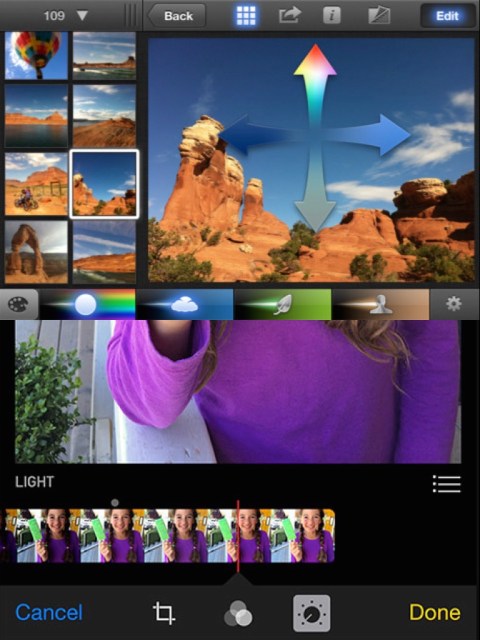
    If you’re in the market for a new app to take and share those 360-degree panoramas, Sphere (formerly Tour Wrist) does a good job and is free. Bubbli is also promising, but captures video instead of photos to stitch a scene together, which means you have to pan slowly to get an even exposure. If you’ve got the cash and a love of new gadgets (mustnotbuymustnotbuy) Ricoh’s new Theta camera does the trick in a single click. It’s the first consumer-ready spherical capture camera and looks like a presentation remote. Simply hold it above your head and hit the button, and it takes in the entire scene. What’s more, the $400 device has built-in wifi and beams photos over to your iPhone for instant sharing. It’s not hard to imagine this feature on an iPhone a decade from now.

  • VSCOcam 2.0 — A New High-Water Mark In Mobile Photography

    I’ve been a fan of VSCO products for awhile, and have written about using their VSCO Film presets with JPEGs from consumer compact cameras, and recommended the last version of their VSCOcam iPhone app in my rundown of Essential iPhone Photography Apps.

    In the latter post, I said of version 1 of VSCOcam:

    As flawed as it is capable, this low-priced alternative to the VSCO company’s pricey desktop plugins is pretty good at giving photos a realistic film look; no light leaks and crazy cross-processing here, just subtle color shifts, fade operations, and real grain overlays. Skip the other basic editing tools included; they’re not up to scratch yet, but the package is an easy buy at $0.99.

    The good news this week is that version 2 of VSCOcam [iTunes] greatly improves upon those editing tools (specifically by giving operations such as adjusting brightness more precise ‘steps’ of control, and making them non-destructive within the app; new adjustments like rotation have also been added), and takes the original’s 10 built-in film looks to another level.

    The new version of VSCOcam (a separate download in the App Store) is a free download, and now contains a store with 16 packs of “presets” for download at 99c each. A pack consists of 3 presets, which are really more like filters since their results cannot be accomplished by tweaking any of the editing parameters. Presets is a strange term to carry over from VSCO’s Lightroom and Aperture products, where they really are Presets.

    Owners of the previous paid app can unlock the original 10 legacy filters in the new app, which is a nice touch. And as a launch special, all 16 packs can be bought for the price of 6.

    The new app is essentially a ground-up redesign and rebuild. All operations are significantly faster, the built-in lightbox mode is nearly unrecognizable and has some very nice power-user features like flagging and filtering by flagged/edited states. The camera module is now good enough to use as a camera replacement, with separate focus/exposure locking, a “big shutter button” mode, high ISO boost support for iPhone 5, and other improvements. There’s also a proprietary photo publishing platform called VSCO Grid built in that I haven’t had the chance to try because accounts are being rolled out slowly as they test it.

    In this week’s issue of The Round Down newsletter (subscribe!), I said:

    This is a new high-water mark in mobile photography apps. […] It’s almost too good to be true, and too good to give away for nothing.

    And it really is. At one point on the mobile photography timeline, taptaptap’s Camera+ app was king of the hill as an all-in-one solution because few others did as much as it did, as inoffensively as it did. However, its shortcomings in editing and effects processing have never been addressed, and the pace of development seems to have slowed down considerably in the past year. With VSCOcam 2.0, I think its successor has arrived. It has the power to fix shortcomings in photos as well as or better than Camera+ ever did, and the professional desktop editing pedigree of its filters is unmatched by competitors.

    A few bugs and metadata issues notwithstanding, if I had to delete every photo app on my iPhone bar one, this would be my choice to keep.

    Not the best example, but one photo I took last night.
    Not the best example, but one photo I took last night.
  • Camera Noir x HK

    A couple of interesting people I follow on Twitter got together and formed an app company awhile back, called Pacific Helm. They released their first iPhone photography app today, Camera Noir, and it’s rather nice.

    It takes (and imports existing) photos in B&W only — a sort of black-heavy, rich sort of processing. It’s been called high-contrast in every review I’ve seen today, but that term usually implies a hard, noisy look; Camera Noir’s output retains subtle gradations and shadows. In some light, the results look almost like infrared film. It’s a look well-suited to landscapes and urban scenes, as these examples from my Hong Kong set show.

    20130605-221859.jpg

    20130605-222216.jpg

    20130605-223809.jpg