Rainy season is reading season. After finishing There Is No Antimemetics Division for my book club, I also wrapped up Taylor Lorenz’s Extremely Online, which is sort of a brief history of social media and the influencer economy. I highly recommend the former for fans of SF stories involving time, unreliable memories, and the nature of reality; some members of the book club who are into Doctor Who likened it to that, but I wouldn’t know.
Then I decided to start getting into the mood for our holiday by reading some Japanese fiction. I began with Mieko Kawakami’s Heaven (a rough story about school bullying), which I thought would keep me occupied for a while, but before I knew it, I’d finished it along with Satoshi Yagisawa’s Days at the Morisaki Bookshop and More Days at the Morisaki Bookshop, two entries in the cozy Asian fiction wave dominating the local charts. Other entrants include Welcome to the Hyunam-Dong Bookshop and Before the Coffee Gets Cold by Hwang Bo-Reum and Toshikazu Kawaguchi, respectively. When the going gets tough, people start fantasizing about quitting their jobs and opening cafes or bookstores, and I think that explains the sudden popularity of this micro-genre. Incidentally, I bought a couple of these books for my mother on her recent birthday because I thought she’d enjoy the vibes, although already retired.
For the avoidance of doubt, all of the above books were three stars for me on Goodreads with the exception of Antimemetics, which got a 5-star rating. But the Morisaki Bookshop series makes reference to many great works of Japanese literature, and so I decided to try reading some Mishima on this trip. I’d read The Temple of the Golden Pavilion as a young adult, and it probably just glanced my frontal lobe at the time.
In a flash of pure coincidence soon after, I was scrolling through MUBI and came across Mishima: A Life in Four Chapters (1985) by Paul Schrader (who wrote Taxi Driver), an American Zoetrope biopic executive produced by George Lucas and Francis Ford Coppola. I watched it immediately, and it’s an incredible work of cinema — why isn’t this talked about more? It only covers the last phase of his life, up until his famous act of terrorism/suicide, which makes up only one of the four chapters. The other three are dramatizations of his work, literally staged on theatrical sets and shot with more care and inspiration than anything you could buy today with $100M in streaming service money.
In a further act of cosmic coincidence, I saw a Facebook post from Paul Schrader being shared on Twitter, having an AI moment of crisis when he found that ChatGPT outdoes him when prompted to provide “Paul Schrader script ideas”.
Writer of the legendary movie Taxi Driver is having an existential crisis about AI pic.twitter.com/5H89SWUKn9
Looking back on holiday photos from March 2023, I rediscovered my rediscovery of Hipstamatic, which had just launched its new subscription-based app at the time. Looking at those photos brings back fond memories; they are “ruined” in a good way — mundane everyday scenes somehow imprinted with the nostalgia of the moment through imperfect filters (it helps that I know that the original, normal photos lie underneath and can be accessed with a tap of the Revert button). My setup at the time was to use the Ricoh GR III as a main camera for all photos that needed to look good and accurate, and to reserve the iPhone + Hipstamatic for casual, silly snapshots. Otherwise, you have two tools competing for the same job. I’m now finding that idea attractive again, except both Hipstamatic apps are quite a pain to use, UI-wise.
I watched this video of “Best Apps in 2024” from the MKBHD Studio team, and decided to give Dazz Cam another try. It’s surprisingly powerful! Some of the vintage “cameras” you can choose from use RAW processes, and you can have it save both the original RAW file and the filtered results separately. So I may end up using this to “gimp” my iPhone rather than Hipstamatic. Plus, the subscription to unlock all its features is only $10/yr compared to Hipstamatic’s $40/yr. I don’t even think you need it as some of the free filters are good enough. I only wish it would use the underlying RAW and not the JPEG when importing an existing image from your library.
We had free tickets to the ART SG fair at the Marina Bay Sands over the weekend and dropped by for a quick look. It was crowded as hell and I was reminded why I don’t think these things are a great way for the general public to see art; it’s mostly a trade show geared towards buyers, and so the scale is too overwhelming for anything to really be appreciated. Not only that, but the selection this year didn’t really make much impact. I was looking out for more of the humor and playfulness I saw at the 2023 edition, something to make light and sense of the trauma we’ve normalized, but it was sorely lacking. I did like the pair in the featured image above, though, as they reminded me of some other works I’ve seen before, including the Act of Emotion digital series by Kelly Milligan.
Trump launched his own memecoin on Solana this weekend, days before the inauguration, and I believe it went up to a market cap of $70bn. That would qualify as a very funny and absurd art project, from ‘probably the greatest’ (scam) artist, if it wasn’t real and thereby depressing.
True to early January patterns in Singapore, it’s looking gloomy, rainy, and dare I say even a little bit chilly out there (lows of 22ºC). My memory of Chinese New Year each year, though, is that it’s always intolerably sunny and hot. So unless climate change has mucked that up, things will flip in a couple of weeks.
If you’re reading this on the web, you may notice the site sporting a refreshed design for the new year. This came out of a chat with Michael about tools for cross-posting to Bluesky and elsewhere. I said that it’s been a longstanding wish of mine to just post everything, including short “tweets”, here on WordPress and have them go out to social networks automatically. At which point I remembered that WordPress’s new annual theme was due out, and that’s what you’re looking at now: Twenty Twenty Five.
The basic architecture is the same, but there are several improvements that I’m happy about. For one, the home page now supports showing full posts, so you don’t have to tap through to read them. You can also hide page titles on specific pages, which I used to get around with a hack. The new default font (Manrope) isn’t bad, but I wasn’t happy with the line spacing and weights they chose, so those have been customized. Wordy bullet lists are also displayed in a more pleasing manner than before, which is great for these updates.
I moved some other components around to make more sense to me, but no one else will probably notice. I also took the opportunity to inject some classic sangsara.net yellow into the header, a callback to how this site looked 20 years ago. I literally had to go dig into my file backups to find a reference for the color code.
I’ll probably improve the About and Archive pages when I run out of other things to do.
===
Have you ever started mentally packing your bags for a trip because it was too early to physically pack, but the anxiety of wanting to sort it out was getting too strong? That’s me now, and I’ve started to decide what devices and chargers I’ll need and how to organize them, and also what bags to bring for different purposes.
It’s at this point that I realized I’ve somehow become one of those “bag guys” — not so hardcore that I keep up with every new release from Peak or WaterField or côte&ciel, but more that I have way too many for a person who really stays in a lot.
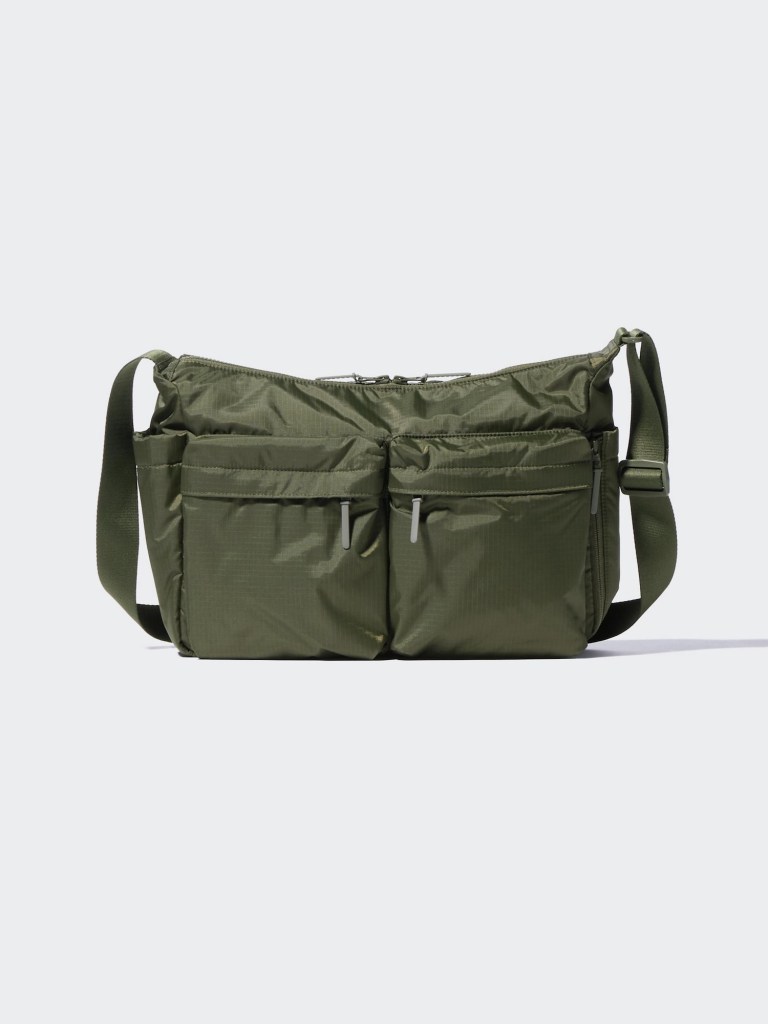
A couple of days ago, I started seeing online mentions and reviews of the new S$40 Uniqlo ‘Multi Pocket Shoulder Bag’ and decided that it could beat Peak Design’s 10L Everyday Sling for carrying headphones, camera, Switch, iPad + keyboard, down jacket, and a bevy of other bits on the flight over. It’s lightweight, water-resistant, and so cheap as to be disposable/replaceable if damaged. It’s also structurally unassuming, and can be used for the “everyday carry” of just a few items if needed, whereas the Peak Design bag can’t flatten down on a crowded Tokyo train even if it’s mostly empty.
If the Uniqlo bag looks familiar, that’s because it’s a ‘dupe’ of a similar Porter bag that costs 20x more. I’m going out later today to pick one up, but can’t decide between boring black and ordinary olive. (Later: I went with black.)
A few more travel points:
I signed up for a YouTrip debit card and have frankly been impressed by how well the app/service works. I used to rely on my bank’s multi-currency account + card for overseas use, but it turns out that their exchange rates are awful compared to YouTrip’s, and even Wise and Revolut’s rates. YouTrip will exchange your SGD on-the-fly as needed, or you can exchange currencies ahead of time if you like the rate. My bank requires exchanging funds ahead of time, and if you don’t have enough to cover a purchase, the entire transaction defaults to SGD (incurring high fees), even if you have enough foreign currency to cover 99% of it. What are banks even good for?
With this, I sadly realized I could have been using YouTrip for every online USD purchase over the past few years, instead of my credit cards which come with 2–3% foreign currency transaction fees 💸.
I selected Saily for my eSIM needs (discount code for $3 off: BRANDO3576). It’s a new service by NordVPN, and 20GB of data in Japan currently costs $23 USD, which I of course paid with YouTrip. Being from NordVPN, it has a good app that lets you toggle ad/malware blocking on the server side, as well as spoofing your location via their network of IPs.
I tried to get an updated Covid vaccine and was denied by the GP because I didn’t fall into the risk categories (e.g. over 60 years of age). This was news to me, as I thought it was available to anyone who wanted it. The Ministry of Health’s website suggests as much, but now I’m annoyed enough by the back-and-forth that I won’t get one.
Many years ago when I was trying to learn basic Japanese, I found some free podcasts from JapanesePod101.com, and this week was surprised to find them still around, and active on YouTube. So I’m dedicating some time over the next few weeks to watching their videos and studying up on some vocabulary which may come in useful.
===
I rewatched Tenet (2020) after hearing it was recently rereleased in IMAX theaters in the US, using the Vision Pro to recreate the large-screen experience at home. It was incredible, and the film was so much better than I’d remembered it. I rated it 3.5 stars on Letterboxd before, but I’ve now upgraded that to 4.5.
[Spoilers ahead] I read some other reviews that agreed ‘this film gets better with every viewing’, and I think it’s because you spend your first viewing trying to decode 1) what is going on, 2) how the time mechanic works, 3) what the next twist is going to be. Once those things are kind of understood, you can appreciate the craft and execution. How did they plan and stage those fight scenes, where one person is moving forward in time while the other is in reverse? And then taking that concept and applying it to driving, shootouts, and a whole bloody army? I don’t think I paid any attention to Kenneth Branagh the first time, or noticed how good Robert Pattinson really is, or the locations, or the madness of crashing a real airplane into a hangar. I was probably having a headache trying to understand catching a bullet with a gun.
Our long #youngstar programming nightmare is over. About two years ago, Michael and I noticed that the aforementioned Apple Music playlist had veered from its Japanese roots and presented differently to international users. The English picks were mediocre, and not edgy or innovative in line with the playlist’s stated purpose. And then it fell into a memory hole and wasn’t updated for months. Well, the localization experiment is over! I’m now seeing the Japanese version here in the Singapore ‘store’. Good on you, Apple Music editors.
I was looking through my archives to see what happened this time last year and found that I did a fun “music awards” post in late December, which I don’t have the energy for this time around. However, I can pick three personal favorites.
Song of the year: Not Like Us — Watching the Kendrick and Drake beef unfold in real time while on vacation in Hong Kong, waking up each morning to hear yet another song released while we slept, and then having this incredible, perfect banger drop at the end? It was a great time to be alive.
Album of the year: It’s a tie between Audrey Nuna’s TRENCH and Maggie Rogers’ Don’t Forget Me. Audrey stretched the fuck out of her sound in the most creative manner possible, to the point that Apple Music classifies the album not as Hip-Hop, but Indie Pop. Like a great Kanye album, it’s filled with little moments that anyone else would have turned into whole songs — this is an album of sonic riches and solid vibes. In contrast, Maggie’s is a streamlined, quickly recorded distillation of everything that makes her great, without extraneous electronic production or gimmicks. Just ten great songs with a band. I must have played it a dozen times when it came out.
A playlist
While I didn’t get around to making my customary “best of the year” playlist (usually titled Listening Remembering 20xx), I did finish compiling BLixTape #5, which is a bunch of songs I enjoyed between June and December. Taken along with the previous installment, it gives a similar picture, although not strictly made up of songs released in 2024.
Girl, so confusing featuring lorde — Charli xcx & Lorde
Eusexua — FKA twigs
We Are Making Out — Mura Masa & yeule
Scumbag — ROLE MODEL
Creatures in Heaven — Glass Animals
Petco — Cassandra Jenkins
In The Living Room — Maggie Rogers
Beaches — beabadoobee
So Glad You Made It — Fantastic Cat
Empty Spaces — Eliot Bronson
Our Town — Iris DeMent
Lately — Fiona Apple
Kaze Wo Atsumete — Happy End
Fear When You Fly — Cleo Sol
Wildfires — Sault
Darlin’ — Jean Dawson
This Is Who I Am (From “The Day of Tomorrow”) — Celeste
Free Fallin’ (feat. Kina Grannis) — Imaginary Future
===
Japan, again
We got back from Langkawi on Monday and immediately started to stress about our upcoming trip to Japan, which has only been a foggy plan to hang out in Tokyo and eat a lot of curry rice, at least on my part. We’ve at least confirmed where we’re going to stay: a sort of serviced apartment unit that’s twice the size of a regular hotel room, for less money. How’s that possible? There’ll be no housekeeping, and the location isn’t as convenient as the hotel we were considering (but still within core Tokyo and walking distance to bus and train stations).
Since I don’t have any pressing need to return when Kim does, I plan on staying on a little longer on my own. Maybe another 10 days, which should be enough time to crawl every floor of Yodobashi Camera and drink my weight in highballs. Who am I kidding? It’ll be the middle of winter and I’ll probably stay in bed with my Switch and watch Japanese daytime TV.
People sometimes say it feels like I go to Japan a lot, but honestly it’s only every three years or so, on average. This will be the longest vacation of my life, and I’ll finally be like one of those people I’m always meeting who say unbelievable, envy-inducing things like, “I visit Tokyo three or four times a year, just to shop and eat”, and that casually tossed-out favorite: “Oh, I was just in Tokyo for a month”.
I’m looking forward to visiting the Tokyo Photographic Art Museum in Meguro, among many others. We gave it a miss the last time around, so it’s been at least six years since we visited. The same goes for the Tokyo Metropolitan Art Museum in Ueno, and the National Art Center, Tokyo.
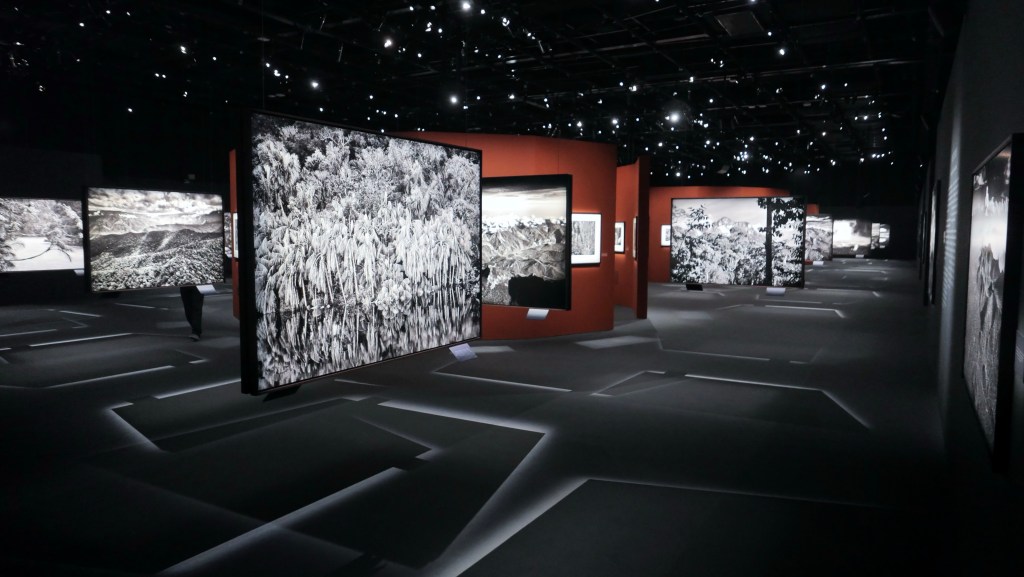
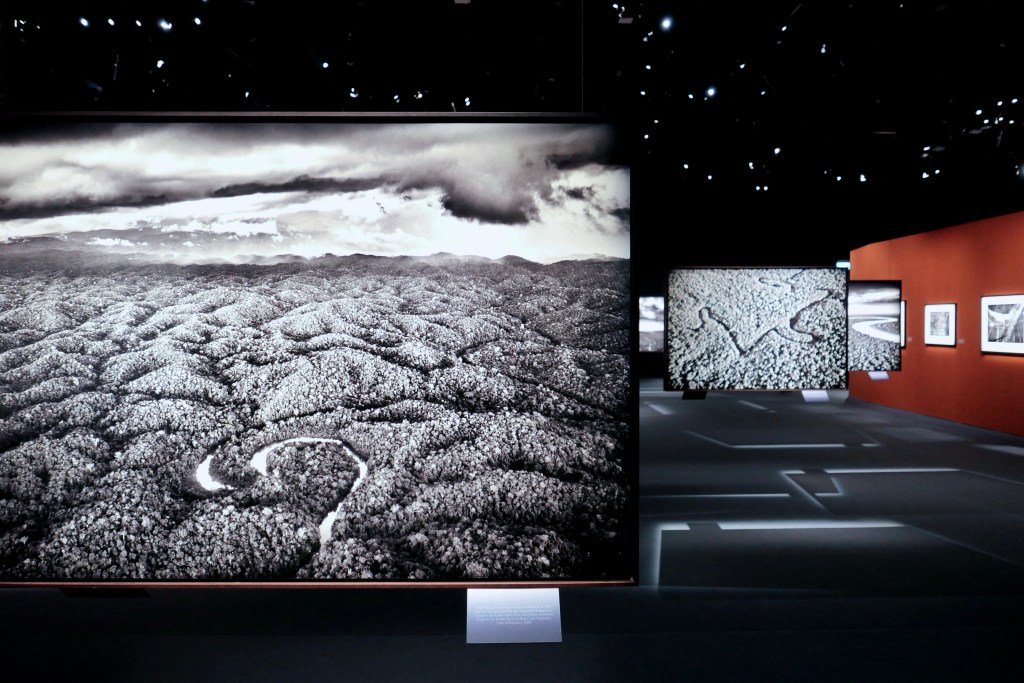
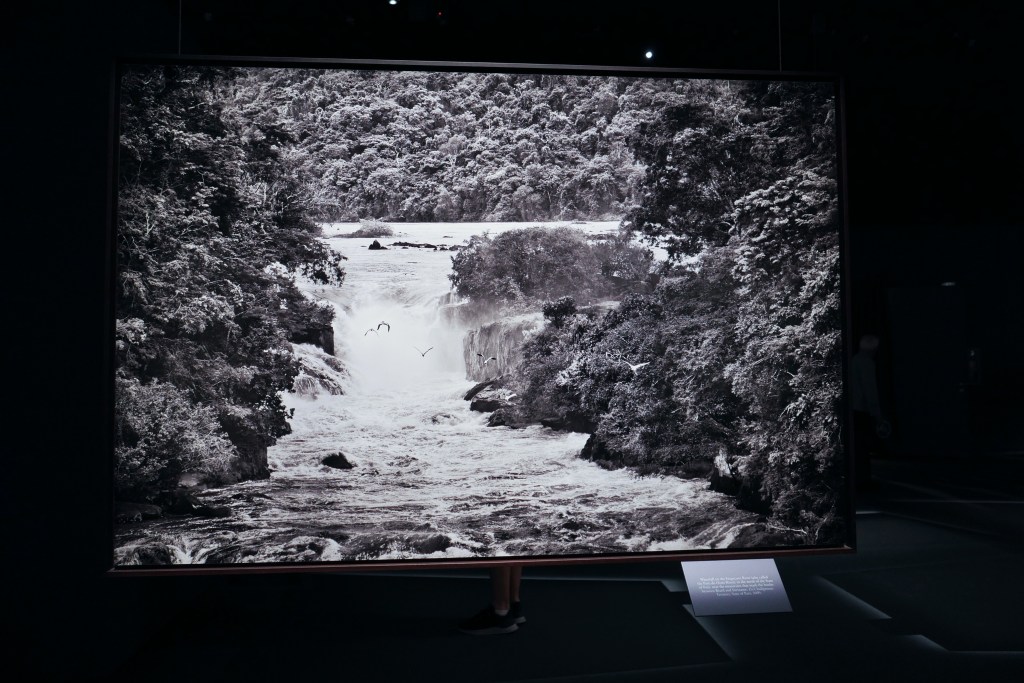
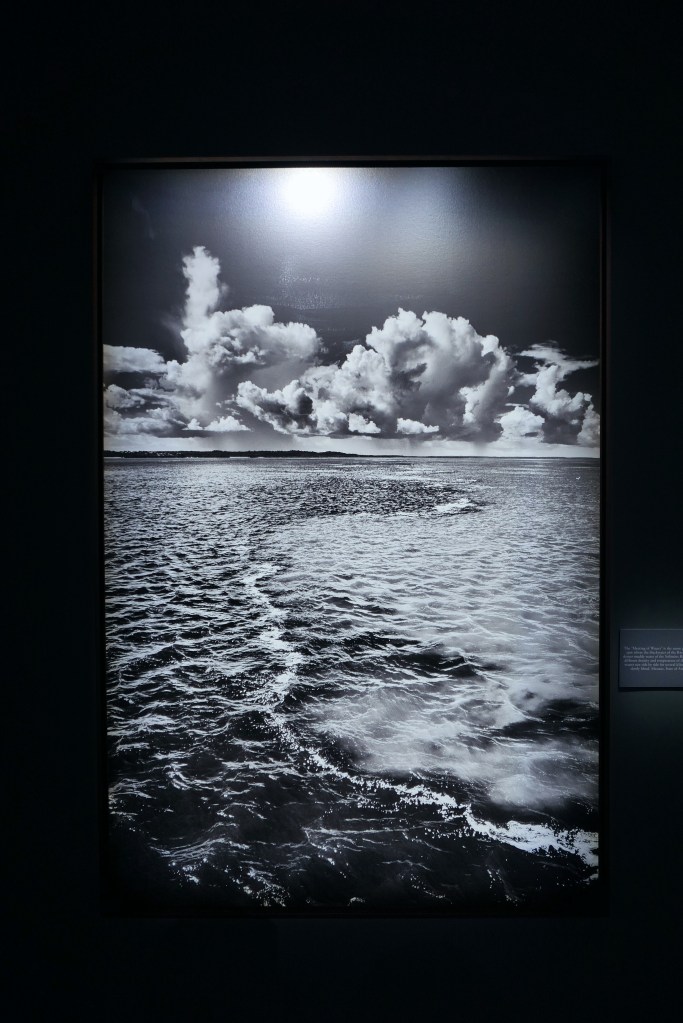
Pure photographic exhibitions seem like a rarity here, so when we heard one was on now at the National Museum of Singapore, it became the plan for the second day of the new year. Amazônia, by Sebastião Salgado, is one of the best uses I’ve seen of the basement gallery space at the National Museum (usually turned into a linear maze with temporary walls). This time, it’s an open space with loose walls created by the photographs themselves. The show is a mix of these large, suspended landscape prints and smaller, intimate portraits of Amazonian tribes, some of them still living by their ancient ways and getting odd facial piercings that most modern-world deviants wouldn’t emulate.
Media Activity
We finished the second season of Shrinking, the lovable Apple TV+ series that probably does therapy more of a disservice than it intends to. Harrison Ford actually gives a shit here (unlike his other cash grabs), and it’s some of his best work. Recommended.
I saw two films involving (false?) choices behind doors.
Sliding Doors (1998) is a film I bought on a pirated VCD like 25 years ago and never got around to watching. I imagined it to be a slick 90s rom-com, but it comes in with slightly low-budget vibes. Maybe Gwyneth wasn’t a big star yet? There’s some slightly clumsy editing, and some shots don’t work. But you can feel the writer/director’s passion for this story coming through, and it’s an alright weekend film. 3 stars.
Heretic (2024) is the latest installment of Hugh Grant playing against rom-com type, and it seems to be an immensely popular career move. I largely enjoyed the film, which is part-horror, part-media history and religious lecture. That is, up until the ending. 2.5 stars.
Just 10 days to Christmas, and I finally got a sense of it happening through my first gift exchange and a couple of meetups. The first was with a few workplace alums, after one suggested to me that it would be nice if we all caught up (and so I ended up getting the job of organizing, which I bumbled through). It was nice after all, and I got to spend time with some people I hadn’t seen in years. The second was last night at a friend’s home that impressively decorated for the season, complete with a playlist of Christmas classics greeting us at the door. I think that was the moment it became real for me.
I brought my Leica D-Lux 7 out of hibernation this week for a few photos, mostly to put its aging battery to the test. It fits in my new Bellroy sling (the Ricoh GR III is still significantly smaller and lighter, albeit without a zoom lens), so I’m entertaining the thought of bringing it on our next holiday. Oh, that’s right. We’ve just booked a trip to Tokyo next year, wayyy behind the trend, but hopefully everyone’s had their fill of Japan by now and it’ll be less crowded when we get there. If I do need a spare battery, I’ll pick up the Panasonic equivalent model from Yodobashi Camera or something.
Another reason for the renewed interest was an update to the Leica FOTOS app (which connects to cameras) that came out this week. For the uninitiated, ‘Leica Looks’ are essentially a series of live filters that can be installed onto newer cameras. Owners of older models have been out of luck, but with this new update they can be retroactively applied in the app to any JPEG taken with a Leica camera. While trying it out, I discovered that photos I’ve been taking with the Leica LUX camera app also qualify as “taken with a Leica camera”, meaning you can apply these Looks to iPhone photos for free as well.
So far, I’ve been surprised by how well photos from its Micro Four-Thirds sensor have turned out, especially in daylight. Low light photos are quite smudgy/noisy if you elect to use an ISO value over 3200. I’m fortunate that Leica’s updated D-Lux 8 model this year was such a relative disappointment: a surface-level redesign of the camera’s body and UI without any improvements to the lens, sensor, or processor. It’s good news for me since an uncompelling update is money saved. Ignoring the PS5 I got in May, NOT upgrading stuff has been a bit of a theme this year. I don’t even covet Fuji’s X100VI camera one bit, maybe because it’s been so (artificially?) rare and overpriced.
===
Our new broadband line was finally activated, and it’s resulted in a doubling of accessible bandwidth. In one speed test, I got over 1.1 Gbps (symmetrical) on my iPhone. At this point, our fleet of un-upgraded hardware is holding us back more than the network. In a couple of years, when every device in the house actually supports WiFi 7, I’ll upgrade the router and unlock the full 10Gbps that we currently have.
How little use am I making of this plentiful bandwidth? Well, listening to a lot of Apple Music Radio.
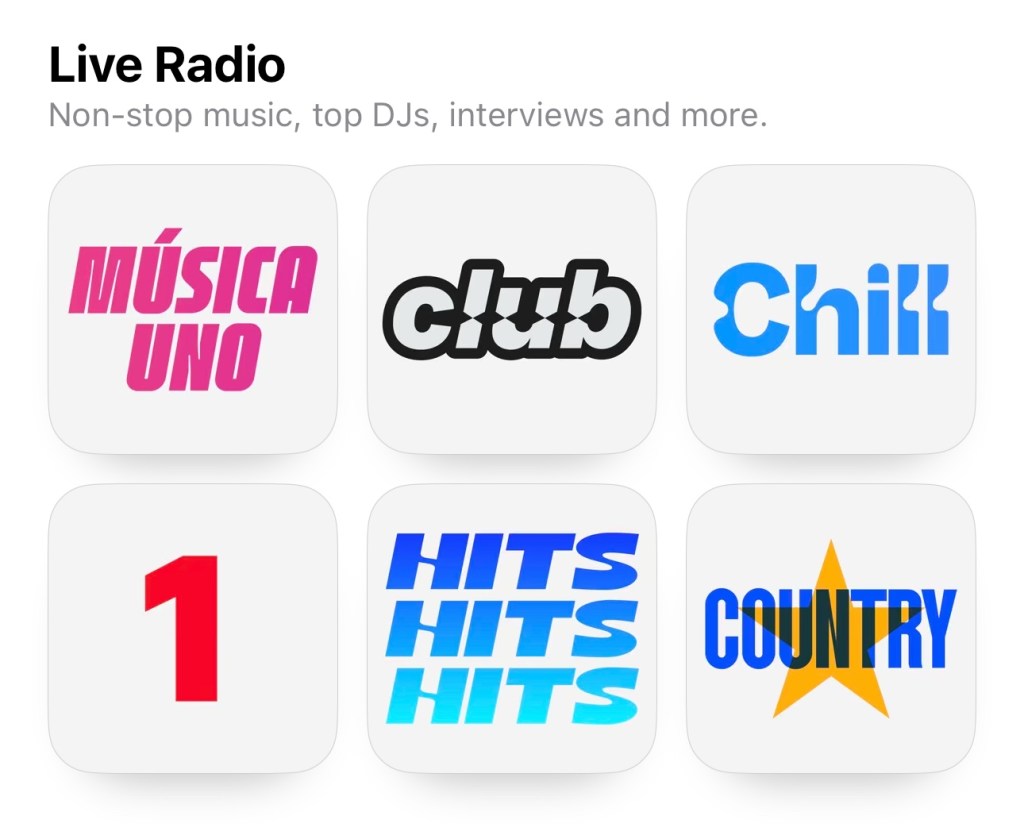
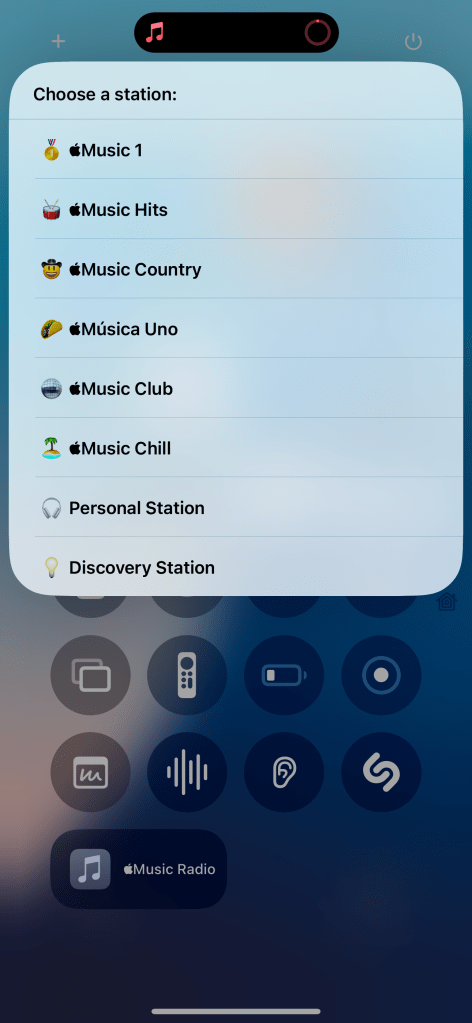
You probably missed this because it hardly made the headlines, but Apple Music doubled the number of their live, hosted radio stations from three to six. Apple Music Club, Chill, and Música Uno now join Apple Music 1, Hits, and Country. In a world where personalized, algorithmic stations/playlists are plentiful and pedestrian, I think these human-led stations are a wonderful zig to Spotify DJ’s zag.
Some of the best artists I’ve discovered this year were serendipitous encounters while listening to Zane Lowe, Rebecca Judd, Matt Wilkinson, or Dotty taking listeners through their latest picks on Apple Music 1. I think receiving and interacting with other people’s passion and opinions is a key part of the cultural experience of music, so these DJs play an important role that is growing ever smaller. It’s so good to see Apple Music expanding their Radio offering rather than shutting it down.
I used to have a Shortcut on my phone to launch Apple Music 1, but with these new stations it seemed time to build a quick launcher. Now, I can start live stations and my personalized stations from the Control Center, Today Screen, or even with the Action Button.
===
iOS 18.2 came out of beta, with new Apple Intelligence features like Genmoji and Image Playground. They are okay for a bit of fun, but definitely won’t cause any artists or illustrators to become unemployed. It’s interesting to ask if they ever will, because Apple could certainly get the models there with time, even with fully on-device inference, so it’s just a question of intention. But I don’t think there are any brakes on this train and every company is onboard, they’ve just bought different tickets.
People sometimes say that I’d make a good teacher if I ever tried it. I think good teachers are probably more patient than I am and love speaking in front of people a lot more than I do. But on reflection, those are both things I’ve gotten a little better at over the last decade, so maybe.
I got a little taste of it this week when I was given the chance to hear a class of college students make their final presentations for a design thinking course, and provide assistance in the assessment of their assignments. They were asked to identify a group with needs, understand them, and then design games that could be of help. They had to prototype and test their ideas before finalizing a working version. They all did pretty well, creating solutions that were surprisingly polished.
The general idea about deploying Generative AI tools in the workplace is that they don’t do much to enhance the work of already talented employees. But for the vast majority of average or below-average workers, LLMs elevate their productivity and quality of work to a consistently higher level, which is still a net positive for teams.
Apple’s current ad campaign for Apple Intelligence seems to take that tack too, resulting in a message that’s so far from the Macintosh’s promise of a “bicycle for the mind” that these ads are rightfully catching some flak. But in the classroom, I saw AI tools give students (with limited time and a lack of traditional design skills) the ability to execute their ideas at high fidelity. Making card games that look and feel almost like professional products, fully illustrated without the help of artists, is not something we could have pulled off when I was their age. I’m partly envious, but also afraid that on a wider scale, execution will be confused with education.
Earlier in the year, when I sat in on another class being taught by a friend, I was struck by how hard it is to control the chaos of a large room of modern students, and the same thing was true here. When you get over 40 laptop and iPad-equipped young adults in a room, having their attention is not a given. Side conversations are happening all the time, and listening to whoever’s speaking seems like a choice.
Maybe it was just my experience as an English student, but our class sizes were smaller, and discussions almost always followed a single track, led by a professor pacing around the room rather than anchored to a screen at the front. There were hardly any screens, come to think of it, just books and notepads. Now everyone’s on Figma, Canva, Miro, and a host of other infinite sheets of AI-enabled SaaS paper. I’m not saying we had it better, but I worry that the option to take things slowly and still excel is disappearing. When kids today say they’re stressed, it’s hard not to believe them, having seen the performative polish that’s now standard. We’re getting awfully close to expecting students to pop out fully formed and ready for the mines.
===
Over the weekend, we decided to get our eyes tested at a Zeiss-approved optician’s, to order the official prescription inserts for Apple Vision Pro. This will let me use the device on days when I’m not wearing contact lenses. The need to have them on first has admittedly been only a very minor inconvenience, but now nothing will get in the way of hopping into the uh… spatialverse.
Of the three eye tests I’ve had this year, this was probably the most thorough one. The key seems to be patience (there’s that word again) on the part of the tester, in the sense that the testee should never feel hurried. They should be allowed to flip between options 1 and 2 as many times as they need to identify the sharpest and most comfortable images. As a result, I have a new prescription that shows my eyesight has slightly, but surely, deteriorated for the first time in over a decade.
My last test was in 2019, when I got my last pair of glasses from Zoff. Those were so comfortable that I stopped wearing contacts regularly and became a spectacles guy again. Now I wonder if wearing contacts actually helped arrest the decline of my eyes.
Anyway, armed with a new prescription and an appetite for vision correction, I went to the nearest Zoff outlet and ended up with a new pair of glasses. I learnt afterwards that the frames I chose were “trendy” and “perfectly suited for Gen Z styling”. Along with recent purchases of wide-leg pants and oversized tees, my fashion Bryan Johnsoning is complete.
Side note on Japanese express optical brands: I stopped considering Owndays because all their frames are small and narrow — they literally don’t have large options. Zoff at least stocks a few, and in general they overindex on “Boston” and “Wellington” shapes, so on both occasions I’ve been able to find something I like with almost no effort.
===
Media activity
After taking a break for several months, I returned to Like a Dragon Gaiden: The Man Who Erased His Name on the PS5 and finished it. And this was a short game by Yakuza standards. I expected to feel pretty over the series by this point, but the emotional ending to Kaz’s story has got me quite excited to get started on the next game, Like a Dragon: Infinity Wealth, sooner rather than later.
I also returned to Luigi’s Mansion 3 on the Switch, which I started (and stopped) playing when I first got the console back in 2017. This game has just sat there for 6 years waiting for me to get back in, and all credit to Nintendo’s designers, it was stunningly easy to pick up where I left off.
There’s a ton of movies on MUBI due to leave in the next two weeks, so I started with Toni Erdmann (2016), which was nominated that year for the Palme d’Or. On the surface, it’s about a jokey dad whose daughter has become a miserable management consultant, and he decides she/they are not doing so well and could use a little cheering up. And yet as a film it was like nothing I’ve ever seen before: I laughed, I cried, I was bewildered. It’s simply art. 4.5 stars.
Another film that is leaving is a 2011 documentary by the late Austrian filmmaker Michael Glawogger, Whore’s Glory, which examined the lives of sex workers in Thailand, Bangladesh, and Mexico. The film’s biggest problem is its inappropriately “cool” millennial-era Western music soundtrack featuring Cocorosie, Tricky, and PJ Harvey. My 3.5-star Letterboxd review: “If anyone asks why I look sad, from now on my answer is ‘I saw Whore’s Glory back in 2024’.”
I haven’t held space to experience the new suddenly released Kendrick Lamar album, GNX, the way it deserves. Hopefully by next weekend.
Kim Deal of the Pixies has a new album out at the age of 63 and I quite like it. It’s called Nobody Loves You More.
I discovered a Japanese singer by the name of Kaneko Ayano while looking for artists with a similar sound to Happy End. She has an awesome ‘gimmick’ where every album is recorded and released in two different ways: acoustic and with a full band.
But for the song/video of the week, it’s Hanumankind’s Big Dawgs. I was listening to Apple Music 1 when it came on, and had to look it up immediately. He’s an Indian rapper from Kerala by way of Texas, and he’s just broken out now with this song after years of making music. His lyrical game is considerable, and as evidence I offer the existence of a YouTube comment calling him “Lendrick Kumar”.
I’m also embedding an older video I like, a freestyle performance, and a recent interview on Apple Music where it’s clear he’s an articulate and very driven young musician who’s going to be huge.
I just got back from a Sunday night dinner date in the East at a newish place called Carlitos. It was new enough that it didn’t have a Swarm entry, so I made one. That reminded me that the Foursquare app is about to be shut down, and I’m choosing to be optimistic about Swarm’s future. We’ve been promised some meaningful changes in the coming year and I hope the rethink will bring check-ins back in vogue.
Vision Pro updates
Kim got back from her work trip and the first thing we did was head out to the Apple Orchard store to pick up the new Belkin Head Strap that everyone’s talking about. And not a day too soon, because it’s now backordered into mid-December!
It is what it looks like: the top bit of Apple’s own Dual Loop Band, which you can attach to your existing Solo Knit Band — a rare best-of-both-worlds occurrence where the comfort, adjustability, and non-hair-mussing qualities of the Solo are met with the weight-relieving structure of a top strap. It works well, and I’m never taking mine off. I was using the Dual Loop before, but its thin strap that pulls upwards near the base of the skull cannot compare to the quality, fit, and comfort of the Solo band, which is such a wonderful design and product that it belongs in a museum.
I haven’t tried Spigen’s slightly cheaper version, but having read many reviews of how poor its adjustment range is, I can’t recommend you take the risk. You’ll want to get the tightness just right, so Velcro is the right solution, and Belkin has rightly made it.
Belkin was never an accessory maker I took too seriously in the last two decades, I mean, they made alright cases and cables, but I’d never choose them over first-party versions. That seems to be changing. This new Travel Bag for Vision Pro is further proof; it’s significantly smaller than Apple’s own Travel Case, and half the price.
1) Should have been in the box instead of the dual strap
2) $50 is overpriced but you’ve already paid $3500 so hard to complain.
3) When Apple knows an accessory is needed but doesn’t want to put its brand on it, it turns to Belkin (owned by a Foxconn subsidiary) https://t.co/oKM5HSIVi5
Career leak publisher Mark Gurman implied in the tweet above that Belkin is Apple’s secret partner; the one they go to when they want an accessory on the market but don’t want to make it themselves. The fact that they stock Belkin’s products in Apple Stores is supposedly proof. In this world, Apple knows the practical flaws of their own form-over-function accessories, and nudges Belkin (which is connected to Foxconn) into making uglier but more effective alternatives to keep customers satisfied. I don’t know if I believe it works exactly like this, but it’s not a bad arrangement? Let’s see if Belkin makes some kludge to access the power button on the underside of the new Mac mini, then.
A new Apple Immersive Video (AIV) feature was released this week, and a music video at that. It’s the song Open Hearts by The Weeknd, and Apple’s own press release says it’s a limited time exclusive for Vision Pro. Interestingly, they’re inviting people to visit their nearest Apple Stores to watch it, which means we’re entering a phase where the retail arm is positioned as providing free public access to the Vision Pro experience, not unlike the ‘Today At Apple’ sessions where people can learn to draw or take better photos with Apple products, even if they don’t own any yet. This is fine, but the barrier to getting people off their butts to see something cool (for free!) is somehow extremely high these days. Is this because the culture promotes ownership hand-in-hand with enjoyment, and people don’t want to try a device they already know they can’t/won’t pay for? I can’t afford a bottle of 55-year-old Yamazaki but I’d sure as hell have a free taste if offered one.
The new Apple Immersive Video from The Weeknd is worth experiencing. For one, it features a lot of movement but none of it is nauseating. I’m not sure if they’ve just figured out ‘one weird trick’ to make that possible.
Anyway, the music video is very impressive, as I said on Bluesky after seeing it. There are a couple of magical moments, some achieved with special effects and some that are just beautiful to experience in immersive video. For some reason, it never feels disorienting or nauseating even though the camera travels at speed for a fair bit. I wonder if they’ve cracked the motion sickness code and are inserting buffer frames or using some other imperceptible technique, but this bodes well for future productions. Perhaps it’s just very smooth dollying and sticking to just one axis at any time.
Apps
Perplexity: Google continues to struggle with integrating its Gemini generative AI models with search results in a way that doesn’t spit out lies, but Perplexity has been working great for me since I started using it earlier this year. It could be the types of questions I ask it, or the default stance of skepticism I adopt when it answers them (the sources are there for you to check, if something feels off), but it’s been a net positive for me and I keep the widget on my iPhone’s Home Screen and use it several times each day. In fact, I thought everyone was using it, and was very surprised to learn while talking to Viv that she had never even tried it.
This week, I got access to a year of Perplexity Pro for absolutely no money, thanks to a giveaway in Kevin Rose’s newsletter, and it feels great to have virtually no daily limit for Pro requests. Standard requests basically use a simpler model, think OpenAI’s GPT-3.5 series, which parses search results and writes an answer to your question. Pro requests use the latest models including Claude 3.5 and GPT-4o, and break your question down into its components before processing results, all to have a better chance of understanding what it is you’re trying to learn and answer accordingly.
I’m aware of the icky implications of Gen AI scraping and that this mode of bypassing publishers will probably destroy the web as it currently works. Perplexity claims to be paying publishers that it sources answers from, on a per-query basis that sounds similar to music streaming services, so it might be a best-alternative model worth watching. It’s an analogy that makes sense because of how Napster upended that entire industry through theft and wanton disregard for copyright laws… kind of like what AI companies are doing now.
===
Mattebox: Now here’s a name I never expected to hear again. I first mentioned Mattebox on this blog 13 years ago in December 2011, when I posted some photos I took on a holiday to Bintan. What I remember is that it was a camera app (as opposed to a photo editor), modeled on the ergonomics of the Konica Hexar camera (respect), and that its developer (Ben Syverson) cared enough to replicate a film-like response to clipped highlights. That torch is currently being carried by the upcoming Fig Camera app. It appears I even made/shared a filter for it called Velvius, which proves this has been a longer-standing hobby than I thought.
Anyway it disappeared off the App Store a decade ago for reasons I never knew, and then reappeared last week completely rebooted and redesigned. It’s now an editor, but still leans hard into the making and sharing of filters. It even lets you share a filter as an App Clip, which means people can apply your looks without even installing the app — probably a first in the photography app world.
I’ve played with it for a little while today and am quite impressed. It focuses on editing ProRAW files, even disabling tone mapping by default for a less HDR look (the trend these days), and a Pro subscription (S$40/yr) unlocks granular controls to dial in micro contrast, black levels, noise reduction, and so on. It even simulates physical diffusion filters, a feature that’s rare these days after the discontinuation of the Tiffen FX app around the same time Mattebox disappeared.
The UI is MUCH better than before, and although I already own the RAW Power app which includes all the same adjustments mentioned above, I would rather do them in Mattebox because of how neatly they are laid out. For a “first” release, Mattebox 3.0 gets so many essentials right, from having a double-tap gesture to reset values, to saving edits non-destructively over originals. You can even export your filters as LUT and Lightroom preset files. I’d like to try making filters for it but will 1) need to subscribe and 2) learn to use its HSL curve system, which is different from what I’m used to.
I’d love to see:
Undo/redo for adjustments
Indicators for RAW files in the photo picker
Using the system photo picker, actually, so you can view by media type, etc.
Grain tool
Media activity
I finished reading Variable Star after two weeks and gave it 4 stars on Goodreads.
I started on Han Kang’s The Vegetarian, just because it recently won the Nobel Prize in Literature. I’m 32% through it and I can’t say it’s anything terribly special yet. I saw that Sara reviewed it on Goodreads seven years ago and (I’m paraphrasing) said it was the kind of mediocre East Asian book that Western readers just lap up.
I watched Megalopolis (2024) in one straight sitting, in a giant virtual theater in Vision Pro, and it kinda rocked. What a Taj Mahal-grade vanity project, a pastiche of Shakespearean and Capital-C for Cinematic bombast. Watching this, you wouldn’t think that Coppola knows anything about urban design or architecture, they’re just metaphors for the story he wants to tell about great (and very pretentious) thinkers who change societies. They’re just MacGuffins for a crazy CGI movie that owes as much to Sky Captain and the World of Tomorrow (2004) as it does Fritz Lang’s Metropolis (1927). I typed that and then searched to see if anyone else made the same connection, and indeed they have. 4 stars.
We watched Look Back (2024). It’s an anime adaptation of Tatsuki Fujimoto’s one-shot manga work of the same name. It recently had a successful theatrical run in Japan, and I’ve been dying to see it since seeing the reactions online. It also played here, but I missed it, and it seemed weird going to the cinema for a film that clocks in at just 58 minutes. Amazon Prime Video secured the worldwide streaming rights, thankfully, and the whole time watching it I wondered why it wasn’t acquired by Apple TV+. That would have been a great fit. I don’t want to say too much about it, but it’s brilliant, beautiful, and a showcase of how animation can express feelings that live action could never. 4.5 stars.
Can I just take a minute to show you this Labubu I saw hanging on someone’s bag on the train? It’s carrying a Chanel bag like the very one it’s attached to! That is just so super cute to me, I think I have a brain worm like the future American Secretary of the Department of Health and Human Services.
This felt like a very long week, and I’d say my mood has been pretty low on account of two cockroaches: Donald Trump winning his second presidency, and an actual one I found at home (the last time was a couple of months ago). The fact that Kim is out of town probably added to the anxiety.
I’ve been keeping windows closed and things locked down, so my working theories for how the real one got in are troubling: it either crawled up a drain/sink or through a tiny gap along a false wall that I’ve since sealed with silicone. It was nearly dead, presumably from the poison I’d put out. I bet the ongoing renovations next door are also a factor; maybe they were driven out of their usual hiding places by the vibrations?
The last time I wrote about this topic, Michael texted me to say that while he was used to the idea of encountering cockroaches in the home growing up in NSW, Australia, he simply hasn’t encountered any since living in Tokyo. Which I’m sure is an exception — shortly after, I opened TikTok and was shown a “day in the life of an unemployed woman in Tokyo” video, and she’d just found a dead cockroach in her kitchen — but I’ve put buying a holiday home in Tokyo back on my to-do list.
On the other thing, I’m just deeply disappointed that someone who so explicitly displays who is he could be voted in again by many of the people he despises, and who will likely suffer the most over the next four years. As much as I have any right to be, I’m disappointed in American society, free markets, confrontation instead of collaboration as a default response, our collective governance of the internet, and the networks that propagate misinformation.
I don’t spend a lot of time thinking about politics, and I didn’t even know how to describe my political mindset. I found this Political Compass quiz that maps your outlook, and scored more left and libertarian, but leaning towards authoritarianism. Maybe it’s a product of being Singaporean, but there are some things that I don’t want left up to a gullible and/or selfish public. But it’s just shocking that people would choose to install an authoritarian of Trump’s quality! Aren’t there any charismatic, intelligent, and attractive psychopaths we could have instead?
===
Perhaps I set myself up for a downer of a second half of the week by spending too many days mostly shut in and binging mostly mediocre anime to make use of my new Netflix sub.
There were some exceptions: I met Brian and Jussi for an evening beer along the river on the eve of the election. We thought it could go either way, but didn’t want to believe it. On the bus to town, I saw this older guy with cute plushies hanging from his backpack. Live your best life, dude. I still haven’t got a Labubu of my own yet. Over the weekend, I met Peishan and Cien for a rainy day brunch at Dough, where they have a really satisfying brunch plate (for about S$33 including tax). It included a “pancetta steak” — I guess a seared slab of pork belly — and awfully good scrambled eggs. I also stepped into a gym for the first time in my life that evening, not to work it off, but for a birthday party.
But, here’s the anime in question.
Oshi no Ko: The second season finished strong, and the third season is sadly at least a year away. I liked its deep dive into the production of stage shows, and its very specific endorsement of the “Stage Around” format where the audience is surrounded by a 360º stage, and their seats rotate to bring different sets into view. The “IHI Stage Around Tokyo” theater opened in 2017 and closed this April, so I guess I’ll never get to experience it.
Terminator Zero: I’d heard so many good things about this new addition to the franchise, and with Production IG involved, I was ready for something cerebral and beautifully animated. While the art was alright and recalled classic 2000s anime to my untrained eyes, the story is unnecessarily drawn out and the conflict isn’t very interesting. I ended up watching it at 1.5x speed, which made it feel normal, that’s how sluggish it is.
Tomb Raider: The Legend of Lara Croft: I’ve had this series bookmarked on Netflix for a couple of years, I kid you not. There was an empty placeholder detail page for it, and I added it to my list before there was even a cover image for it. I’m pretty sure I read somewhere that it was going to be anime, but as it turns out, it’s an awful American animation. I quit in the middle of the first episode.
Solo Leveling: I watched the entire season and am already having trouble remembering it clearly. It’s based on a Korean fantasy manhwa that feels like an isekai, where a weak fighter gains access to a floating UI that no one else can see, suggesting that he’s living in a simulation, and then levels up (which no one else can do) to become a formidable fighter.
Wind Breaker: Pretty generic brawler story where a gang of high school delinquents ‘defend their town’. Might not finish this.
Ron Kamonohashi’s Forbidden Deductions: A comedic detective show I watched an episode of over a year ago and forgot about. That I’ve now picked up again instead of better shows because I hate myself?
Oh, I also decided to watch The Substance (2024) while feeling lousy, which was not a smart decision because it’s so thoroughly depressing, but I loved it. It reuses some ideas and even shots from the director’s earlier short, Reality+ (2014), but is even more deranged and ham-fisted in its commentary on beauty than I could have ever imagined. French cinema must be protected at all costs. 4 stars.
XG’s second mini-album/EP came out, along with a new single, Howling. I love that they’ve put a song out into the world with a very prominent “awoooooooo” in it, and better yet, it echoes the yell in Led Zeppelin’s Immigrant Song.