Tag: Technology

  • Link: Jawbone’s Greater Ambitions for the UP

    This Wristband Could Change Healthcare | Monday Note

    The corpus of medical observations is based on classic clinical tests of a small number of patients. On the other hand, Jawbone thinks of the UP wristband — to be worn 24/7 by millions of people — in a Big Data frame of mind. Hosain Rahman is or will soon be right when he says his UP endeavor contributes to the largest sleep study ever done.

    Monday Note examines the Jawbone UP, which I’ve enjoyed using these past two weeks, and explores its implications for the healthcare industry — the real potential of the device — and why Jawbone has received over $200m in funding from investors to date. You might not like where it’s going: giving corporations more data and insight, quite granular at that, into our lives and health statuses, but the potential for good here is also strong.

    As for me, my use is still going strong; I enjoy the knowledge and statistics, and feel motivated to reach my daily activity goal of 8,000 steps (last night, I walked almost the whole way back home from the office and exceeded it by 50%).

    End of Day Update: Jawbone has just announced a new API for connecting the UP smartphone app with other services such as My Fitness Pal, Sleepio, Withings (Wi-Fi weighing scale), and the very popular Runkeeper. With the latest 2.5 update, you’ll be able to log runs and other data in UP just by using these other apps the way you already do. Big news, as My Fitness Pal instantly improves the food/calorie database, and Runkeeper should bolster the wristband’s sensors with GPS accuracy.

    Jawbone launches an ecosystem for Up | The Verge

  • One Week with the Jawbone UP: How its Design Inspires Behavioral Change

    up-by-jawbone-lowres-015

    I bought one of the newly revised Jawbone UP wristbands a week ago. For those not following the rise of wearable activity trackers such as the Nike+ FuelBand, they are essentially pedometers you put on your wrist as you go about your business each day (and wear to sleep at night, in some cases), that connect with your PC or smartphone to give you more insight into your health. The UP was one of the first products on the market, but suffered from design and manufacturing defects that led to a hasty recall and another year on the drawing board before it was finally re-released last Christmas.

    It all started with using the free Moves iPhone app (by the Finnish company ProtoGeo) for about a week, during which I got a taste for recording and quantifying my movements. When I saw the UP on sale locally, it was an easy purchase. It’s only been a week, but it has been a behavior-altering experience for me so far. Along with its companion app, the UP provides a couple of key features.

    • Activity reports
    • Food logging
    • Sleep quality tracking
    • Social network awareness
    • Fiddle-free design
    • Comfort and style

    Activity reports

    carousel-2-3

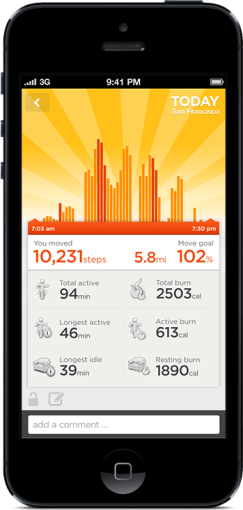
    Open up the app and you’ll see at a glance how you’re doing against your set objectives. A healthy target is 10,000 steps a day, but few sedentary workers can meet that. Because UP is an internet-connected service, it’s able to tell you what others like you (in age, gender, height, and weight) are averaging. In my case, the average most do is about 5,500 steps a day. I decided to set myself a high but achievable goal of 8,000 steps.

    What’s happened since? I’ve found myself striving to reach that by alighting one bus stop ahead of my destinations, taking the long way around the office, and going for more short walks whenever I can.

    It translates your activity into calories burnt, which it shows you alongside an estimate of how many calories you burn just resting, and a total for each day. Every now and then, the application shows you “Insights”; pre-written facts and advice tailored to your own performance. Examples include deciphering hidden patterns in your behavior and mood, and helping you understand terms like “you walked 8,000 steps” with statements such as “equivalent to walking across the Golden Gate Bridge and back”.

    Food logging

    This part is optional, but you can enter your meals (or just photos of them) to keep a record of what you’ve eaten. If they’re available in the online database, nutritional information is attached. It has the same effect as using an expense tracking app: it makes you acutely aware of every little bit you put into your body, and alerts your conscience to the unnecessary.

    In practice, having a vague idea of how many calories I’m consuming, coupled with the knowledge of how much I’m burning (or NOT burning, on idle days) has been powerful. If I know that I’ve only moved a minimal amount all afternoon, any random urge to snack quickly meets a mental roadblock — “Why would I need more calories?”

    Sleep quality tracking

    Like the popular Sleep Cycle app, the UP band can monitor your movements in the middle of the night, and map out your light vs. deep periods of sleep on a graph. And then at the best possible time close to your intended waking hour, it will silently vibrate in the morning.

    You are asked to set a sleep goal for yourself, and along with all the other data it collects, this is plotted over a timeline of days, weeks, and months, which illustrates how good you’ve been at getting the sleep and exercise you need.

    Social network awareness
    carousel-2-1
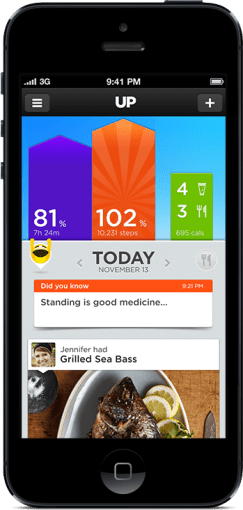
    This is easily one of the best features of the UP. Other people can be added as “teammates” and their activities populate your Home screen, turning it into an Instagram of physical activity. You’re encouraged to inspect their details, leave comments, or react with a small selection of emoticons. You might see that a friend had a healthier lunch, or walked far more than you, or slept better than you. These events nudge you into behavior change.

    When I started, one of the only people it found for me to add to my “team” was someone living in Japan that I only follow on Twitter and YouTube. I asked, she said ‘Sure’. I don’t know her personally at all, but I’ve found that reading UP’s activity feed is a unique interaction different from regular status updates. Being able to correlate your own physical state with another person’s through shared metrics, leads to a different sense of awareness; any encouragement you receive resonates that much more. Her most active day blew me away at over 24,000 steps, followed by 11 hours of sleep. It really spurred me on to try and find the time for activity. Multiply that by the number of people you follow, and the social features become an extremely compelling component.

    On my second day, two more people I interact with online bought their own. On the third, my girlfriend joined in.

    Fiddle-free Design

    While the UP is not designed to be worn and forgotten — its constant presence serves to remind you of your goals — it is designed to be worn and left alone. Its long battery life (about 7-10 days) is one of the ways in which this is obvious. Charging via USB only takes about 80 mins, which you can easily do while idle.

    In chasing this long battery life, the UP eschews Bluetooth syncing, which other products like the Fitbit and Nike+ FuelBand have. To sync the UP, one must remove it and plug one end into a smartphone’s headphone jack. Jawbone recommends doing this about twice a day to keep up with your own stats and update your team. On the other wristbands, one only has to start the app, and they sync wirelessly.

    I actually think this omission is a strength.

    Like how shooting on film frees you from constantly checking how the photo came out on the little digital screen, thereby letting you take more photos and experience the scene you’re in, not continuously syncing the UP creates mystery, anticipation, and actually lets you get on with it and not fiddle with tracking apparatus every spare minute.

    In his excellent essay about using a FitBit, Paris and the Data Mind, Craig Mod described looking at the LED display and seeing that he had climbed 96 flights of stairs one day. The next thing he did was walk halfway across the flat town of Palo Alto to the nearest flight of stairs he knew of, so that he could shift that number to read 100. It sounds like great exercise, but I don’t want to obsess over live numbers or end up conducting accuracy tests each day over how many steps it’s counting.

    The UP way, you’re wondering things like “will I break my record today?”, and if you’re extra competitive, “I hope I don’t lose to so-and-so,” as you go about your business. Sometimes, by not knowing, you exceed your targets. And then you sync at the end of the day, and it’s like waiting for lottery numbers to be called out. It’s its own kind of fun.

    Comfort and style

    up-by-jawbone-lowres-016

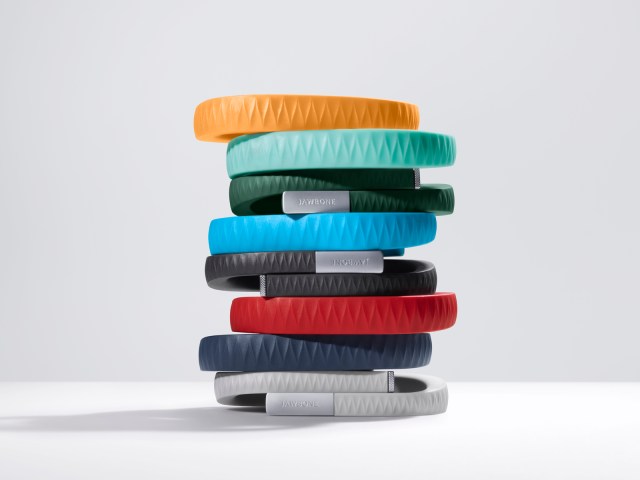
    The UP is available in 8 colors, of which 3 are available here in Singapore right now. I got the Black (sorry, Onyx), and it’s pretty nondescript and unlikely to draw attention. The brighter colors pop more, and show off a subtle zig-zag texture that identifies it as part of the company’s product range under design chief Yves Béhar. None of them are what you’d expect a “wearable computing device” to look like. The only button is cleverly hidden, looking like an integrated design feature. Two LED lights are embedded beneath the hypoallergenic rubber surface, and only visible when lit. It’s much thinner than the FuelBand, and could easily be mistaken for one of those Livestrong-type charity support wristbands from a few feet away.

    These things help with making the UP an invisible part of daily life, which gives it potential to succeed at being adopted by more. But as the wearer, I always feel its presence (at least in this first week). The routines I’m developing around the app, around thinking about moving more, burning more, eating less, around how my teammates improve themselves, are the very definition of behavior change.

    If having visualized, connected, and actionable data on your own body and movements sounds interesting to you, the UP will probably be a great addition to your life.

  • A Sudden Crop of New iPhone Photo Apps

    iPhone photography apps hit a sort of peak with Hipstamatic, Instagram, Camera+, 645 Pro, and Snapseed. The past few months have seen a few quirky apps being released (Gridditor being one that comes to mind), but most have been crappy knockoffs of the very successful but sadly neglected Camera+*, or silly ones for decorating your shots with candy-colored doodles or cartoon stamps.

    Very little for the serious photographer determined to replace a compact camera with an iPhone… until these came along!

    •••

    Blux Camera: The first app I’ve seen to offer the equivalent of what’s called “Auto Scene Mode” on most point-and-shoot cameras. The app applies a compensation scene mode based on what it thinks you need (taking local weather into account too). I’ve been waiting for someone to do this, but Blux seems to go even further with 14 filters, tilt-shift effects, and a futuristic, customizable UI that might prove too fiddly in actual use. Still, it looks very good and it’s free for a couple of days.
    Edit: Having tried it now, it’s not worth the trouble. Too much high-tech flash, not enough substance and usability. I’d put this at the top of the cheesy knockoff category.

    Alt Photo: This one has some real pedigree, like VSCO Cam, coming from maker of pro Photoshop plugins, Alien Skin Software. It has one of the best-looking brightness adjustment algorithms I’ve seen in an iPhone app (Mattebox has another great one), not to mention some nicely tuned filters designed to emulate film looks.

    Perfectly Clear: This just got a big 3.0 update today, with a fully redesigned UI and higher quality results. This is a one-function app — it tunes up lackluster photos with more clarity, color, and brightness — and it does it well. There’s now also the ability to remove noise for no extra charge; it used to be an in-app purchase. It even claims to recognize and brighten eyes, smoothen skin, and whiten teeth. That last one sounds like a joke, but there it is on the page.

    Scout Camera: A camera replacement app with a few nice filters, and the welcome ability to see and shoot in 1:1, 4:3, 3:2, and 16:9 aspect ratios, all live. It’s a shame you can’t change filters on a photo after you’ve shot it, and that you can’t import your own photos into its lightbox for editing. Hopefully the developer is looking into these things, because you can get those aspect ratios from 645 Pro too, and there’s little reason to make this your first choice in a pinch.

    Beamr: From the makers of JPEGmini, one of the best photo technologies I’ve seen in awhile (it crunches down high quality JPEGs to half their size, and your eyes won’t see the difference) comes this new photo sharing app. The app description is a bit confusing, but I think it uploads your full-size photos using the aforementioned tech, and then creates a flippable online magazine — oh god, those are back? — that you can send as a link to friends and family. The selling point here is high quality photos, not the recompressed junk you see on Facebook or other sharing sites.

    Photoset: Another sharing app, this one from Tumblr. It lets you very quickly create a layout of several photos by dragging them around, and then publish them to a webpage on Photoset.com or to an existing Tumblr blog. Pretty cool, and much more versatile than using something like, say, Twitphoto for impromptu sharing.

    • I say Camera+ has been neglected despite having recently been updated because of how unusable its filters look these days on brighter iPhone 5 photos, and because other much needed refinements never materialized. It’s like there’s nobody there looking out to keep it #1.
  • MacHeist 4 ends today

    MacHeist 4 ends today. The annual bundle has gotten bigger and better — just US$29 for a ton of apps and services worth 20 times more — but they’ve struggled to reach the minimum target of 25,000. That was how many needed to be sold before the premium bonus apps became unlocked for everyone. After 8 days into the 10-day window, they gave up and opened them anyway. Now they’ve finally crossed the mark (26,053 at time of writing) with hours left to go.

    There’s probably a longer article in here about why this is the case. Bundles like these used to make a much bigger splash, and I remember a period where Groupon-like daily deal sites for Mac applications were like… daily deal sites for free iOS applications. I guess that’s where the attention has gone now, and much of the spending intent has followed the growth in mobile platforms. Prices there are generally lower too, and I wonder if this means independent Mac apps have to start charging less, or more, to keep profits up.

    Anyway, I highly recommend you look into MacHeist while it’s available. 25% of the money goes to charity, and you get a 15-month subscription to Evernote Premium as part of it. I usually pay US$45/year for Evernote and find it immensely useful as a place to store all the webpages I see and want to have searchable, shopping and reading lists, wholesale documents for safekeeping, and snippets of data in an offline notebook whenever I go on a trip. It’s essentially a digitized version of your memory for sanity. There are also great games like Braid, Bioshock 2, and the episodic adventures of Sam & Max, Jurassic Park, and Strong Bad, from developer Telltale Games. That’s like… a hundred hours of gameplay.

    One great utility was added this morning: Bartender. It’s not a cocktail recipes app, the world hardly needs more of those, but a tool that sits in your Mac’s menu bar and subsumes all the other menu bar items into it. I’ve greatly cleaned up the visual clutter on mine (made somewhat worse by recent versions of OS X preferring to show menu bar icons in monochrome only), moving things like Bluetooth status, Volume, Dropbox, and my Jawbone status monitor into Bartender’s “bar menu”. Good stuff, and normally sells for US$15.

  • iPhone 5 Camera Comparison vs. Ricoh GR Digital III

    The new iPhone 5 features an improved camera, mainly in the area of image signal processing in the A6 chip, which reportedly allows it to do intelligent sharpening, noise removal, and pixel binning for low-light situations. The lens elements have also been rearranged, resulting in a slightly different field of vision from the iPhone 4S. There’s also the new sapphire crystal lens cover which resists scratches — unfortunately, I already have a tiny speck of dust on the inside of mine, which I’ll have to get them to clean at some point.

    I’m more interested in seeing how the iPhone 5 competes with other point and shoot cameras than with the iPhone 4S. Here are two scenes taken with the Ricoh GR Digital III (my review here), a high-end compact comparable to Panasonic’s LUMIX LX3/5/7 series, and Canon’s S90/95/100 cameras.

    The photos below are direct from camera and have not been fixed or enhanced. The GRD III is something of a prosumer camera, and if handled correctly, i.e. with manual controls and lots of fiddling, is capable of some great results. For parity with the iPhone 5, these photos were taken in fully automatic mode, letting the camera figure things out.

    Ricoh GRD 3

    I had to take this shot twice because the Ricoh chose a very shallow focus, directed on the leaves in the middle, which left the stone duck and foreground leaves blurred out. It’s a little underexposed, but the larger sensor gives some beautiful detail to the fern.

    iPhone 5

    The iPhone 5 analyzed the same scene, and chose to keep a relatively deep focus for a usable shot the first time around. The photo is also noticeably warmer (pleasant, but perhaps inaccurate) and brighter. This photo is good to go without any editing, which is how most users want it. No problems with sharpness in the details.

    Ricoh GRD 3

    The GRD had trouble focusing again, and ended up with a spot in the middle (above and to the right of her nose), which keeps the dog’s legs in focus but not the face. Although what fine details that were in focus got captured with a good amount of clarity, the photo is pretty dull and boring on the whole. Your aunt would not consider this a keeper without a trip to iPhoto.

    iPhone 5

    Again, brighter and warmer. I don’t think the iPhone makes everything warmer, only in shade and indoor lighting conditions. None of the daylight shots I’ve seen so far look overly warm. Sharpness is consistent across all areas of interest, and noise is acceptable for ISO 400. Fine fur details are not as well resolved as in the GRD photo, but this may be down to JPEG compression. Using an app that allows setting lower JPEG compression, such as 645 Pro, may compensate for this.

    For most purposes, I can’t see why the iPhone 5 wouldn’t be an adequate camera replacement. In terms of straight-from-the-camera usability, these photos are astounding compared to the GRD III, which used to cost in the region of USD$500-600 (it has now been replaced by the GRD IV model).

    I’ve gone on a few trips where I ended up taking all or most of my photos on an iPhone 4/4S, with few regrets. Focusing on the 4S was a little touchy, and it tended to take photos before focus had fully locked, if you hit the button too soon; this seems to work the way it should on the iPhone 5.

  • Why Can’t Twitter Be Like Foursquare?

    Turf Geography Club

    I never thought little ol’ Foursquare could lead the way for Twitter, but their approach to the third-party access and monetization problem shows more class and understanding. For the past few weeks now, instead of investing in a user experience that users would choose, Twitter’s stated solution has been to make their apps the only ones in town.

    Thanks to a tweet from @tarngerine today, I discovered Turf Geography Club, a location-based iPhone game built atop Foursquare’s place database, with additional Monopoly-like mechanics for upgrading and defending your property. It stands out from all the other “check-in and own this location” type apps by taking a flat-out fun (as opposed to a utility) approach: retro 16-bit style graphics, a Wes Anderson-inspired aesthetic (evident in the name, video trailer, and writing), bears, compasses, illustrated logbooks, and nonsensical references to an eternal struggle between man and nature.

    What I liked was how I could suddenly start using Turf as my Foursquare client of choice, checking in as I usually do, but also playing this separate, app-specific metagame at the same time. Likewise, I can choose to use Path to document my movements with friends, and share a subset of those actions to Foursquare, for my other contacts to see them. Or I could document something private in Day One, the journaling app, and still check in to Foursquare from there where the location made sense (publicly, without sharing the contents of my journal entry).

    Whatever you think of Foursquare and the people who use it, you can’t deny that this is what everyone would love Twitter to continue being, and what the company seems bent on defying: a confident social platform open to innovative ways of being used.

    Foursquare recently updated their mobile apps in a big way, taking focus away from previous key features such as Mayorships, and emphasizing discovery and recommendations instead. The Foursquare app is now really good at showing you things of interest nearby, in categories such as food, shopping, and sightseeing, based on recommendations from other users. I can’t get those in Path or Turf, but my one-way actions in those apps feed back into the enrichment of Foursquare. That’s reason enough for me to keep the Foursquare app on my phone in addition to all the other ones that offer check-in functionality.

    Twitter’s mobile apps also do a couple of things that third-party apps aren’t allowed to. It shows interactions that your friends have had on the service: tweets they’ve liked, people they’ve recently started following, and it shows supposedly personalized things of interest: local trending topics, and popular links being shared. The latter is where their advertising monetization is meant to happen, and it’s something that no one loves because it’s often dead wrong about what we want to see.

    Imagine if Foursquare’s app showed you places you would never go, or check-ins from people you didn’t know or like. What would be the value in that? Instead, contextual intelligence and expert data mining help Foursquare stay valuable and interesting to users when they want to explore, while their availability to third party apps keeps users active and in the equation. The people at Twitter can’t go wrong throwing everything behind the creation of that value, in the interests of long-term viability, instead of shutting down the future of their service that may come from apps like Turf.

  • Ten Days with Android & the Samsung Galaxy S III


    Fulltype7

    I’ve been an iPhone user since the first day it was possible to be one in Singapore. I love the platform, but I’ve been intrigued for awhile now by the larger-screened Android devices that I see every day on public transport here. Anecdotal evidence suggests that these enjoy greater acceptance and penetration in Asia than elsewhere in the world. The comments thread that begins here on an Asymco post are quite enlightening, for further reading on the Korean market.

    The short version of those insights, from memory: the Korean market is heavily dominated by Samsung, which predominantly makes Android devices. Koreans (and other metropolitan dwellers in areas of low urban crime must fall into this category — e.g. Singapore, Tokyo) spend a lot of time commuting on public transport. Large screen phones are more suitable for information consumption than tablets in such situations, where one stands in a crowd and holds a handrail; in some cases a single session may last 1-2 hours. An interesting phrase in one of the comments called Koreans “diligent information sponges”. It’s hard not to imagine a face glued to a large 4.8″ screen, hoovering up the day’s news and social media updates on the way to work. Games and movies are also better — I see many a Chinese drama series being watched on large phone screens whenever I take the subway. My theory is that personal security concerns may deter commuters in some cities from being fully immersed in such devices. I’d love to hear more opinions on this.

    More so than for users who drive or walk or have shorter commutes, where typical smartphone sessions throughout a day are counted in minutes and not hours, the impracticalities of a large screen are tolerated here. Women I’ve spoken to say they wouldn’t mind at all if the next iPhone had a screen that was as big as or nearly as big as the Samsung Galaxy S III (4.8″). They ‘can’t put the iPhone 4S in their pockets anyway’. The Galaxy Note seems impractically big, even to me, but I see many women here on a daily basis who appear to enjoy using it. The difficulty of one-handed operation does not seem to be a deal-breaker for the Singaporean/Korean/Asian user.

    So having managed to resist the urge to buy an unlocked, off-contract Galaxy S II a year ago at full price, just for research, I recently found myself fixated on the idea of getting the new Galaxy S III at a subsidized price as my contract comes to an end. Note that my first reaction to the phone was amusement, followed by dismissal. Their launch presentation was absurd, and had more than a couple of WTF moments (for example, one of the presenters slipping and using the word ‘bizarre’ to describe it). But within two weeks, I’d convinced myself I should get one. I don’t know how this always happens to me. I figured with 4.0 Ice Cream Sandwich, Android was finally ready for prime time.

    It’s been 10 days. Here’s what I’ve experienced.

    Almost immediately, I noticed that battery life wasn’t what it’s been promised to be. Android gives you plenty of ways to break down the battery meter (and plenty of ways to have a nervous breakdown watching stats). You can see exactly what percentage of power consumption is going to the screen, the cellular radios, applications, and so on. I discovered that my phone wasn’t going to sleep when the screen was turned off. It was actively trying to do something, but I didn’t know what. So I shelled out 4 bucks and bought BetterBatteryStats, which promises to identify what those behind-the-scenes “wakelocks” are. If you’re thinking that this is already sounding like more trouble than you want from your phone, out of the box, you’ll know how I felt coming from the iPhone.

    It turns out that it was a problem with Google Backup, a feature similar to how the iPhone will back itself up to iCloud over Wi-Fi each day when you plug it in to charge; except this phone was trying to do it all the time, apparently even over 3G. I turned the feature off, and things seemed to get a little better. The next big battery drain problem came from a background process associated with switching networks to find a good signal in areas of low coverage, except this was happening everywhere. My “Cell Standby” usage was at 30%, when Android users on other phones see numbers closer to 5-10%. Because I’ve encountered this complaint consistently from other Galaxy S III owners on forums, it could be a design or software fault.

    I then spent another day reading up about a feature called Fast Dormancy, which may or may not have been the problem, depending on whether or not my phone provider has optimized their network for it — all of the above a moot point, I eventually found, because Samsung disabled the secret menu option in Android that would have allowed me to turn it off like some American users found was improving their battery life. Oh yes, I spent a few hours messing around with these secret menus too. Remember typing in stuff like *#*#49090** into feature phone dialers, pre-iPhone? That’s still around.

    There also also many apps you can get for optimizing your battery life. Some seem to be nothing more than placebo task killers; others are more intelligent and can disconnect the mobile data network in intervals to save battery life. Unlike iOS, where push notifications are delivered via a single Apple-managed connection that’s probably kinder to battery life, many Android apps have to run in the background and do periodic checks. New tweets and emails, for example, can only be set to come in at 15, 30, 60 minute intervals, depending on the app.

    The built-in keyboard has pretty bad word prediction. You can install third-party keyboards. I’ve tried like four. They all have their own flaws. Don’t like the way the homescreen works? You can install third-party launchers. I’ve tried like four. You can guess they all have flaws. Android defenders point to this ability as a key strength. I’ll admit I had a little fun. I used to waste a lot of time on my PCs futzing around and hacking solutions to problems. But it’s far from optimal for most users. Speaking of touch controls, capacitive buttons are as bad as I’ve heard they are. The “Back” button area is extremely easy to nudge when holding the phone in landscape position, such as when you’re watching a film or playing a game. Even in portrait orientation, if you hold the phone tight, it’s easy for the fleshy bit of the palm under your thumb to creep over the edge and trigger it, exiting you from your current screen.

    Charging: The phone charges via a standard Micro USB cable, but when connected to a USB power source such as a computer, it charges very slowly. I’m talking upwards of 10 hours for a full charge. Online research suggests that for some reason, it only takes in a fraction of the power being delivered to it, if it detects that data could also come down this cable. There are instructions to DIY mod your cable so that it charges as quickly over USB as via an AC adapter. This was just too much for me, so I spent even more of my valuable time tracking down a cable that does the same job out of the box. It’s the McKal MM83A Supercharger cable. You’re welcome.

    After having gone through the things I have in 10 days, where the state and maintenance of my phone has been constantly on my mind, I think the drawbacks outweigh the large and beautiful screen on this phone (quality-wise, it’s not better than the iPhone’s Retina display). I haven’t even mentioned the lack of really solid Twitter applications on this thing, or how Path’s Android app is so inferior to the iPhone version, or how scrolling is still nowhere as fluid or as natural from a physics standpoint as it is on the iPhone, THROUGHOUT the iPhone experience. I believe scrolling can be quite different on Android, from app to app, but I’m not entirely sure at this moment.

    But when I hold my iPhone now, it feels wrong. It feels more like a little camera than a phone (the camera on the iPhone is tons better, as is the selection of photo apps on iOS — I have yet to find a credible, well-designed photography app on Android. There is nothing in the league of Hipstamatic, Camera+, VSCO Cam, Infinicam, Noir, TiltShift Generator, and many others I have happily paid for on iOS. The best ones are the ones that are also available on iOS: Pixlr-o-matic, Instagram, AfterFocus). The screen feels cramped, and it’s a little heavier and thicker than I’d like. I miss having the glanceability of Twitter/Facebook widgets on my homescreen alongside app shortcut icons (something that Windows Phone 7 gets a lot of praise for too). But other aspects of the iPhone user experience are beyond comparison. I don’t want to mess with battery settings and tweaks. I don’t want the ‘freedom’ to spend hours scouring the web for ways to make my phone better. I want a phone made by a solid company that I trust, optimized to the best of their ability in a combination of software and hardware design, so that I cannot possibly believe that I could do better myself. Because that frees me to do everything else. But I also want that phone to have a larger screen.

    Essentially, I’ve been paying to relearn a lesson I already did back in 2007 with the first iPhone. I’ll keep using it for now and see what else I can learn about Android (it’s beneficial for my work, anyway), but I’m crossing my fingers that whatever iPhone comes next will give me every reason to sell this off, and restore my sanity. When someone asks me if they should buy an iPhone or an Android phone, my new answer is “If an Android phone is right for you, you’d already know it.” It’s the right choice for those people, but not most, not the way it is now.


  • Everpix, The Rise of Centralized Cloud Photos, and The Decline of Flickr

    Everpix-web

    I signed up for Everpix last night and have been thinking about it all morning, even as I’ve yet to get my photo collection uploaded to it.

    In essence, Everpix is an online repository of every digital photo you’ve ever taken, supported by a background Mac utility that keeps it in sync with your iPhoto/Aperture/Lightroom, and an iPhone app that syncs your Camera Roll, and allows you to view your library in the cloud. Crucially, it also syncs with your online photos on Flickr, Instagram, Google+/Picasa, and Facebook.

    Every photo is private by default, and making an album (called a Moment), or part of it, public, gives you an obfuscated URL that can be shared with others. You can also publish photos ‘offshore’ to Facebook Albums, Twitter, and possibly other destinations.

    Philosophically, this is almost everything I want my Flickr account to be right now, but that they are so, so far away from achieving. I signed up for Flickr Pro to have an online backup of all my photos, with the ones I want to share set to ‘Public’ visibility. In the past few years, the internet has moved on, and we now share photos on other stickier social networks. There’s been a fair bit written in the past week about Flickr’s decline as a destination, and it’s because photographers at all levels are getting more views and feedback through Facebook, G+, and even other photo sites like 500px and Smugmug.

    Adobe had a go at cloud photos with a product called Carousel that was recently renamed to Revel (why?), but that effort tried to be an entire workflow, with a desktop photo management app that had half-baked Lightroom editing tools built in. Adopting a product like that involves a complete change of tools. Good for beginners, but bad for anyone comfortable with what they have.

    Everpix promises to meet us halfway. Use whatever you’re used to, and have all those photos in the cloud, with easy publishing to any and all online destinations through beautiful web and mobile apps. All publishing actions take place between Everpix’s servers and the other web service, so the user experience is simply that of instantaneous uploads. It’s the best of both worlds: backup and effective sharing.

    You can tell this is an important facet of the service because one of their core features is “Auto Curation”. Click a button, and the service picks what it thinks are your best photos, with clear faces, even exposure, and other secret sauce traits. Another click, and those are shared online.

    More than just disrupting Flickr, it also shows us what Apple’s iCloud Photo Stream could be, but understandably isn’t just yet. Rolling out free, unlimited storage and access to millions of iOS users would test their billion dollar war chest; the inevitable failures, their invaluable credibility. Everpix is a small startup in beta that I’ve decided to entrust with access to all my photos; I’m hoping their pricing structure, when revealed, will be reasonable enough to pay for.