Thanks to a series of early mornings this week, I don’t think I’ve felt very rested, despite my quantified self apps saying I’ve spent about the same amount of time in bed as usual. One of the things that usually happens when I have an early morning call or meeting is that I don’t trust my alarms and dream all night that I’ve overslept, and keep waking up. This happens before flights as well, so I’m just really terrible at anything that starts before, oh, 9:30am?
Monday was a public holiday on account of National Day here, our 55th anniversary of independence. Having to work on a holiday doesn’t happen too often, but it did this time on account of a regional project, but I’m planning to take the day later this month and get a long weekend to catch up on some reading.
I only managed a few more chapters of This Is How You Lose the Time War this week, but they were exquisite chapters. I love when you can sense the author having a load of fun.
National Day is usually marked by a military parade and a quasi-musical show performed at a stadium, broadcast live on TV. This year, they rolled the tanks and hardware out on neighborhood streets across the country so everyone could have a look from their windows (were they aware this is not usually a welcome sight, or that some countries have a real problem with this now? I’ll never know), and the weird song and dance bits were just beamed from a stage somewhere. Watching this live is usually quite cringey, but I leave it on in the background every year just to feel a little connected.
On Thursday, I went back to the office for the first time in five months, to pick up some mail and stuff in my locker (a fistful of cables and adapters, my SNES Classic Mini, whisky, stationery). There was no one around except for security, but it’s being cleaned regularly and all the lights were on, so it was like visiting a museum exhibit of life before COVID-19; everything on my desk perfectly preserved just as I’d left it. It brought back memories of the day we left, not knowing at the time how long we’d be away but certainly not imagining it’d be five months either. As I left, it was hard not to imagine it being the last time ever.
After that, I met up with a few colleagues for a pre-arranged visit to one of our usual bars in the area, since we’re now allowed to meet in groups of five and take our masks off for the purposes of eating. Which was initially surreal to be doing again in person, but very nice for a change.
Probably contributing to my feeling worn out were a few more social events, all delightful but so unusual these days. At one, there was an interesting conversation about how the music industry works these days, given that the host currently works at a publisher. I said that I used to think about record labels a whole lot more in the old days of physical products where I could read liner notes. Then, labels acted as a layer of curation and were effectively brands that stood for certain tastes or movements. The move to digital definitely changed the commerce around music, but I think the loss of liner notes was an underappreciated strategic blunder. iTunes tried to offer digital booklets for awhile but the take-up was low, and so today I’d be surprised if kids could even name two major labels.
I think people who don’t consciously try to discover new music either still rely on radio or just tap on curated playlists from their streaming service of choice (probably Spotify, given that it has a free tier). Those who don’t regard music as just background noise probably remember and consciously choose their favorite playlists, which are now clearly brands in their own right, like RapCaviar. And given that there are so many of them, in different states of being maintained by their editors/algorithms, it kinda makes sense to not only share songs and albums with friends, but also playlists.
I don’t use Spotify anymore, but that’s a rant for another time. While writing this, I searched my own blog to see if I’d ever mentioned it, but found this instead on the then-rumored Beats acquisition by Apple. I thought they’d extend the iTunes brand to include streaming music, but they chose to start over. Around these parts, most people I know still don’t understand what the Apple Music offer is about, or how it relates to iTunes.
While working, I often just put Apple Music’s Pure Jazz radio station on, but sometimes I like the BEATstrumentals playlist, which is their version of ChilledCow’s lofi hip hop beats to study/relax to. One recent discovery is Pop Deluxe, a playlist which describes itself as featuring artists who are “left-of-center, under the radar … pop’s modern vanguard”. In other words: catchy stuff hip people don’t have to make excuses for liking.
Two weeks ago I was listening to The Sunset Tree as a sort of throwback album. This week it was Bleachers’ Gone Now. Big melodies, saxophones, heartfelt anthemic choruses… another all-time fave.
A death in the family this week, which makes it the third time in six months that I’ve been to the facilities of Singapore Casket and the Mandai Crematorium. I’m even the mayor of the former on Swarm now (please, hold your congratulations). If this life is a simulation, then 2020 is the stage at which the main player has gotten bored and started unleashing disasters from the menu.
2.
Cooking isn’t something I do for fun or self-expression, assuming those are the main reasons why anyone does it when they don’t have to. Apart from putting some bottled sauce on pasta or reheating something already ready to eat, I don’t. But since it was her birthday this week, my wife assumed that I could manage a couple of meals if she wanted me to.
Although for the breakfast portion of this non-competition, I mostly assembled. Here’s how I described it to a chat group:
It was a round the world concept. Starting in Singapore with scrambled eggs that I tried to make taste like soft-boiled eggs with white pepper and dark soy sauce. It was a prototype. I have a new idea for it that I’ll try next weekend. Then we moved to the US with the fried sausages, but they were laid on an layer of laoganma sauce on the plate, representing the rising influence of China. Also, the sausages were subversively cut “Asian style” (diagonally, as per Kylie Kwong’s ridiculous statement I saw on tv once). Then we ended up in the safe waters of Europe with some smoked fish on geometrically arranged triangles of toast, representing Scandinavian design.
For lunch, I made a spinach, chicken, and artichoke recipe I found on the Food Network website. It’s loaded with a tremendous amount of cream and cheese that put me out for a nap later in the afternoon. Since we didn’t have any pimientos, I added paprika and this Singapore-made “gunpowder chili” powder product I got as a gift. Go easy on the latter, it’s nuts.
It went really well with this olive and cheese bread from our neighborhood bakery
3.
The range of f1.4 Sigma lenses for L-Mount I mentioned awhile back are now available in Singapore and I got the 30mm model (about S$430 including delivery). I haven’t taken anything except test shots, but it’s light and feels like a quality item. The grip is rubberized and the design language is clearly different from the closest equivalent Leica Summilux that I’m now NOT buying, but I doubt there are many quality differences I’d appreciate in their outputs.
It’s not my birthday month, but I sure contemplated buying more stuff! Sony released their long-anticipated WH-1000XM4 headphones, which look like a nice upgrade from my Mark 1 model (less so if you have the M3). But how much do we need the latest and greatest noise canceling these days anyway? For working at home or the occasional excursions back into public, I figure you’d be perfectly served by older 1000Xs, AirPods Pro, Bose’s QC35, or most of the other options that may already be in your closet. Sony does boast improved sound quality on these, though, but I’ve decided to wait for Apple’s iPhone event in the fall to see what the rumored AirPods Studio over-ear headphones look like. I’m hoping they’re more HomePod than AirPods, that is to say, actually focused on delivering audiophile-grade performance rather than mediocre sound propped up by usability conveniences.
A short entry this week, because it’s been largely uneventful outside of work. I returned on Monday and it was like being a kid on the first day back at school after vacation. Maybe you liked it; I didn’t.
I think I’m finally beginning to tire of the new routine, several months after everyone else was complaining about being cooped up, not going out for anything, and working from home. The lockdown here ended over a month ago, and by all accounts, the streets are busy again and people are in malls, seeing films, and eating out (with masks, of course), but I haven’t been doing much of that at all. We had some friends over the other night and they asked how I managed through the 10 weeks of isolation. I said I was still doing it, and it’s been 20?
But yeah, when I described the typical working day, it was depressingly simple. Just a short series of movements between rooms in the house, between laptop, coffee machine, dining table, and TV. It’s almost like being on a small space station or planetary outpost. This is not to say that I’d prefer being back at the office! But that life at least afforded some walking around lunchtime and a bit of ad hoc shopping.
I finished Lee Child’s “A Wanted Man”, and it was a yawn. At this point, I am only invested in the series’ first-ever story arc, which began in book 14 or 15, where Reacher just wants to travel to Virginia to meet an army woman with a sexy voice. All the books between that and #18 are just him on the road, slowly heading to Virginia and getting caught up in implausible international arms/drugs/human trafficking intrigues. The next book is #18, where it finally happens. But I’m taking a break.
We decided this weekend would be good for rewatching Denzel Washington films on Netflix, and made it through 2Guns and The Equalizer. I didn’t believe I’d ever paid to see a movie called 2Guns at all, and yet remembered enough of it to suggest that, yes, at some point in 2014 I’d bought tickets to go see a movie called 2Guns.
I can’t decide if I miss going out to see films or not.
It turns out earning interest on crypto isn’t a total scam (see Week 28.20). I got my first month’s payout, and it’s amazing that individual people can now play the role of financial institutions and profit from it, albeit without the chance of being bailed out by a government when it all goes wrong.
I’m not sure how it happened, but I started hearing songs from The Mountain Goats’ The Sunset Treein my head. This happened again and again, and now I’m listening to it. Maybe it’s connected to a point in my life (I think I was in university, and discovered it while a subscriber of the eMusic site — you paid a fixed monthly fee and could download a few albums worth of DRM-free MP3s, legally). Somehow, it’s become one of my favorite albums.
I took most of the week off from work. It was vacation time scheduled to coincide with last week’s wedding, and I was expecting to be in the UK in the midst of summer. Maybe I would have had a crappy Carling and a Pot Noodle for old time’s sake.
Instead I spent about three whole days roaming the plains and beaches of 13th-century Japan in Ghost of Tsushima. It’s pretty much Red Dead Redemption meets Assassin’s Creed in a new setting. It’s been years since I sat down in front of the TV and played a game for hours until my hands felt stiff and the controller’s battery needed topping up. I’d normally consider that an achievement of leisure but it felt kind of empty. By the fourth day, I realized this and put it away to get some reading done instead.
Theory: video games are a great way to pass time quickly, but a lousy way to make use of treasured and valuable time. If I was in jail, I’d love to have my PS4. But if I’m using up the rest of my leave for the year, and want the hours to last and feel meaningful? A stack of books, no question. So much time just evaporates while you’re riding your horse from point A to B, or completing templated side quests to help someone find their lost sister or whatever. It’s not like watching a film; many moments are completely disposable. I still love the virtual tourism of exploring a new world (and maybe VR would make all the difference here), but maybe I did too much of it all at once.
As soon as I switched gears to reading, it’s like time slowed down, and the experiential resolution went past anything 4K or 8K graphics are capable of. The signal to noise ratio was just not comparable. So that’s my advice to all the other old lapsed gamers clearing vacation time in a pandemic: leave the game marathons to when you go on sabbatical. They’re just empty calories. One exception comes to mind: when I played 140 or so hours of Animal Crossing at the start of the lockdown, it didn’t feel wasted. Maybe because it was more “creative” and I was putting my own island together. In contrast, triple-A open-world games just feel like coloring books for adults?
I also visited friends who’ve moved back to Singapore and found themselves a lovely new apartment, and the night ended with everyone playing Overcooked 2 (admittedly my first time), which was so much fun that I came home and bought the first installment for my Switch. “Get the divorce papers ready”, they said. That’s definitely something games have over books.
The first two above are thematically linked, and highly recommended. The first one builds a world where time travel just exists (and in a wonderfully weird and unexpected way), and the second finds a clever opening for approaching said time travel, but achieves an epic payoff that must surely have gotten it optioned for a film adaptation by now. After reading Recursion, I don’t have much anticipation left for Tenet because it’s not going to be in the same class. No way. I’ll probably follow them up next weekend with This Is How You Lose the Time War by Amal El-Mohtar.
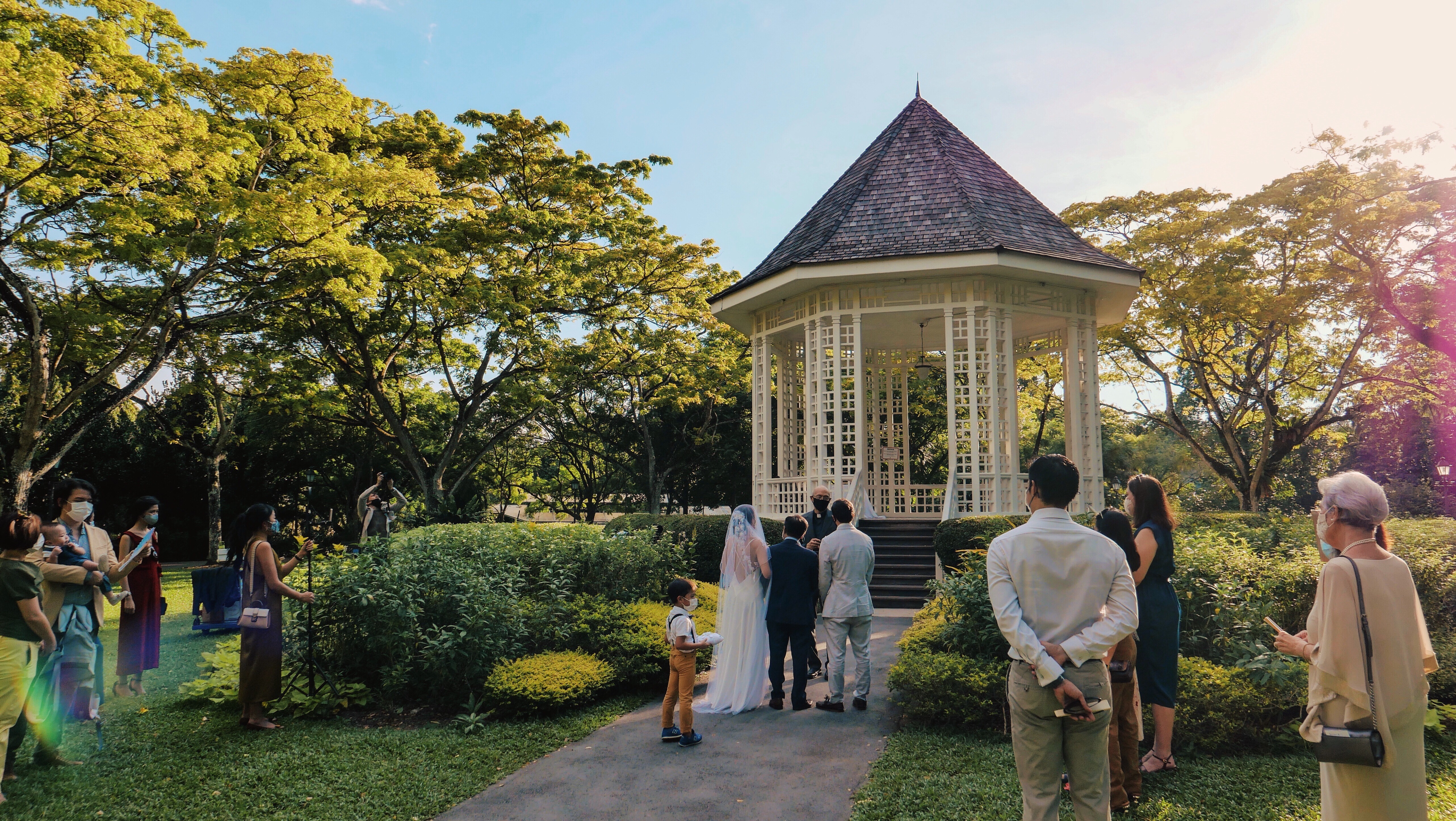
We had a wedding in the family this week, which was planned to be in the UK, before things got unusual, and so took place in the local Botanic Gardens instead. Permits were obtained, numbers were restricted, and everyone wore face masks for most of it, but apart from that it was very nice.
I brought my D-Lux 7 along and got some workable shots. I love that it has that old Panasonic trick of natively changing aspect ratios from the sensor instead of cropping, for when you need a wider angle. The alternative was the CL with 18–55mm Vario-Elmar which would have been useless in the evening (f3.5 and no IBIS). But by the time we were having drinks on a rooftop, the only camera that could reliably see anything was the iPhone 11 with its Night Mode.
Technically the worst photo I kept thanks to the lens flares, but hey no faces to be recognized!
The weather service says we’re in for storms and 22ºC nights in the days to come, which is highly unusual here in Singapore. Standing out in the fading sun at the wedding after 5pm was a rather sweaty affair, to say nothing of being out at noon. I think the average nighttime temperature must be around 28–30ºC, so I’m looking forward to seeing this.
Segue to things I’ve seen: the Snowpiercer TV series on Netflix. Am not a fan of any Bong Joon-Ho film I’ve seen apart from Parasite, so have not been keen to put the film on my list, but am slightly curious now that I’m done with the TV adaptation. It was not a complete waste of time. Fully expecting to be hit over the head with Themes will make it easier to go in, I suppose.
Better things I can actually recommend: John Schlesinger’s Marathon Man (1976) starring Dustin Hoffman, Laurence Olivier, and Roy Scheider. It’s even on Singapore’s Netflix so it must be widely available everywhere else. I’ve seen snatches of this on random late-night TV screens over the years, but never the whole thing. They don’t make them like this anymore — it’s generous with scenes and shots that exist just for world and character building, and you’d never say it needed tightening.
Aaron Schneider’s Greyhound (2020) starring Tom Hanks is worth whatever Apple TV paid for it. I read an interview where Hanks said he was upset that the film wouldn’t get a theatrical release because it needed to be seen on a big screen. We saw it last night with the lights down, virtual surround sound bar cranked up, LCD backlight at maximum, and it was a thrill. Don’t see this one on your iPad.
Patrick Vollrath’s 7500 (2019) starring Joseph Gordon-Levitt is a gem of a hijack movie on Amazon Prime Video that’s practically a play. I know a couple of aviation nuts who’d love its opening minutes, devoted to the pilot and co-pilot’s pre-flight routine of checking meters and flipping switches amidst small talk. It’s a rarely seen moment on screen, rendered with a lavish amount of mundane detail and realism that sets the tone for a film that takes place almost entirely in the cockpit.
7500 got me looking for more quiet-but-intense films set at night or in relative darkness, because they’re perfect for watching in bed. I also quite enjoyed Into The Night, which makes me think maybe I just want more films set on planes? Anyway, this eventually led me to a subgenre of YouTube mood videos not unlike lofi hip hop radio – beats to relax/study to, but a blend of rain sounds, faint jazz BGM, and cafe noises. Check this one out.
I bought Ghost of Tsushima because I couldn’t resist a graphically gorgeous open-world game set in feudal Japan, Western gaze or not. One of my long-time wishes for the Assassin’s Creed series was for them to do a Japanese edition, but they arguably waited too long and now no one cares. This also marks the first time in at least six months that I’m turning my PS4 Pro on. The Switch can’t compete on looks, but not having to commit to significant time in front of the TV means a lot.
I was wondering what book to read after Cryptonomicon and fell back into the easy, brainless comfort of another Jack Reacher novel by Lee Child. This time it was #16, The Affair. It stands out for being a prequel to all the others, written in the first person. Now that I’m done, I think my next book will be some kind of SF.
We have a baker across the street who does pricy (and good) pies, tarts, cakes, and various breads out of his little shop. And since we’re home 99% of the time now, I’ve been trying to buy more things from the neighborhood, hyperlocal spending and all that. The bakery especially, since they don’t sell on delivery services. That said, my mother is in the habit of making the 20-minute trip to buy their quiches (not to see me!) This week I started buying big slices of cake as after-dinner treats. No danger of the pandemic weight gain reversing soon.
Yesterday was polling day in the local elections, and we were given an afternoon window of about two hours to show up, line up, have our temperatures taken, IDs scanned, and our votes cast. There were bottlenecks in the morning, and stories of old people struggling to put on mandatory plastic gloves after having their hands sprayed with alcohol — how nobody in the Elections Department tested this and realized it would be impossible to do quickly, I don’t know. By noon, the gloves were optional. By the time we voted, the entire process was over in 60 seconds and we were headed home.
I caved and installed the first(!) public beta for iOS 14 on my primary phone, which I use for both work and personal purposes. I filed an Apple Music bug within the first 30 minutes, and noticed a few other issues like how the OS think it’s using 90GB of free space for “Other” temp files. According to Reddit, this is widespread but doesn’t actually mean my phone is full, so, okay. It’s surprisingly stable otherwise.
The way I organize my home screens has evolved over the years, particularly after folders were added, but it’s been simple: the first page is for apps I’m likely to need often, the second page is for all my camera and photo-editing apps, and the third is for games. The fourth is where junk goes. Now that there are large widgets vying for real estate (the Files widget can take up the room of 16 icons!), and an App Library where you’re meant to keep all but the most immediately needed icons, I’m having to rethink the whole approach and get comfortable with a totally different model. Of course, no one is forcing me to use widgets or change my ways, but I’ll take the opportunity to maintain some neuroplasticity.
A friend told me last year about services that let you gain interest on your cryptocurrency holdings, but they were small UK companies and I didn’t particularly feel like going through the trouble at the time. The premise is sensible though, if not free of risk. If you’re going to be holding currency in any form, you don’t want it stagnating and not earning interest of some sort. These companies will loan out your capital to others, and in return you get interest rates ranging from 4–8% per annum. Which is stunning compared to any traditional savings account, and makes one wonder how high the risk is. But if you’ve got money in crypto to begin with, what’s a little more risk? It seems this has now become a “mainstream” offering at several exchanges and so I’ve decided to give it a go with what little I have. Perhaps I’ll regret it.
I’m pinching an idea from Michael Camilleri’s blog: what he calls Weeknotes. I like how the bullet format keeps things simple while the weekly cadence provides a structure that will hopefully mean I update more.
There was some mild pain and inconvenience this week dealing with Apple over the phone for an iCloud Drive issue. My free space was 13GB less than what it was supposed to be. It’s sorted now and I wrote about it here, but little failures like this make it hard to rely on iCloud and move away from Dropbox and Google Drive.
I was reading a lot a couple of weeks ago when I was on vacation (at home). I think I finished 9 novels in three weeks, including 1Q84 which comes close to about a thousand pages. Then I went back to work and simultaneously started on the massive Cryptonomicon, the combined effect of which has put the brakes on my Goodreads progress. Maybe because the last few things I read were mindless Jack Reacher novels, this one was an exhilarating change of pace. I’m still astonished a mere human being sat down and created something this wild, violent, complex, and also funny. I finally finished it this weekend and can’t imagine what to follow it with.
I’ve written too much about HEY already, but you know you’re all-in on a new email address when you change your main daily logins and usernames over to it. That’s now been done.
On the subject of email, my mom was cleaning up around the house and found some I’d sent her 20 years ago. How? She’d printed them out and kept them in a folder! She gets the last laugh, though. Not only did I forget even owning that old email address, I think all that pre-Gmail history is just gone; I don’t have any record of mails sent or received. If I had to guess, I used a hosted POP/IMAP server and a local mail client (maybe Eudora? Thunderbird?), so it was first lost during the move to Gmail — I don’t believe importing from elsewhere was supported, and I guess I’m fragmenting my email history again now by moving to HEY — and then totally lost during a PC transition. How do we still not have a universal personal data vault solution?
Unsplash gets photographers to give their work away for exposure — a deal that never goes out of style in the creative industry. But so many have volunteered to do it that the site is now a very useful resource for people looking for free images. I often use it when I need photography for presentations, and I‘m familiar enough with some of the best photos to recognize them popping up in other people’s decks.
Since I haven’t sold any of my photos for money in quite awhile, and the idea of seeing otherwise unused photos appear someday in someone else’s deck seemed like fun, I’ve now become part of the problem. I trickled four photos in over six days, and they’ve already been viewed 3,000 times. I suppose I’ll keep going.
I switched mobile providers after a year and a half with Circles. I’m still amazed at how easy it is now, and how bad things were before. You just sign up online and someone shows up at your door the next day with a SIM card! Your number is automatically ported the day after! Used to be you had to go to a store and sign many papers and wait a week, and occasionally even call your old telco to break up with them. Not to mention contracts are out of fashion. Progress. Since working from home, I’ve barely used any mobile data since there’s WiFi. I’m sure it’s one reason why I was able to find a more generous deal on the market. They’re probably happy to hand out massive data allowances now that most people aren’t going to use them.
On Friday night we went to hang out with a friend who lives down the street, and her kids stayed up with us as an excuse to play more Animal Crossing Pocket Camp and Minecraft. It was nice to see them tapping around proficiently and being engrossed in designing worlds. Even at the age of six! Lego has its limits, and we couldn’t work with dream material in such a direct way when we were kids.
Season 2 of Hanna is out on Amazon Prime Video. Seems like this time it’s not just one coming of age story, it’s a genetically modified school of them. I saw the first two episodes last night and the fight scenes were so clumsy, it broke the elite assassins world-building for me.
It was the Chinese Dragon Boat Festival recently, but I prefer its other name, the Dumpling Festival, because come on, that’s really the part we all care about. I’ve always known these pyramid-shaped rice clumps as Bak Zhang/Chang, but I guess they’re also known as Zong Zi. They look awful but are mad good, and I can’t think of a taste reference point in the world so you’ll just have to try and get some. I spent nearly an hour on Tuesday trying to find a good delivery option while salivating wildly, and eventually managed to catch the Kim Choo Kueh Chang company’s online store in a good mood (if it’s down, try, try again).
I looked for a good chart to help explain Bak Chang, but you’ll have to make do with this low-res copy someone sent me. I couldn’t even find it on on Tidbits Mag’s own website.
It was with some dismay that I read Apple Arcade is looking to change up their curatorial strategy, and cancelled some games in the process. Hopefully the affected developers will be able to fund and continue their projects via Kickstarter or something.
What made the service so refreshing at the start was its dedication to art and quality, stickiness and engagement metrics be damned. You paid a subscription fee, and got access to a peaceful library of games that didn’t try to milk wallet-attached endorphins out of your brain. We got delightful little experiences like Assemble with Care and WHAT THE GOLF?, and I stuck around on the promise that we’d get a steady stream of those. Well, it seems that train has stopped because somebody upstairs wants more addictive games that will keep people subscribed past the free trial.
One example of what Apple wants, according to Bloomberg, is Grindstone. I personally love it; a fun pick-up-and-play puzzler, and an evergreen game you could easily be playing years from now. But not every game needs to be a Grindstone, and there’s only room for one or two Grindstones in my life at any time. These are games you use to soak up free time, go-to icons for when a moment appears while in line for something, or on the bus. There are plenty of them already on the App Store, so Apple Arcade should supply a breadth of other experiences.
I see the potential of Apple Arcade as analogous to the Apple TV+ strategy : quality over quantity, unique visions only. A change of course so soon comes across as a lack of courage. It’s a long game, so to speak. If people aren’t staying past the trial, maybe they’re not reaching enough of the right people who’ll be their early adopters. Even Airpods didn’t take off immediately.




 sangsara.net