Tag: Technology

  • The Stars Have Aligned

    I was surprised to learn that astrology is experiencing a comeback amongst millennials, thanks to an app called Co–Star that has been steadily growing beneath my radar. When a decade-younger friend sold it to me over drinks last week, the most interesting thing about it to me was its inexplicable use of an n-dash in the name. I installed it for a look, saw a personality trait in the natal chart* that didn’t quite match my self-image, and promptly forgot about it until the push notifications started arriving.

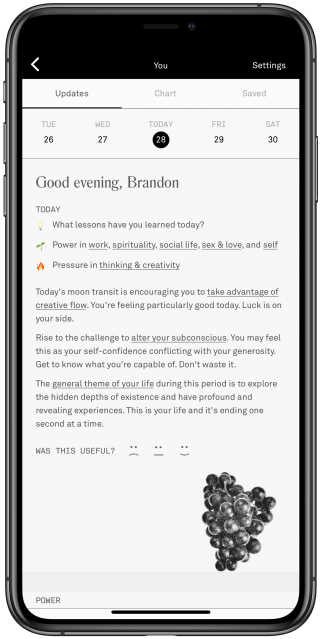
    Screenshot of the Co–Star app

    These nudges are titled “Your day at a glance”, and are so iconic to this audience that the Instagram filter creator known as autonommy has made one that superimposes Co–Star notifications over your head. They’re usually a single mysterious line or proverb that you’re meant to contemplate as things happen to you.

    Yesterday (an uneventful day), I was assured, “You don’t have to be afraid.” Today, it asked, “What lessons have you learned today?” Tapping into the app unleashes a torrent of AI-assembled advice that tells you how to deal with the challenges of existence as per the day’s astral alignment. The tone of voice is often surprising: acerbic, blunt, even dark.

    Instead of deleting the app as I meant to do, I discussed it with some people around me and shared a Verge article about the team behind it, and now I’ve got irl friends on this astrology social network, and we can see each other’s fates and compatibility, and I think I’m keeping it? It’s not like I’ve suddenly taken horoscopes at face value, but perhaps it fills a gap — I need someone to regularly kick my ass on personal development, and whether I agree with the “advice” or not, these prompts might get me to work a little harder at things. They’re challenges.

    Coincidentally, I spent much of yesterday reading through the backlog of email newsletters I subscribed to and then got overwhelmed by. When someone’s thoughts on screen are a year old, making reference to events that you and the internet are so over by now, but the words remain productive, insightful, and capable of inspiring you to look back at your old email newsletter project from 6(!) years ago and maybe start writing on your blog again, they can have all the paid subscription money. If you’re in need of a couple recommendations: try Dan Hon and Craig Mod’s.

    There’s always a voice gently suggesting I “write more”. Sometimes I think I write enough at work as it is. As the activities that make up my day job changed over the last few years, so did the emphasis on actual writing as a vehicle for Client Value Delivery. It took awhile to join the dots between the kind of writing I did in advertising, publishing, side projects, and now in a design/consulting context, but that still leaves out the “pleasure writing”, as one acquaintance recently called it.

    Right now, I’m feeling out of practice and clumsy when it comes to this stuff. I don’t know how to write to you anymore. Maybe I cut down on tweeting and blogging because we all entered a digital privacy crisis, but the net result was falling out of the public writing habit altogether. I lost imaginary friends.

    So. Why not try again? What do I have to be afraid of? What lessons am I learning today?

    *Those natal charts: You plug in your date/time/location of birth, and it pulls historical NASA data to see where celestial bodies were when you were born, and interprets their deviations in space each day to produce your horoscope. Are these even called horoscopes? I don’t know; that word seems dated and quacky, like something in a crinkled copy of Reader’s Digest, whereas Co–Star feels like something new — a bit of not entirely serious millennial wellness — dressed up in ancient clothes.

    A couple of years ago, we had a colleague from Hong Kong in town who would do the exact same thing as a party trick, except she manually read and interpreted the natal charts which she generated using a Chinese app. Co–Star has simply scaled this with technology and a content team.

  • Autumn in Japan, and some observations

    Autumn in Japan, and some observations

    We paid Tokyo and Osaka a visit last fall, following up on my life’s goal of visiting Japan at least once every two years, and nothing disappointed — not the food, people, weather, galleries, nor multi-storey complexes designed to make me buy media and electronics. As Craig Mod alluded to recently on Twitter, Tokyo is a place that fulfills the city’s promise as a tool for human life.

    https://twitter.com/craigmod/status/951372392986681344

    The thing I love about its density and intensity is how that translates into support for all manner of subcultures and obscure hobbies. Today, you can barely find a functioning and interesting bookstore in Singapore, while in Tokyo it’s not just bookstores that thrive. One can wander into massive stores selling model train and forest diorama-building supplies, or records curated from a specific period, or vintage camera parts emporiums. We’re not large enough to incubate that kind of diversity, and the city dweller’s life suffers for it.

    The retail industry in Singapore is in decline, or so the news outlets tell us every day. I wonder if they ring the same alarm bells in Japan. Online shopping and its infinite inventory can fill the gap a brick & mortar apocalypse would leave behind, but digital ~~replaces~~ overwrites our collective memory of browsing and inspecting these items in a physical space. I think it’s really important we don’t lose that, because, as one of my company’s founders is fond of saying, technology might change fast but people fundamentally don’t.

    (more…)
  • Singapore Gets An Apple Store

    Singapore Gets An Apple Store

    Finally.

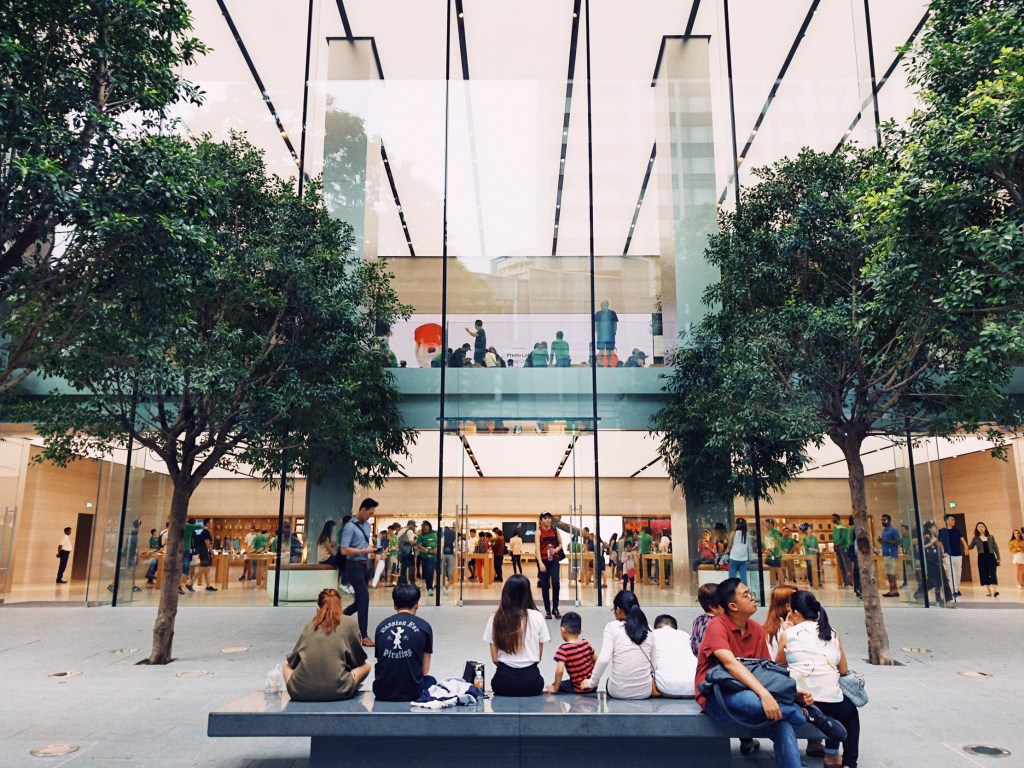
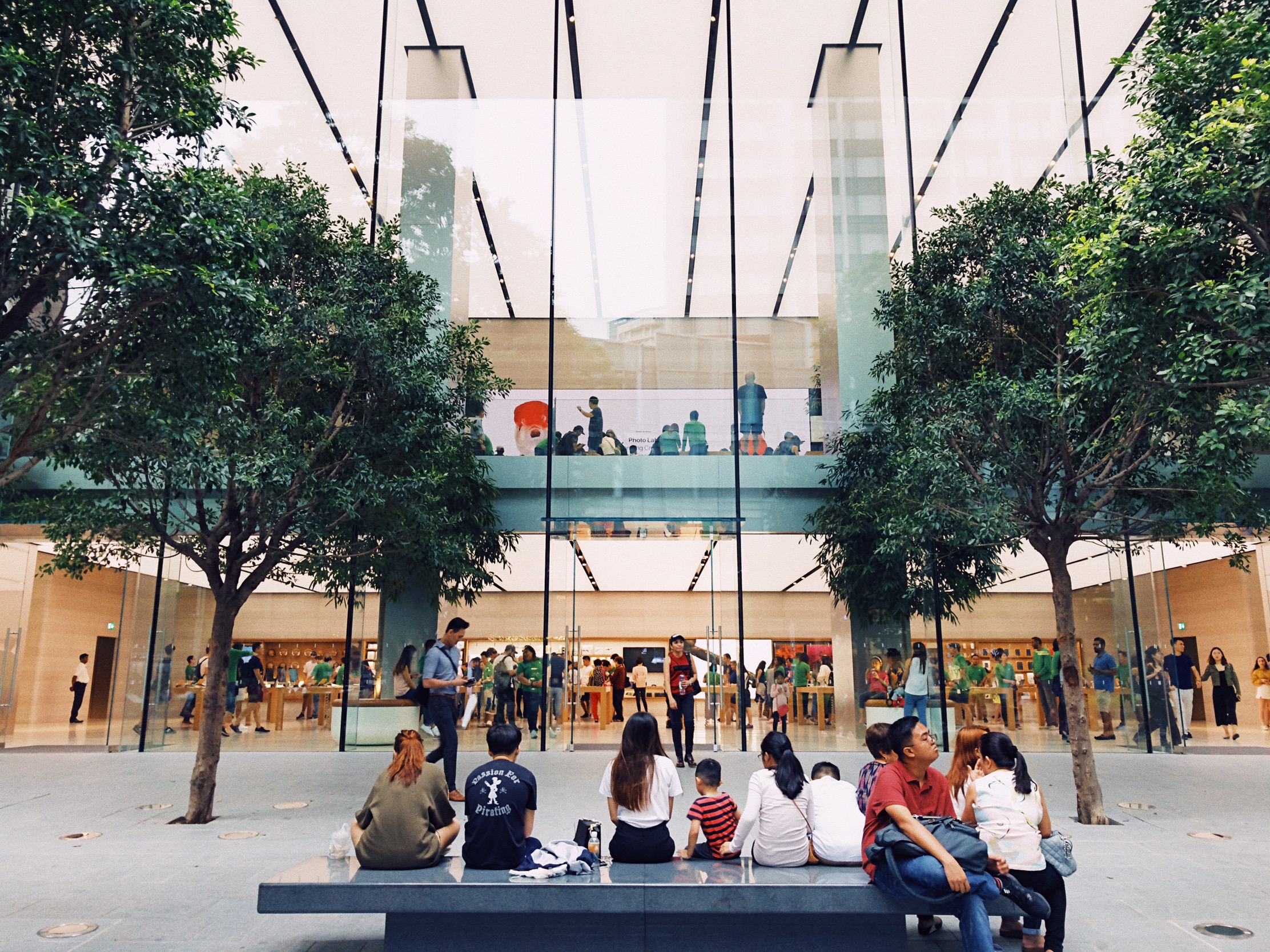
    After years of waiting, Singapore got its own Apple Store on Orchard Road (where else?) in May of 2017.

    I’ve been in the ecosystem for about 14 years now, and getting good sales service and support from third-party resellers has been consistently hard. Back when Funan the IT Mall was still around, there were a few small shops that knew what they were doing with Macs, but for the most part, the bigger chains gave people bad advice, installed RAM chips facing the wrong way, and stocked some pretty abysmal accessories at outrageous prices. Apple Retail have done all of the above on a bad day, too, I’m sure, but at least they’re held to higher standards.

    The two-level store follows the recent round of store designs by Norman Foster, with lots of large indoor plants and round headphone stands on the far end. You get upstairs via a symmetrical pair of spiral staircases cut into cool stone walls on either side; no glass staircases or elevators here. I read in some press release that the materials are meant to echo the Apple Park campus’s design language, which I guess is … fine.

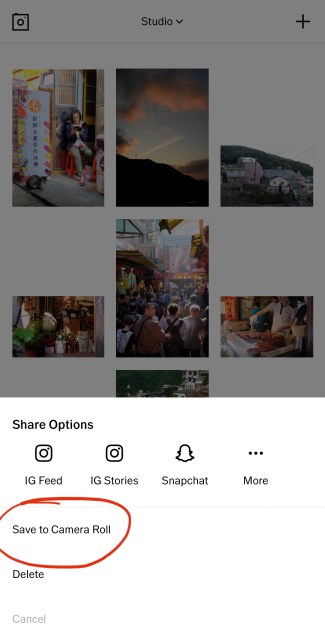
    Processed with VSCO with kp8 preset

    While it’s nice to have a place to buy devices and “feel part of a community” with the new Today At Apple events, I think the main benefit of having this here is going to be accessible, proper customer support in the city. I’ve been down to industrial parks way too many times to get my iPhone looked at in the past, and it’s not fun.


    A word about my current setup, for future reference: I’ve not bought a new Mac in 7 years. The current iMac struggles along and is only used once every couple of months to do the things only a Mac can do for arbitrary reasons. I get most of my work done on a MacBook Pro supplied by the company, but for personal use, my iPhone and a couple of iPad Pros do everything I need or have time for. The 12.9” version gets a lot of use as a desk-bound typing machine and a bed-bound Netflix player, which is really underutilizing it, I know. The smaller one gets taken everywhere because of its size, and I’m hoping for it to replace the MBP for a lot of little things at work like note taking and task management. Who wants to bring a big laptop home every night anyway?

  • iOS 10 Makes the Timeline UI a Reality

    Wired: Apple May Have Figured Out the iPhone’s Most Promising Feature

    3D Touch is instrumental to Apple’s newly rethought lock screen, in a way that could fundamentally change how you interact with your iPhone.

    But with iOS 10, you’ll use your home screen a whole lot less.

    This article from Wired today recalls the thinking of many UX designers who believe that homescreens tiled with app icons will soon give way to a new kind of smartphone UI: the timeline. Over the last few years, both iOS and Android have been making their notifications richer, with simple functions like deleting new emails, quickly replying to texts, or faving tweets, amongst others.

    lockscreenBut iOS 10 looks to be taking it to a whole new level. iPhones will light up when you raise them, and interactive notifications can expand into whole widget-like apps with live maps and data, and house more complex options than a dialog box or text input field can provide. And the best place for this new timeline UI to live is on the lock screen of your phone, the starting point of any interaction, and an arguably more valuable space for accomplishing tasks than the homescreen.

    And it’s 3D Touch, launched to public disinterest with last year’s iPhone 6S, that’s been the missing piece all along. Without pressure sensitivity and Apple’s Peek & Pop gestures, a self-activating lock screen might be a pretty bad place to have action buttons that can accidentally touched. I’d be interested to see how it works on phones without it, such as the new iPhone SE. Perhaps they just won’t have Raise to Wake.

    Also worth remembering that this new timeline of Things That Need Your Attention Most will live beside the Today screen of widgets (swipe to the right), which should do a lot for the idea that we’ll all be unlocking our iPhones a lot less and getting stuff done quicker later this September.

  • “Onions” Breaks One of Apple’s Oldest Advertising Rules

    Apple’s new iPhone ad departs from some of their oldest and most inspiring advertising by making fun of what customers do.

    I’m curious what people make of the new iPhone 6S ad from Apple, the comedy one called “Onions”. On the surface, it looks like another one of the fun, irreverent ads that have been made for the 6S series so far — the previous ones leaned heavily on their sassy, self-reflexive voiceovers by the actress Lake Bell. It only has a brief product demo lasting about 3 seconds, followed by nearly a minute of story; it has a celebrity appearance; some humor; and a quirky sign-off that says “Onions on iPhone 6S” before “Onions” becomes “4K Video”.

    While I enjoyed it, I think it perverts one of the unspoken rules that have made past Apple ads great. The people in those ads were always more creative, more talented, doing better work, and living fuller lives than the average viewer. But the ads seemed to believe that you were that person, and always spoke up to you. In other words, they assumed the best of their customers.

    That’s just a company that knows how to utilize aspiration. You see it in fashion advertising, but you’re either model material or you’re not. When it comes to products that let anyone create, the dream is ever alive!

    The Apple Pencil lets an artist draw beautiful lines, an app on the Mac lets a young musician record a touching song for her mom, photographers take billboard-worthy photos on their iPhones, an architect edits blueprints on his iPad Pro at the coffee shop, a misunderstood teenager cuts a family film over Christmas. These are scenes you’ve probably seen, and I’ll bet they inspired you to make more stuff more often, or convinced you that upgrading to the new one would upgrade the quality of your work, or both. The examples were aspirational, but completely relatable.

    “Onions” takes a different tone. It’s a somewhat sarcastic, belittling parody that pokes fun at what its protagonist shoots, pretending to have a bit of fun with exaggeration. It says, “this is what YOU will probably make with the power of a 4K movie camera in your pocket, and this is what you probably think it’s worth: an award presented by Neil Patrick Harris. So, please enjoy your comical fantasy!”. Instead of showing an example of great accomplishment, as was the tradition, it goes for the cheap laugh. It fails at showing us something we should aspire to achieve with an iPhone 6S of our own. It’s an odd departure from a winning formula that has long defined the brand’s outlook on technology enabling creativity, and I hope not to see many more like it.


    I also watched Samsung’s new celebrity-laden ads for the Galaxy S7 phone, and some of them were really entertaining, well-written, and funny. A couple fell flat.

    In comparison with Apple’s style, about 3 of them featured Lil’ Wayne absurdly pouring bottles of expensive champagne all over his waterproof S7, which made the existence of that feature absolutely clear, but didn’t do anything to make me want one. I’m not in the habit of intentionally drowning my phone.

    The waterproofing ad that worked better? A script that meanders about how water is everywhere on earth, making up 72% of our bodies, etc. etc. before ending on a scene where a phone gets dropped into a fountain while taking a photo. The owner picks it back up, and continues getting the shot, no beats missed. Anecdotally, lots of phones have been dropped into water by people I know, and I think this crucial point would resonate with them. A relatable real life moment, real people, and a real problem we’d love to suddenly go away overnight.

  • iPad Pros

      
    When the 12.9″ iPad Pro was first unveiled, I was pretty sure I didn’t want or need one. Then I held it in the Ginza Apple Store while on vacation and bought one later that same day. The experience of holding such a large screen in your hands and touching it directly is more impressive than it sounds. But what you won’t realize while handling one in the store is how heavy it gets once you add a Smart Cover or Smart Keyboard and a silicone case for the back, if so inclined.

    In the couple of months since, I’ve merely used it like a big iPad, watching movies in bed and occasionally reading comics or news on it; that sort of thing. But I knew it was meant for more and wanted to try bringing it to work with the Pencil and Smart Keyboard. Spoiler: it’s awesome, and I could probably do a lot of my daily stuff on it while moving easily from meeting to desk. The main problem has been its weight, especially when carried in my bag with a camera and power bank and umbrella every day. It’s also too much to hold in one hand while sketching with the other.

    So after a few weeks of deliberation and bugging other people with the pros and cons, I decided to pony up for the new 9.7″ size and try to see if I could make justifiable use of two iPad Pros in one life. The Smart Keyboard hasn’t arrived yet, but I expect it will be even easier to type on than the Logitech and Belkin ones I’ve had for earlier iPads. The size and weight are perfect for one-handed use with the Pencil, although the back is slippery without a silicone case. I don’t think adding one is worth the weight gain, though. The larger iPad Pro is going to stay home and try to become a desktop computer in place of my ageing 2010 iMac. It was an unnecessary and guilt-inducing expense, but the thing that helped justify this dual-iPad setup was asking why I’ve allowed the iMac to go so long without an upgrade.

    I got old! Which makes one treat computers differently, not to mention the nature of the tasks have changed.

    Years ago, I would replace my PC/Mac every couple of years, usually by the end of every three-year AppleCare cycle. My computer was at the center of my life, and as a student living in a single bedroom, I’d spend most of the day in front of its screen; it was TV, telephone, game console, word processor, and library. I ate meals in front of it, and I know I wasn’t the only one.

    These days, I spend most of my time at the office in front of a MacBook Pro, and at all other times, the job of that home computer is being done by an iOS device or Apple TV. I have a bigger house to move around in, and I’m almost never found sitting in front of the iMac. Having a desktop for those purposes seems awfully restrictive now, and confronting the mess of my HDD and locally stored files feels tiresome and archaic. Doing everyday tasks on an iPad without that legacy is a sort of escape, and there’s some measure of security to be had in knowing I could use one of the Macs if I really needed to. Chances are, I won’t. With music and photos on iCloud and other files on Dropbox, the iPad has all it takes to be a primary computer most days. I’ve stopped editing photos in Aperture and Lightroom and do it all with an iOS workflow now. You just have to let go and not look back.

    I think all of us iPad Pro owners are waiting on iOS 10 to see Apple’s grand plan to bring this post-PC vision to maturity, but in the meantime it’s not bad at all.

  • Because we love Twitter

    Randi Harper: Putting out the Twitter trashfire

    8. Fix Tweetdeck. Fix Twitter for Android. Fix Twitter for OSX. Twitter for OSX still has a hard limit on how many blocks it can apply because they didn’t bother updating the API call when they switched to paged requests. It also crashes a lot if you’re receiving a lot of notifications. Tweetdeck doesn’t use server side mutes. The ability to mute users originated from Tweetdeck prior to Twitter buying it. They then added this functionality to Twitter itself, but never updated the client to store these mutes server side.

    What a fantastic to-do list for the people at Twitter. Reading this, what strikes me most is that the product really is a shitheap on fire sailing down a river with passengers onboard. It’s got so much legacy crap; so much inscrutable complexity built up from rounds of careless iteration and business priorities, that it’s really hard for a team still working under said priorities to fix it all within further digging the UX a grave. Same goes for iTunes, really, but so much harder for a real-time social service that people are posting to thousands of times a second.

    The good news is that the most toxic parts of Twitter, the abuse and management of noise, are probably the most within reach for a quick fix without anyone having to relearn anything.

  • Mobile or Console, the Name of the Game is the Same

    Mobile or Console, the Name of the Game is the Same

    Playing Oceanhorn on the new Apple TV, with a Bluetooth game controller like the SteelSeries Nimbus, feels distinctly like a traditional console gaming experience. It’s been compared to a modern Zelda title, and if you’re in the mood to explore, its large world lends itself to leaning back on the couch for a good hour or more.

    What’s interesting is that you can pick up your iPhone later and continue your savegame synced over iCloud, at which point its modified-for-touch controls and mini quest structure actually turn it into a modern mobile gaming experience.

    What might be undersold by a simple bullet point — “Cloud Saves” — is really significant: one game that can be played in very different contexts, made possible by having the same OS in your pocket and living room (and car, one day). It’s probably the future of gaming.

    Much like how we now commonly design for the web, going mobile-first in gaming makes sense for companies looking to the players to come. That means not making the mobile bit just a simplified companion app with minigames connecting back to the “proper” console version. The level of control complexity and engagement can and should scale to the device, all within the same game.

    Geometry Wars 3

    Many of the guidelines for apps on the new Apple TV force developers to adapt the experience to the available controller. Geometry Wars goes from a dual-analog stick shooter on a regular gamepad to an auto-shooter when on Siri Remote, where the player only has to steer. You get what fits, but never less than the whole story.

    The experience of seamlessly jumping from a phone to a 60” TV reminds me of how it felt to play the first iPhone games. I remember Crash Bandicoot, in particular, as a sign of things to come. You could get games like it on the Nintendo DS, but they weren’t downloaded over Wi-Fi in seconds, for mere dollars, or paid for electronically. It made the portable gaming systems of 2008 feel dated. And as Apple added more power, multitasking, social features, and cloud saves to iOS, the iPhone overtook them completely.

    Games on the new Apple TV have more than a whiff of that to them. Even if the platform doesn’t come to dominate gaming a decade from now, I believe the winner will work and feel like it.

    In a sea of diminished companies out-innovated from changes they didn’t see coming, it’s gratifying to think that Nintendo may have played their cards right with the upcoming NX. It’s rumored to be a home console with a detachable mobile device, playing games that also work with smartphones and networks from its rivals. God knows how they’ll do it, but that describes the right shape to survive: experiences designed to shift context, open to different forms of interaction (hey, even VR), ready to fill varied slices of time, long or short, in a busy user’s day.