
An update on my app addiction
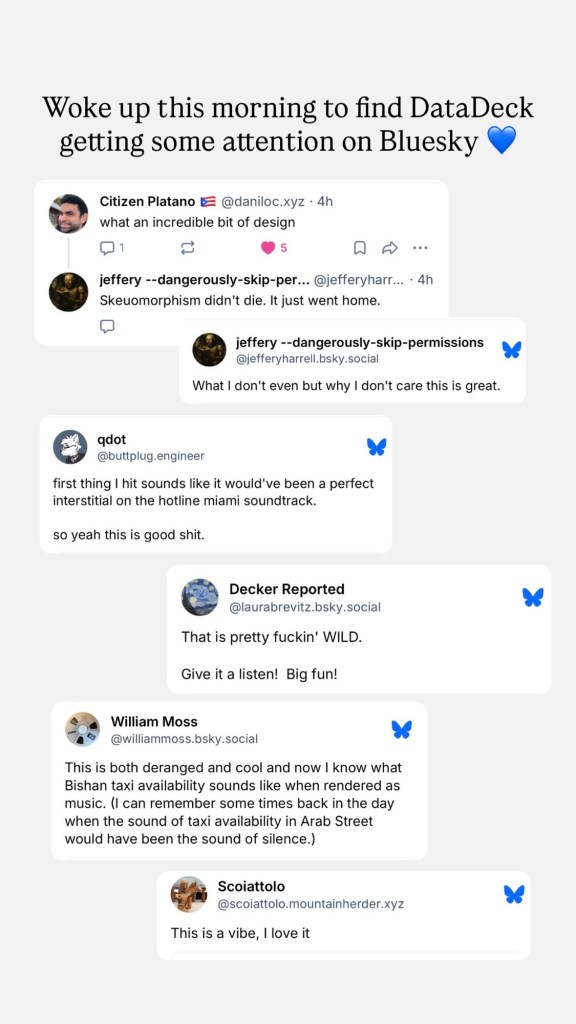
On Wednesday morning I woke up and saw that my last app DataDeck was getting a bunch of likes and reposts on Bluesky, which was a nice surprise. If ever there was a place where people would appreciate a wacky, nerdy idea, I guess that would be it.
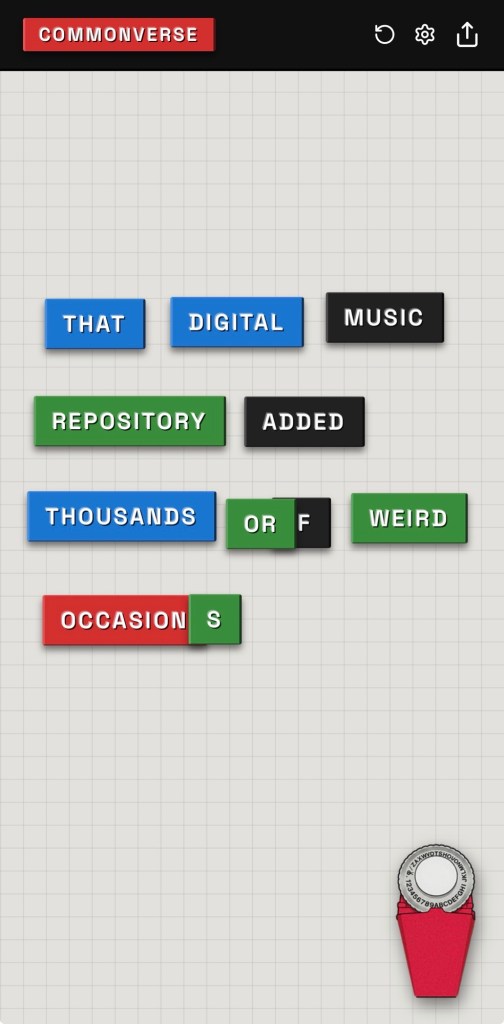
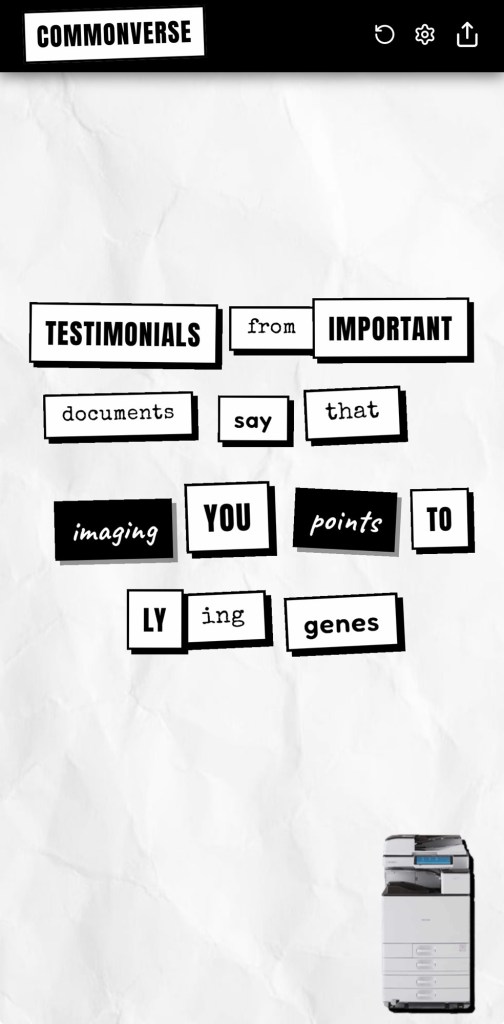
I made a couple of post-release updates to my magnetic poetry non-game, CommonVerse. There are now two new themes, one called Label Maker that resembles those little Dymo stickers we used to make, and another called Zine which is like a random note of cutout words. The UX has also been improved in subtle ways that might make it easier to manage making sentences.
My “main” app project now is one that I can keep noodling on in the background, with no real endpoint — it’s done when I think it’s done — and the idea was that would help me slow down and spend less time with this vibe coding stuff. Guess what happened? That’s right, if you design something that can sit on the back burner, it will sit on the back burner. I started work on another app instead.
Defying time and gravity
I’ve known that the next step was to play with agentic coding tools like Codex or Google’s Antigravity. These are code editors with integrated AI that can look across all your project files and manage multiple agents working on simultaneous tasks. It’s a far cry from the way I’d been working: getting advice and instructions from a single chat, and then doing everything myself in a code editor. So I finally got started with Antigravity, and it blew my mind.
The productivity increase is hard to describe. I could just describe stuff and it would get done without further work on my part. The tool can use the system’s terminal and Chrome browser to install packages, click around and test the app, figure out why things aren’t working, and fix it while you watch. Stuff that took me days over the last month could have been done in hours. It was automating so much of what little I, the non-programming human, was doing and considered my job, that it made me feel kinda redundant, to say nothing of real programmers.
With Antigravity, the MVP of my app concept was done in three hours on a Friday. The good/bad news was that it blew through most of my token allocation for the week. So I went back to the “old” way of working and made subsequent changes manually. What I discovered was that I much prefer getting hands on with the project files, looking through the code to understand what was going on and what went where. I think I’ll use these agentic tools to get started fast and figure out a working architecture. After that, it’s more fun to get involved and make improvements slowly.
Ate and left the Crumbs
So the new app is called Crumbs, as in breadcrumbs, as in leaving a trail of them so you know where you’ve been. It’s a private location journal that lets you mark where you are on a map with a single button push. Over time, you can see the path of your journey(s).

I made this because I’ve always wanted something like this for logging holidays, and no app really does what I want. Foursquare’s Swarm is based on Places, so you have to find the business listing or entry in order to check in. If you’re in the middle of a national park, or in a country where no one has created Places, or you can’t read the names, you’re out of luck. Google Maps has a Timeline, but it tracks your location all the time, and it only shows your trail on a day-by-day basis. Your data is also locked in their app and you can’t get it out to visualize in other ways.
Crumbs is private, and you can take the data out in JSON format. It logs the time and weather along with your location, and you can write little notes. You can save an image of your map, or export a PDF of your journal.
A big breakthrough (for me)
Unfortunately, because it’s a web app and not a native iOS app, it can’t permanently store data on your device. The OS may decide to purge all your data if you haven’t used it in a week. That’s a dealbreaker for any app intended to be a life-logging tool. That really bummed me out, and I thought it would just have to be a personal tool that I couldn’t distribute to anyone else — since remembering to do manual backups/restores of the JSON file would be a massive PITA for any user.
And then I had a Eureka moment! I thought of a possible solution and asked Gemini if it was feasible, to which it answered “Yes, this is an ideal solution”. I wanted to scream “Well, then why didn’t you suggest it all this time we’ve been discussing how to get around the problem!?”
The answer was Dropbox integration. I can’t make a web app read/write files locally, but I can do it in the cloud. So now Crumbs is as useful as a “real app”, provided you connect a Dropbox account.
As of Monday morning this post is late and I think Crumbs is ready, so here it is.
Other thoughts
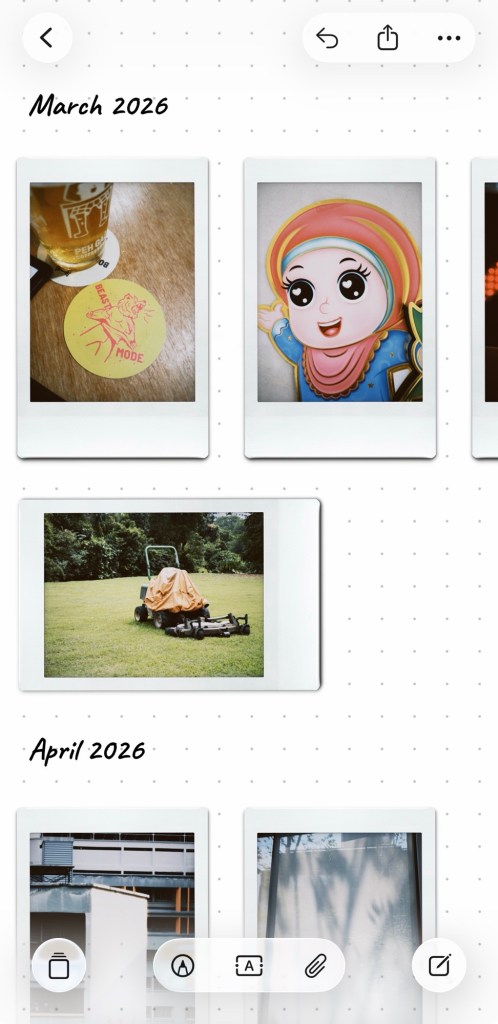
- Here’s a free idea: I was inspired by this stamp journal that went semi-viral, and wanted to make some sort of digital Instax photo album. It’d be kinda nice to keep a virtual scrapbook of interesting images, right? Well, turns out you can just use Apple’s Freeform app and Dazz Cam. It’s as simple as making a board and dropping in images, then arranging them however you want. All stored locally and synced to iCloud, easy peasy. Just because you can vibe code it doesn’t mean you should.
- My iPhone’s MOFT Snap Case developed a cut/tear in its faux leather surface, and so had to be replaced after just six months. Its replacement is a Caudabe Sheath, which fits my requirements of being neither silicone nor slippery, with full edge coverage and a Camera Control passthrough button. It’s a hard plastic material with a rough, pebbled texture that makes it feel secure when held. It also came in second in MobileReviewsEh’s roundup of the year’s best cases. I got the version with the ‘open’ cutout for the 17 Pro Max’s camera island, not the ‘precise’ covered design.

- Kim managed to finish reading Project Hail Mary and we went to see the film on Sunday (non-IMAX). Apparently there’s a longer cut, nearly four hours, which will be released on streaming in August when it comes to Amazon Prime Video. Yes, this is billed as an Amazon original film from the very first frame, coming even before the MGM logo (which they own), and I don’t think that will ever stop being weird. The film is good, a mostly faithful adaptation of a fun but slightly flawed book. I just think they glossed over a lot of detail in the final act, which lowered the stakes and made it less exciting and rewarding than it could have been. Hopefully the extended cut’s extra run time is concentrated at the end.
 sangsara.net
Leave a comment